





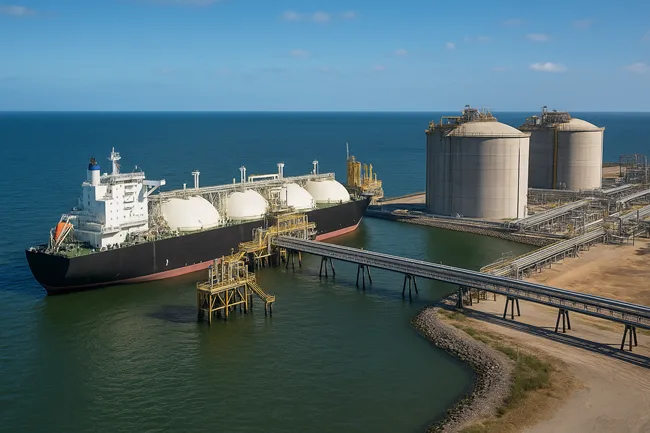
Texas LNG Brownsville LLC, a subsidiary of Glenfarne Group, LLC, has moved deeper into the pre-final-investment-decision phase for its proposed 4 MTPA LNG export terminal at the Port of Brownsville in Texas. Glenfarne Group, LLC has issued a limited notice to proceed to Kiewit Energy Group Inc. for long-lead equipment orders, engineering work and geotechnical activity, while Glenfarne Global Commodities, LLC has also signed a Heads of Agreement with BGN for a potential 1 MTPA, 20-year LNG supply arrangement from Texas LNG. The project already has Federal Energy Regulatory Commission authorisation, a lump-sum turnkey EPC agreement with Kiewit Energy Group Inc. and long-term commercial arrangements involving EQT Corporation, RWE Supply & Trading, Gunvor Group and Macquarie Energy LLC. However, Texas LNG has not yet reached a final investment decision, and the BGN agreement remains subject to negotiation and execution of a definitive sale and purchase agreement. The strategic issue is whether Glenfarne Group, LLC can now convert permits, offtake support, early EPC work and lender engagement into financing, full construction and LNG exports within the approved 2029 completion window.
Why is Texas LNG entering the most important phase before full project sanction?
Texas LNG is no longer an early-stage concept waiting for basic market interest, but it is also not yet a fully sanctioned export terminal. That distinction matters because the project has assembled several of the components required for bankability while still needing the final corporate and financing decision that releases full construction. The limited notice to proceed gives Kiewit Energy Group Inc. authority to begin specific early works, but it does not amount to a full notice to proceed for the entire liquefaction project.
This stage is often the most difficult point in an LNG project’s development cycle. Permits, customer agreements and contractor structures can create the impression of inevitability, but final sanction requires lenders, equity providers, buyers and contractors to converge on one executable risk package. Glenfarne Group, LLC must demonstrate that Texas LNG’s construction cost, offtake profile, feed-gas access, regulatory standing and commercial returns remain strong enough to justify a multibillion-dollar capital commitment.
The project’s position is therefore stronger than a speculative proposal but still conditional. Federal approvals reduce regulatory uncertainty, long-term buyers improve revenue visibility and the Kiewit EPC structure gives lenders a clearer construction framework. However, financial close, final investment decision and a full construction release remain the decisive milestones.
For the LNG market, Texas LNG is important because it represents a different model from the largest Gulf Coast export terminals. Its 4 MTPA scale is smaller, its commercial portfolio is more concentrated and its positioning relies partly on lower-emissions design and flexible global marketing. That makes the next phase a useful test of whether smaller contracted United States LNG projects can still move forward in a crowded export-development cycle.
What does the limited notice to proceed with Kiewit actually change for Texas LNG?
The limited notice to proceed allows Kiewit Energy Group Inc. to begin selected early activities before Texas LNG reaches full construction release. These activities include long-lead equipment purchase orders, EPC-phase engineering and geotechnical work at the Port of Brownsville site. The practical objective is to reduce schedule risk before full sanction by advancing workstreams that could otherwise delay construction.
Long-lead procurement matters because LNG projects depend on specialised equipment that cannot always be sourced quickly after final investment decision. Compressors, cryogenic systems, electrical infrastructure, modular components and process equipment compete for manufacturing slots across a global LNG and industrial-project pipeline. Early purchase orders can help preserve delivery timelines if the project proceeds.
The geotechnical work is equally relevant because coastal LNG terminals carry site-specific execution risks. Foundation conditions, soil stability, flood resilience, storm exposure and marine-construction requirements can all affect cost and schedule. Addressing those uncertainties before final sanction can improve lender confidence and reduce the probability of post-FID design changes.
The limited notice also strengthens Glenfarne Group, LLC’s credibility with customers and financing partners. It signals that the developer is willing to commit preparation capital and that Kiewit Energy Group Inc. remains actively engaged. The limitation is that early work can only reduce risk. It does not eliminate the need for final financing, committed equity and a full notice to proceed.
Why does the Kiewit lump-sum turnkey contract strengthen the project’s financing case?
The lump-sum turnkey EPC agreement with Kiewit Energy Group Inc. is one of the most important commercial features of Texas LNG. Under this structure, Kiewit Energy Group Inc. is expected to manage the engineering, procurement, module fabrication, construction and commissioning scope for the facility. For lenders, a defined turnkey contractor model is generally easier to evaluate than a fragmented project built through multiple loosely connected contracts.
LNG construction risk has historically been one of the biggest threats to project returns. Cost overruns, contractor disputes, design changes and labour shortages can weaken the economics of a project even when long-term LNG demand remains strong. A lump-sum turnkey structure can transfer part of that risk to a contractor with relevant United States energy-infrastructure experience.
Kiewit Offshore Services is expected to fabricate key liquefaction, pretreatment and pipe-rack modules in Texas after a full notice to proceed. Domestic module fabrication could reduce exposure to some international logistics risks and strengthen local industrial participation. It may also support greater schedule control compared with importing highly complex modules from distant fabrication yards.
The structure still has limits. No EPC contract can remove all exposure to owner changes, weather disruption, permit conditions, force majeure events or unexpected site conditions. The value of the contract depends on the quality of the scope, the strength of the contractor’s delivery systems and the ability of Glenfarne Group, LLC to avoid late design changes.
For financial institutions, the Kiewit agreement provides a more concrete construction-risk framework. That does not guarantee financial close, but it gives lenders a clearer basis for assessing debt capacity, contingency requirements, completion guarantees and project schedule.
How strong is the long-term offtake base supporting Texas LNG?
Texas LNG has built a meaningful offtake base across several customer types. EQT Corporation has a 20-year tolling agreement covering 2 MTPA of liquefaction capacity, linking the project with one of the largest natural gas producers in the United States. RWE Supply & Trading has a 20-year agreement for 1 MTPA, adding European utility demand to the commercial structure.
Gunvor Group has a definitive 20-year agreement for 0.5 MTPA, while Macquarie Energy LLC has also been identified as part of the project’s customer base. These arrangements give Texas LNG a diversified commercial foundation involving a gas producer, a European utility, commodity traders and portfolio energy players.
The newly announced BGN Heads of Agreement could add another 1 MTPA for 20 years if converted into a definitive sale and purchase agreement. This is commercially useful, but it must be interpreted carefully. A Heads of Agreement demonstrates intent and provides a basis for negotiations. It does not carry the same financing value as a signed, binding sale and purchase agreement.
The customer mix is strategically valuable because it reduces dependence on one buyer category. EQT Corporation provides upstream gas linkage and a pathway from Appalachian production into global LNG markets. RWE Supply & Trading brings European demand and portfolio management. Gunvor Group, Macquarie Energy LLC and BGN add trading and market flexibility.
The next test is conversion and credit quality. Lenders will examine pricing formulas, start dates, termination rights, credit support, force majeure language and the relationship between the offtake contracts and the construction timetable. Texas LNG has strong commercial ingredients, but financing will depend on how those agreements are ultimately documented and risk-weighted.
Why does Glenfarne Global Commodities make Texas LNG more than a single-terminal story?
Glenfarne Global Commodities, LLC gives Glenfarne Group, LLC a marketing and trading platform that extends the Texas LNG story beyond physical construction. LNG developers increasingly need more than liquefaction capacity. They need the ability to manage customers, shipping, pricing exposure, emissions documentation and regional demand shifts over long contract periods.
A dedicated commodities platform can help Glenfarne Group, LLC optimise supply across Texas LNG and potentially across its wider LNG development portfolio. Glenfarne Group, LLC also controls Magnolia LNG and Alaska LNG development interests, giving the group a broader North American LNG strategy rather than a single Brownsville project.
The BGN Heads of Agreement fits into this wider platform strategy. BGN is active across LNG, LPG, crude oil, refined products, biofuels and other energy commodities. A definitive agreement with BGN would give Glenfarne Global Commodities, LLC another commercial route for placing Texas LNG volumes into global markets.
The portfolio model can create value because LNG buyers increasingly seek flexibility. A developer that can manage multiple supply points, customer types and destination markets may have more commercial resilience than one relying only on a single plant and a narrow customer list.
The risk is that a marketing platform adds complexity before operating cash flow exists. Trading and portfolio management require risk controls, credit management, shipping coordination and market discipline. Glenfarne Group, LLC must ensure that the commodities strategy supports bankability rather than creating additional uncertainty for lenders and buyers.
How does Texas LNG’s 4 MTPA scale compare with larger Gulf Coast LNG projects?
Texas LNG’s proposed 4 MTPA capacity makes it smaller than many United States Gulf Coast export projects. That smaller scale can be an advantage because Glenfarne Group, LLC does not need to sign 10 MTPA or 15 MTPA of long-term contracts to make the project commercially credible. The offtake challenge is more contained, and the project may be easier to finance than a much larger multitrain terminal.
The scale could also appeal to buyers that want meaningful exposure to United States LNG without making a giant portfolio commitment. A 0.5 MTPA or 1 MTPA agreement is easier for many utilities, traders or industrial buyers to absorb than a larger anchor contract.
The disadvantage is unit cost. Larger LNG export projects can spread fixed infrastructure costs across more production. Marine facilities, utilities, site development, management systems, regulatory compliance and security all carry fixed components. A smaller project must manage construction and operating costs tightly to remain competitive.
Texas LNG’s strategic answer is differentiation rather than scale dominance. Its electric-drive design, lower-emissions positioning, focused capacity and contracted customer base are intended to make the project bankable without becoming the largest LNG terminal in the United States.
That strategy can work if the final project cost remains disciplined and the commercial agreements generate stable cash flow. If costs escalate or financing becomes expensive, the smaller size could become a disadvantage because there are fewer tonnes over which to spread the burden. The project must therefore be both focused and efficient.
Why does the Port of Brownsville location remain useful but sensitive?
The Port of Brownsville offers access to Gulf Coast energy infrastructure, marine export routes, industrial labour and South Texas logistics. For Texas LNG, the location provides a practical base for exporting LNG into Atlantic Basin and global markets. It also sits within a region familiar with large energy and port-related infrastructure.
The location has strategic value because Brownsville has emerged as an important LNG development zone. Nearby projects have drawn capital, regulatory attention and contractor activity, creating a regional ecosystem that can support construction and operations. Proximity to broader United States gas supply networks also strengthens the commercial case.
The same location carries political and environmental sensitivity. Brownsville LNG projects have faced scrutiny from local communities and environmental groups concerned about wetlands, emissions, vessel traffic, coastal ecosystems and cumulative industrialisation. These issues can affect project timelines even when federal authorisation has been granted.
Texas LNG has Federal Energy Regulatory Commission authorisation for construction and operation, which significantly reduces regulatory uncertainty. However, authorisation is not the end of the compliance process. The project must continue satisfying environmental, safety, construction and operational conditions throughout development.
The project’s lower-emissions design may help address some concerns. Electric-drive liquefaction and emissions-monitoring frameworks can strengthen the case with customers and stakeholders. However, these advantages need to be supported by transparent performance data once the facility operates. LNG buyers and regulators are increasingly looking for measured emissions performance rather than only design claims.
What does the debt-financing pathway indicate about lender appetite for Texas LNG?
Texas LNG has previously identified a potential senior debt package supported by a group of financial institutions, with lender interest reportedly exceeding the amount required. That indicates that the project has attracted serious financing attention. It also shows that lenders are willing to engage with smaller, contracted United States LNG export projects when offtake, permits and EPC arrangements are sufficiently advanced.
Lender interest is not the same as financial close. Banks and other financing institutions still need final documentation, satisfaction of conditions, credit approvals and alignment with equity commitments. They will examine the full risk package before releasing funds for construction.
The financing case will depend on offtake quality, EPC structure, feed-gas access, regulatory durability and the sponsor’s ability to fund contingencies. Debt providers will also review whether customer contracts align with the expected construction schedule and whether delays could create revenue or penalty exposure.
The limited notice to proceed may support the financing process by demonstrating that early execution risks are being addressed. Long-lead equipment orders and geotechnical work can reduce schedule uncertainty. However, pre-FID spending also creates pressure to complete financing within a reasonable period.
The most important financing milestone remains full financial close. Until then, lender interest is a positive signal but not a completed capital structure. Texas LNG’s project status improves with each de-risking step, but the financing bridge still has to be crossed.
What could still prevent Texas LNG from reaching full sanction?
The most immediate risk is that remaining commercial agreements take longer than expected. The BGN Heads of Agreement must be converted into a definitive sale and purchase agreement before it carries full financing weight. Any unresolved pricing, credit-support or delivery-timing issues could slow the process.
Financial close is the central hurdle. Texas LNG must secure committed debt and equity on terms that preserve project economics. Higher interest rates, lender caution or changes in LNG market sentiment could affect financing cost and timing.
Construction cost is another risk. A lump-sum turnkey EPC structure improves visibility, but LNG projects can still face cost pressure from weather, site conditions, supply-chain delays, contractor availability and owner-driven design changes. Early procurement reduces some exposure but does not freeze every variable.
Feed-gas and pipeline arrangements must also support the customer contracts. Texas LNG needs dependable gas delivery at prices that keep United States LNG competitive. Higher Henry Hub prices, pipeline bottlenecks or basis volatility could affect the economic value of liquefaction contracts.
Regulatory durability remains important. Federal authorisation is in place, but LNG projects can still face litigation, compliance reviews, environmental monitoring obligations and community pressure. A weak compliance record during construction could create delays and reputational cost.
Global LNG timing is another external variable. New capacity from the United States, Qatar, Canada and other regions is expected to enter the market before or around the end of the decade. Long-term contracts protect Texas LNG from full spot-price exposure, but broader market sentiment can still influence financing appetite and expansion value.
What milestones should investors and industry watchers track before Texas LNG reaches construction?
The first milestone will be a formal final investment decision. That is the moment when the project moves from late-stage preparation into committed development.
The second milestone will be full financial close. Debt and equity commitments will reveal whether the project’s commercial package is strong enough to support construction.
The third milestone will be a full notice to proceed to Kiewit Energy Group Inc. This would authorise the contractor to move from limited early work into complete EPC execution.
The fourth milestone will be conversion of the BGN Heads of Agreement into a definitive sale and purchase agreement. A binding contract would strengthen the offtake portfolio and improve lender confidence.
The fifth milestone will be disclosure of final construction cost and schedule. Investors and customers need clarity on whether the project can meet the approved completion window.
The sixth milestone will be visible site mobilisation at the Port of Brownsville. Civil works, module fabrication, equipment delivery and marine construction activity will demonstrate whether early preparation is turning into real project execution.
The final milestone will be commissioning progress before the approved 2029 completion deadline. Texas LNG will create strategic value only if Glenfarne Group, LLC moves from development credibility to physical delivery.
Key takeaways on why Texas LNG remains a high-stakes pre-FID project
- Texas LNG is advanced but not yet fully sanctioned, with final investment decision still pending.
- Glenfarne Group, LLC has issued a limited notice to proceed to Kiewit Energy Group Inc. for early equipment, engineering and geotechnical work.
- The limited notice improves execution readiness but does not authorise full construction.
- Texas LNG has a lump-sum turnkey EPC agreement with Kiewit Energy Group Inc., strengthening cost and schedule visibility.
- Federal Energy Regulatory Commission authorisation reduces regulatory risk but does not remove compliance, litigation or community challenges.
- EQT Corporation, RWE Supply & Trading, Gunvor Group and Macquarie Energy LLC support the project’s existing commercial base.
- The BGN Heads of Agreement could add 1 MTPA of long-term supply, but it remains subject to negotiation of a definitive sale and purchase agreement.
- Glenfarne Global Commodities, LLC gives Glenfarne Group, LLC a broader LNG marketing platform rather than leaving Texas LNG as a standalone terminal.
- The 4 MTPA scale may improve financeability but requires strict cost discipline to compete with larger Gulf Coast projects.
- Final investment decision, financial close, full notice to proceed and definitive offtake conversion remain the decisive catalysts.
Discover more from Business-News-Today.com
Subscribe to get the latest posts sent to your email.



