



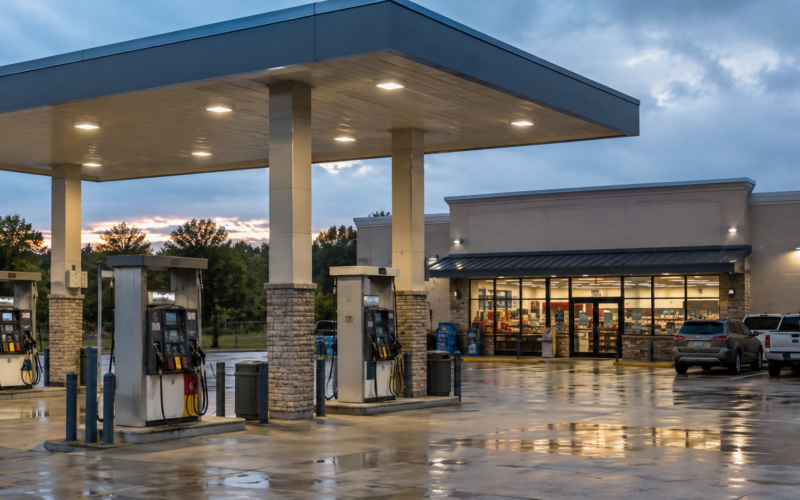
Arko Corp (Nasdaq: ARKO), one of the largest operators of convenience stores and wholesalers of fuel in the United States, delivered second-quarter 2026 revenue of $2.35 billion and reaffirmed its full-year adjusted EBITDA guidance of $245 million to $265 million, but the market punished the stock, sending shares down roughly 15 percent in early trading on 7 August 2026 to $6.22. Reported net income attributable to Arko Corp fell to $6.1 million from $20.1 million, and adjusted EBITDA slipped to $72.0 million from $76.9 million a year earlier, as retail same-store fuel gallons dropped 5.7 percent and same-store merchandise sales declined 1.7 percent. Alongside the results, Arko Corp’s 74 percent-owned subsidiary ARKO Petroleum Corp (Nasdaq: APC) announced an agreement to acquire the business of U.S. Petroleum Partners, LLC, for $205 million in cash plus inventory and $30 million of APC Class A common stock held in escrow, adding 280 million gallons of annual volume and more than 400 dealer sites across the Great Lakes region. The central tension for investors is now clear, Arko Corp’s dealerization strategy has widened first-half adjusted EBITDA to $122.9 million from $107.8 million, but the second-quarter softness in retail volumes and the $205 million cash outlay at the subsidiary level raise fresh questions about consumer resilience and integration risk into the second half.
What did Arko Corp actually deliver in the second quarter of 2026 to trigger a 15 percent share-price drop?
The headline numbers were a mixed picture that markets read pessimistically. Total revenue climbed to $2,346.5 million from $1,998.9 million, a 17.4 percent increase driven almost entirely by higher fuel prices and higher wholesale throughput rather than retail unit growth. Fuel revenue rose to $1,965.9 million from $1,569.0 million, while merchandise revenue actually declined to $347.4 million from $400.1 million, reflecting a smaller retail store base after ongoing dealerization. Reported operating income fell to $30.4 million from $56.7 million, and the prior-year period included a $20.8 million non-cash gain related to the expiration of a real estate purchase option accounted for as a sale-leaseback, meaning the underlying operating comparison is closer than the headline suggests. Reported net income attributable to Arko Corp was $6.1 million versus $20.1 million, and diluted earnings per share came in at $0.04 against $0.16 a year ago, while for the six months ended 30 June 2026 the company posted a small net loss attributable to Arko Corp of $0.5 million against $7.4 million of net income in the prior-year half.
Adjusted EBITDA of $72.0 million for the quarter was down 6.4 percent year-on-year and reflected pressure from a $3.3 million increase in credit card fees driven by higher fuel prices, higher same-store site operating expenses and softer retail volumes. First-half adjusted EBITDA of $122.9 million, however, was up 14.0 percent, which is the number Arie Kotler, Chairman, President and Chief Executive Officer of Arko Corp, emphasised in his prepared commentary. The market chose to weight the sequential deceleration in Q2 more heavily than the year-to-date improvement, and the roughly 15 percent intraday decline pushed the stock back below the two-analyst consensus target price of $9.50.

How does the $205 million USPP acquisition change the growth story for ARKO Petroleum Corp and its parent?
The proposed USPP transaction is the most consequential capital allocation announcement Arko Corp has made since the APC initial public offering in February 2026, which raised $206.8 million and established APC as a separately listed vehicle operating the wholesale, fleet fueling and GPM Petroleum segments. The acquired business is described as a vertically integrated fuel supply and distribution platform serving customers throughout the Great Lakes region, and management expects it to add approximately 280 million gallons of annual fuel volume, roughly 14 percent of APC’s trailing twelve-month volume, plus more than 400 dealer locations and two fuel terminals with expanded transportation capabilities. Consideration at closing consists of $205 million in cash plus the cost of inventory, with an additional $30 million of APC Class A common stock placed in escrow and released to the seller subject to EBITDA-based financial targets in the first four full quarters after closing.
Management said the transaction is expected to be accretive and add approximately $30 million of annualised adjusted EBITDA, which implies a purchase-price multiple in the region of seven times on the base consideration. That is a defensible mid-cycle multiple for a fuel distribution asset with terminals and captive dealer volumes, but it does depend on APC realising the operational synergies, throughput uplift and future acquisition optionality that Arko Corp described. Because APC is 74 percent owned, only about three-quarters of the incremental EBITDA will accrue to Arko Corp equity holders once non-controlling interests are stripped out, and this now-permanent minority leakage was already visible in the second quarter, when $3.3 million of net income was attributable to non-controlling interests against zero in the prior-year period.
Why do retail same-store fuel gallons falling 5.7 percent matter more than the reported Q2 revenue beat?
The 5.7 percent decline in retail same-store fuel gallons is the most important operating number in the release, because it points to demand elasticity rather than portfolio mix. Retail same-store merchandise sales fell 1.7 percent, with same-store merchandise sales excluding cigarettes down 0.9 percent, both narrower declines than the prior-year quarter but still negative. Total retail fuel gallons sold fell to 204.8 million from 240.3 million, and a large portion of that decline reflects the dealerization of 197 net stores year-on-year, but the same-store number strips out that portfolio effect. Mr Kotler acknowledged in the results commentary that consumer demand softened during the quarter as sustained higher fuel prices continued to pressure household budgets, and that framing matters because the acquired USPP business will land into that same weakening consumer environment.
The reported revenue beat against a FactSet consensus of $1.99 billion was largely a pricing and pass-through story rather than an operational one. Higher pump prices lift fuel revenue on a dollar basis even when gallons sold decline, and the $2.35 billion print says less about underlying demand than the same-store gallons number does. That is why the market appears to have discounted the top-line beat.
How does Arko Corp’s dealerization program hold up now that 471 stores have been converted since 2024?
Dealerization remained the central plank of Arko Corp’s cost-transformation strategy, with 21 retail stores converted to dealer locations during the second quarter and total conversions reaching 471 sites since the program began in the middle of 2024. The retail store count now stands at 1,057 sites, down from 1,254 a year ago and from 1,079 at the end of the first quarter, while the wholesale segment site count has climbed to 2,129 from 2,014 as converted locations reappear on the dealer supply side. The economic logic is that dealerization strips out about $25.8 million of site operating expense on a like-for-like Q2 basis and shifts converted volumes into a higher-margin, lower-capex wholesale contract, and the wholesale segment operating income did rise to $24.9 million from $23.2 million, giving the company a $1.6 million incremental gain on the same conversions that removed $9.3 million of retail fuel contribution.
Whether that trade continues to work depends on which segment absorbs the retail volume erosion. In the second quarter, the retail segment took most of the pain, with same-store site operating expenses climbing 5.6 percent to $156.5 million on higher credit card fees, insurance, personnel costs and rent, while retail merchandise contribution fell to $120.5 million from $134.5 million. The 471-store cumulative conversion figure is a genuine achievement, but the remaining retail footprint now has to carry the fixed-cost base and the loyalty investment.
Why did adjusted EBITDA slip to $72 million in the second quarter even as retail fuel margins expanded to 48.7 cents?
The margin story inside the retail segment was actually strong. Same-store fuel margin per gallon rose 3.0 cents to 48.7 cents per gallon, primarily as a result of significant volatility in the fuel market during the quarter, and retail merchandise margin expanded 110 basis points to 34.7 percent, reflecting disciplined pricing, favourable product mix and vendor-supported promotions. Same-store merchandise contribution was essentially flat at $118.7 million against $119.4 million, suggesting the loyalty program and the fas craves food and beverage rollout across roughly 140 stores are protecting the merchandise economics even in a softer consumer environment.
The reason adjusted EBITDA still slipped is that the margin gains at the store level were more than offset by the $8.3 million rise in same-store operating expenses, of which $3.3 million was credit card fees driven by higher fuel prices, plus a $14.0 million decline in merchandise contribution linked to closed and converted stores. Add in the higher operating cost line and the modest wholesale and fleet fueling contribution offsets, and the $4.9 million year-on-year adjusted EBITDA decline is the arithmetic result. This is a quality-of-earnings problem more than a margin problem, and the company’s decision to reaffirm rather than raise 2026 adjusted EBITDA guidance suggests management does not yet see a clear route to recouping that $4.9 million gap in the second half.
What does the reaffirmed 2026 adjusted EBITDA guidance of $245 to $265 million imply for the second half?
The reaffirmed adjusted EBITDA range of $245 million to $265 million implies second-half adjusted EBITDA of between $122.1 million and $142.1 million, against $122.9 million delivered in the first half. That is a wide range, and the low end of guidance would imply essentially no adjusted EBITDA growth for the second half despite the raised retail fuel margin outlook of 45.5 to 47.5 cents per gallon and the announced dealerization tailwinds. The higher retail fuel margin corridor is a genuine positive because it captures the volatility uplift the company saw during the second quarter, but management explicitly framed it as offsetting lower retail fuel volumes rather than adding to earnings.
The USPP acquisition is not embedded in the reaffirmed guidance because the transaction has not closed. Once it does, and assuming the $30 million annualised adjusted EBITDA figure holds, the run-rate contribution to Arko Corp equity holders after non-controlling interests would be closer to $22 million on an annualised basis. Timing matters here, if closing slips or integration disruption bleeds through, the deal could shift from a modest 2026 tailwind into a 2027 story only. Management chose not to guide on net income given depreciation and amortisation uncertainty tied to capital allocation, which is consistent with prior practice but leaves the equity story anchored to the adjusted EBITDA range.
How does the $205 million cash outlay for USPP fit alongside senior note repurchases and the balance sheet?
Arko Corp ended the quarter with approximately $1.0 billion of total liquidity, comprising $246 million of cash and cash equivalents and $786 million of availability under credit lines, and outstanding debt of $675 million, giving net debt of about $429 million. During the quarter, the company repurchased approximately $37.9 million principal amount of its 5.125 percent senior notes at a discount, booking a $2.5 million gain from the repurchase, and after quarter end one of the PNC lines of credit was increased by $74 million to an aggregate of $214 million under the two PNC lines. Total long-term debt fell to $658.5 million from $875.5 million at year-end 2025, reflecting the deployment of APC IPO proceeds into debt reduction and the notes buyback.
The $205 million cash consideration for USPP is a material commitment, and the mechanics matter. Because the acquisition sits at APC level, the funding will come from APC’s balance sheet and credit capacity rather than directly from Arko Corp’s corporate cash. That structure preserves Arko Corp’s parent-level flexibility, but it also means Arko Corp equity holders bear the transaction risk indirectly through their 74 percent economic stake in APC. The $30 million contingent APC stock issuance ties a portion of consideration to EBITDA-based targets in the first four post-close quarters, which is a reasonable structural protection but does not eliminate integration risk on a business acquiring 400 dealer accounts, two fuel terminals and expanded transportation capacity in a single transaction.
What role do the Wholesale and Fleet Fueling segments now play as Arko Corp leans harder on APC?
The Wholesale and Fleet Fueling segments, both housed inside APC, continued to perform steadily and now anchor the diversified-platform narrative. Wholesale operating income rose to $24.9 million from $23.2 million, with fuel margin per gallon at fuel supply locations expanding to 7.6 cents from 6.3 cents on higher prompt pay discounts related to elevated fuel costs, partially offset by a 1.5 cent decline in consignment agent margin per gallon as market prices declined faster than weighted average inventory cost. Fleet Fueling operating income was essentially flat at $13.3 million, with proprietary cardlock margin per gallon down slightly to 51.2 cents from 51.7 cents and third-party cardlock margin per gallon compressed to 9.0 cents from 21.2 cents, again primarily because indexed prices declined more quickly than weighted average inventory cost. Site counts moved marginally, with Fleet Fueling at 290 sites versus 287 a year ago.
Post-USPP, these two segments become the primary organic growth engine for the group. Arko Corp identified 20 additional new fleet fueling locations to open during 2026, of which one was opened in March, two in July and 17 remain in progress, and management described the fleet fueling business as offering low capital requirements, expected mid-to-high-teens returns per location and recurring cash flow. The combined message to the market is that APC is becoming a distinct, growth-oriented vehicle within the Arko Corp portfolio, and that the retail segment increasingly serves as the mature cash engine funding transformation rather than the growth driver.
What should investors track as Arko Corp integrates USPP and navigates a softer convenience-store consumer?
- Q2 2026 revenue reached $2,346.5 million against $1,998.9 million a year earlier, beating the FactSet consensus of $1.99 billion, but the beat was pricing-driven rather than volume-driven, and the stock fell roughly 15 percent intraday to $6.22 on 7 August 2026
- Reported net income attributable to Arko Corp of $6.1 million and diluted EPS of $0.04 compared with $20.1 million and $0.16 a year ago, though the prior-year quarter included a $20.8 million non-cash sale-leaseback gain that flattered the comparison
- Q2 adjusted EBITDA declined 6.4 percent to $72.0 million on higher credit card fees and same-store operating expenses, even as first-half adjusted EBITDA rose 14.0 percent to $122.9 million from $107.8 million, and full-year guidance was reaffirmed at $245 million to $265 million
- ARKO Petroleum Corp (Nasdaq: APC) agreed to acquire U.S. Petroleum Partners for $205 million in cash plus inventory and $30 million of APC Class A stock in escrow, adding 280 million gallons of annual volume, more than 400 dealer sites and two fuel terminals in the Great Lakes region
- Management guided that USPP is expected to add approximately $30 million of annualised adjusted EBITDA, though Arko Corp equity holders will capture roughly 74 percent of that contribution after non-controlling interests
- Retail same-store fuel gallons fell 5.7 percent and same-store merchandise sales declined 1.7 percent, with management citing sustained higher fuel prices pressuring household budgets and softer consumer demand as the second quarter progressed
- Retail same-store fuel margin rose 3.0 cents to 48.7 cents per gallon and retail merchandise margin expanded 110 basis points to 34.7 percent, prompting the company to raise its 2026 average annual retail fuel margin outlook to a range of 45.5 to 47.5 cents per gallon
- Dealerization reached 471 conversions since the program began in mid-2024, with 21 stores converted in Q2, taking the retail store count to 1,057 from 1,254 a year ago while the wholesale segment site count climbed to 2,129 from 2,014
- Arko Corp ended the quarter with approximately $1.0 billion of total liquidity and net debt of $429 million after repurchasing $37.9 million of 5.125 percent senior notes at a discount, and post-quarter it increased one PNC line of credit by $74 million to an aggregate $214 million across two PNC facilities
- The next measurable proof points are the USPP closing timeline and post-close EBITDA delivery against the escrow targets, the Q3 same-store trajectory as an indicator of consumer resilience, and whether the raised retail fuel margin corridor fully offsets the volume decline embedded in reaffirmed FY guidance
Discover more from Business-News-Today.com
Subscribe to get the latest posts sent to your email.


