





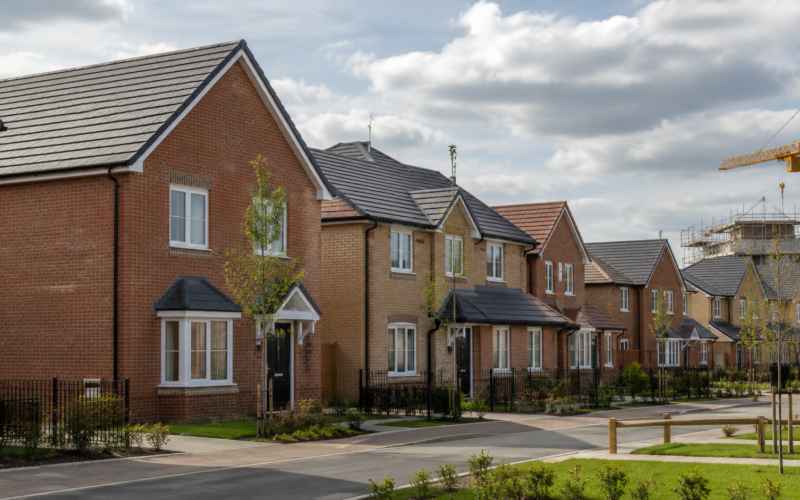
Persimmon plc (LSE: PSN) has lifted its 2026 home-completion outlook to around 12,500 properties, the top of its previous guidance range, after first-half completions increased 13% to 5,189 homes. Underlying profit before tax rose 3% to £170.1 million for the six months ended June 30, while management expects full-year underlying profit before tax to be broadly in line with the current market expectation of approximately £454 million. The stronger volume outlook differentiates Persimmon from several United Kingdom housebuilding peers that have responded to weaker demand by becoming more cautious on land and production. The tension is that construction inflation linked partly to higher energy and materials costs could add £40 million to £50 million of expense over the next 18 months, potentially delaying Persimmon’s medium-term ambition of restoring its underlying housing operating margin to around 20%.
The August 6 results therefore present two different pictures of the same business. Persimmon is increasing output, maintaining investment in new sites and gaining confidence in its ability to grow despite one of the more difficult United Kingdom housing markets of recent years. At the same time, affordability remains stretched, buyer enquiries softened during July and open-market sales excluding bulk transactions slipped below the prior-year level during the five weeks leading into August.
For investors assessing Persimmon on August 7, the key issue is no longer simply whether housing volumes can recover. The more important question is whether the company can convert additional completions into higher margins and returns while absorbing another round of industry cost inflation. That distinction will determine whether recent operational progress produces a durable earnings recovery or merely higher revenue accompanied by stubborn cost pressure.
Why is Persimmon raising its 2026 completion target while several UK housebuilders are becoming more cautious?
Persimmon now expects approximately 12,500 completions during 2026, compared with its previous range of 12,000 to 12,500. That represents further growth from the 11,905 homes completed in 2025, itself a 12% increase from 2024. First-half 2026 completions of 5,189 were 13% higher year on year, suggesting that the company entered the second half with production momentum already established.
The upgrade is significant because Persimmon is not operating against a uniformly improving housing backdrop. Mortgage affordability remains challenging for many prospective buyers, inflation is affecting household budgets and recent sales indicators have softened. Persimmon said buyer enquiries weakened in July, while open-market sales excluding bulk deals fell below the comparable 2025 level during the five weeks into early August.
The company is nevertheless benefiting from decisions made before the current slowdown. Persimmon increased its average number of sales outlets during 2025 and entered 2026 with more homes under construction, having raised work in progress to £1.63 billion at the end of last year. The group also continued adding to its strategic land pipeline, giving management a larger pool of sites from which to open outlets and increase production when planning approvals permit.
That creates an important competitive distinction. Taylor Wimpey plc and Barratt Redrow plc have reduced elements of their land-buying ambitions as market conditions became harder, while Persimmon has continued selective investment. Reuters cited JPMorgan analyst Zain Beekawa as saying that the guidance improvement should reassure investors at a time when rivals have reduced completion expectations.
The strategy carries more financial risk than simply conserving cash. Land expenditure and work-in-progress investment consume capital before homes are completed and customers pay for them. If demand weakens materially, Persimmon could be left carrying more land and inventory while sales rates slow.
The potential reward is equally clear. If mortgage conditions stabilise and demand begins to recover, Persimmon should have more outlets, more available plots and a larger construction pipeline from which to respond. The company is effectively positioning for eventual housing-market normalisation rather than shrinking its production platform around current demand.

What does 13% first-half completion growth say about Persimmon’s operating recovery?
Persimmon completed 5,189 homes during the first six months of 2026, compared with 4,605 in the first half of 2025. The increase is particularly important because the 2025 comparative period had already represented growth from 4,445 completions in the first half of 2024. Persimmon is therefore building a multi-year volume recovery rather than merely rebounding from an unusually weak six-month period.
Underlying profit before tax rose more slowly, increasing 3% to £170.1 million. The difference between 13% completion growth and 3% underlying profit growth illustrates the problem facing the wider housebuilding sector. Higher volumes do not automatically produce equivalent profit growth when build costs, financing expenses, sales incentives and other operating costs remain elevated.
Persimmon reported an underlying housing operating margin of 14.3% for full-year 2025. This was substantially below the margins the company historically generated during stronger housing cycles and below the medium-term ambition of approximately 20%.
The margin gap explains why management’s strategy is focused on more than simply selling additional houses. Persimmon needs higher output to spread overhead across more completions, but it also needs to control land costs, construction expenses and sales incentives while improving productivity.
Vertical integration plays an important role. Persimmon manufactures products including bricks, roof tiles and timber frames internally. This can provide greater control over supply availability and manufacturing economics than relying entirely on external suppliers. Reuters reported that this model has helped the company manage cost pressure during the current inflationary environment.
Yet vertical integration cannot eliminate commodity and energy exposure. Internal factories themselves require energy, raw materials and transportation. The model can reduce dependence on supplier margins and improve purchasing visibility, but it cannot insulate Persimmon from a sector-wide increase in underlying input costs.
That means the path back toward a 20% margin will require several factors to work simultaneously. Volumes need to rise, sales prices must remain sufficiently firm, incentives need to remain controlled, build efficiency must improve and inflation needs to moderate.
Why could £40m to £50m of new inflation delay Persimmon’s 20% operating margin ambition?
Persimmon expects additional inflationary pressure to cost approximately £40 million to £50 million over the next 18 months. Higher energy costs linked to continuing Middle East disruption are affecting construction materials and broader supply chains, creating a new obstacle just as the company attempts to rebuild profitability.
Management has already identified cost-saving measures capable of offsetting at least half of the estimated impact. If achieved, that would substantially reduce the net financial burden, although the remaining cost pressure could still slow margin improvement.
Chief Executive Officer Dean Finch indicated that reaching a 20% operating margin would represent a considerable step from current levels and acknowledged that the macroeconomic environment could delay the timetable. He nevertheless maintained confidence that Persimmon’s broader strategy can eventually deliver the target.
This distinction matters. Persimmon has not abandoned its margin ambition, but investors should avoid treating 20% as a near-term forecast with a fixed delivery date. It is better understood as a medium-term objective whose timing depends partly on market conditions outside the company’s direct control.
Inflation affects housebuilders differently from companies able to reprice products immediately. A home may take months to build, while sales prices are constrained by customer affordability and mortgage availability. Construction costs can therefore rise before Persimmon has an opportunity to recover those costs through higher selling prices.
Affordability limits how aggressively prices can be increased. If Persimmon attempts to pass every cost increase to buyers, demand could weaken or incentives could rise. Either outcome would partly neutralise the benefit of higher headline prices.
The more sustainable response is consequently a combination of procurement savings, manufacturing efficiency, site productivity and careful land acquisition. That makes Persimmon’s internal cost programme almost as important as its completion target for determining 2027 profitability.
Can Persimmon keep investing in land while demand across the UK housing market remains fragile?
Persimmon spent £541.3 million net on land during 2025, compared with £437 million in 2024. It also acquired interests in approximately 10,000 potential strategic-land plots, increasing the strategic pipeline to more than 77,000 plots by year-end.
Management previously guided to 2026 net land spending of approximately £450 million to £600 million. The strategy reflects an assumption that attractive land acquired during a weaker housing cycle can generate stronger returns when volumes and prices recover.
Land acquisition is one of the most important determinants of future housebuilder profitability. The price paid for a site, planning obligations, infrastructure costs and the eventual number of homes permitted establish much of the economic framework years before the properties are sold.
Buying land when competitors are cautious can therefore be advantageous. Persimmon may secure better terms and increase its future outlet network while sellers face a smaller pool of active buyers.
However, this advantage exists only if management maintains underwriting discipline. Cheap land is not inherently valuable if planning is delayed, infrastructure requirements increase or final selling prices fail to justify development costs.
Persimmon’s balance sheet provides some capacity to pursue the strategy. At the end of 2025, the group reported £117 million of net cash and had access to a £750 million revolving credit facility extending to July 2030, alongside a £250 million loan maturing in January 2028. The company previously expected to finish 2026 somewhere between £100 million of net debt and £100 million of net cash because of investment for growth.
The balance sheet is therefore being used deliberately rather than preserved in an unusually cash-rich position. That can enhance long-term returns if the new land delivers profitable volumes, but it means free cash flow must be considered alongside reported earnings.
Persimmon is also spending heavily on building safety remediation. The company previously expected approximately £100 million of related cash expenditure during 2026, with 2026 and 2027 representing peak years for the programme.
Land investment, remediation costs and shareholder distributions must all compete for the same cash. Strong completion growth makes this allocation easier, while any extended sales slowdown could force management to moderate one or more of those uses.
Why does July’s softer buyer demand matter despite Persimmon’s upgraded full-year guidance?
The housing market data contained an important warning beneath the completion upgrade. Persimmon reported softer buyer enquiries during July, while open-market sales excluding bulk transactions were below the previous year during the five weeks leading into early August.
This does not undermine the 2026 completion guidance immediately because much of the current year’s delivery has already been reserved or contracted. Earlier in the year, Persimmon said more than half of its expected private completions and almost all housing-association volumes for 2026 had already been secured.
The concern is more relevant to the future order book. Reservations made during the second half of 2026 will contribute to completions later in the year and into 2027. Persistent weakness in customer enquiries could therefore reduce forward visibility even if the current year finishes strongly.
Mortgage rates remain one of the most important variables. Lower borrowing costs would improve affordability and increase the mortgage amount available to prospective buyers. Higher inflation, however, could delay monetary easing or push longer-term borrowing costs upward, reducing the benefit.
Persimmon has an advantage through its focus on relatively affordable homes and its three-brand structure. A broad geographic footprint can also reduce dependence on the most expensive housing markets, where affordability pressures may be greatest.
Bulk and partnership sales provide another source of demand. Sales to housing associations and institutional buyers can support volumes during periods when individual private buyers are more cautious.
The trade-off is that partnership transactions normally produce different margins from open-market private homes. Increasing completions through lower-margin channels can support factory utilisation, construction activity and cash generation, but it may not accelerate the return toward a 20% operating margin.
The sales mix therefore matters almost as much as the number of homes delivered.
What does Persimmon’s August 6 share-price reaction reveal about LSE investor sentiment?
Persimmon shares closed at £11.56 on August 6, up 2.89% for the session. The stock outperformed the FTSE 100, which declined 0.19% to 10,867.89 points, while Persimmon trading volume reached approximately 2.7 million shares compared with a 50-day average of around 2.2 million.
The positive reaction suggests investors gave greater weight to the completion upgrade and relative resilience than to the warning over future inflation. Persimmon shares had traded above 4% higher earlier in the session before finishing with a smaller gain.
The August 6 closing price is the latest completed London trading-session reference available as of early August 7. At £11.56, Persimmon remained 25.55% below its 52-week high of £15.52 reached on February 18.
The shares had closed at £11.23 on August 5 and £11.31 on August 3. The results-day rally therefore recovered the previous session’s decline and pushed the stock moderately above its level at the beginning of the week.
Over a broader period, sentiment remains much more cautious. Reuters reported that Persimmon was still down almost 16% in 2026 following the August 6 move. That was nevertheless a better year-to-date performance than Taylor Wimpey, down nearly 23%, and Barratt Redrow, down around 17%.
Persimmon also closed July 6 at approximately £10.50, meaning the August 6 price represented a gain of around 10% over roughly one month. The recovery suggests investors have begun recognising Persimmon’s operational differentiation even though the stock remains materially below its February peak.
The sentiment picture can therefore be described as improving rather than fully restored. The market rewarded stronger delivery but has not assigned the company the valuation implied by its earlier 2026 high.
A sustained rerating would probably require evidence that higher completions are translating into higher margins rather than simply absorbing cost inflation.
How does Persimmon compare with Taylor Wimpey and Barratt Redrow as the housing cycle remains difficult?
Persimmon’s decision to target approximately 12,500 completions contrasts with greater caution elsewhere in the large-cap United Kingdom housebuilding sector. Reuters noted that Taylor Wimpey and Barratt Redrow have scaled back land-purchasing ambitions while Persimmon continues making selective acquisitions.
This does not automatically mean Persimmon has the better strategy. Each company has a different land bank, regional exposure, product mix, capital position and integration programme.
Barratt Redrow, for example, continues working through the combination of Barratt Developments and Redrow, which creates opportunities for cost savings but also adds integration considerations. Taylor Wimpey has chosen greater land discipline as management responds to uncertainty around demand and profitability.
Persimmon’s differentiated factor is the combination of volume growth, vertical integration and continued outlet expansion. Quilter analyst Oli Creasey described the company as navigating an exceptionally challenging housing market relatively well.
The competitive advantage will become clearer if the market improves. A company with ready-to-build plots and growing outlets could increase volumes more rapidly than competitors that curtailed land purchases during the downturn.
The opposite scenario also needs consideration. If affordability remains constrained for longer than expected, a more aggressive land strategy could tie up additional capital without producing near-term earnings.
Persimmon is therefore making a more constructive call on medium-term United Kingdom housing demand than some competitors. The 2026 results so far indicate that the strategy is working operationally, but the full return on that investment remains dependent on margins and cash generation.
Key takeaways from Persimmon plc’s 2026 interim results and housing-market outlook
- Persimmon plc raised its 2026 completion outlook to approximately 12,500 homes, the top of its previous 12,000 to 12,500 range.
- First-half completions increased 13% to 5,189 homes, extending the volume growth delivered during 2025.
- Underlying profit before tax increased 3% to £170.1 million, considerably slower than completion growth and highlighting continuing margin pressure.
- Persimmon expects full-year underlying profit before tax broadly in line with the current market expectation of approximately £454 million.
- Additional inflation could cost £40 million to £50 million over the next 18 months, although management has identified savings expected to offset at least half of the pressure.
- The company’s medium-term ambition of an approximately 20% operating margin remains intact, but renewed inflation could delay the timetable.
- Buyer enquiries softened during July, while open-market sales excluding bulk deals fell below the previous year during the five weeks into August.
- Persimmon continues selective land investment even as some major United Kingdom competitors become more cautious, positioning the group for higher future volumes if demand improves.
- Persimmon shares closed 2.89% higher at £11.56 on August 6, outperforming a falling FTSE 100, although the stock remained almost 16% lower in 2026 and more than 25% below its February 52-week high.
- The next major test is whether Persimmon can convert higher 2026 completions into stronger margins while maintaining sales momentum and controlling construction inflation.
Can Persimmon’s volume-led recovery eventually deliver the margins shareholders are waiting for?
Persimmon’s August 6 results strengthen the argument that its operational recovery is progressing faster than the wider United Kingdom housing market. Completions are increasing, the outlet and land pipeline continues expanding and management is confident enough to move 2026 delivery expectations to the top of its previous range. The market’s positive reaction indicates that investors recognised the significance of that relative resilience.
What has not yet been demonstrated is a comparable recovery in profitability. A 13% increase in first-half completions produced only 3% growth in underlying profit before tax, while another £40 million to £50 million of potential inflation is approaching. That is why the margin story now matters more than the volume story.
The strongest evidence of a successful strategy would be continued completion growth accompanied by a meaningful increase in underlying housing operating margin, stable incentives and controlled net debt. Progress toward offsetting the new inflation burden through manufacturing, procurement and operating savings would strengthen that case further.
The downside test is equally measurable. Persistent weakness in private reservations, rising incentives or construction inflation that exceeds management’s mitigation programme would push the 20% margin goal further into the future and reduce the economic benefit of the company’s aggressive investment in land.
Persimmon has shown that it can grow volumes while much of the sector remains cautious. The next stage is harder: proving that every additional home can generate enough incremental profit to turn that operational advantage into sustainably higher returns.
Discover more from Business-News-Today.com
Subscribe to get the latest posts sent to your email.

