

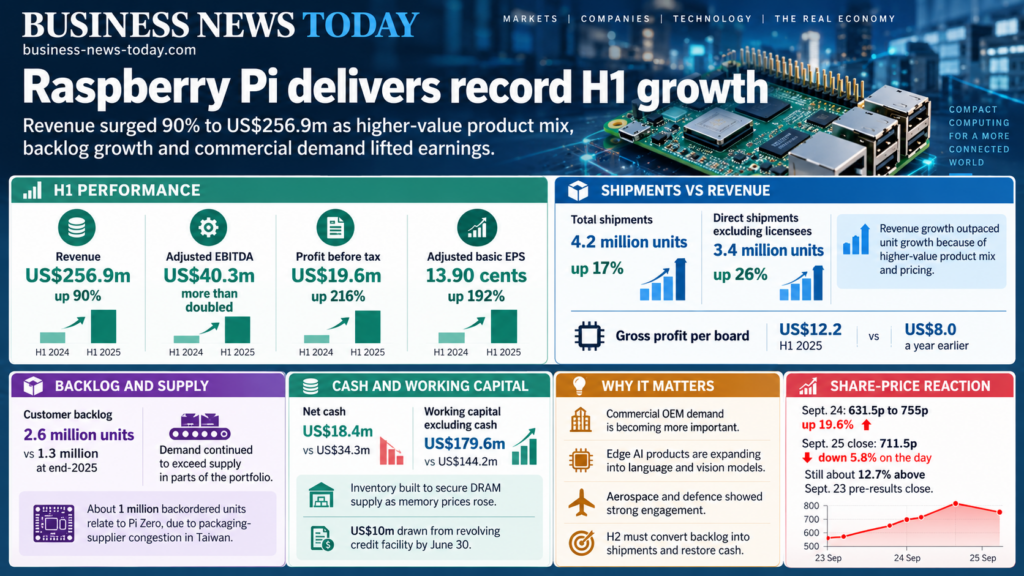
Raspberry Pi Holdings plc (LSE: RPI), a Cambridge-based designer and supplier of low-cost, high-performance computing platforms used by industrial, educational and enthusiast customers worldwide, delivered record first-half revenue of US$256.9 million, up 90% from US$135.5 million. Adjusted EBITDA more than doubled to US$40.3 million, profit before tax increased 216% to US$19.6 million and adjusted basic earnings per share rose 192% to 13.90 cents. The shares surged 19.6% to 755p on September 24 before giving back 5.8% to close at 711.5p the following day, still about 12.7% above their September 23 pre-results close.
The scale of the revenue increase is striking, but investors should separate unit growth from pricing and product-mix effects. Total shipments increased 17% to 4.2 million units while direct shipments excluding licensees rose 26% to 3.4 million, considerably below the 90% headline revenue growth rate. Customer backlog nevertheless doubled from 1.3 million units at the end of 2025 to 2.6 million at June 30, indicating that demand continued to exceed available supply in parts of the portfolio.
Why did Raspberry Pi revenue grow much faster than unit shipments?
Direct board revenue increased sharply because Raspberry Pi sold more higher-value products while average selling prices also rose. Gross profit per board reached US$12.2 compared with US$8.0 a year earlier, an increase of 53%, supported by product mix and the economics of strategic memory inventory purchased before the latest industry-wide increase in memory pricing. The result means Raspberry Pi generated considerably more gross profit from each board even before considering the higher number of units shipped.
That benefit should not automatically be extrapolated indefinitely. Semiconductor and memory pricing can move sharply between periods, and part of Raspberry Pi’s current advantage reflects procurement decisions made before DRAM costs increased substantially. Gross margin actually fell from 25% to 23% even though absolute gross profit rose 79% to US$59.4 million, showing that rapid revenue growth did not translate into percentage-margin expansion.
The most useful interpretation is therefore that H1 combined genuine volume growth with unusually strong value growth per shipped unit. OEM customers increasingly use Raspberry Pi hardware as a component inside commercial products rather than buying boards solely for experimentation, which can change both product mix and average selling prices. That transition is strategically attractive because commercial deployments can create repeat demand measured in thousands or millions of units rather than individual hobby purchases.
Does the 2.6 million-unit backlog signal more growth or a supply problem?
It signals both. Backlog doubling demonstrates that underlying demand remains strong, particularly across OEM customers, Smart Home applications and Aerospace and Defence, but it also shows Raspberry Pi has not yet been able to ship everything customers want. Around one million of the backordered units relate to Pi Zero, where production congestion at a Taiwan-based packaging supplier affected component availability.
The distinction matters because an order backlog creates value only when production capacity eventually converts it into sales. Persistent bottlenecks can delay customer programmes or encourage commercial users to design alternatives into their products, particularly when the board represents a critical embedded component.
Raspberry Pi is taking several steps to reduce that risk. The group is diversifying semiconductor and memory suppliers while co-investment with Sony is expected to add manufacturing capacity, and management expects broader memory-supply conditions to remain constrained until additional industry capacity arrives around 2028. The company’s willingness to hold unusually large inventories is therefore a deliberate response to securing supply for an expanding commercial customer base rather than ordinary inventory accumulation.
Why has Raspberry Pi’s net cash fallen despite record profitability?
Net cash declined 46% to US$18.4 million from US$34.3 million even as EBITDA more than doubled. Working capital excluding cash increased from US$144.2 million at December 31 to US$179.6 million by June 30, largely because Raspberry Pi deliberately accumulated DRAM inventory to protect supply as memory prices increased. The group had drawn US$10 million from its revolving credit facility by June 30 and subsequently moved temporarily into net debt as inventory continued building.
That is not the same as cash disappearing because the operating business is loss-making. A substantial amount of liquidity has effectively been converted into inventory intended to support future shipments, and the quality of that investment will depend on whether those components can be sold through profitable finished products.
The strategy nevertheless introduces balance-sheet sensitivity that investors did not face to the same extent when memory markets were easier. Carrying a large strategic inventory creates exposure to component-price movements and increases reliance on banking facilities, even when the underlying rationale is sensible.
Cash therefore deserves almost as much attention as revenue in H2. A continued backlog combined with falling net cash would indicate that supply-chain management remains a constraint, while inventory conversion and recovering liquidity would demonstrate that H1 working-capital pressure was primarily timing rather than structural cash consumption.
How important could edge AI and defence become for Raspberry Pi?
Raspberry Pi is positioning its boards increasingly as edge-computing platforms capable of running artificial-intelligence workloads locally rather than sending every task to a data centre. The AI HAT+ 2 expands this capability into language and vision models, giving industrial customers a lower-cost route to add inference capability to machines, cameras and embedded systems.
Management also reported particularly strong engagement in Aerospace and Defence and said its commercial programme includes direct engagement with senior executives at large customers. This matters because defence, automation and industrial applications generally involve long qualification cycles but can generate durable unit demand once a computing platform has been designed into a product.
The opportunity is substantially different from Raspberry Pi’s original educational identity. More than 77 million units have been sold across the platform’s lifetime, creating a large developer ecosystem, but commercial OEM adoption can potentially produce higher volumes per customer and a more predictable demand profile.
The risk is that industrial buyers care more about assured supply, lifecycle support and component consistency than enthusiasts do. Raspberry Pi’s success in these markets will therefore depend as much on supply-chain execution as processor performance.
What does the two-day share-price reaction tell investors?
The September 24 rise from 631.5p to 755p showed investors responded strongly to the record numbers and doubled backlog. The following session’s decline to 711.5p removed about one-third of that one-day gain but left the shares materially above their pre-results level, suggesting the market retained a positive assessment while tempering the initial reaction.
That price path is more informative than focusing only on Friday’s 5.8% decline. Raspberry Pi shares had already appreciated substantially during 2026 and remain highly valued relative to traditional hardware manufacturers, meaning exceptional growth numbers need to translate into durable cash earnings to sustain the valuation.
The next investor test is therefore unusually clear. Raspberry Pi needs to turn its 2.6 million-unit backlog into shipments while navigating memory constraints, restore working-capital cash and show that edge AI and commercial OEM demand can maintain growth once favourable pricing effects normalise. H1 demonstrated remarkable earnings momentum; H2 will reveal how repeatable it is.
Discover more from Business-News-Today.com
Subscribe to get the latest posts sent to your email.