

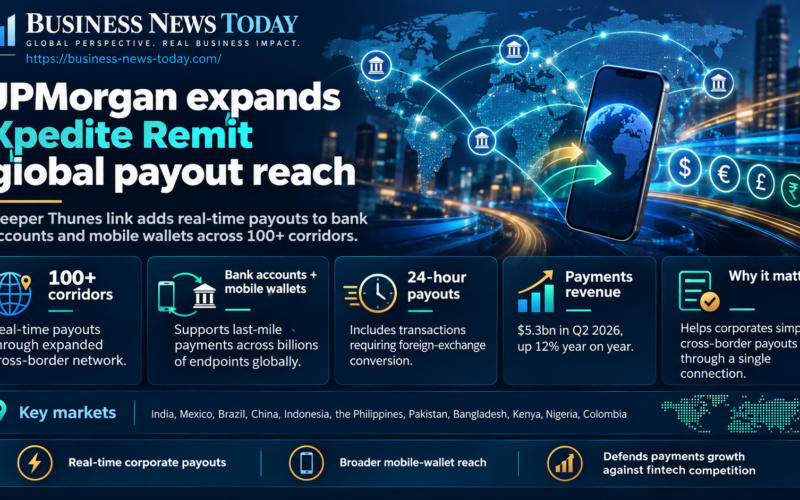
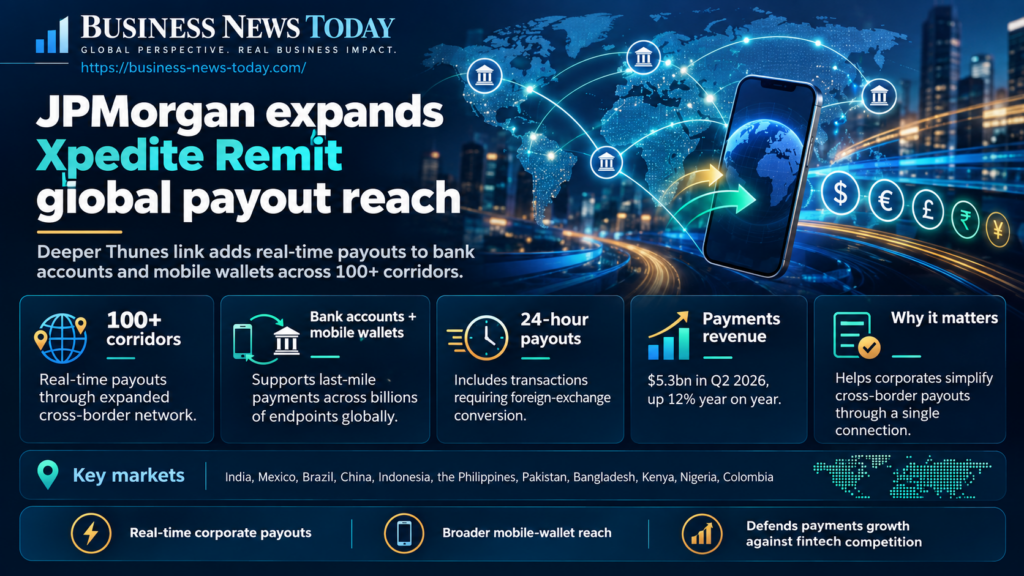
JPMorgan Chase & Co. (NYSE: JPM), the largest United States bank by assets, is expanding its Xpedite Remit cross-border payments service through a deeper connection with Thunes, giving corporate clients access to real-time payouts into bank accounts and mobile wallets across more than 100 corridors. The arrangement combines J.P. Morgan Payments’ own connections to domestic real-time payment systems with Thunes’ Direct Global Network.
The network reaches billions of bank and mobile-wallet accounts globally and is designed to support 24-hour payouts, including transactions that require foreign-exchange conversion. Initial or expanded market coverage includes large remittance and commerce destinations such as India, Mexico, Brazil, China, Indonesia, the Philippines, Pakistan, Bangladesh, Kenya, Nigeria and Colombia.
Financial terms were not disclosed, so the partnership cannot currently be modelled as a discrete revenue event. Its importance lies instead in widening the functionality of a Payments business that generated a record $5.3bn of revenue in the second quarter of 2026, up 12% year on year.
What does JPMorgan’s expanded Thunes partnership change for corporate payments?
Traditional cross-border payments can pass through several correspondent banks before reaching a recipient. Every intermediary can introduce additional processing time, reconciliation and uncertainty around fees or foreign exchange.
Xpedite Remit is designed to give a corporate client a single connection through JPMorgan while the bank and its partners route the final payment into local rails.
Through Thunes, JPMorgan can extend that last-mile connectivity into markets where mobile wallets are as important as conventional bank accounts. That matters because payment habits differ dramatically by country.
A multinational company paying a supplier or worker in one market may need a bank transfer, while a platform paying a small merchant or contractor elsewhere may find a mobile wallet more practical.
The expanded service supports same-currency payouts or foreign-exchange conversion while offering end-to-end payment visibility. JPMorgan also emphasises principal protection, an important feature for corporations sending large transaction volumes through third-party networks.
The customer does not necessarily care which domestic rail completes the payment. The commercial value comes from making many different payment systems appear as one usable global service.
Why is JPMorgan investing so heavily in cross-border payment infrastructure?
Payments is already one of JPMorgan’s largest growth businesses. J.P. Morgan Payments generated $5.3bn of second-quarter revenue, its sixth consecutive record quarter and a 12% year-on-year increase.
The business sits inside JPMorgan’s Commercial & Investment Bank and benefits from relationships with multinational corporations, financial institutions, governments and technology companies.
Scale creates several advantages. Corporate clients can hold deposits, manage liquidity, hedge currencies and send payments through one bank rather than assembling different providers for each function.
JPMorgan also processes more than $10tn of payments on a typical day across around 120 currencies and 160 countries. Its 2025 annual report said the Payments franchise processed a record $16.1tn on its highest-volume day.
That scale makes even incremental improvements strategically important. Faster cross-border capability can help JPMorgan protect transaction flows from specialist fintech companies that built businesses around making international payments simpler and more transparent.
The competitive threat comes from several directions. Wise, Airwallex, Stripe, Adyen and other technology companies have improved user experiences, while card networks, local instant-payment systems and digital wallets are expanding their own cross-border capabilities.
Large banks therefore cannot rely on correspondent relationships alone. They need the speed and software interfaces that technology-focused customers expect.
Why do mobile wallets matter to a bank the size of JPMorgan?
In many emerging markets, mobile wallets are not a peripheral payment method. They are a primary financial interface for consumers and small businesses.
A global payment network that connects only to bank accounts consequently leaves a substantial part of the market outside its reach.
Thunes specialises in connecting institutions to alternative payment systems, wallets and local networks. By using that infrastructure, JPMorgan can extend coverage without building direct technical integrations with every wallet provider individually.
The economics resemble other network businesses. Each additional country, wallet and payment rail increases the usefulness of the platform to an existing global customer.
That can strengthen customer retention because a corporate treasury team prefers fewer integrations, reporting systems and contractual relationships.
The challenge is controlling third-party risk. JPMorgan remains accountable to clients for reliability, sanctions screening, anti-money-laundering controls and operational resilience even where a partner provides part of the underlying connectivity.
That means expansion requires more than plugging in application programming interfaces. The bank must continuously assess counterparties, transaction monitoring, data flows and local regulatory requirements.
How does Xpedite Remit compete with fintech cross-border payment platforms?
Fintech companies often built their advantage around simpler pricing, fast settlement and modern digital interfaces. Banks historically had deeper liquidity and regulatory infrastructure but could appear slower and more complicated.
JPMorgan is trying to combine the two propositions. Xpedite Remit offers corporate customers bank-grade treasury infrastructure while connecting to faster local rails and third-party payment networks.
The bank’s advantage is that payments can sit alongside foreign exchange, cash management, trade finance, lending and investment-banking relationships.
The disadvantage is organisational complexity. A large regulated bank can take longer to add new markets or products because every expansion passes through risk, compliance, technology and legal controls.
Partnerships such as Thunes provide a way around part of that speed problem. JPMorgan can use specialised external connectivity while maintaining the client relationship and core payment account.
Financial terms will determine how much economics the bank retains versus the network provider, but those details have not been disclosed.
Why could real-time cross-border payments change corporate working capital?
Payment speed is not merely a convenience issue. Delayed settlement creates uncertainty around cash positions and can force businesses to hold larger liquidity buffers.
If a company knows that a supplier or marketplace seller can receive funds within minutes instead of days, treasury teams can manage cash closer to actual payment deadlines.
Faster confirmation also improves reconciliation. A company can identify whether a beneficiary has received money rather than waiting through an opaque correspondent chain.
That can be particularly valuable for marketplaces, gig-economy platforms, insurance payouts and businesses making large numbers of relatively small international payments.
The economic benefit depends on pricing. A faster payment is not automatically better if transaction fees or FX spreads are materially higher. JPMorgan will have to demonstrate that the combined service provides competitive total cost as well as speed.
What does JPMorgan stock performance say about investor sentiment?
JPMorgan shares closed at $343.06 on September 25, recovering from a 3.42% decline on September 22, the day the Thunes expansion was announced. There is no evidence that the payment partnership caused that decline; bank shares were moving amid broader interest-rate and market developments.
The stock had traded above $350 immediately before the announcement and remained well above levels seen earlier in 2026. Investors value JPMorgan primarily through net interest income, credit quality, capital returns, investment-banking activity and the profitability of its enormous consumer and commercial franchises.
Payments nevertheless deserves greater attention because it is already producing more than $5bn of quarterly revenue and has delivered repeated record periods.
A Thunes partnership will not materially change JPMorgan’s valuation by itself. Its importance lies in defending a high-growth franchise against fintech competitors while extending the bank deeper into payment methods and markets that conventional correspondent banking does not reach efficiently.
The strategic question is whether JPMorgan can make global payments feel local. If a corporate client can reach a bank account or mobile wallet in more than 100 corridors through one connection, that is increasingly what the market expects.
Discover more from Business-News-Today.com
Subscribe to get the latest posts sent to your email.