


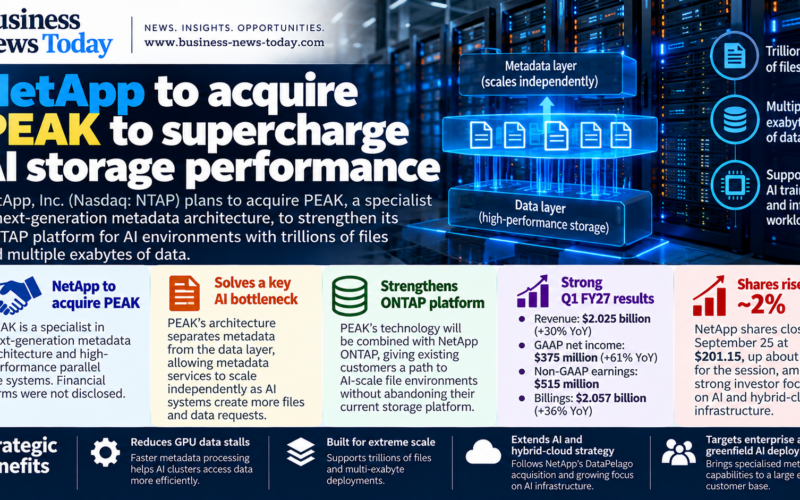
NetApp, Inc. (Nasdaq: NTAP) plans to acquire PEAK, a specialist in next-generation metadata architecture and high-performance parallel file systems, as the storage company attempts to position its ONTAP platform for artificial intelligence environments containing trillions of files and multiple exabytes of data. Financial terms were not disclosed, and completion remains subject to customary closing conditions and regulatory approvals.
The acquisition goes after a part of the artificial intelligence infrastructure stack that receives far less public attention than graphics processing units but can still determine whether expensive computing clusters operate efficiently. NetApp said PEAK’s architecture separates metadata from the underlying data layer, allowing metadata services to scale independently as AI systems create more files, users and simultaneous data requests.
NetApp shares finished September 25 at $201.15, up about 2% for the session. That move cannot be attributed solely to the acquisition announcement, but it arrived against a broader period of strong stock performance, with investors increasingly treating NetApp as an artificial intelligence and hybrid-cloud infrastructure beneficiary rather than merely a mature enterprise-storage vendor.
Why is metadata becoming a bottleneck for artificial intelligence infrastructure?
The easiest way to understand the problem is to separate computing power from data access. An artificial intelligence training cluster may contain extremely expensive graphics processing units capable of processing enormous amounts of information, but those processors create economic value only when data reaches them fast enough.
Traditional storage systems were designed around enterprise databases, virtual machines, office files and other workloads where access patterns were comparatively predictable. Artificial intelligence systems can generate and retrieve huge numbers of files simultaneously, and large training or inference environments can involve thousands of processors requesting data in parallel.
Metadata tells the storage system what a file is, where it is located, who can access it and how it relates to other data. As file counts rise into the billions or trillions, metadata processing itself can become a constraint. A storage system that has enough physical capacity but cannot locate and serve files quickly enough can leave expensive GPUs waiting.
NetApp said the combined architecture is intended to support trillions of files and multi-exabyte deployments using scalable metadata services, a global namespace and standards-based parallel NFS access. The company specifically identified reduction of data-related GPU stalls and improved infrastructure efficiency as objectives of the planned technology integration.
That makes the acquisition strategically different from simply adding more storage capacity. NetApp is trying to improve the control plane that determines how large artificial intelligence workloads access that capacity.
What exactly is NetApp buying from PEAK?
PEAK developed technology around high-performance parallel file systems and metadata management. NetApp said that work originated partly through collaborations with Los Alamos National Laboratory and Carnegie Mellon University, environments where high-performance computing and data-intensive research require storage systems to operate at extreme scale.
The intended product strategy is to combine PEAK’s metadata innovations with NetApp ONTAP, the software foundation underlying much of NetApp’s storage portfolio. Existing ONTAP customers would theoretically gain a path toward AI-scale file environments without abandoning the security, resiliency and operational tooling they already use.
That installed base is strategically important. Artificial intelligence infrastructure vendors are competing not only for greenfield “AI factory” projects but for traditional enterprises trying to introduce AI workloads without rebuilding their entire technology stack. NetApp can therefore position PEAK’s specialised capabilities as an extension of an existing platform rather than as a completely separate architecture.
The planned transaction also follows NetApp’s acquisition of DataPelago, another artificial intelligence data-infrastructure company, disclosed with its first-quarter fiscal 2027 results. The two transactions suggest NetApp is using M&A to accelerate capabilities in areas where the AI data stack is changing faster than conventional product-development cycles.
Why is NetApp becoming more aggressive around AI infrastructure now?
The financial backdrop gives management room to invest. NetApp reported record fiscal first-quarter 2027 revenue of $2.025 billion, up 30% year over year. Hybrid Cloud revenue increased 30% to $1.819 billion, Public Cloud revenue rose 28% to $206 million and all-flash array revenue climbed 47% to a record $1.3 billion.
GAAP net income rose 61% to $375 million and earnings per share increased 63% to $1.88. Non-GAAP earnings reached $515 million, while billings increased 36% to $2.057 billion. NetApp subsequently lifted its fiscal 2027 outlook to revenue of between $7.975 billion and $8.225 billion.
That growth changes the context for the PEAK deal. NetApp is not acquiring technology to offset a collapsing core business; it is trying to use current momentum to strengthen its exposure to workloads that could determine storage spending over the next several years.
Artificial intelligence training has initially concentrated attention on accelerators, networking and electricity, but enterprise deployments require the rest of the infrastructure stack to scale as well. As more organisations move from model experimentation into production, data governance, storage efficiency, retrieval performance and integration with existing corporate data become increasingly important.
NetApp’s opportunity is to argue that enterprises should not create separate storage islands for every AI initiative. ONTAP can instead become a common data layer spanning conventional enterprise workloads, public cloud and high-performance artificial intelligence systems.
How does PEAK fit with NetApp’s DataPelago acquisition?
The acquisitions address related but different parts of the AI data problem. DataPelago focuses on enabling computation and analytics closer to where large datasets reside, while PEAK strengthens high-performance access and metadata scaling across very large file environments.
Together, they point toward an architectural strategy rather than a collection of isolated products. NetApp appears to be building technology capable of moving, governing, serving and processing data across hybrid infrastructure without forcing enterprises to copy every dataset into specialised AI storage systems.
That matters because data movement can become one of the hidden costs of artificial intelligence. Copying petabytes of corporate information into separate environments consumes network capacity, storage and administrative resources, while creating additional security and governance challenges.
A platform that allows AI compute resources to work efficiently with enterprise data where it already resides could therefore lower total infrastructure costs. Whether NetApp can technically achieve that at hyperscale remains an execution question, but PEAK adds a specific capability aimed at one of the hardest parts of the architecture.
Could AI storage become as strategically valuable as AI compute?
Storage is unlikely to command the same economics as the leading accelerator chips because hardware scarcity, intellectual property and software ecosystems are different. Yet that does not mean storage is a commodity.
AI workloads can expose dramatic performance differences between architectures. A customer that spends hundreds of millions of dollars on GPUs has a powerful incentive to prevent those processors from sitting idle because storage cannot supply data quickly enough.
This creates an economic argument for premium storage systems. The relevant comparison is not simply the price per terabyte but the cost of the entire AI cluster, including expensive compute assets whose utilisation rate depends on the surrounding infrastructure.
NetApp’s reference to “GPU stalls” is therefore commercially meaningful. Even modest improvements in accelerator utilisation can justify meaningful storage investment when the compute cluster itself is sufficiently expensive.
The same principle has helped drive investment into high-speed networking, liquid cooling and data-centre power equipment. Artificial intelligence is effectively pulling supporting technologies into the value chain because bottlenecks migrate as one part of the system becomes faster.
What does NetApp stock performance reveal about investor expectations?
NetApp shares closed September 25 at $201.15, gaining roughly 2% during the session and remaining close to the upper end of a 52-week range that had reached $209.06. MarketScreener data showed the stock up more than 80% during 2026 by the September 25 close, illustrating how dramatically sentiment has improved.
That creates opportunity and risk. Strong share performance gives NetApp credibility and financial flexibility to pursue acquisitions, but it also means investors are already pricing in substantial benefits from AI, flash storage and hybrid cloud.
The PEAK purchase therefore needs to translate into products and customer deployments rather than remaining a technology narrative. Financial terms have not been disclosed, which prevents investors from judging the acquisition price against near-term revenue or earnings contribution.
Integration risk should also be considered. PEAK is an innovation-driven specialist, while NetApp is a large public infrastructure company with mature product-development, sales and support processes. Retaining key technical talent and incorporating the technology into ONTAP without slowing innovation will be important.
The analytical takeaway is that NetApp is making a calculated bet on where the next AI bottleneck emerges. GPUs have dominated the first phase of the infrastructure boom. If enterprises increasingly discover that data access, metadata scale and storage orchestration limit the productivity of those GPUs, PEAK could give NetApp technology positioned exactly where spending pressure moves next.
Discover more from Business-News-Today.com
Subscribe to get the latest posts sent to your email.