




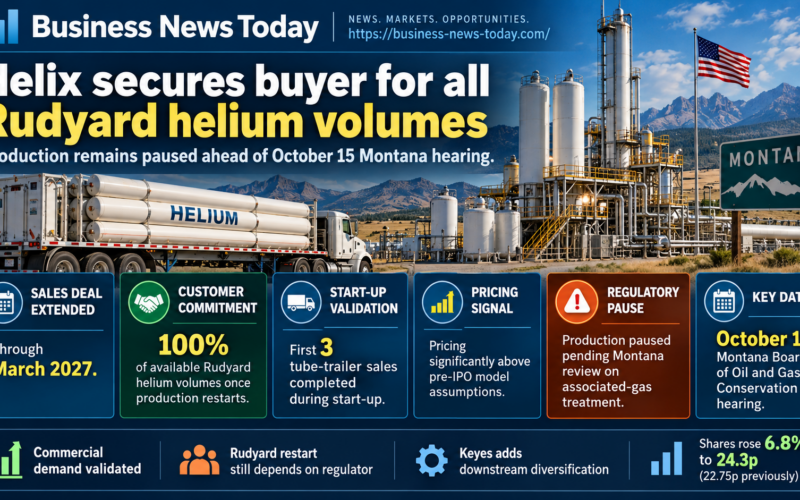
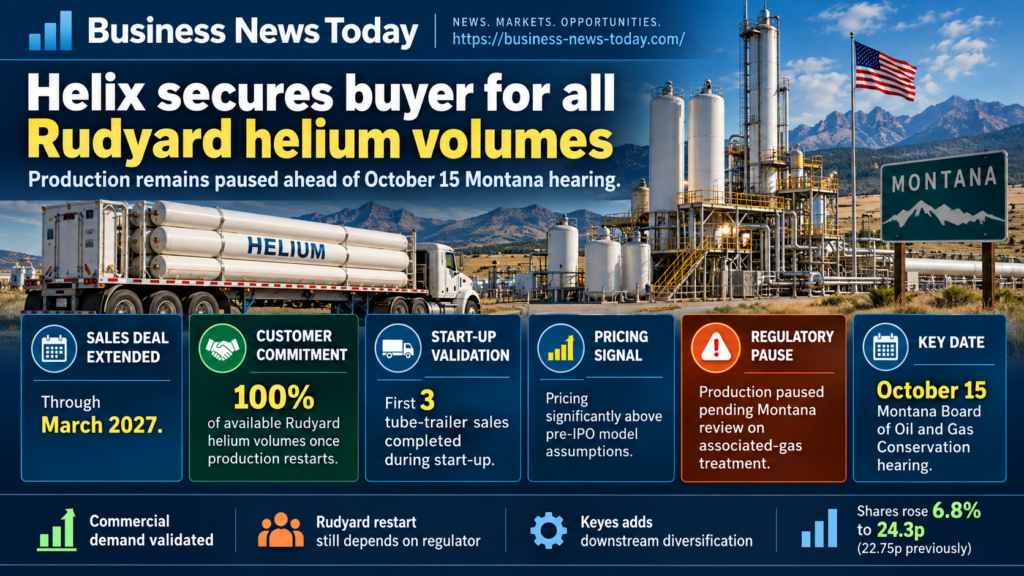
Helix Exploration PLC (AIM: HEX), a US-focused helium producer and liquefier with production assets in Montana and the Keyes helium processing complex in Oklahoma, has extended its Rudyard sales arrangement through March 2027 after completing its first three tube-trailer sales during start-up. The unnamed industrial-gases customer has committed to purchase 100% of available Rudyard helium volumes once production restarts, and Helix said agreed pricing is significantly above the assumptions used in its pre-IPO financial model. Shares closed September 25 at 24.3p, up 6.8% from 22.75p the previous session.
The positive commercial development sits alongside an unresolved regulatory issue. Rudyard production is currently paused following a Montana Board of Oil and Gas Conservation review concerning the treatment of associated gas, with Helix saying the procedures are not clearly defined because it is Montana’s first helium producer. The company is working with regulators ahead of a scheduled October 15 hearing.
Why is committing 100% of Rudyard production strategically important?
Helium projects can fail commercially even after successful wells if producers cannot secure suitable processing, transport and customers. Helix has now demonstrated an initial route to market through three completed tube-trailer sales and has extended that relationship for another six months, meaning the immediate commercial question is less about finding a buyer and more about restoring output.
The customer is taking all available Rudyard production rather than a fixed small trial volume. That reduces near-term marketing risk because incremental production from the current expansion programme should have a defined outlet, subject to the contractual arrangements and the customer’s continuing performance.
Pricing is another meaningful signal. Helix has not disclosed the dollar amount, but saying terms are significantly above the assumptions used before its IPO indicates project economics may be stronger than the base case originally presented to shareholders.
Investors should still avoid converting that statement into an invented revenue forecast. Without disclosed volumes, helium concentrations, realised pricing and operating costs, there is not enough information to calculate Rudyard’s future cash flow precisely.
How serious is the Montana regulatory pause?
It is currently the clearest gating risk. Helix began commercial production in July and completed three trailer sales before the Montana Board of Oil and Gas Conservation requested that production pause while issues surrounding associated-gas handling were clarified.
The company says the matter reflects the novelty of being Montana’s first helium producer rather than a known breach of an established helium-production rule. Helix has complied with the request and continues discussions with the regulator before the October 15 hearing.
That explanation may ultimately prove correct, but investors should still treat the pause as a real operating constraint until the regulator authorises production to resume. A customer agreement cannot generate Rudyard revenue if helium is not flowing.
The September 25 share-price rise suggests the market gave substantial weight to the commercial validation provided by the extended sales arrangement. Yet the regulatory hearing remains the more immediate operational catalyst because it determines when Helix can convert that demand into sales.
Does the Keyes acquisition reduce Helix’s dependence on Rudyard?
Yes, and this is one of the more important changes to the investment case since the IPO. Helix completed the US$11 million acquisition of the Keyes Helium Complex in Oklahoma in July, gaining one of only six operational helium liquefaction facilities in the United States. The purchase price represented an estimated 65% discount to a replacement-cost estimate of about US$31 million, although replacement cost should not be confused with market value or future profitability.
Keyes generated US$2.91 million of revenue and US$1.42 million of EBITDA in the five months to May 31 before Helix acquired it. More importantly, the facility can process helium from multiple sources rather than depending exclusively on Rudyard, allowing Helix to earn tolling and liquefaction revenue from third-party gas even when its own upstream production is constrained.
That vertical integration changes Helix from a single-project explorer into a company with exposure across production, purification and liquefaction. Owning downstream infrastructure can allow the group to capture more margin from its own helium while also earning revenue from other producers.
The acquisition was financed alongside an equity raise of up to £16 million plus a retail component, so existing shareholders paid for the diversification through dilution. The economic test is whether Keyes generates enough additional EBITDA and strategic value to exceed that cost over time.
What does the Rudyard expansion programme add to the sales agreement?
Helix is drilling additional wells to increase production, including the Ollie #1 programme announced in September. More wells could raise available helium volumes and therefore increase the absolute value of the sales agreement, provided the regulatory pause is resolved and the wells perform as expected.
The customer arrangement includes continuous tube-trailer rotation using both Helix-leased and customer-provided equipment. That logistics structure is important because helium transportation capacity can become a bottleneck even when production and demand are available.
Longer term, Helix wants a diversified route-to-market portfolio rather than permanent dependence on one buyer. The six-month extension provides revenue visibility during the ramp-up while preserving the ability to negotiate longer-term or larger-volume arrangements as production expands.
The current arrangement should therefore be viewed as commercial proof rather than the final marketing structure of the business.
Why did HEX rise despite production still being suspended?
Helix closed at 24.3p on September 25, up 6.8%, with around 2.8 million shares traded. The move indicates investors viewed guaranteed demand and stronger-than-modelled pricing as meaningful enough to offset at least some of the regulatory uncertainty.
The shares remain well below their 52-week high near 47.5p, however, showing that the market is still assigning a substantial risk discount to the company despite its transition into commercial operations and acquisition of Keyes.
October 15 therefore becomes the most important near-term date. A clear regulatory route to restarting Rudyard would allow investors to focus on production rates, helium pricing and cash margins, while prolonged uncertainty would keep the asset’s commercial potential disconnected from actual revenue.
Helix has already answered one difficult question: there is a customer willing to buy all available Rudyard helium through March at pricing management considers attractive. The next question is more binary. The company needs permission and operating processes that allow it to produce the helium it has already sold.
Discover more from Business-News-Today.com
Subscribe to get the latest posts sent to your email.
