



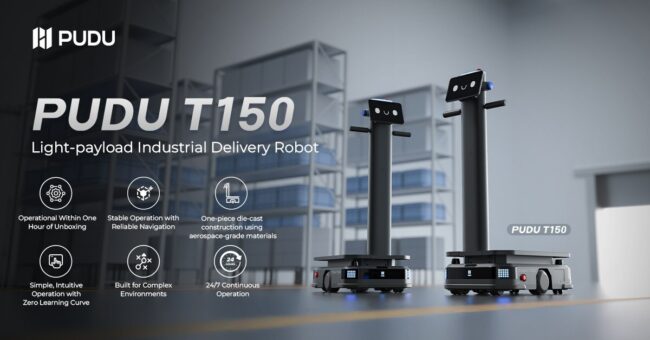
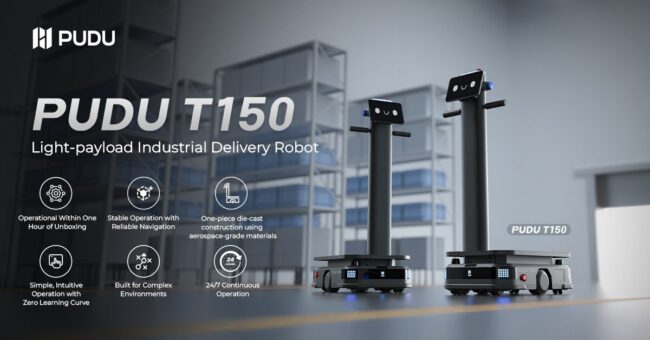
Pudu Robotics has introduced the PUDU T150, a light-payload industrial delivery robot built to transport up to 150 kg in internal logistics environments. The launch signals a strategic shift to broaden industrial automation access for small and mid-sized manufacturers across Asia, particularly in sectors where lean operations, fast deployment, and cost sensitivity remain key barriers to robot adoption.
Why is Pudu Robotics targeting the light-payload segment in Asia’s industrial automation market?
Pudu Robotics’ decision to debut the T150 in China and key Southeast Asian markets reflects a growing focus on the underpenetrated segment of light-payload, high-frequency material movement. While most industrial automation efforts have traditionally centered on large payloads or high-throughput systems, a significant portion of production facilities — particularly in electronics, FMCG, and small-part manufacturing — still rely on manual trolleys or human-run intralogistics due to the high entry cost of traditional AGV or AMR systems.
By optimizing for rapid, out-of-the-box deployment and eliminating the need for extensive site modifications, Pudu Robotics is trying to overcome what it calls the “automation hesitancy barrier” common in smaller factories. The company claims that mapping can be completed within 10 minutes and operational stability reached in under an hour — a proposition that, if substantiated, could position the T150 as a frictionless automation entry point.
Geographically, its initial roll-out strategy — prioritizing China, Vietnam, Thailand, Indonesia, and Malaysia — aligns with where the company believes light-payload automation will scale fastest. These countries are not only logistics and manufacturing hubs but also host to a rising population of digitally modernizing SMEs that Pudu Robotics sees as ripe for automation, but historically underserved by heavyweight AMR providers.
How does the T150 differentiate itself from traditional AGVs and Pudu’s own T300/T600 systems?
The T150 does not attempt to compete on the basis of payload capacity or warehouse orchestration scale. Instead, it doubles down on low-friction deployment, minimal operational training, and remote task dispatching capabilities. Unlike traditional AGVs that require markers, guide rails, or cloud-based integrations, the T150 runs locally using VSLAM + dual LiDAR for 360-degree dynamic mapping and obstacle avoidance.
Its construction — featuring an aerospace-grade one-piece chassis — appears designed to withstand repetitive workloads and frequent layout shifts that are typical in mid-tier industrial environments. This contrasts with the more ruggedized, high-load T300 and T600, which have a very different integration and cost profile. By extending the T-series downward in payload and price, Pudu Robotics is building what looks like a layered portfolio strategy, ensuring wider coverage of use cases while keeping the T150 targeted and lean.
It also offers dual SKUs — a standard version for basic point-to-point delivery and a lifting variant meant for more complex workflows and automated integration. This gives facilities an upgrade path without overcommitting at the outset, a flexibility that many AMR vendors struggle to offer in the same SKU family.
What are the operational and economic assumptions behind Pudu’s “fast deployment” pitch?
The T150’s one-hour operational readiness claim rests on three assumptions: (1) that facilities are indoor and relatively structured, (2) that layout maps can be generated quickly via onboard software, and (3) that frontline workers can be trained within minutes using its tablet-like interface. While these assumptions may hold true in modern factories, they might face limitations in cluttered or semi-automated environments where sensor drift, signal occlusion, or inconsistent Wi-Fi could disrupt seamless operation.
Moreover, while the company promotes the T150 as low-cost, the total cost of ownership (TCO) narrative depends on battery lifecycle, maintenance cycles, and charging infrastructure. Pudu claims a five-year service life and offers options for fast battery swapping or automatic charging. If these claims are accurate, the T150 could sidestep one of the biggest hurdles for small manufacturers: the downtime risk and service unpredictability of automation.
The real economic breakthrough lies not in headline robot pricing, but in minimizing soft costs — time to train, time to deploy, and time to scale across similar production lines. If Pudu Robotics’ system is indeed infrastructure-light and API-ready, it could become one of the first commercially viable plug-and-play AMRs in the light-load category.
How does Pudu’s go-to-market strategy reflect broader automation trends in 2026?
The T150’s launch reflects a broader trend in 2026: industrial automation is no longer just for megaplants or high-tech cleanrooms. As Asian economies recalibrate toward flexible manufacturing, just-in-time delivery, and smart production zones, automation is being reframed as a necessity rather than a luxury — but only if deployment friction can be reduced.
The fact that Pudu Robotics is targeting the beauty, FMCG, and fast fashion verticals is revealing. These are fast-turn, SKU-heavy industries that traditionally depended on labor-intensive workflows. For these sectors, robotics is not about maximizing throughput — it’s about eliminating inefficiencies in the 5–15% of internal logistics that routinely break manual workflows.
The company’s push to support multi-robot collaboration without on-premise servers suggests that Pudu is betting on decentralized intelligence and device-side autonomy as the future of scalable AMRs. This aligns with emerging industry thinking that traditional WMS-AMR integrations are too brittle for dynamic or resource-constrained environments.
What risks and uncertainties could limit adoption of the T150 in its target markets?
While Pudu Robotics has a strong track record in service delivery robots, its industrial delivery segment faces tougher competitive dynamics. Companies like Geek+, Quicktron, and ForwardX Robotics have already established footholds in various warehouse and factory automation niches across Asia. Even though these vendors often focus on larger payloads or more complex orchestration, down-market competition is inevitable if T150 gains traction.
Another critical risk lies in after-sales support and fleet management. Small and mid-sized factories lack dedicated IT or engineering teams, meaning Pudu Robotics must either build a hyperlocal service network or embed robust remote diagnostics and maintenance capabilities to maintain uptime guarantees.
Additionally, geopolitical risk is worth noting. As automation becomes strategically linked to national productivity agendas, companies with exposure to cross-border electronics or government contracts may prefer domestically backed or regionally compliant AMRs. How Pudu Robotics navigates these procurement dynamics — especially in markets like India or South Korea — will shape its commercial viability far more than just technical specs.
Is Pudu Robotics quietly carving out a new segment in the service-to-industrial crossover zone?
It may be premature to call the T150 a category-creator, but it could be a category-expander. Pudu Robotics is attempting to bridge its strength in hospitality and service automation with the emerging demand for lightweight intralogistics in industrial settings. This crossover play is strategically attractive — especially if it enables the company to leverage shared software stacks, drive component reuse, and reduce marginal R&D costs across product lines.
This strategy mirrors moves by other robotics players (e.g., Bear Robotics, Keenon) that began in hospitality but are now diversifying into healthcare and warehousing. What distinguishes Pudu Robotics is its apparent commitment to modular product architecture, allowing for vertical-specific SKUs that still benefit from a common mobility and AI platform.
Whether the T150 becomes a breakout product will depend less on specs and more on customer friction reduction. If Pudu Robotics can back its out-of-the-box deployment promise with real-world case studies, strong documentation, and vertical go-to-market alignment, the T150 may become a quiet workhorse in a sector long starved of plug-and-play innovation.
What does the Pudu T150 launch mean for the robotics market and small-scale industrial automation?
- Pudu Robotics’ T150 launch targets a gap in light-payload industrial automation for small and mid-sized factories in Asia.
- The robot’s 150 kg capacity, VSLAM-LiDAR combo, and one-hour deployment promise position it as a fast-start solution.
- Unlike traditional AGVs, the T150 does not require environmental retrofitting or server-based coordination.
- Dual SKUs — a standard and a lifting version — offer flexibility for basic delivery and integration-intensive workflows.
- The initial go-to-market strategy focuses on China, Southeast Asia, and high-growth light-manufacturing sectors like FMCG and fashion.
- Execution risks include support infrastructure, integration with existing systems, and rising competition in light-load AMRs.
- Pudu Robotics is leveraging its service robotics strength to create crossover opportunities in small-scale industrial automation.
- Successful adoption of the T150 could drive broader acceptance of out-of-the-box AMRs in non-traditional factory settings.
Discover more from Business-News-Today.com
Subscribe to get the latest posts sent to your email.