

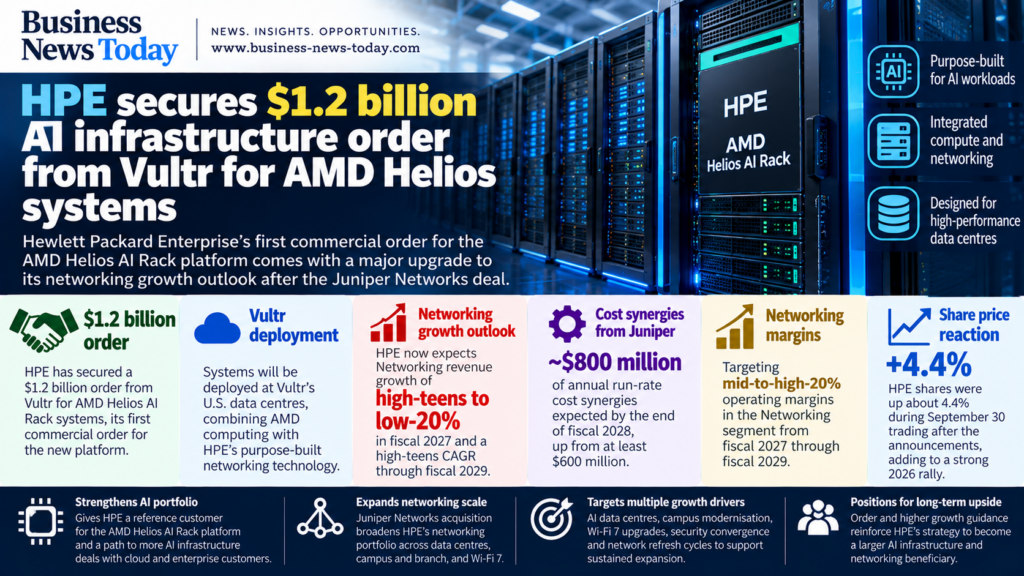
Hewlett Packard Enterprise Company (NYSE: HPE), the Texas-based enterprise computing, networking and hybrid-cloud infrastructure group, has secured a $1.2 billion order from cloud infrastructure provider Vultr for AMD Helios AI Rack systems, giving Hewlett Packard Enterprise its first commercial order for the new platform. The transaction was announced alongside a significant upgrade to Hewlett Packard Enterprise’s networking outlook, turning what could have been viewed as another artificial intelligence hardware win into a broader signal about the company’s post-Juniper Networks growth strategy.
Vultr plans to deploy the Hewlett Packard Enterprise systems at United States data centres, combining Advanced Micro Devices computing with purpose-built Hewlett Packard Enterprise networking technology. Hewlett Packard Enterprise simultaneously increased its fiscal 2027 Networking segment revenue-growth expectation to the high-teens-to-low-20% range and now expects Networking revenue to grow at a high-teens compound annual rate from fiscal 2026 through fiscal 2029. Management is targeting Networking operating margins in the mid-to-high-20% range throughout fiscal 2027 to fiscal 2029.
Investors reacted strongly. Hewlett Packard Enterprise shares were up about 4.4% during September 30 trading after the announcements, adding to a substantial 2026 rally as investors increasingly treat the company as an artificial intelligence infrastructure and networking beneficiary rather than primarily a mature enterprise server vendor.
Why does the $1.2bn Vultr order matter for Hewlett Packard Enterprise’s AI strategy?
The importance of the Vultr transaction begins with the fact that this is Hewlett Packard Enterprise’s first announced order for the AMD Helios AI Rack platform. New infrastructure architectures need reference customers before suppliers can credibly position them against established alternatives, particularly in an artificial intelligence market where customers are committing billions of dollars to systems expected to remain productive for several technology cycles.
Vultr gives Hewlett Packard Enterprise that first commercial validation. The privately held cloud infrastructure provider operates data-centre capacity serving developers and enterprises that want alternatives to the largest hyperscale platforms, making it an appropriate customer for an integrated rack architecture capable of supporting intensive artificial intelligence workloads. Hewlett Packard Enterprise is supplying not just conventional compute equipment but networking technology designed specifically for the Helios architecture.
The deal is also strategically significant for Advanced Micro Devices, Inc. because artificial intelligence infrastructure remains overwhelmingly associated with Nvidia Corporation. AMD has developed an increasingly competitive accelerator and processor portfolio, but competing effectively requires much more than semiconductor performance. Customers need complete racks, high-speed networking, cooling, power management, software and service support that can be deployed at scale.
Hewlett Packard Enterprise can help provide that packaging layer. If the Vultr deployment performs well, Hewlett Packard Enterprise potentially gains a replicable architecture that can be marketed to cloud providers, sovereign computing projects and enterprises seeking greater supplier diversity in artificial intelligence infrastructure.
That is where the $1.2 billion headline potentially becomes more important than the immediate revenue. A first order can establish a reference architecture for subsequent customers, particularly when the supplier already has extensive enterprise sales relationships.
How is the Juniper Networks acquisition changing HPE’s growth expectations?
The other major development is the increasingly ambitious outlook for Hewlett Packard Enterprise’s networking business following its acquisition of Juniper Networks. Hewlett Packard Enterprise now expects approximately $800 million of annual run-rate cost synergies from the combination by the end of fiscal 2028, up from its previous target of at least $600 million.
An additional $200 million of targeted annual savings materially changes the economics of a major acquisition. Cost synergies can come from overlapping corporate functions, procurement, product-development rationalisation, sales infrastructure and other areas, although Hewlett Packard Enterprise will still need to demonstrate that the savings do not impair innovation or customer service.
More important than the cost figure is the revenue outlook. Hewlett Packard Enterprise expects the Networking segment to expand at a high-teens compound annual growth rate through fiscal 2029. That is unusually strong for a large enterprise networking business and implies management believes artificial intelligence data centres, campus modernisation, Wi-Fi upgrades, security convergence and broader network refresh cycles can collectively support sustained expansion.
Campus and branch networking is expected to grow at a high-single-digit compound annual rate through fiscal 2029, supported partly by the Wi-Fi 7 upgrade cycle. Security revenue is also targeted to grow at a high-single-digit rate as Hewlett Packard Enterprise combines network access control, firewalls, secure access service edge technology, identity-based policy and artificial intelligence-assisted network operations.
The strategic logic behind Juniper Networks therefore extends well beyond eliminating duplicated expenses. Hewlett Packard Enterprise acquired a networking portfolio that gives it deeper participation in the infrastructure layer connecting artificial intelligence servers, corporate campuses and distributed cloud environments.
Could networking become more valuable than HPE’s traditional server business?
Servers historically defined Hewlett Packard Enterprise in the minds of many investors, but artificial intelligence is changing where value sits within infrastructure. Compute demand is expanding rapidly, yet customers also need high-bandwidth networking capable of connecting enormous numbers of accelerators without creating performance bottlenecks.
Networking can carry attractive economics because customers buy both hardware and recurring software capabilities. Once a network architecture is deployed across an enterprise or data centre, switching suppliers can involve significant engineering, security, training and operational costs.
Hewlett Packard Enterprise is consequently trying to position its networking portfolio as a strategic control layer rather than simply another hardware category. Combining Aruba’s enterprise networking footprint with Juniper Networks’ data-centre and Mist artificial intelligence capabilities gives the company a broader installed base from which to cross-sell security, automation and infrastructure products.
The Vultr contract reinforces that strategy because the AMD Helios system includes purpose-built Hewlett Packard Enterprise networking. Instead of providing isolated servers that connect to networking equipment supplied by another company, Hewlett Packard Enterprise can capture a greater portion of the infrastructure bill.
That vertical integration is particularly important as artificial intelligence systems become rack-scale products. Individual processors matter, but buyers increasingly evaluate complete systems based on compute density, network performance, cooling efficiency, reliability and deployment speed.
What execution risks could undermine the upgraded networking outlook?
Supply remains one of the most immediate risks. Hewlett Packard Enterprise disclosed that it doubled quarter-over-quarter networking supply purchase commitments during the third quarter of fiscal 2026 to support strong demand and mitigate constraints entering fiscal 2027.
Committing to additional supply is rational when demand visibility is strong, but it increases working-capital and inventory exposure if customer spending slows. Artificial intelligence infrastructure orders can be enormous, and individual cloud customers may therefore have an outsized effect on quarterly revenue timing.
Integration risk around Juniper Networks also remains important. Hewlett Packard Enterprise has raised its synergy target, but investors need evidence that the company can achieve those savings while maintaining product road maps and retaining specialist engineers. Aggressive cost removal would be less valuable if customers delayed purchases because product integration created uncertainty.
Competitive pressure is equally intense. Hewlett Packard Enterprise competes with Dell Technologies Inc., Cisco Systems, Inc., Arista Networks, Inc., Super Micro Computer, Inc. and several specialised infrastructure providers. In artificial intelligence systems, it must also operate within an ecosystem heavily influenced by Nvidia Corporation while supporting customers seeking alternatives through Advanced Micro Devices.
The opportunity is enormous enough to support several suppliers, but customers are unlikely to tolerate weak execution because infrastructure delays can postpone entire data-centre deployments.
What does the stock reaction reveal about HPE investor sentiment?
The September 30 share move suggests investors were responding to more than the headline order. Hewlett Packard Enterprise stock gained roughly 4% to 5% during the session after the Vultr announcement and upgraded networking outlook, while Reuters reported an even larger premarket move earlier in the day.
That reaction is understandable because the announcements address two different parts of the investment case. The $1.2 billion order provides immediate commercial evidence that Hewlett Packard Enterprise can participate in large artificial intelligence deployments, while the higher Networking growth and synergy targets strengthen the medium-term earnings framework.
The challenge is that expectations have already increased substantially. Hewlett Packard Enterprise shares have risen sharply during 2026, meaning future results need to validate the increasingly optimistic assumptions embedded in the stock.
Investors should therefore watch three measurable indicators. The first is the pace at which the Vultr order converts into recognised revenue. The second is whether networking growth actually reaches the high-teens-to-low-20% range during fiscal 2027. The third is whether Hewlett Packard Enterprise can capture $800 million of annual Juniper-related synergies while maintaining the mid-to-high-20% Networking operating margin target.
If those numbers materialise simultaneously, Hewlett Packard Enterprise will increasingly look less like a legacy enterprise computing company and more like an integrated artificial intelligence infrastructure platform. The Vultr order is an important proof point, but the larger revaluation depends on whether the same architecture can attract the next billion-dollar customer.
Discover more from Business-News-Today.com
Subscribe to get the latest posts sent to your email.