


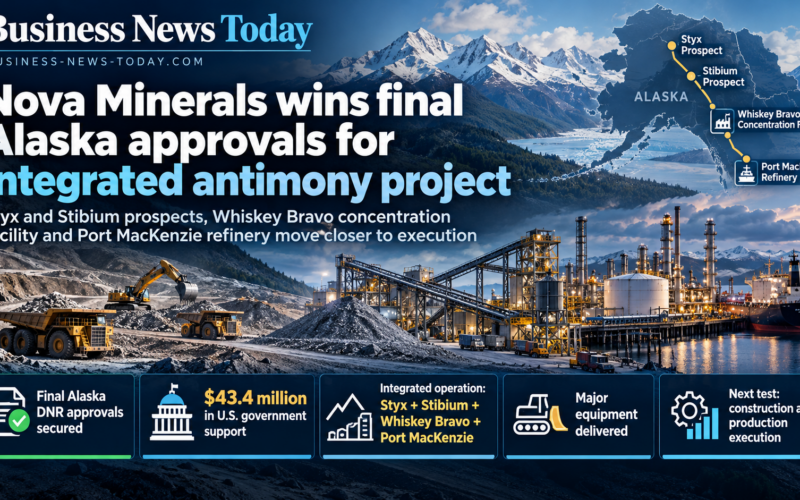
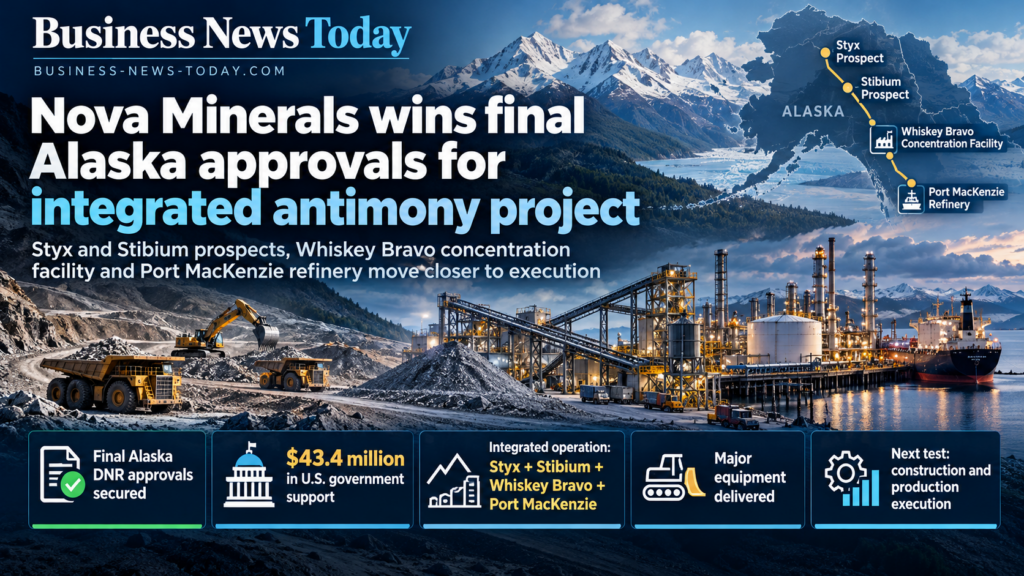
Nova Minerals Corp (NYSE American: NVA; ASX: NVA), the Alaska-focused gold and critical minerals developer, has received final approvals from the Alaska Department of Natural Resources for its antimony project’s Plan of Operations and Reclamation Plan. The October 27, 2026 decision completes the company’s disclosed permitting process for an integrated development covering stibnite mining at the Styx and Stibium prospects, concentration at Whiskey Bravo and downstream processing at Port MacKenzie. Nova Minerals says the project is supported by an existing $43.4 million award from the U.S. Department of War, with critical equipment already delivered and metallurgical engineering completed. The approvals remove a significant regulatory obstacle, although first antimony production in 2027 remains a development target rather than an achieved commercial milestone.
The company says it obtained the remaining permits approximately three months after submission. The approvals authorise construction and operating activities over an initial three-year term, providing the framework for advancing the different stages of the project. This is more comprehensive than approval for a single processing site because it addresses mining and the movement of material through the company’s proposed supply chain.
Chief Executive Officer Christopher Gerteisen has identified the decision as a transition from planning towards execution. Nova Minerals intends to establish domestic production of military-grade antimony trisulfide and standard Grade II antimony metal. Its process design targets antimony metal purity above 99.65%, although product specification and commercial-scale consistency remain to be demonstrated in operating conditions.
The project is strategically relevant because the United States has sought to strengthen domestic supplies of minerals used in defence equipment, energy storage and advanced industrial applications. Government funding provides support for developing local capabilities, but it does not remove the technical and construction risks associated with bringing a new processing operation into production.
What exactly has been approved across Nova Minerals’ Styx, Stibium and Port MacKenzie operations?
The final permits encompass three linked operating stages intended to convert antimony-bearing material into refined products. The first involves mining stibnite at the Styx and Stibium prospects within Nova Minerals’ Estelle Gold and Critical Minerals Project. Stibnite is an antimony-bearing mineral that can provide feedstock for downstream processing.
The second stage involves ore sorting and concentration at the Whiskey Bravo site. Material from the mining areas would undergo processing to produce a suitable intermediate product for transfer to the refinery. Concentration is important because the grade, mineral composition and recovery characteristics of the feedstock influence subsequent processing efficiency.
The third stage involves refining at Port MacKenzie, Alaska. The planned facility is designed to produce products suitable for specified industrial and defence uses. Locating a processing operation at an established port area could provide logistics advantages, although transportation costs, road access and operating arrangements must still be managed.
The integrated design addresses a significant challenge in critical minerals development. Establishing a domestic mine does not automatically provide domestic refined products if the extracted material must be transported overseas for processing. Nova Minerals is attempting to develop successive stages within Alaska so that the proposed supply chain extends beyond extraction.
The approvals cover the company’s disclosed initial project scope, but should not be interpreted as permission for every conceivable future expansion. Changes in mining activity, processing capacity or site conditions may require additional assessment or amended approvals. The initial three-year term also establishes a regulatory timeframe that must be managed alongside the construction schedule.
The company has not published a verified commercial production rate for each approved operating stage in the October announcement. Therefore, permission to proceed with construction does not by itself establish future annual antimony output or revenue.
How does the $43.4 million U.S. government award affect Nova Minerals’ funding and project economics?
Nova Minerals says its Phase 1 development is fully funded through the previously announced $43.4 million Department of War award. That support is intended to advance domestic antimony production capacity, particularly material meeting military-related requirements. The commitment distinguishes the project from developments dependent exclusively on speculative future equity financing.
The funding provides a basis for planning the initial operation, but it is important to distinguish an award from unrestricted cash already available for any purpose. Government-supported projects generally operate under specified work requirements, expenditure conditions and reporting arrangements. The October announcement does not provide a detailed schedule of funds disbursed or remaining reimbursable costs.
The project also benefits from Nova Minerals’ decision to acquire equipment from a recently decommissioned North American industrial facility. Reusing existing processing equipment may reduce manufacturing lead times and costs compared with purchasing every component as a newly manufactured system. The company has described that decision as an important element of its accelerated development schedule.
In October, Nova Minerals confirmed that the final major equipment shipments had reached Port MacKenzie. Earlier deliveries included more than 40 containers, followed by additional truckloads of processing equipment. Together, the shipments represent a significant procurement milestone.
However, delivery of machinery is not equivalent to installation or commissioning. Equipment must be assembled, connected to utilities, integrated into the process design and tested under operating conditions. Additional expenditure may arise through site preparation, construction services, operating staff and commissioning work.
The company has also accumulated more than 100 tonnes of antimony-bearing material through bulk sampling activities, according to its annual disclosure. This material may support initial processing work, but a sample stockpile is not the same as an established commercial feedstock supply. Sustained output requires reliable mining activity and an appropriate material balance across the complete operation.
For investors, government support lowers some financing uncertainty while leaving construction and performance risk intact. The next financial evidence should show whether the approved budget remains sufficient and whether additional working capital or expansion funding is required beyond the initial supported phase.
Why is the Port MacKenzie refinery central to the U.S. domestic antimony supply-chain strategy?
Antimony is used in various industrial and defence applications, including specialty materials and certain components of ammunition and energetic systems. The market includes both metallic antimony and processed compounds, with suitability determined by chemical characteristics and required specifications. A reliable domestic supply chain must provide the relevant product quality, not simply access to mineral-bearing ground.
Nova Minerals intends to produce military-grade antimony trisulfide alongside standard Grade II antimony metal. These outputs serve different applications and require appropriate processing and quality controls. The company has completed metallurgical test work supporting its proposed process flowsheet, but consistent production at the required specifications remains a commissioning objective.
Port MacKenzie provides the proposed site for downstream processing, separating the mining location from the final refining operation. This arrangement can potentially support a modular industrial facility and provide scope for future changes in processing capacity. It also introduces transport requirements between the upstream concentration facility and the refinery.
The strategic argument rests on domestic control of several successive stages. A U.S.-based mine producing material ultimately processed overseas would provide a different level of supply-chain independence from a mine, concentrator and refinery operating within one country. The company’s project is intended to address that gap.
Government participation indicates public-sector interest in developing local critical minerals capacity. However, a government award is not necessarily a guaranteed long-term purchase contract for every tonne of refined output. The October announcement does not disclose firm commercial offtake volumes or a complete schedule of product deliveries.
Once production begins, customers will need evidence of reliable quality, consistent output and delivery performance. Qualification processes can be important for defence applications, especially where material characteristics affect safety or product performance. The company must therefore move beyond pilot processing and establish confidence in the final product.
The project’s potential strategic contribution is meaningful, but it will depend on actual production and commercial acceptance rather than the number of permits or the stated purity target alone.
Can Nova Minerals meet its 2027 production target now that the permitting process has been completed?
The final approvals remove one of the principal outstanding prerequisites identified by Nova Minerals in its October 8 project update. At that time, the company said the final major equipment had arrived and construction of the processing facility would begin following receipt of the remaining permits. The latest decision allows management to advance that sequence.
Early earthworks had already been underway at Port MacKenzie before the final announcement. The company expects construction and related site work to continue as seasonal conditions permit. Alaska’s climate creates practical challenges for transport, civil engineering and outdoor installation, making project scheduling important.
The next steps include completing site preparation, installing processing equipment, connecting utilities, confirming material handling arrangements and undertaking mechanical and metallurgical commissioning. Each activity must progress sufficiently for the facility to produce an acceptable product. Delays in one stage could affect the schedule for the remainder of the project.
The company has not disclosed a firm first shipment date or the period required to move from initial production into steady-state operations. A production target covering the 2027 calendar year should therefore be understood as a range of potential commissioning outcomes rather than a guaranteed start at the beginning of the year.
Mining development also remains important. The facility requires antimony-bearing material with sufficiently consistent characteristics to support the intended processing route. The Styx and Stibium prospects have been the focus of exploration and development work, but continuing geological evaluation and operating preparation will influence feedstock planning.
Initial production may establish technical feasibility without immediately delivering the volumes or margins associated with a larger commercial operation. A pilot-scale facility can be valuable for validating recovery, product quality and logistics, while still requiring subsequent investment for a broader supply chain.
The most credible evidence of progress will be reported construction completion, operating test results and confirmation of finished antimony meeting required specifications. Those milestones would move the investment case beyond permitting into operational validation.
How does the antimony project relate to Nova Minerals’ larger Estelle gold and critical minerals business?
Nova Minerals’ broader asset base includes the Estelle Gold and Critical Minerals Project in Alaska’s Tintina Gold Belt. The project contains two defined multi-million-ounce gold resources and more than 20 prospects along a mineralised trend of approximately 35 kilometres. Gold exploration and antimony development therefore form related but distinct parts of the company’s strategy.
The antimony initiative provides a potential route to earlier production of a critical mineral while the wider gold asset continues advancing through exploration and development. These activities may share infrastructure, local knowledge and logistical capabilities, but their financial and technical requirements are not identical.
Nova Minerals completed a corporate redomiciliation from Australia to the United States in June 2026. The transaction established Nova Minerals Corp as the ultimate parent while retaining its Australian-listed structure. This corporate change aligns the business more closely with its principal Alaska operations, although it does not independently change the economic quality of its mineral assets.
The company completed its 2026 field season with drilling and sampling at Estelle. Results from the work may inform future resource development, including antimony prospects relevant to the integrated project. Exploration results will remain subject to the normal uncertainties of geological interpretation and resource estimation.
For shareholders, the combination of gold and antimony provides several potential value drivers, but it also increases the number of activities requiring management attention and capital. Government-supported antimony development may provide a defined near-term programme, while gold project advancement involves a longer investment horizon.
The operating milestones of the antimony facility should therefore be assessed separately from exploration progress at the larger Estelle project. A successful processing demonstration would not automatically establish commercial economics for the undeveloped gold deposits, just as gold resource estimates do not guarantee antimony production.
What should NVA investors monitor after the final Alaska permit approval?
The final permitting announcement provides a clearer route towards construction and confirms that the initial development programme has passed an important regulatory stage. Investors can now focus on whether equipment installation, commissioning and feedstock availability progress according to management’s expectations.
A constructive interpretation would emphasise the $43.4 million public-sector award, the completed equipment deliveries and the potential value of establishing a domestic antimony supply chain. These factors reduce some uncertainty surrounding project preparedness.
A more cautious assessment would recognise that an approved development is not the same as an operating business. Mining, concentration and refining must each function reliably, and the company must demonstrate that products meet customer specifications at an acceptable cost.
The announcement does not provide a completed feasibility-based forecast of annual revenue, operating cash flow or project-level returns for Phase 1. It would therefore be premature to calculate a price-to-earnings valuation for the new facility or assume that government funding translates into operating profitability.
The most useful forthcoming data will cover construction progress, processing recoveries, production quality, operating expenditure and any commercial delivery arrangements. Evidence of repeatable output would provide a stronger basis for estimating future economics.
Nova Minerals has removed a material permitting obstacle. The investment question now moves from whether the company is allowed to proceed to whether it can build and operate the integrated system on time and within its financing arrangements.
What are the key takeaways from Nova Minerals’ final Alaska antimony approvals?
- Nova Minerals received final Alaska Department of Natural Resources approvals on October 27, 2026.
- The approvals cover the Plan of Operations and Reclamation Plan over an initial three-year term.
- The development includes mining at Styx and Stibium, concentration at Whiskey Bravo and refining at Port MacKenzie.
- Phase 1 is supported by a $43.4 million U.S. Department of War award.
- Nova Minerals says the project’s major long-lead mining and processing equipment has been delivered.
- The process is designed to produce military-grade antimony trisulfide and Grade II antimony metal above 99.65% purity.
- The company targets initial antimony production during 2027, but construction and commissioning remain incomplete.
- The project has a wider strategic objective of building an integrated domestic antimony supply chain.
- The company also retains significant gold exploration exposure through the Estelle project.
- The next valuation milestones will be successful commissioning, product qualification and evidence of commercially sustainable production.
Discover more from Business-News-Today.com
Subscribe to get the latest posts sent to your email.