

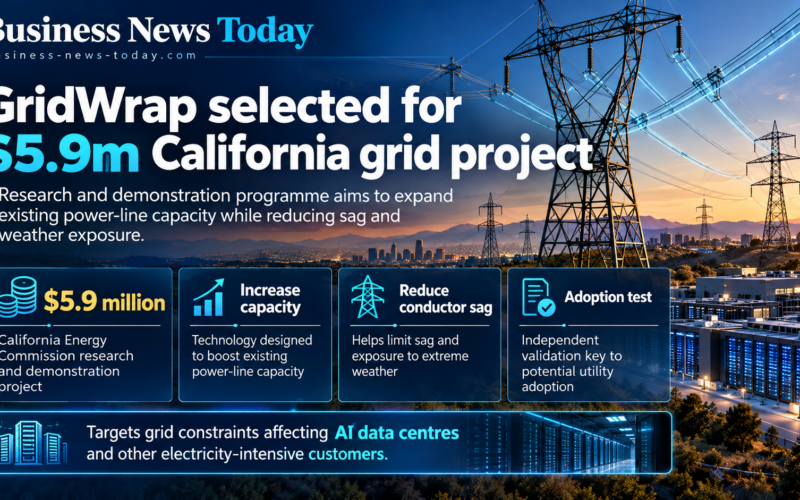
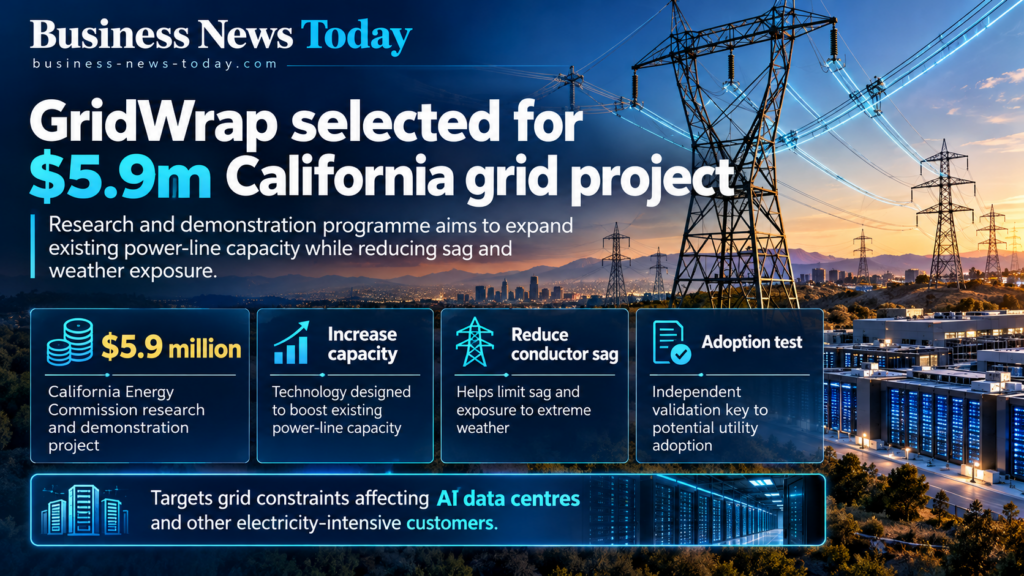
GridWrap, Inc., the San Diego-based power infrastructure technology developer, has been selected by the California Energy Commission for a $5.9 million project to validate its patented Composite WiRe Wrap system under real-world grid operating conditions. Announced on October 21, 2026, the initiative will involve San Diego State University’s Brawley Campus, Idaho National Laboratory and the Electric Power Research Institute in testing technology designed to increase the capacity of existing overhead power conductors without completely replacing them. GridWrap claims the system could double applicable line capacity, reduce thermal sag by up to 75% and significantly lower the cost of certain grid upgrades. The public funding selection creates an opportunity to test those claims independently, although the announcement does not establish that the technology has already achieved commercial-scale performance or secured widespread utility adoption.
The demonstration will focus on Composite WiRe Wrap, a reinforcement technology intended to be installed directly onto existing overhead electricity conductors. Rather than removing a power line and replacing it with a new conductor, GridWrap proposes wrapping the existing conductor with a composite material engineered to improve its mechanical and thermal operating characteristics. The company also intends to use autonomous robotic equipment during installation.
The research program is supported through the California Energy Commission’s Electric Program Investment Charge, known as EPIC. This initiative funds research, development and demonstration activities intended to improve electricity reliability, affordability and environmental performance. Its financing ultimately comes from customers of participating California investor-owned utilities under the oversight of the California Public Utilities Commission.
GridWrap Chief Executive Officer Davoud Zamani has identified the need for independently verified utility performance as a primary objective of the award. Management is seeking to demonstrate that conductor reinforcement can offer a commercially practical alternative for selected grid upgrades. The $5.9 million figure represents the announced project award or selection, not evidence that the entire amount has already been received as cash or recognized as GridWrap revenue.
How does GridWrap’s Composite WiRe Wrap technology increase power-line capacity without replacing conductors?
Overhead electricity conductors are subject to both electrical and mechanical operating limits. As current increases, resistance causes heating, which can lead to conductor expansion and greater sag between support structures. Utilities must maintain appropriate clearances from vegetation, buildings and the ground while keeping conductor temperatures within acceptable operating limits.
GridWrap’s Composite WiRe Wrap is designed to reinforce existing conductors so they can carry greater loads while limiting temperature-related sag. The company claims the system can increase line capacity by as much as two times and reduce thermal sag by up to 75% under applicable conditions. These are stated engineering performance targets rather than independently confirmed results for every type of power line.
The ability to retain an existing conductor distinguishes the approach from conventional reconductoring, in which an operator removes and replaces the conductor. Reconductoring may require significant construction resources, electrical outages, equipment and engineering work, depending on the line and location. A suitable reinforcement process could reduce some of those requirements.
The proposed installation method uses an autonomous robotic system that applies the composite reinforcement to existing overhead lines. Automation may reduce some manual installation requirements and improve consistency across longer sections of conductor. However, the announcement does not establish the time required per kilometre, the number of crews needed or the specific operating conditions under which installation can proceed.
The technology’s actual effectiveness will depend on the characteristics of the original conductor, the supporting structures and the wider electrical network. Improving the thermal or mechanical capacity of one conductor does not necessarily increase the amount of power that the complete grid corridor can safely transfer. Transformers, substations, protection systems and adjacent circuits may impose separate limits.
The International Energy Agency has highlighted that increasing a line’s capacity can simply move an electrical bottleneck elsewhere if connected equipment is not capable of handling the additional load. Utilities must therefore assess grid-enhancing technologies within the complete network rather than treating a conductor’s individual rating as the sole determinant of usable capacity.
GridWrap’s demonstration will need to show how the system performs under actual operating conditions and how any improvement translates into a rating that utilities can use in planning and system operations.
Why is the claimed 75% reduction in thermal sag relevant to California wildfire prevention?
Conductor sag is a safety and reliability consideration because overhead power lines must maintain sufficient clearance from the ground, vegetation and other objects. As temperatures rise or electrical loading increases, certain conductors can expand and hang lower between support structures. Appropriate clearance is particularly important in areas with vegetation exposure or challenging terrain.
GridWrap claims Composite WiRe Wrap can reduce thermal sag by up to 75%, potentially providing greater clearance under qualifying operating conditions. A stronger conductor structure may also help maintain mechanical performance during wind, ice, snow and other weather events. These potential advantages are part of the rationale for testing the technology in California.
Wildfire exposure makes the clearance issue commercially significant for electricity utilities. Contact between energized equipment and vegetation, conductor failures and other electrical incidents can contribute to ignition risks under certain conditions. Reducing one potential failure mechanism may support mitigation, but no single conductor technology can eliminate the wider risk of utility-related wildfires.
GridWrap’s announcement identifies wildfire resilience as a proposed benefit, not as a demonstrated reduction in ignition incidents. No field data have been disclosed showing that installation of Composite WiRe Wrap reduced wildfire frequency or severity on a particular utility network. The distinction is important because mechanical improvements and real-world fire outcomes are different measures.
The project’s validation work should therefore evaluate physical performance, clearance requirements and reliability in addition to broader safety implications. Utilities may also need to consider how reinforced conductors behave during faults, equipment failures or extreme environmental conditions. A material that performs well under normal loading must still meet the relevant requirements for abnormal events.
The potential benefit also depends on existing infrastructure conditions. Lines with substantial clearance and adequate mechanical strength may gain relatively little from sag reduction, while circuits constrained by temperature-related clearance limits could see greater value. The appropriate installation decision will depend on asset-level engineering analysis.
For California regulators and utilities, a technology that can improve capacity and reliability without major reconstruction could be attractive. However, its safety value must be established through test results and utility-specific assessments rather than inferred directly from the manufacturer’s headline percentage claims.
Can GridWrap’s proposed one-tenth installation cost make conventional reconductoring less attractive?
GridWrap has stated that Composite WiRe Wrap targets an installed cost of approximately one-tenth the cost of conventional reconductoring. If achieved for suitable applications, this would represent an approximately 90% reduction in installation expenditure compared with the reference approach. However, the company has not published a complete cost model showing the circumstances in which the comparison applies.
The financial implications could be substantial because transmission and distribution upgrades can involve materials, specialist crews, access arrangements and system outages. Projects requiring new support structures or changes to rights of way may involve additional expenditure and lengthy approval processes. A technology installed on existing conductors could potentially avoid some of these costs.
Nevertheless, a valid comparison requires both alternatives to deliver equivalent required performance. A reinforced existing line and a completely replaced line may differ in expected service life, maintenance requirements, operating losses and future expansion capability. Lower initial installation cost does not automatically mean lower lifetime cost.
GridWrap also estimates that widespread use of the technology could save California utilities and ratepayers up to $12 billion. This is a company projection rather than a verified saving or an amount allocated through the public award. The announcement does not disclose the number of potential deployment miles or the detailed assumptions used to calculate the statewide figure.
The $5.9 million project can help establish more reliable inputs for future economic evaluations. Installation time, labor requirements, equipment costs, maintenance expectations and actual conductor performance are all relevant. Data collected under field conditions would allow utilities to compare the technology more accurately with established upgrading methods.
Utilities may also evaluate the system against other approaches, including advanced conductor replacement, dynamic line rating and grid power-flow optimization. Each solution addresses different network constraints and carries its own implementation costs. Composite WiRe Wrap will need to demonstrate advantages in the specific applications for which it is intended.
A commercially compelling outcome would involve repeatable performance and attractive lifecycle economics, supported by third-party testing. Without those results, the one-tenth cost target remains a proposed advantage rather than a confirmed basis for utility investment decisions.
Why is rising AI data-centre electricity demand creating an opportunity for GridWrap?
Artificial intelligence infrastructure and hyperscale computing facilities require significant electricity supply, often concentrated at individual locations. New data-centre developments may need substantial grid connections, while existing facilities can require additional capacity as equipment density increases. Electricity infrastructure that was originally designed for lower or more dispersed demand may need reinforcement.
The challenge is not limited to generating sufficient electricity. Power must also be transferred through transmission and distribution infrastructure to the locations where customers need it. A grid can have access to available generation while still facing delays in connecting new loads because of local network constraints.
Lawrence Berkeley National Laboratory identified accelerating large-load connections as a major planning challenge in a June 2026 report. The research examined solutions involving forecasting, interconnection processes, resource planning, markets and cost allocation. Its findings indicate that conductor upgrades represent one part of a wider response rather than a complete solution to data-centre connection delays.
GridWrap is targeting the physical infrastructure component of that challenge. If the technology increases usable capacity on constrained lines, utilities might be able to serve additional demand without immediately undertaking a complete line replacement. This could be particularly relevant where rights-of-way are already established and supporting equipment can accommodate the change.
However, the commercial benefit depends on the location of the constraint. If a proposed data centre requires additional transformer capacity, new generation or major substation investment, reinforcing a nearby overhead conductor may provide only a limited improvement. Utilities must identify the actual binding constraint before determining whether Composite WiRe Wrap is suitable.
The International Energy Agency has identified grid-enhancing technologies as one mechanism for unlocking capacity from existing infrastructure while longer-term investment proceeds. Such technologies can complement conventional expansion, potentially improving asset utilization and reducing delays. The agency has also emphasized the importance of verifying operational limits across entire electricity systems.
For GridWrap, this creates a potential market extending beyond wildfire-prone regions. Areas experiencing rapid computing, manufacturing or electrification demand may need capacity increases on existing lines. The ability to demonstrate reliable performance in California could support interest from utilities elsewhere, although no additional contracts have been announced as a direct result of the EPIC project.
What roles will Idaho National Laboratory, EPRI and San Diego State University play in the demonstration?
The announced project will involve San Diego State University’s Brawley Campus, Idaho National Laboratory and the Electric Power Research Institute. Their participation gives the demonstration access to academic and technical expertise beyond GridWrap’s own engineering team. The collaboration is intended to establish performance benchmarks and evaluate the technology under realistic operating conditions.
Idaho National Laboratory conducts research involving energy infrastructure, grid reliability and advanced technologies. Its involvement may support evaluation of engineering performance and system-level requirements. The announcement does not specify the exact laboratory tests or deliverables assigned to the institution.
The Electric Power Research Institute works with electricity utilities and other energy-sector participants on research involving power systems and infrastructure. Its expertise may help connect test results with the practical requirements utilities apply when selecting and operating equipment. However, participation in a demonstration should not be interpreted as an endorsement of the technology before the evaluation is completed.
San Diego State University’s Brawley Campus provides a California-based institutional partner for the program. The project announcement identifies the campus as part of the planned demonstration, but it does not establish a final installation length, construction schedule or completed operational test. Those details will be important when evaluating the scope of the field work.
GridWrap also intends to engage California’s investor-owned utilities during the project. Their participation in defining operating requirements and monitoring priorities could help ensure that the test addresses questions relevant to eventual adoption. The announcement does not identify a completed purchase order or utility-wide rollout agreement involving Composite WiRe Wrap.
Independent evaluation is valuable because equipment intended for utility networks must operate reliably over long periods. A technology may perform well in a controlled laboratory while experiencing different stresses under continuous field use. Mechanical fatigue, thermal cycling, environmental exposure and installation variability can affect long-term performance.
The demonstration should therefore generate data relevant to both initial functionality and operational durability. Utility procurement decisions may depend on whether those results can be translated into standards, maintenance practices and approved operating ratings. The project’s commercial value will extend beyond a successful test if it helps establish a repeatable process for qualification and deployment.
How does GridWrap’s existing DEMIRWRAP business differ from its new conductor reinforcement technology?
GridWrap already markets a separate pole-hardening technology called DEMIRWRAP. The company states that this product has been deployed with more than 95 utilities across the United States, Canada, Brazil and Europe. That installed base provides experience in utility infrastructure products and relationships with power companies.
DEMIRWRAP and Composite WiRe Wrap address different physical components of electricity networks. Pole hardening focuses on reinforcing utility support structures, while the new conductor technology is intended to improve the capacity and mechanical characteristics of existing overhead wires. Experience with one product does not demonstrate that the other has achieved equivalent commercial maturity.
The distinction affects assessments of company progress. GridWrap has an established history of supplying utility reinforcement products, but Composite WiRe Wrap is entering a specific publicly supported validation phase. The number of utilities that have used DEMIRWRAP should not be presented as the number that have adopted the new conductor system.
There may be opportunities to use the company’s existing utility relationships when introducing additional products. Customers familiar with GridWrap’s installation approach and support services may be more willing to evaluate another offering. However, conductor reinforcement is subject to different engineering and operational requirements from pole reinforcement.
Commercialization will therefore depend on independent technical evidence and customer-specific qualification. The existing utility base may facilitate discussions, but it does not replace the need for product testing. GridWrap has not disclosed firm sales orders or commercial revenue from Composite WiRe Wrap in the October announcement.
What are the next milestones for GridWrap’s California project and wider commercialization strategy?
The immediate objective is to complete the project planning needed for testing the technology under real-world operating conditions. GridWrap and its technical partners must establish installation arrangements, performance benchmarks and monitoring requirements. These measures will determine whether the demonstration produces evidence relevant to wider utility adoption.
The project will then need to assess the claimed capacity increase, thermal sag reduction and mechanical strengthening under the selected test conditions. Installation time and operational disruption should also be measured because they directly influence the proposed cost advantage. The company has not published a confirmed completion date for the demonstration.
Subsequent commercialization may depend on how utilities evaluate the results. A successful demonstration could support additional pilots or procurement discussions, while performance below the advertised targets could require design changes or limit suitable applications. The absence of a disclosed commercial rollout schedule means that future revenue cannot be estimated reliably.
GridWrap is privately held and has not published detailed financial statements associated with the project. The announcement does not specify total project cost beyond the reported $5.9 million selection, any required matching expenditure or the final schedule of public funding payments. It should therefore not be treated as evidence of an immediate increase in profit or available cash.
The strategic opportunity is substantial if the technology can improve line capacity and resilience at a materially lower cost than replacing conductors. However, the strongest proof will come from independently documented performance and lifecycle economics rather than engineering projections. A successful California deployment followed by repeat utility orders would provide a clearer indication that Composite WiRe Wrap can become a commercially established grid modernization product.
What are the key takeaways from GridWrap’s $5.9 million California Energy Commission project?
GridWrap announced its selection for a $5.9 million Electric Program Investment Charge project on October 21, 2026. The initiative will test Composite WiRe Wrap technology with participation from San Diego State University’s Brawley Campus, Idaho National Laboratory and the Electric Power Research Institute. The system is designed to reinforce existing conductors using robotic installation, potentially increasing line capacity and reducing thermal sag without complete replacement.
GridWrap claims the technology could double conductor capacity, reduce thermal sag by up to 75% and achieve installed costs around one-tenth of conventional reconductoring. It also estimates potential California savings of up to $12 billion, although these figures remain company projections requiring real-world validation. The demonstration’s decisive outcomes will be independently verified electrical performance, mechanical reliability, installation economics and evidence of subsequent utility adoption.
Discover more from Business-News-Today.com
Subscribe to get the latest posts sent to your email.