


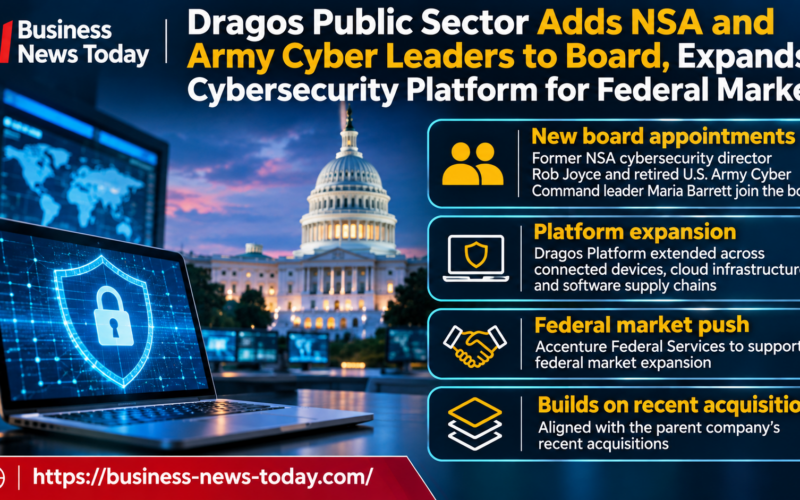
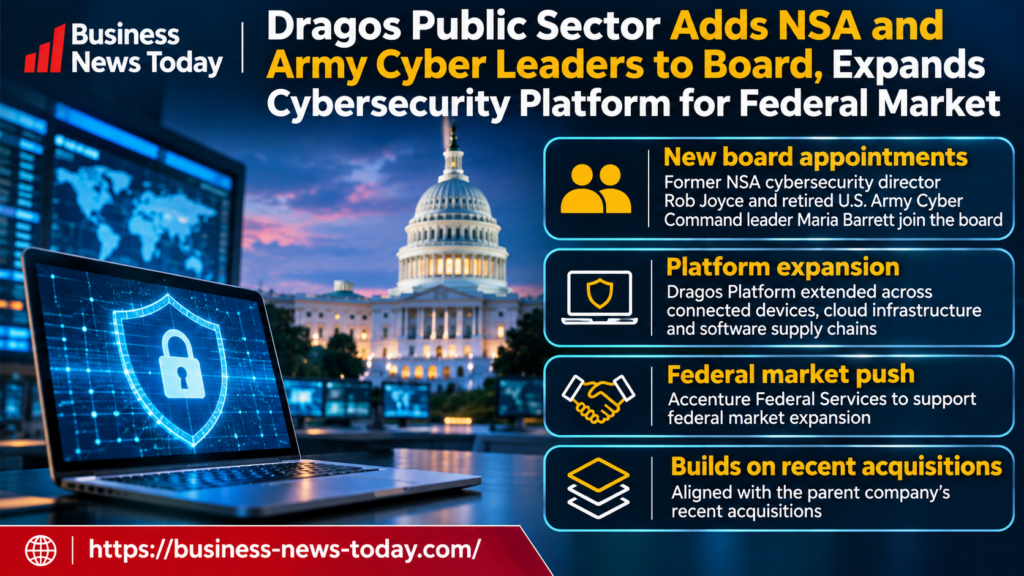
Dragos Public Sector LLC, the federal government-focused subsidiary of operational technology cybersecurity specialist Dragos, Inc., has appointed a new board of directors including former National Security Agency cybersecurity director Rob Joyce and retired Lieutenant General Maria Barrett, previously commanding general of U.S. Army Cyber Command. Announced on October 27, 2026, the governance changes accompany the expansion of the Dragos Platform through capabilities acquired from Phosphorus, NetRise and runZero, extending protection beyond conventional industrial networks into connected devices, software supply chains and other systems supporting physical operations. The company has also designated Accenture Federal Services as a strategic go-to-market partner to broaden access to federal civilian, defense and intelligence customers. The combination creates a more comprehensive public-sector cybersecurity offering, although its commercial impact will depend on product integration, federal procurement decisions and the ability to improve security without disrupting critical operations.
Dragos Public Sector confirmed Daniel Dorchinsky as general manager, formalizing his leadership role after more than three years overseeing growth at the subsidiary. The organization operates as a distinct federal-focused business within the wider Dragos group. Its new board is intended to provide governance suited to government customers with demanding security, procurement and operational requirements.
The company is responding to a cybersecurity environment in which industrial control systems increasingly depend on equipment and software extending beyond traditional operational technology boundaries. Military bases, federal facilities and infrastructure operators rely on a combination of industrial controllers, connected devices, enterprise networks and software components. An attacker exploiting one of these elements may create consequences extending into physical operations.
Dragos Chief Executive Officer Robert M. Lee has positioned the subsidiary’s new structure as a means of combining specialist federal oversight with broader platform capabilities. Management argues that protecting modern operational environments requires visibility across the systems capable of influencing physical processes, not only the equipment traditionally classified as industrial control technology.
Why are Rob Joyce and Maria Barrett joining the Dragos Public Sector board?
The appointment of Rob Joyce and Maria Barrett brings two senior former U.S. cybersecurity and defense officials into the governance of Dragos Public Sector. Joyce previously served as director of cybersecurity at the National Security Agency, while Barrett commanded U.S. Army Cyber Command. Their experience involves organizations responsible for protecting sensitive systems and responding to sophisticated cyber threats.
The board appointments may help the company evaluate its products and operating practices against the requirements of federal customers. Public-sector cybersecurity suppliers must often address security assessments, procurement rules, information handling and operational mission requirements that differ from those of conventional commercial customers. Directors familiar with these environments can provide relevant oversight.
The announced board also includes Tim Conway, a SANS Institute fellow and technical director associated with industrial control systems and supervisory control and data acquisition programs. Conway contributes specialist knowledge of the industrial cybersecurity field, complementing the national security experience represented by Joyce and Barrett.
The remaining directors are Robert M. Lee, Dragos’s chairman and chief executive officer; Daniel Dorchinsky, the subsidiary’s general manager; and David Fitch, Accenture’s Americas cybersecurity lead. The structure combines external directors with executives connected to the subsidiary, its parent and a major strategic partner. The company has not disclosed separate compensation arrangements or a detailed committee structure for the new board.
The appointments should be distinguished from changes to the board of Dragos, Inc. itself. The October announcement concerns the federal subsidiary’s governance, while the parent has its own board and ownership arrangements following Accenture’s recent investment. The two structures serve different corporate purposes.
Senior public-sector experience can support understanding of customer requirements, but it does not confer government approval or guarantee contract awards. Federal agencies will continue to assess products through applicable procurement and security processes. Dragos Public Sector’s commercial position will depend on meeting those requirements through technology and service delivery.
The involvement of former senior officials also creates an expectation of strong governance discipline. Effective oversight will require attention to potential conflicts, contractual responsibilities and appropriate boundaries between private-sector activity and government relationships. The company has not announced any preferential procurement arrangement resulting from the appointments.
What is extended operational technology, and why is Dragos expanding protection beyond conventional industrial networks?
Operational technology traditionally refers to hardware and software used to monitor or control physical processes. Examples include industrial controllers, monitoring systems and equipment involved in power generation, manufacturing, water treatment and other infrastructure operations. Protecting these systems requires consideration of safety and operational continuity alongside conventional information security.
Dragos uses the term extended operational technology, or xOT, to describe the wider collection of digital systems that can influence physical processes. Its definition includes connected devices, supporting networks, cloud-connected applications, software components and the traditional operational core. The concept reflects changes in how industrial and infrastructure systems exchange information.
A modern electricity facility may depend on industrial controllers, maintenance systems, network equipment and remote services. A manufacturing site may similarly connect production machinery with enterprise applications, monitoring devices and external service providers. Vulnerabilities in supporting systems can create pathways affecting operations even when the original industrial controller has not been directly compromised.
Conventional cybersecurity programs often separate information technology and operational technology responsibilities. Those distinctions can create gaps when devices or applications cross organizational boundaries. An xOT approach seeks to provide a more complete inventory of systems relevant to physical operations and the relationships among them.
However, a broader definition of the protected environment does not automatically mean that every connected device presents the same risk. A vulnerability affecting an office printer may have different consequences from one affecting an industrial controller. Risk assessment must consider connectivity, exploitability, available safeguards and the potential operational impact.
Dragos’s platform strategy therefore emphasizes asset discovery, vulnerability prioritization and coordinated remediation. The objective is to help defenders identify relevant systems and understand which problems require urgent attention. Achieving that objective will depend on the accuracy and completeness of the underlying asset information.
The company’s description of its platform as an industry-first end-to-end xOT offering is a vendor claim rather than an independently established ranking against every competing product. Federal buyers will need to evaluate whether the integrated capabilities address their particular networks and security requirements more effectively than existing tools.
How do the Phosphorus, NetRise and runZero acquisitions change the Dragos cybersecurity platform?
Dragos’s expanded capabilities follow three completed acquisitions during 2026. The company acquired Phosphorus in June to extend protection across connected devices embedded in critical infrastructure and operational networks. NetRise and runZero joined the group in September after Accenture completed its majority investment in Dragos.
Each acquisition addresses a different part of the cybersecurity problem. Phosphorus brings device discovery and remediation functions for connected equipment. Its technology can support activities such as credential rotation, firmware updates and configuration changes where those actions are suitable for the target devices and operating environment.
runZero contributes asset intelligence and exposure assessment capabilities across information technology, operational technology and cloud-connected environments. The platform can combine information from existing sources, helping organizations establish an inventory without necessarily deploying a new sensor across every network segment. This could be useful for government agencies operating complex systems distributed across multiple facilities.
NetRise adds analysis of firmware and software components, enabling customers to examine software incorporated into connected devices. Such analysis can identify vulnerable libraries, outdated components and other weaknesses that may not be visible through conventional network discovery. Understanding these dependencies is relevant when manufacturers supply equipment containing third-party software.
The October announcement extends these acquired capabilities into the federal business offering. Dragos Public Sector says customers can use the combined platform to identify assets, assess vulnerabilities and undertake selected remediation activities. The result is intended to link asset visibility with actions rather than leaving security teams to manage disconnected findings.
Nevertheless, integrating acquired products into one practical workflow can be difficult. Different systems may use distinct asset identifiers, data formats, access controls and deployment models. Federal customers will need to determine whether the combined offering provides consistent information and suitable operational controls across their environments.
Dragos has not disclosed the federal subsidiary’s current recurring revenue, contract backlog or the percentage of its customers already using the newly integrated capabilities. The announcement demonstrates expanded product availability but does not quantify commercial adoption. Future contract awards and customer deployments will provide more direct evidence of the strategy’s financial impact.
Why do firmware visibility and software supply-chain security matter for U.S. government infrastructure?
Industrial devices and connected equipment often contain embedded software that receives less direct attention than conventional enterprise applications. Firmware can include operating components, third-party libraries and management functions that influence how a device behaves. Vulnerabilities within those components may remain difficult to identify without specialized analysis.
Software supply-chain security focuses on understanding the components and dependencies incorporated into products. For federal agencies operating equipment from multiple suppliers, the ability to identify vulnerable components can improve assessments of exposure. However, discovery alone does not determine whether a particular vulnerability is exploitable in the deployed configuration.
NetRise’s capabilities are intended to provide visibility into compiled firmware and software binaries. This may allow agencies to identify components even when complete source code or detailed manufacturer documentation is unavailable. The technology could support vulnerability management, procurement assessments and incident response.
The challenge is particularly relevant to equipment that remains in service for long periods. Industrial controllers and specialized devices may operate beyond the standard support life of conventional information technology products. Patching can require vendor assistance, maintenance windows or equipment replacement, particularly where changes might interrupt essential services.
Dragos has described a vulnerability management model called Now, Next, Never, which prioritizes actions according to operational risk and practical remediation requirements. The approach is intended to distinguish problems requiring immediate attention from those better addressed through planned maintenance or other risk controls. Its effectiveness depends on the quality of asset context and threat intelligence used to support decisions.
For agencies, the practical objective is to reduce risk without causing the type of disruption that cybersecurity tools are intended to prevent. Automated changes to operational devices must be applied cautiously and supported by appropriate authorization and testing. A firmware update that is safe for ordinary enterprise equipment may require a different process when applied to infrastructure supporting a physical mission.
The company’s expanded offering therefore needs to demonstrate both technical visibility and operational suitability. Buyers will evaluate whether the tools can identify meaningful exposures while providing clear procedures for handling systems that cannot be patched immediately.
How do the 2026 OMB logging memorandum and CISA vulnerability directive create demand for asset visibility?
Federal cybersecurity requirements are changing as agencies seek more effective ways to identify and prioritize security risks. On May 22, 2026, the Office of Management and Budget issued Memorandum M-26-14, addressing agency logging and network visibility. The memorandum promotes a more risk-based approach to collecting useful security information rather than retaining large volumes of logs without clear operational value.
The memorandum builds on earlier federal logging requirements while emphasizing the need to detect suspicious activity and support incident investigation. Agencies must understand which systems and events are important to their security posture. Asset visibility can help direct logging resources toward systems that present meaningful operational or information-security risks.
The Cybersecurity and Infrastructure Security Agency has also issued Binding Operational Directive 26-04, which establishes risk-based vulnerability management requirements for federal civilian executive branch agencies. The directive emphasizes prioritizing high-risk vulnerabilities, including those known to be exploited by attackers. Agencies must begin operating under specified updated vulnerability evaluation and remediation processes by December 7, 2026.
The requirements create a commercial opportunity for suppliers providing asset discovery and vulnerability management capabilities. Agencies cannot reliably assess exposures involving systems they have not identified. However, a technology platform must also help customers determine which vulnerabilities are actionable under the relevant directive.
The directives should not be interpreted as universal requirements covering every U.S. government system in an identical way. Federal civilian executive branch agencies have specific obligations, while defense and intelligence systems may operate under different statutory and policy arrangements. The applicable requirements depend on the agency and the system involved.
Dragos Public Sector has aligned its product offering with these developments, emphasizing inventories and risk-based remediation across extended operational technology. That positioning may support procurement discussions, but regulatory deadlines do not guarantee that an agency will select the company’s platform. Existing tools, budgets, acquisition procedures and security requirements will influence buying decisions.
Successful implementation would involve more than producing a list of devices. Agencies need accurate inventory records, appropriate exposure classification and evidence that relevant remediation or compensating controls have been applied. Those outcomes are the more meaningful measures of compliance support.
How will Accenture Federal Services expand Dragos Public Sector’s reach across federal agencies?
Accenture Federal Services has been named a strategic go-to-market partner for Dragos Public Sector. The arrangement is intended to bring Dragos technology into federal engagements supported by Accenture’s existing delivery organization. Accenture Federal Services serves civilian, defense, intelligence and other government customers through technology and consulting programs.
The relationship is commercially relevant because cybersecurity procurement often requires more than a software license. Agencies may need architecture assessments, integration services, training, operational support and compliance documentation. A technology supplier working with an established federal systems integrator may be able to participate in larger or more complex programs.
Accenture Federal Services brings existing customer relationships and experience delivering technology within government procurement frameworks. Dragos contributes specialized operational technology security capabilities. The partnership combines product development with a broader professional services and implementation channel.
The agreement follows Accenture plc’s majority investment in Dragos and the completed acquisitions of NetRise and runZero. Accenture announced the broader transactions in June at a combined enterprise value of approximately $4.175 billion, including its majority investment and the two technology acquisitions. That amount should not be described as the standalone purchase price of Dragos Public Sector.
Accenture reported that Dragos, NetRise and runZero collectively represented approximately $208 million in annual recurring revenue as of June 2026, with year-over-year growth of 53%. This was a combined pre-integration measure associated with the broader cybersecurity businesses, not revenue generated solely by the federal subsidiary. The financial contribution of Dragos Public Sector has not been separately disclosed.
The expanded federal channel may support recurring license and service revenue if agencies adopt the platform. However, major government contracts can involve lengthy procurement processes and specific security assessments. A strategic partnership creates access to opportunities but does not establish that revenue has already been contracted.
Dragos Public Sector will also retain relationships with existing distributors and integrators, including Carahsoft, which has served as a public-sector distribution partner since 2024. Continuing to support multiple channels may preserve customer choice and help the company reach different procurement environments. The announcement does not establish that Accenture Federal Services has exclusive rights to sell the platform.
What does the Dragos expansion mean for Accenture investors and the industrial cybersecurity market?
Dragos is privately held, while Accenture plc (NYSE: ACN) provides a publicly traded route through which investors may assess the broader cybersecurity expansion strategy. Accenture shares closed at approximately $247.23 on October 26, 2026, declining 0.86% from the previous session’s $249.37 closing price. The Dragos Public Sector announcement was released on October 27, so the previous day’s market movement cannot be attributed to the new board and platform announcement.
The larger strategic opportunity lies in Accenture’s ability to combine cybersecurity products with implementation and managed services. Industrial organizations often require specialized security capabilities because their networks contain equipment that cannot be maintained like ordinary corporate information technology. Accenture’s established services business may help address those requirements at greater scale.
The challenge is to convert the broader platform into recurring, profitable customer engagements. Acquisitions can expand product capabilities, but integration costs and overlapping functions may affect profitability. The combined businesses must also maintain customer confidence during technology and organizational changes.
Dragos has emphasized that it will continue operating independently despite Accenture’s majority ownership. This is relevant because industrial customers use equipment from numerous manufacturers and may prefer cybersecurity suppliers that remain technically neutral across different vendor environments. Maintaining that positioning while working closely with a major consulting and technology services company will be an important commercial consideration.
The new federal board may strengthen governance and customer understanding, while the product additions could improve the company’s competitive offering. However, the announcement does not include a financial forecast, new federal contract award or quantified cost savings achieved by customers. A material change in investor expectations would require evidence of revenue growth, customer adoption and attractive operating returns.
The strongest operational test will be whether federal agencies can use the expanded platform to discover previously unidentified assets, prioritize meaningful vulnerabilities and complete remediation without disrupting critical services. Repeat customer deployments and verifiable improvements in security performance would strengthen the company’s competitive case. The new board and partner structure provide a framework for growth, but actual delivery will determine the commercial value.
What are the key takeaways from Dragos Public Sector’s new board and expanded xOT platform?
Dragos Public Sector announced a board including former National Security Agency cybersecurity director Rob Joyce and retired U.S. Army Cyber Command leader Maria Barrett on October 27, 2026. Daniel Dorchinsky remains general manager, while the expanded platform incorporates capabilities from Dragos’s completed acquisitions of Phosphorus, NetRise and runZero. The technology covers asset discovery, software supply-chain visibility, connected-device remediation and operational technology threat monitoring.
Accenture Federal Services will support federal market development alongside existing channel partners such as Carahsoft. The initiative follows Accenture’s majority investment in Dragos and the wider group’s completed acquisitions, with a combined transaction value announced earlier in 2026 of approximately $4.175 billion. Federal cybersecurity requirements create opportunities for broader adoption, but the next commercial evidence will come from actual agency deployments, contract activity and demonstrated improvements in operational security.
Discover more from Business-News-Today.com
Subscribe to get the latest posts sent to your email.