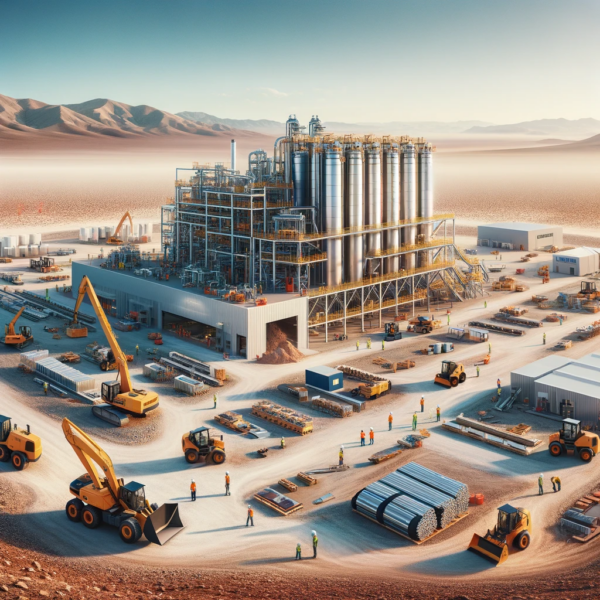

Macmahon Holdings Limited (ASX: MAH) has executed a A$355 million underground mining services contract for the Mt Marion lithium operation in Western Australia, marking one of the group’s most significant recent additions to its underground portfolio. The agreement was awarded to wholly owned subsidiary Macmahon Underground Pty Ltd and covers all underground development and production mining over an initial three-year term, with a further one-year extension option. Mt Marion is jointly owned by Mineral Resources Limited and Jiangxi Ganfeng Lithium Co., Ltd., each holding a 50% interest. The contract strengthens Macmahon Holdings’ exposure to lithium without requiring it to own the underlying commodity asset, although mobilisation costs, operating performance and achieved margins will determine how much of the headline contract value ultimately benefits earnings and cash flow.
Why does the A$355 million Mt Marion contract matter for Macmahon’s underground mining strategy?
The contract provides further evidence that Macmahon Holdings is becoming a broader underground mining contractor rather than remaining predominantly associated with large-scale surface operations.
Macmahon Holdings has spent several years expanding its underground capability, including through its acquisition of GBF Underground Mining Group in 2019. That platform has since been used to pursue work across gold, base metals and commodities linked to energy transition demand. The Mt Marion award gives the company exposure to a large Australian lithium operation with an approved underground expansion rather than an early-stage project that still depends on financing or a final investment decision.
The award also supports Macmahon Holdings’ longer-term financial target of generating more than A$750 million in annual underground mining revenue by the 2028 financial year. Underground services accounted for around 23% of group revenue during the first half of the 2026 financial year, showing that the division is already material but still has room to expand relative to surface mining and civil infrastructure.
An average allocation of the A$355 million initial contract value across three years would equate to approximately A$118 million annually. Actual revenue is unlikely to be distributed evenly because early development, equipment mobilisation and subsequent production mining will create different activity levels throughout the contract.
Even so, the implied annual value represents roughly 4% to 5% of Macmahon Holdings’ current annual revenue guidance. That makes Mt Marion large enough to support growth while avoiding the level of dependence that could arise if one contract represented an excessive share of group activity.
Chief Executive Officer Michael Finnegan indicated that the company viewed the award as an opportunity to build a long-term partnership at Mt Marion while further strengthening its presence in commodities expected to benefit from future electrification demand. The more important commercial question is whether Macmahon Holdings can convert that strategic positioning into acceptable returns after accounting for labour, equipment, maintenance and underground development risk.

How significant is the Mt Marion award compared with Macmahon Holdings’ revenue and order book?
Macmahon Holdings entered the second half of the 2026 financial year with an order book of approximately A$5.1 billion, including contracts awarded during January but excluding possible extensions and several opportunities that had not reached final execution.
The A$355 million Mt Marion contract is equivalent to approximately 7% of that previously disclosed order book. It therefore represents a meaningful addition, although the total company order book will also have changed as existing work was performed and other contracts were added after December 31, 2025.
Macmahon Holdings reported first-half revenue of A$1.3 billion, an increase of 11%, while underlying earnings before interest and tax and amortisation rose 17% to A$91 million. Free cash flow reached A$39.3 million and return on average capital employed improved to 21.2%. Net debt was A$144.1 million at the half-year point.
For the full 2026 financial year, management has guided to revenue of between A$2.6 billion and A$2.8 billion and underlying earnings before interest and tax and amortisation of A$180 million to A$195 million. Because the Mt Marion underground programme is associated with activity beginning in the 2027 financial year, the award is more relevant to future revenue visibility than to the closing weeks of the current reporting period.
The contract also arrives alongside a sizeable tender pipeline. Macmahon Holdings previously identified A$25.6 billion of potential work across its divisions, including A$8.1 billion within underground mining. Around A$3.5 billion of the underground pipeline was expected to be awarded within 12 months.
Winning Mt Marion demonstrates that some of that pipeline can be converted into executed contracts. The next challenge is maintaining award discipline. Mining contractors can expand revenue rapidly by accepting aggressive pricing, but sustainable shareholder value depends on contract margins, capital intensity and cash conversion rather than revenue growth alone.
Why is Mt Marion’s underground transition strategically important for the wider lithium operation?
Mt Marion has historically operated as an open-pit lithium mine supported by a dense-media separation processing plant. Mineral Resources Limited and Jiangxi Ganfeng Lithium Co., Ltd. approved a broader A$490 million investment programme in May 2026 to expand and extend the operation through underground development, flotation processing and supporting infrastructure.
The approved investment includes approximately A$220 million for underground pre-production development, A$240 million for a flotation plant and A$30 million for non-processing infrastructure. The project is intended to increase lithium recovery towards 70%, lift installed production capacity and support a simplified concentrate product strategy.
Underground ore is expected to provide as much as 40% of Mt Marion’s processing feed from the 2028 financial year once the combined open-pit and underground operating model is established. Central underground development was targeted to commence during the first quarter of the 2027 financial year, making the execution of Macmahon Holdings’ contract an important step in translating the investment decision into physical mine development.
For Mineral Resources Limited, the underground mine is intended to access ore beyond the economic limits of the open pit and support a longer operating life. For Macmahon Holdings, the contract creates multi-year activity across development and production rather than a shorter construction-only assignment.
The scope covering all underground development and production mining is strategically valuable because it gives Macmahon Holdings responsibility across different stages of the mine cycle. Development activity creates access to the orebody, while production mining determines the longer-term volume and productivity profile.
That integrated scope may also create opportunities for an extension beyond the initial term if performance meets the owners’ requirements and the underground operation expands as anticipated. The one-year option provides a formal pathway, although it should not be treated as guaranteed revenue until exercised.
Does lithium price volatility still matter when Macmahon operates as a contractor rather than an owner?
Macmahon Holdings will not receive the lithium price achieved by Mt Marion, which means its direct revenue exposure is governed primarily by the mining contract rather than fluctuations in spodumene concentrate prices.
That distinction can make mining services earnings less volatile than returns earned by an asset owner. Macmahon Holdings is paid to perform agreed mining activities, while Mineral Resources Limited and Jiangxi Ganfeng Lithium Co., Ltd. carry direct exposure to commodity pricing, processing economics and product sales.
Commodity risk has not disappeared, however. Sustained weakness in lithium prices could influence mine plans, production volumes, expansion timing and the owners’ willingness to exercise contract options. It could also affect the amount of development activity commissioned beyond the initial scope.
The decision to proceed with the Mt Marion expansion was supported by lithium market conditions and project-level economics. Mineral Resources Limited said in May that the investment could achieve a payback period of less than one year based on then-prevailing spodumene pricing of approximately US$2,700 per tonne for 6% lithium oxide concentrate. That was a company estimate tied to a specific price assumption rather than a guaranteed outcome.
For Macmahon Holdings, the strongest protection comes from a contract structure that clearly allocates commodity, volume, inflation and operating risks between contractor and client. Those terms have not been publicly disclosed in sufficient detail to assess the precise margin protection available.
The award therefore gives Macmahon Holdings indirect exposure to lithium industry investment rather than a pure commodity-price position. This can be attractive when producers are expanding, but contractor earnings still depend on clients maintaining their development plans and paying for the required activity.
What execution risks could determine the margin and cash-flow outcome at Mt Marion?
The A$355 million contract value indicates expected revenue across the initial term. It does not disclose the profit margin, mobilisation expenditure or working capital needed to deliver the work.
Underground mining can require substantial upfront investment in mobile equipment, maintenance systems, site infrastructure, workforce recruitment and specialised technical capability. Cash outflows may therefore occur before contract earnings and receipts reach a stable level.
Macmahon Holdings will also need to manage underground development rates, equipment availability, ground conditions, ventilation, scheduling and coordination with ongoing open-pit and processing operations. Delays in mine access or changes to the client’s development sequence could affect productivity even where the contractor performs its immediate responsibilities effectively.
Labour availability represents another important variable. Western Australia’s mining sector competes for underground operators, maintenance personnel, engineers and supervisors. Recruiting workers is only part of the challenge. Retention, accommodation, training and roster stability can materially influence safety and productivity.
Macmahon Holdings’ scale should provide some advantages. The company already operates multiple mining contracts, maintains a substantial equipment fleet and has an established underground division. Its prior exposure to lithium through surface mining at the Greenbushes operation also gives it experience with the operating standards and commercial expectations associated with major Australian lithium assets.
Nevertheless, the market should not assume that the A$355 million award will immediately earn the group’s average margin. New projects can experience lower profitability during mobilisation before reaching planned production rates.
The most useful future disclosures will be confirmation that mobilisation is proceeding on schedule, underground development milestones are being achieved and group margins remain within management’s broader expectations.
What does the recent MAH share-price performance reveal about investor sentiment?
Macmahon Holdings shares traded around A$0.94 during the July 15 session, modestly above the previous close of A$0.925. The stock had gained almost 6% compared with its level seven days earlier and approximately 2.6% over the preceding four weeks.
The company’s market capitalisation was approximately A$2 billion, while the share price remained below its reported 52-week high of A$1.03 and well above the 52-week low of A$0.285. The shares have risen by more than 200% over the past year, indicating that the market had already substantially rerated Macmahon Holdings before the Mt Marion announcement.
The positive intraday movement coincided with the contract announcement, but a single session does not establish that the award was the only cause. Broader market conditions, commodity sentiment and existing earnings expectations can also influence daily trading.
The longer-term share-price recovery suggests investors have responded to stronger earnings, improved returns on capital and an expanding contract pipeline. This creates a higher performance threshold for new awards. A A$355 million contract supports growth visibility, but the market may increasingly demand evidence that revenue additions are sustaining margins and free cash flow.
The current valuation also places the stock relatively close to its annual high. That does not determine whether the shares are expensive or inexpensive, but it indicates that expectations are materially stronger than they were a year earlier.
Further rerating may therefore require more than order-book growth. Investors are likely to focus on the August full-year results, updated 2027 guidance, cash conversion and any evidence that the underground division is advancing towards its 2028 revenue target.
Which milestones will show whether the Mt Marion contract is creating real shareholder value?
The first near-term indicator will be the mobilisation of Macmahon Underground Pty Ltd at Mt Marion and the commencement of development work consistent with the project schedule.
Management will then need to demonstrate that the contract is progressing without causing an unexpected increase in capital expenditure, debt or working capital. The company’s full-year results, scheduled for August 18, 2026, should provide an updated starting point for assessing balance-sheet capacity and future contract investment.
Guidance for the 2027 financial year will be particularly important. Investors will want to understand how much Mt Marion revenue has been included, whether additional equipment purchases are required and whether the contract supports or initially dilutes group margins.
Operational milestones at the mine will offer further evidence. Development progress, the transition towards underground production and integration with the expanded processing strategy will determine whether Macmahon Holdings can move from mobilisation revenue into a stable multi-year production phase.
The extension option could eventually add another year of work, but its value depends on successful execution during the initial term. A strong safety record, development performance and cost discipline would improve the probability of continued activity.
Macmahon Holdings has secured a substantial award that supports its strategic expansion in underground mining and future-facing commodities. Revenue visibility has improved, and the contract is linked to an approved project with committed owners and a defined development pathway.
What remains unresolved is the economic quality of that revenue. The decisive proof will be whether Mt Marion contributes to rising underground earnings, stronger returns on capital and continued free cash generation rather than merely enlarging the order book.
Key takeaways from Macmahon Holdings’ A$355 million Mt Marion contract
- Macmahon Holdings has executed a A$355 million underground mining services contract at Mt Marion.
- The initial contract term is three years and includes an option for a further year.
- Macmahon Underground Pty Ltd will undertake all underground development and production mining.
- Mt Marion is owned equally by Mineral Resources Limited and Jiangxi Ganfeng Lithium Co., Ltd.
- The award supports Macmahon Holdings’ target of generating more than A$750 million in annual underground revenue by the 2028 financial year.
- The contract represents approximately 7% of Macmahon Holdings’ previously disclosed A$5.1 billion order book.
- Mt Marion’s approved expansion includes underground development, flotation processing and supporting infrastructure.
- Lithium price volatility remains an indirect risk because it can influence future mine plans and contract extensions.
- Mobilisation costs, labour availability, development productivity and contract margins will determine the financial contribution.
- Macmahon Holdings’ August full-year results and 2027 guidance will provide the next measurable tests of earnings and cash-flow impact.
Discover more from Business-News-Today.com
Subscribe to get the latest posts sent to your email.