


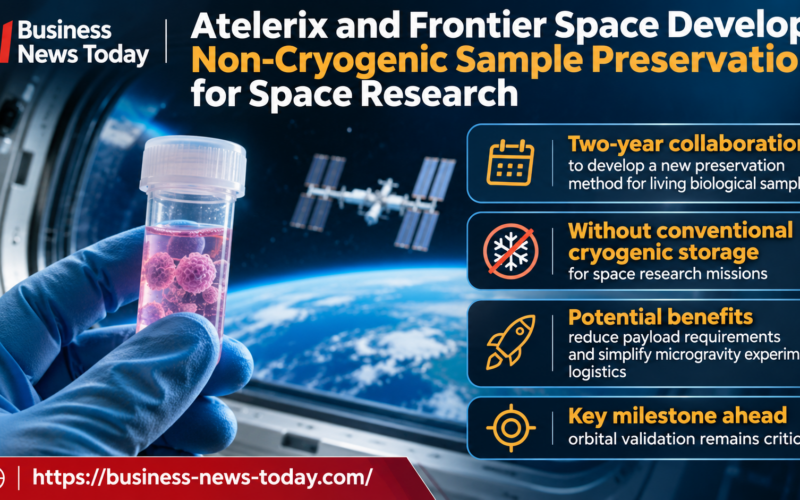
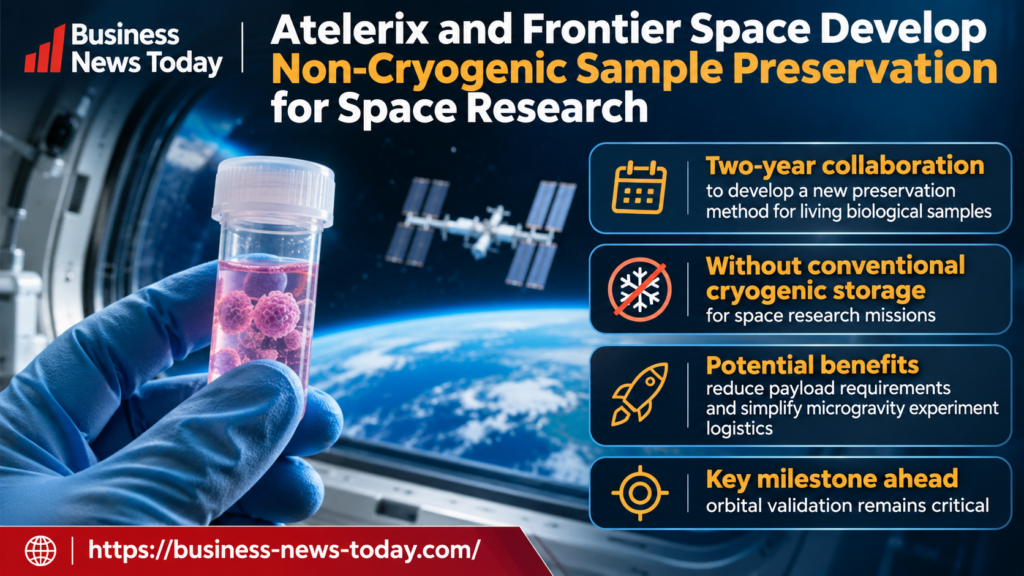
Atelerix, the Newcastle-based biotechnology company specializing in non-cryogenic cell preservation, has signed a two-year memorandum of understanding with Frontier Space to evaluate its patented alginate hydrogel technology for transporting living biological samples during space missions. Announced on October 27, 2026, the collaboration will examine whether suspended mammalian cells, organoids and organ-on-chip models can remain suitable for microgravity research without depending on conventional cryogenic storage. The partners are targeting launch opportunities during 2027, with Frontier Space estimating potential launch-cost savings of up to $30,000 from reducing bulky preservation equipment. The agreement creates a potential route into commercial space biotechnology, although neither company has confirmed a completed orbital validation or disclosed a binding revenue commitment arising from the partnership.
Frontier Space develops platforms for in-orbit research and biomanufacturing, enabling scientists to investigate biological processes under microgravity conditions. Its services are designed to support research into cell cultures, protein crystallization and other applications where conditions in space may produce different experimental outcomes from those observed on Earth. Atelerix will contribute preservation materials, technical protocols and scientific support, while Frontier Space will identify appropriate payloads and coordinate the requirements for testing.
The collaboration addresses a practical obstacle associated with transporting biological research materials into and out of orbit. Living cells can be sensitive to temperature changes, mechanical stress and delays between preparation and analysis. Maintaining their integrity during a mission may require specialized storage equipment, additional handling and carefully controlled transport arrangements.
Atelerix Chief Executive Officer Alastair Carrington has described the partnership as an opportunity to test whether its preservation technology can reduce the logistical burden of microgravity research. Frontier Space Chief Executive Officer Dr Aqeel Shamsul has similarly emphasized the importance of improving the practicality and affordability of space-based biotechnology. Both companies are presenting the initiative as a validation program rather than a commercially proven service.
How could Atelerix’s alginate hydrogel technology preserve living cells without cryogenic storage during space missions?
Atelerix’s technology uses an alginate-based hydrogel to encapsulate biological materials within a soft, protective matrix. Alginate is a material derived from seaweed that can form a gel under suitable conditions. The company’s preservation approach is designed to support cell viability during storage and transportation at ambient temperatures, reducing reliance on freezing and refrigerated logistics for compatible samples.
The encapsulation process places living cells or tissue models inside a three-dimensional environment that helps maintain their condition during transport. According to Atelerix, cells stored within the matrix can enter a relatively inactive state, reducing some of the metabolic demands associated with normal culture conditions. The company also provides a release buffer that allows researchers to remove the gel before subsequent laboratory procedures.
Atelerix’s published technical information indicates that the time required for encapsulation typically ranges from 10 to 30 minutes, depending on the format. Releasing cells from the gel generally takes approximately five to 10 minutes. These figures describe the company’s established preservation workflow rather than validated performance under launch and orbital conditions.
The company reports that many customers use its technology to preserve biological materials for three to seven days, while longer periods of up to 21 days may be possible for certain cell and tissue types. The duration depends on the biological material and application. These terrestrial capabilities provide a starting point for space testing, but they do not establish that every sample will remain viable throughout a mission of equivalent duration.
For space biotechnology, eliminating cryogenic storage could simplify the preparation and transportation of certain experimental materials. Researchers might be able to ship samples to launch integration facilities without maintaining a continuous low-temperature environment. However, the technology must still demonstrate that encapsulated samples can withstand launch vibration, acceleration, radiation exposure and mission-specific handling.
Temperature stability is only one component of sample preservation. Researchers also need cells to retain the biological characteristics required for their experiments after release from the hydrogel. A sample that remains physically intact but undergoes unwanted changes in gene expression, metabolism or cellular behavior may not be suitable for every scientific application.
The partnership will therefore need to evaluate both viability and functional integrity. Successful preservation would require evidence that the recovered material remains appropriate for its intended research use, rather than merely demonstrating that some cells survive the journey.
Why does removing bulky cryogenic equipment matter for the economics of space biotechnology research?
Transporting biological samples to space can involve a combination of packaging, thermal-control equipment, specialized containers and mission-specific support systems. Cryogenic preservation may also require substantial preparation before launch and controlled thawing after recovery. These requirements can increase the mass, volume and complexity allocated to biological experiments.
Launch providers generally impose limits on payload mass, physical dimensions and available resources. Equipment assigned to preserving samples occupies capacity that cannot simultaneously be used for additional research materials or other mission requirements. Reducing preservation equipment could therefore allow a greater portion of a payload allocation to support the experiment itself.
Frontier Space has estimated that avoiding bulky cryogenic storage could save up to $30,000 in launch costs. That estimate is commercially relevant because smaller research payloads often operate within constrained budgets. However, the companies have not published a mission-specific cost comparison showing how the figure was calculated.
Actual savings will depend on several factors, including launch-provider pricing, the type and mass of storage equipment displaced, integration requirements and the duration of the mission. Removing one cooling component does not necessarily eliminate every temperature-control or life-support requirement associated with the experiment. Some biological samples may also remain unsuitable for ambient preservation.
The economic benefit should therefore be assessed at the complete mission level. A lower-mass preservation system could reduce transport expenditure while still requiring testing, technical support and post-flight analysis. The net saving will depend on whether those additional requirements are smaller than the expenses avoided.
There is also a potential scientific benefit from simplifying logistics. Researchers could spend less time coordinating specialized sample transport and more time preparing experiments. That may improve access for smaller laboratories, biotechnology companies and academic groups that lack dedicated spaceflight infrastructure.
Nevertheless, reducing preparation complexity does not automatically make microgravity research inexpensive. Access to orbital platforms, payload integration, launch services and sample return can continue to represent substantial costs. Atelerix’s proposed technology addresses one operational component rather than the entire economics of conducting research in space.
What will the partnership test across mammalian cells, organoids and organ-on-chip models?
The two-year memorandum covers three broad categories of biological material: suspended mammalian cells, organoids and organ-on-chip models. These systems differ in structure and experimental purpose, creating a more demanding validation program than testing a single cell type under uniform conditions.
Suspended mammalian cells are commonly used in biological research and biotechnology development. Their preservation requirements vary according to cell type, sensitivity and intended application. A suitable transport system must maintain enough viable and functionally appropriate material for researchers to complete the planned experiment.
Organoids are three-dimensional cellular structures developed to reproduce selected characteristics of human or animal tissues. They are increasingly used in disease research, drug evaluation and studies of biological development. Their complex organization makes preservation particularly challenging because maintaining individual cell survival may be insufficient if the overall tissue-like structure is damaged.
Organ-on-chip models use engineered systems to reproduce selected aspects of tissue or organ behavior under controlled conditions. These platforms can incorporate different cell types, structural materials and fluid-handling features. Transporting such systems creates additional requirements involving the integrity of both the biological material and the experimental device.
Microgravity research introduces further variables. Cells and tissue models may behave differently when exposed to reduced gravitational forces, affecting their structure, signaling and growth. Researchers need to distinguish those experimental effects from changes caused by sample preparation or preservation.
If a transport method alters the biological baseline before the experiment begins, the results may be difficult to interpret. Similarly, degradation during the return journey could complicate post-flight analysis. The validation program must therefore consider what happens before launch, during the mission and after sample recovery.
Frontier Space will identify sample types and payload configurations appropriate for testing. Atelerix will provide preservation products and protocols, while the partners will examine sample integrity and suitability for subsequent analysis. The announcement does not specify how many samples will be tested or which missions will carry them.
The program’s value will depend on evidence showing that preserved samples produce sufficiently reliable and reproducible results for their intended applications. Validation across several biological model types could support broader commercial adoption, while inconsistent performance may require a narrower initial market.
How does the Frontier Space agreement build on Atelerix’s existing organoid preservation business?
The space collaboration follows Atelerix’s expansion into specialized preservation products for complex biological models. In April 2026, the company introduced STORganoid, an ambient-temperature preservation solution designed for three-dimensional organoids and spheroids. The product targets research applications requiring the storage and shipment of structurally complex cellular material.
STORganoid was developed to reduce dependence on cryogenic and refrigerated logistics while maintaining sample viability and reproducibility. It is intended to allow research organizations to transport biological models between facilities without requiring extensive preparation immediately before use. The company has positioned the product within the growing market for human-relevant research models and alternative methods of drug testing.
Atelerix also entered a collaboration with French biotechnology company Cherry Biotech in December 2025. That agreement focused on integrating non-cryogenic preservation with advanced organoid and organ-on-chip technologies. The initial arrangement involved a 12-month evaluation period, illustrating the company’s use of staged technical partnerships before broader commercial deployment.
The Cherry Biotech collaboration included testing involving organoid models associated with different human tissues. According to the companies, early evaluation supported the preservation of cellular membrane integrity and biological function under the tested conditions. Those results provide relevant terrestrial experience but cannot be treated as proof of successful preservation during spaceflight.
The Frontier Space agreement extends Atelerix’s technology into an environment with additional mechanical and operational challenges. Launch acceleration, payload integration and orbital exposure introduce requirements that conventional laboratory shipments do not necessarily reproduce. Successful testing could therefore strengthen the technology’s credibility in demanding research applications beyond ordinary terrestrial transport.
Atelerix is privately held and has not disclosed the financial consideration attached to the new agreement. It has also not published a forecast for revenue from space biotechnology customers. The collaboration should therefore be considered a prospective commercial development channel rather than an established contributor to earnings.
Its strongest strategic advantage would arise if the same preservation platform could serve multiple customer groups without requiring entirely separate underlying technologies. Such reuse could support product development efficiency and broaden the addressable market. However, space-specific qualification may introduce additional costs that are not necessary for conventional laboratory customers.
How is Frontier Space building the infrastructure needed to commercialize microgravity biotechnology?
Frontier Space was founded in 2021 by graduates of Cranfield University and develops platforms intended to make biotechnology research in orbit more accessible. The company is working on experimental systems that allow researchers to investigate biological behavior under microgravity conditions. Its commercial proposition involves providing technical infrastructure and services rather than expecting individual pharmaceutical customers to develop spacecraft themselves.
The company has identified several potential areas of interest, including protein crystallization, three-dimensional cell culture and biological processes associated with aging. These applications may offer scientific advantages under selected conditions, but the commercial value of space-based experimentation must be established for each use case. Not every research activity will benefit sufficiently from microgravity to justify additional mission expenditure.
In May 2026, Frontier Space announced a partnership with g-SPACE to develop a more integrated offering for microgravity biotechnology research and manufacturing. The arrangement combines Frontier Space’s orbital platforms and transport capabilities with expertise in experimental design and biological research. It reflects an effort to provide customers with a more complete research service.
Frontier Space subsequently announced a September 2026 partnership with Xponential Space, focused on commercial development and identifying pharmaceutical applications where microgravity may offer measurable advantages. The collaboration involves customer engagement, market validation and business development. These activities complement the technical work needed to operate research payloads.
The company has reported delivering two space biotechnology payloads within a nine-month period. This establishes experience in payload development and delivery, although it does not demonstrate that every element of the proposed Atelerix preservation workflow has already been tested in orbit. The new agreement introduces a specific preservation technology that requires its own validation.
Together, the partnerships suggest that Frontier Space is developing an ecosystem covering experimental platforms, biological research design, sample handling and commercialization. That model could reduce the number of separate suppliers a customer must coordinate. Its financial viability will depend on recurring mission demand, reliable execution and the ability to offer services at prices justified by research outcomes.
The addition of Atelerix potentially strengthens one of the supporting components of that ecosystem. A useful preservation system could simplify sample preparation and recovery, helping customers focus on the scientific questions they want to investigate. However, the partnership does not establish exclusive access to Frontier Space missions or a guaranteed market for Atelerix products.
What commercial and scientific milestones will determine whether the 2027 space missions create lasting value?
The first priority is developing a validation protocol suitable for the different biological samples covered by the memorandum. The partners must establish acceptable measures of cell survival, structural integrity and biological function, then determine how these characteristics will be assessed before and after flight. Control samples preserved and transported through conventional methods may also be useful for evaluating relative performance.
The next stage will involve translating laboratory results into mission-compatible procedures. Materials must meet relevant payload requirements, fit within available space and remain suitable for the operating environment. The companies will also need to coordinate preservation timing with launch preparation, orbital experimentation and sample recovery.
Launch opportunities are being targeted throughout 2027, but the agreement does not identify a confirmed mission, spacecraft provider or launch date. Planned flights should therefore not be described as booked or guaranteed. The schedule will depend on test readiness, payload integration and the availability of suitable missions.
Scientific validation will be the decisive point. Demonstrating that preserved samples remain suitable for post-flight analysis could justify more extensive research use and discussions with commercial customers. If sample quality varies substantially across model types, the technology may initially be more suitable for a narrower set of applications.
The financial opportunity will also require evidence beyond the estimated $30,000 launch-cost saving. Prospective customers must consider the total cost of sample preparation, preservation materials, mission integration and analysis. Atelerix and Frontier Space will need to demonstrate that the overall service offers a practical advantage compared with existing approaches.
The two-year agreement provides a framework for collecting that evidence rather than guaranteeing commercial adoption. A successful program could support additional partnerships with pharmaceutical companies, academic laboratories and space biotechnology operators. Its value will become clearer when the companies disclose completed tests, actual flight results and any subsequent commercial agreements.
What are the key takeaways from the Atelerix and Frontier Space biological preservation partnership?
Atelerix and Frontier Space announced a two-year memorandum of understanding on October 27, 2026, to validate alginate hydrogel preservation technology for microgravity research. The program will examine suspended mammalian cells, organoids and organ-on-chip models, with launch opportunities targeted for 2027. Frontier Space estimates that reduced reliance on bulky cryogenic storage could save up to $30,000 in launch costs, but the figure remains an estimate rather than a demonstrated mission saving.
Atelerix will contribute preservation materials and scientific protocols, while Frontier Space will support payload selection, integration and mission planning. The collaboration builds on Atelerix’s STORganoid product and earlier organoid research partnerships, alongside Frontier Space’s expanding network of biotechnology service partners. The next measurable milestones are successful validation of sample quality, confirmation of suitable flight opportunities and demonstration that the approach provides reproducible scientific results at commercially attractive costs.
Discover more from Business-News-Today.com
Subscribe to get the latest posts sent to your email.