



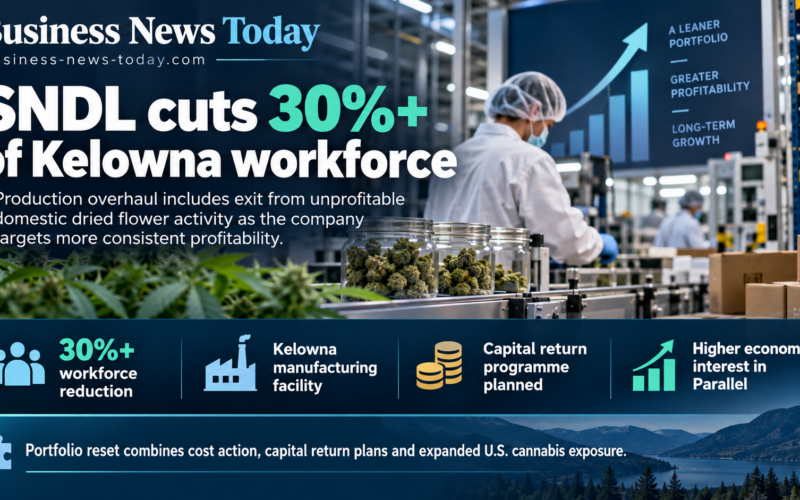
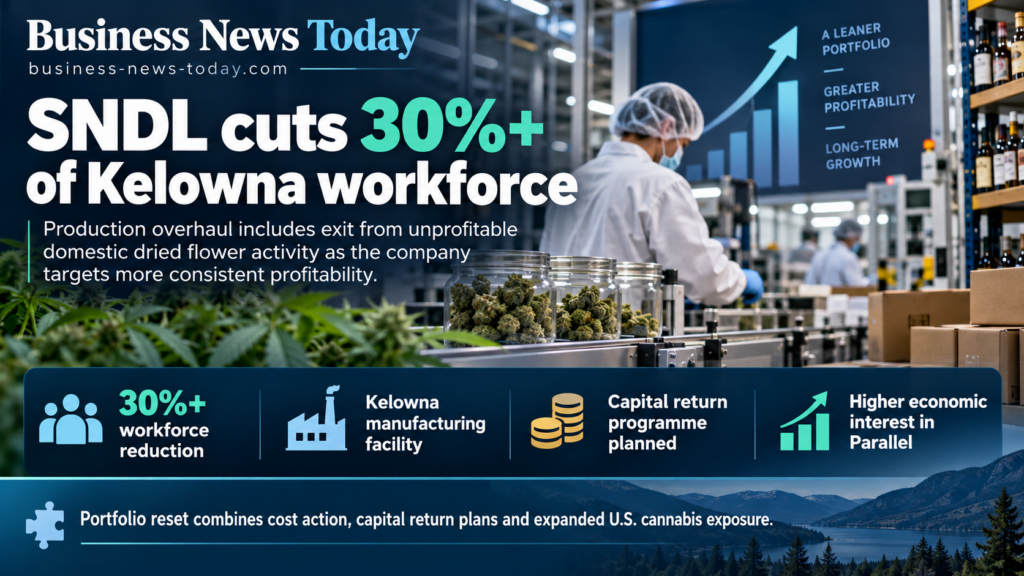
SNDL Inc. (NASDAQ: SNDL; CSE: SNDL), the Canadian cannabis producer and retailer with a substantial liquor distribution business, has reduced more than 30% of the workforce at its Kelowna manufacturing facility as part of a broader effort to improve cannabis operating profitability. The reduction, reported on October 27, 2026, follows management’s decision to withdraw from unprofitable domestic dried flower activities and concentrate resources on products and operations offering more attractive economics. The announcement comes after a difficult second quarter for cannabis manufacturing, when higher production costs, softer demand and challenges associated with a product launch reduced profitability. The key financial question is whether lower manufacturing expenditure can produce sustainable cash generation without damaging the product brands and distribution relationships SNDL intends to retain.
SNDL operates a vertically integrated business spanning cannabis production, processing, brands and retail, alongside an established liquor retail network. This structure gives the group exposure to different consumer markets, but it also introduces the complexity of balancing production capacity with demand from retail customers. A manufacturing facility operating below efficient utilization levels can create a substantial fixed-cost burden.
The Kelowna workforce reduction represents a material employment change at the location. However, SNDL has not provided a sufficiently verified total headcount for the facility alongside the percentage reduction, preventing a reliable calculation of the exact number of affected employees. The available information also does not establish the severance costs or annual savings attributable specifically to the reductions.
Management’s October strategy update provides the wider rationale for the decision. Chief Executive Officer Zach George has emphasised a more disciplined production portfolio, improved operating performance and the importance of removing activities that do not generate attractive returns. The company is attempting to simplify Canadian cannabis operations while preserving options for growth in higher-value products and the United States.
Why is SNDL reducing manufacturing capacity instead of pursuing more Canadian cannabis production?
Canada’s legal cannabis market provides established nationwide retail access, but market maturity has intensified competition and placed pressure on certain product categories. Licensed manufacturers must balance consumer demand against production costs, wholesale pricing, inventory management and regulatory requirements. Expanding output is not necessarily profitable if the market price of finished products does not cover the full cost of production.
SNDL’s strategy recognises that greater manufacturing volume is not always equivalent to better operating performance. Domestic dried flower can be exposed to considerable price competition, while manufacturing facilities require employees, equipment, quality management and inventory investment regardless of near-term market conditions. When margins become inadequate, reducing selected activities can be more economically rational than sustaining volume at a loss.
The company has explicitly identified its withdrawal from unprofitable domestic dried flower as part of the broader repositioning. This does not mean that every SNDL cannabis product or retail activity is being discontinued. The strategy involves shifting emphasis towards higher-value opportunities while seeking greater efficiency across the operations that remain.
Kelowna’s workforce reduction therefore needs to be assessed as a change in operating capacity rather than evidence that SNDL is abandoning Canada’s cannabis market. The business continues to own established consumer brands and retail channels, including Value Buds and Spiritleaf. Its challenge is to align production, procurement and distribution so that the cost of supplying those channels supports acceptable margins.
Workforce reductions can lower payroll expenditure, but the benefits depend on how management reallocates production and preserves essential capabilities. If remaining facilities can manufacture suitable products more efficiently, the restructuring could improve the cost base. If reduced staffing creates operational bottlenecks or quality problems, some expected savings may be offset by other expenses.
The company has not disclosed a verified annualised savings target for the Kelowna action. Investors should therefore avoid assigning an assumed improvement in earnings or free cash flow to the percentage workforce reduction alone.
What do SNDL’s second-quarter financial results reveal about the pressure on cannabis manufacturing?
SNDL’s second-quarter 2026 financial results provide a clear explanation for management’s focus on operating efficiency. Consolidated revenue declined 3.7% to C$235.8 million from C$244.8 million a year earlier. Gross profit fell 16.6% to C$56.3 million, while gross margin declined to 23.9% from 27.6%.
The deterioration was more pronounced within Cannabis Operations. Segment revenue declined 10.1% to C$32.2 million, while gross profit fell to approximately C$567,000 from C$9.2 million. Gross margin contracted to 1.8% from 25.8%, illustrating the extent to which the production business struggled to convert sales into gross profit.
The Cannabis Operations segment reported an operating loss of approximately C$9.2 million, compared with C$3.1 million a year earlier. Its adjusted operating loss widened to almost C$9 million. These figures demonstrate that manufacturing difficulties were material to the group’s operating performance before the latest workforce decision.
SNDL attributed the weaker margin partly to production ramp-up costs associated with the Jeeter launch, alongside softer market demand and reduced business-to-business flower deliveries. International cannabis sales increased, but that growth was insufficient to offset the wider operating pressures. The result illustrates why management is now prioritising the profitability of individual activities over aggregate production scale.
The manufacturing performance also affected consolidated earnings. SNDL reported a second-quarter operating loss of approximately C$7.8 million, compared with operating income of C$5 million in the corresponding prior-year period. Adjusted operating loss was approximately C$7 million.
These financial results predate the October restructuring actions. They establish the baseline against which subsequent improvement can be assessed, not the financial outcome of the newly announced Kelowna workforce reductions. More recent reporting will need to distinguish recurring operating changes from exceptional accounting charges.
Can workforce reductions improve SNDL’s margins without weakening its remaining cannabis brands?
A manufacturer restructuring its operations must determine which products justify continued investment and which consume resources without delivering sufficient returns. The analysis involves gross margins, production complexity, inventory requirements, customer demand and the strategic importance of particular brands. Decisions based only on short-term sales could undermine products with stronger longer-term potential.
SNDL’s brand portfolio covers different price levels and consumption formats. The business has positioned itself across both value-oriented and premium cannabis categories, creating opportunities to serve customers with different preferences. However, the economics of individual products vary according to raw materials, processing requirements, distribution costs and achievable retail prices.
Reducing employment at one facility may support a more efficient production footprint if the remaining workforce and equipment can handle the selected product portfolio. Better utilisation could reduce the proportion of fixed expenditure associated with each unit manufactured. This benefit is conditional on demand remaining sufficient to support the revised capacity.
The transition also introduces operational risks. Cannabis products are subject to quality, labelling and regulatory requirements, making manufacturing consistency important. Workforce changes can disrupt production if experienced employees leave faster than essential responsibilities can be reassigned.
The company will also need to manage inventory associated with discontinued or reduced activities. Products that no longer fit the strategy may require disposal, discounting or accounting write-downs. Such charges can reduce reported earnings in the period when a restructuring occurs, even if the underlying decision is intended to improve future profitability.
For shareholders, the most convincing evidence would be a sustained recovery in Cannabis Operations gross margin accompanied by lower operating losses. A reduction in payroll expenditure without a corresponding improvement in manufacturing economics would provide only partial evidence of a successful restructuring.
How do SNDL’s preliminary C$20 million free cash flow and proposed C$50 million buyback fit the restructuring?
On October 15, SNDL announced that it expected approximately C$20 million in third-quarter free cash flow, which management described as potentially its highest quarterly result. The preliminary figure was unaudited and subject to completion of financial reporting procedures. It provided a more positive cash generation signal after negative free cash flow of approximately C$6.7 million in the second quarter.
However, the company disclosed that around C$10.6 million of the preliminary third-quarter benefit arose from the initial unwinding of a captive insurance arrangement, net of related premium payments. Working-capital actions and operating cash generation also contributed. The insurance-related component means the reported improvement should not be interpreted as entirely recurring operating cash flow.
The board has authorised management to explore a substantial issuer bid involving up to C$50 million of share repurchases. The possible bid would be priced at no more than C$1.92 per share, equivalent to approximately US$1.35 using the company’s stated October reference. SNDL has not formally launched the offer, and the final terms and approvals remain outstanding.
SNDL also reported repurchasing approximately 5.4 million shares in the third quarter. Across the 12 months ended September 30, the group had purchased approximately 21.8 million shares for around C$43.4 million. These repurchases reduce the number of outstanding shares but do not necessarily improve underlying business profitability.
The capital allocation decision creates an important trade-off. Cash used to repurchase shares cannot simultaneously be invested in manufacturing improvements, working capital or future acquisitions. Management must balance shareholder returns with the requirements of restructuring the Canadian operations and developing its U.S. strategy.
The proposed buyback may appeal to investors concerned about dilution or the share count, but its attractiveness depends on valuation and liquidity. The effectiveness of the capital return programme will be clearer when considered alongside the company’s post-restructuring cash generation and financial resources.
Why is SNDL simultaneously expanding its exposure to the U.S. cannabis market through Parallel?
The Canadian manufacturing changes coincide with a strategy intended to increase SNDL’s economic exposure to regulated medical cannabis operations in the United States. In October, the company reported that its indirect interest in Surterra Holdings and associated Parallel entities had increased from approximately 67% to approximately 92% following a rights offering.
The increased interest gives SNDL greater economic participation in the underlying business, although the exact financial effect depends on the structure of the investment and its accounting treatment. Management has identified potential future pathways for more direct integration, subject to legal, regulatory, accounting and Nasdaq requirements.
The strategy includes development of a cultivation and processing facility in Gainesville, Florida, through SunStream-related financing. The planned operation is intended to support cannabis products supplied to Parallel’s Florida retail network. The project creates potential opportunities for greater coordination between production and retail activity, but development expenditure and execution risks remain.
The regulatory environment differs materially between Canada and the United States. Cannabis businesses operating under state medical programmes must navigate rules that do not necessarily align with federal law or the requirements imposed on publicly traded companies. SNDL has therefore avoided describing future integration as an unconditional or completed transaction.
From an investor perspective, the combination of Canadian restructuring and U.S. expansion illustrates a portfolio reallocation strategy. Management is seeking to reduce exposure to weaker activities while retaining options in markets or product categories where it sees more attractive economics. Whether that allocation produces stronger returns remains uncertain.
How should SNDL investors interpret the Kelowna cuts alongside the company’s broader earnings outlook?
The immediate employment reduction indicates that SNDL is willing to make significant operational changes rather than continuing to support loss-making manufacturing activity indefinitely. That may improve financial flexibility if reductions are implemented without undermining profitable operations. Nevertheless, investors need evidence that the revised production structure can support reliable product supply and positive operating margins.
The second-quarter figures provide a demanding starting point, especially the 1.8% gross margin and C$9.2 million operating loss within Cannabis Operations. The October preliminary cash-flow improvement offers some reassurance, but the presence of a substantial insurance-related benefit prevents an assumption that the manufacturing operation has already recovered.
The rejected proposal to consolidate SNDL shares adds another layer to investor sentiment. At the company’s October shareholder meeting, the consolidation resolution received 54.1% support, below the required two-thirds threshold. The company subsequently indicated that it would respect the outcome and consider other ways of supporting shareholder value.
Management’s priorities now involve reducing unprofitable activity, controlling the cost structure and allocating cash among investment opportunities and repurchases. A credible improvement in the investment case would require stronger recurring cash generation rather than reliance on exceptional accounting or financing effects.
Specific financial savings from the Kelowna action have not been quantified, and the total number of employees affected has not been independently established from the available disclosure. The workforce reduction percentage is therefore significant operational information but cannot be converted into a reliable per-share earnings estimate.
The next useful indicators will include Cannabis Operations gross margin, restructuring charges, remaining manufacturing capacity, inventory management and underlying cash flow. Improvement across those measures would support the view that the portfolio changes are creating economic value. Until then, the restructuring remains a potentially important but financially unproven step towards sustainable profitability.
What are the key takeaways from SNDL’s Kelowna workforce reduction and Canadian cannabis restructuring?
- SNDL has reduced more than 30% of the workforce at its Kelowna manufacturing facility.
- The action forms part of a broader effort to improve the profitability of Canadian Cannabis Operations.
- Management is withdrawing from unprofitable domestic dried flower activity while concentrating on higher-value opportunities.
- Second-quarter Cannabis Operations revenue fell 10.1% to C$32.2 million.
- The segment’s second-quarter gross margin declined to 1.8% and its operating loss widened to C$9.2 million.
- SNDL reported preliminary third-quarter free cash flow of approximately C$20 million, including a substantial insurance-related benefit.
- The company is considering a substantial issuer bid of up to C$50 million, although a formal offer has not been launched.
- Its indirect interest in Parallel increased to approximately 92%, expanding potential U.S. medical cannabis exposure.
- The exact number of Kelowna employees affected and the associated annual cost savings have not been reliably quantified.
- A sustained recovery in manufacturing margins and recurring operating cash flow will determine whether the restructuring strengthens shareholder value.
Discover more from Business-News-Today.com
Subscribe to get the latest posts sent to your email.