




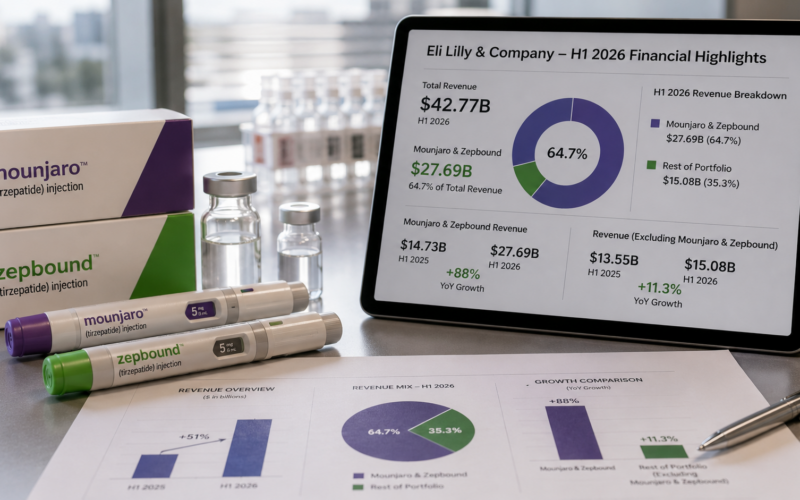
Eli Lilly and Company (NYSE: LLY) is growing at a pace rarely seen among trillion-dollar pharmaceutical companies, but the first-half numbers reveal just how concentrated that expansion has become. Mounjaro and Zepbound generated a combined $27.69 billion of revenue during the first six months of 2026, equal to approximately 64.7% of Eli Lilly and Company’s $42.77 billion total revenue.
A year earlier, the same two tirzepatide brands generated $14.73 billion, representing about 52.1% of company revenue. Their combined sales have therefore risen roughly 88% in one year while their share of Eli Lilly and Company’s revenue mix has increased by almost 13 percentage points.
The more revealing calculation sits underneath that growth. Strip out Mounjaro and Zepbound, and the rest of Eli Lilly and Company generated approximately $15.08 billion of first-half revenue, compared with $13.55 billion a year earlier. That is growth of only about 11.3%, versus 51% for the company as a whole.
How much of Eli Lilly and Company’s growth now depends on tirzepatide?
The contrast is stark. Mounjaro generated $18.61 billion during H1 2026, more than double the $9.04 billion recorded a year earlier, while Zepbound increased 60% to $9.09 billion. Together, the two products added approximately $12.96 billion of year-over-year revenue.
Eli Lilly and Company’s total first-half revenue increased by approximately $14.49 billion. That means Mounjaro and Zepbound mathematically accounted for almost 90% of the absolute increase, with the rest of the portfolio contributing only about $1.53 billion.
This does not make the broader pharmaceutical business weak. An approximately 11% increase excluding the two largest tirzepatide brands would still be respectable growth for a company of Eli Lilly and Company’s scale. The point is that the extraordinary 51% headline growth rate is overwhelmingly being created by one molecule sold across diabetes and obesity indications.
That makes tirzepatide increasingly important not just to growth, but to the earnings expectations embedded in Eli Lilly and Company’s valuation.

Why does rising revenue concentration matter when pricing is already falling?
Concentration becomes more relevant when the dominant products are simultaneously experiencing pricing pressure.
Eli Lilly and Company said second-quarter worldwide revenue increased 48% as volume rose 60%, partly offset by a 13% decline in realized prices. In the United States, realized prices fell 3%, but management said the decline would have been approximately 9% excluding adjustments to rebate and discount estimates. Outside the United States, realized prices fell 36%, largely because Mounjaro entered China’s National Reimbursement Drug List.
For now, volume growth is comfortably overpowering that pressure. Mounjaro revenue still surged 91% in Q2 to $9.94 billion, while Zepbound rose 46% to $4.93 billion. Combined quarterly revenue reached $14.87 billion, again representing almost 65% of Eli Lilly and Company’s $22.97 billion total.
The risk emerges if volume growth eventually normalizes while pricing continues declining. When nearly two-thirds of company revenue is tied to the same active ingredient, changes in reimbursement, manufacturing supply, competitive positioning or patient demand can have an unusually large effect on overall growth.
Is Eli Lilly and Company already building its way out of that concentration?
Management is clearly trying to ensure tirzepatide is a bridge to the next growth cycle rather than the end of it.
The company has submitted Foundayo, its oral GLP-1 treatment orforglipron, for type 2 diabetes in the United States, while the Phase 3 obesity package for retatrutide is complete and a U.S. regulatory submission is planned for the first quarter of 2027. Eli Lilly and Company is also investing outside metabolic disease through immunology, oncology, neuroscience, genetic medicine and a series of acquisitions.
That diversification effort is already producing smaller growth engines. Lilly said key products in immunology, oncology and neuroscience grew 121% during Q2, while newer medicines including Ebglyss, Kisunla, Jaypirca and Inluriyo continued expanding. Those franchises remain far smaller than Mounjaro and Zepbound, however, meaning they cannot yet meaningfully alter the concentration calculation.
The strategic challenge is therefore unusual. Eli Lilly and Company does not need to replace a declining blockbuster. It needs new franchises to grow fast enough that an exceptionally successful blockbuster molecule does not become an ever-larger percentage of the company.
What does the rising tirzepatide concentration mean for LLY valuation risk?
LLY closed August 14 at $1,180.16, down 2.25% for the session and about 5.6% below its July 7 record high of $1,249.45. The shares were roughly flat over the preceding five sessions, up about 2.4% over one month and remained dramatically above their 52-week low, while Eli Lilly and Company retained a market value above $1 trillion.
That valuation makes concentration a more nuanced issue than a conventional pharmaceutical patent-cliff problem. Investors are rewarding Eli Lilly and Company precisely because Mounjaro and Zepbound are growing so rapidly. The danger is not that 65% concentration is automatically unhealthy, but that the valuation increasingly assumes tirzepatide growth can remain exceptional while pricing pressure, competitors and manufacturing requirements are managed successfully.
The first-half numbers put the dependence into perspective. Eli Lilly and Company grew revenue 51%, but outside Mounjaro and Zepbound the increase was approximately 11%. The two brands generated almost $28 billion in six months and accounted for close to 90% of the company’s incremental year-over-year revenue.
The next stage of the Lilly story is therefore not simply about selling more Mounjaro and Zepbound. It is about whether Foundayo, retatrutide and the rest of the pipeline can eventually broaden the earnings base before tirzepatide’s extraordinary growth rate inevitably becomes harder to sustain.
Discover more from Business-News-Today.com
Subscribe to get the latest posts sent to your email.


