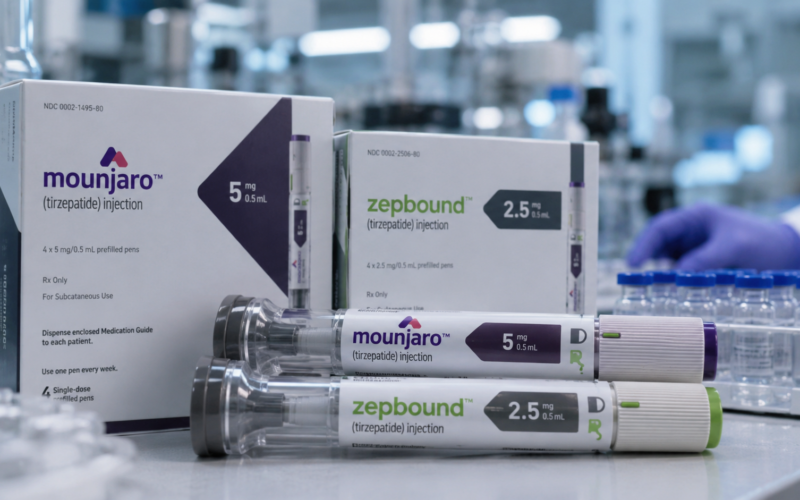
Eli Lilly and Company (NYSE: LLY) has raised its full-year 2026 guidance after another quarter dominated by explosive demand for Mounjaro and Zepbound. The Indianapolis-based pharmaceutical group reported second-quarter revenue of $23.0 billion, up 48% from the prior year, driven primarily by volume growth in its diabetes and obesity franchise. Mounjaro generated $9.94 billion in quarterly revenue, while Zepbound delivered $4.93 billion, giving the tirzepatide platform nearly $14.9 billion of revenue in just three months. Lilly now expects 2026 revenue of $85.0 billion to $87.0 billion, reinforcing why LLY continues to trade close to its 52-week high. The strategic question is no longer whether Lilly has built the world’s strongest metabolic-drug franchise, but whether manufacturing scale, pricing pressure and pipeline renewal can keep the valuation ahead of expectations.
Why did Eli Lilly raise 2026 guidance after another Mounjaro and Zepbound surge?
Eli Lilly’s guidance raise reflects the company’s ability to convert unprecedented GLP-1 and incretin demand into measurable revenue acceleration. Second-quarter revenue rose 48% to $23.0 billion, while first-half revenue reached $42.77 billion, up 51% from the prior year. For a company already valued above $1 trillion, that rate of growth is exceptional and explains why investors continue to treat Lilly as a category-defining pharma stock rather than a conventional large-cap drugmaker.
The upgraded 2026 revenue guidance of $85.0 billion to $87.0 billion means Lilly is now operating at a scale where every incremental capacity decision, payer agreement and product launch can move billions of dollars. This is no longer a single-product success story. It is a full operating-system shift in which metabolic disease has become the company’s central growth engine.
The most striking element is that revenue growth is being driven mainly by volume, not pricing. Lilly reported that worldwide revenue growth in Q2 was driven by a 60% increase in volume, partly offset by a 13% decline in realised prices. That distinction matters because it shows demand remains powerful enough to absorb pricing pressure while still producing very large revenue growth.
The price declines are not irrelevant. In the United States, realised pricing pressure was tied to Mounjaro and Zepbound dynamics, while outside the United States, Mounjaro’s addition to China’s National Reimbursement Drug List weighed on realised prices. This is the operating trade-off of global scale. Lilly can reach more patients, but wider access often comes with lower net prices.
Investors are therefore valuing two things at once. The first is near-term volume growth. The second is Lilly’s ability to keep expanding supply, reimbursement and indications fast enough to offset price erosion. The company’s guidance raise says management is confident in that equation for 2026.

What does nearly $15 billion of quarterly tirzepatide revenue say about Lilly’s concentration risk?
Mounjaro and Zepbound together generated nearly $14.9 billion of Q2 revenue. That figure is extraordinary, but it also exposes a central concentration question. Lilly’s valuation increasingly depends on the durability of tirzepatide demand across diabetes, obesity and related cardiometabolic conditions.
This concentration is not the same as ordinary product dependency. Tirzepatide is not a narrow specialty drug with a limited patient pool. It sits inside diabetes and obesity, two of the largest chronic disease markets in the world. That gives the franchise a much larger runway than a typical blockbuster product.
Still, concentration matters because investor expectations have become enormous. When a product family becomes the main driver of a trillion-dollar valuation, even modest changes in growth rate, pricing, payer access or competitive positioning can affect sentiment. A very large success can become a vulnerability if the market assumes flawless continuation.
Lilly is trying to reduce that risk by expanding the franchise across formulations, indications and adjacent diseases. Zepbound is positioned beyond weight loss alone, while retatrutide, orforglipron and other metabolic assets are intended to extend the company’s leadership into the next wave of incretin therapies.
The company’s challenge is to make the metabolic franchise feel like a platform rather than a cliff. If investors see Mounjaro and Zepbound as the beginning of a multi-generation cardiometabolic portfolio, Lilly can sustain a premium valuation. If they see them as a peak-cycle revenue surge vulnerable to competition and pricing resets, the stock may become more sensitive to every quarterly update.
Why is manufacturing capacity becoming Eli Lilly’s biggest strategic advantage?
Lilly’s additional $4.5 billion commitment to expand Indiana manufacturing sites may be as strategically important as any clinical update in the quarter. In the GLP-1 market, manufacturing capacity is not background infrastructure. It is a competitive weapon.
Demand for obesity and diabetes medicines has exceeded the industry’s ability to supply patients quickly. This has turned factories, fill-finish capacity, device assembly, active ingredient production and supply-chain reliability into major determinants of market share. The company that can produce more product at consistent quality can capture more demand before competitors can respond.
Lilly’s manufacturing investment also supports future launches. Retatrutide and orforglipron could add new capacity requirements if approved, and expanding production ahead of demand reduces the risk that the next product cycle runs into the same supply constraints seen across the GLP-1 category.
This is why Lilly’s capital spending should not be viewed merely as a cost line. It is part of the moat. Scientific innovation created the first advantage, but manufacturing scale may determine how much of that advantage becomes revenue. In pharma, a miracle drug that cannot be supplied is basically an excellent poster.
The risk is that capacity investments are large, fixed and long-term. If demand slows, pricing falls faster than expected, or competitors narrow the efficacy and convenience gap, manufacturing expansion could pressure returns. For now, however, Lilly’s problem remains the more attractive one: demand is strong enough that the company needs more supply.
How does Lilly’s pipeline reduce dependence on today’s GLP-1 winners?
Lilly’s pipeline update was designed to show that the company is not relying only on today’s tirzepatide products. The company highlighted positive Phase 3 data from additional retatrutide obesity trials and said the clinical data package is now complete to support global registrations for obesity, obstructive sleep apnea and knee osteoarthritis pain. Lilly plans to submit a biologics license application to the U.S. Food and Drug Administration in the first quarter of 2027.
Retatrutide is strategically important because it could represent the next generation of injectable metabolic therapy. If approved, it may allow Lilly to defend leadership even as competitors pursue their own incretin combinations. The goal is not simply to replace Zepbound. It is to extend the franchise into broader obesity-related complications and reinforce Lilly’s position as the company defining treatment escalation.
Orforglipron, branded as Foundayo in Lilly’s product table, is another critical asset because oral GLP-1 therapy could expand the addressable market. Injectable therapies have already proven demand, but an effective oral medicine taken without complex food or water restrictions could reach patients who hesitate to start injections or who prefer easier long-term administration.
The pipeline also extends beyond metabolic disease. Lilly cited regulatory and clinical progress in immunology, oncology, neuroscience and cardiovascular-linked technologies, including Ebglyss, Jaypirca, Kisunla, Omvoh, Retevmo and VERVE-102. These assets are smaller than Mounjaro and Zepbound today, but they matter because Lilly must eventually prove it can grow more than one mega-franchise.
The risk is that pipeline breadth can be overshadowed by the obesity business. Investors may underappreciate non-metabolic assets while Mounjaro and Zepbound dominate results. That is a nice problem, but still a problem. Lilly needs the rest of the portfolio to mature before metabolic growth inevitably normalises.
Why did business development charges rise, and what does that say about Lilly’s strategy?
Lilly’s Q2 earnings included substantial acquired in-process research and development charges tied to business development activity. The company completed acquisitions of Orna Therapeutics, Ajax Therapeutics, Centessa Pharmaceuticals and Kelonia Therapeutics during the quarter, and later completed three acquisitions to build an infectious disease portfolio. It also entered into an agreement to acquire AtaiBeckley.
This acquisition pace shows that Lilly is using its financial strength aggressively. The company is not simply sitting on GLP-1 cash flow and waiting for internal research to deliver every future growth asset. It is buying capabilities across RNA medicines, oncology, sleep-wake disorders, genetic medicine and infectious disease.
The strategy makes sense because Lilly’s current success gives it a rare advantage in biotech business development. It can fund acquisitions while maintaining large internal research investment and manufacturing expansion. Smaller biotechs need capital. Lilly has capital, currency and commercial credibility.
The downside is that dealmaking creates integration and capital-allocation risk. Acquired IPR&D charges reduced reported earnings, and not every acquired programme will become a product. Investors will tolerate this as long as the core business is growing rapidly, but they will become less forgiving if several acquired assets fail or if management appears to be buying too broadly.
The best interpretation is that Lilly is trying to build future optionality while it is strongest. That is usually the right time to buy innovation, provided discipline remains intact. The worst interpretation would be that the company is using current abundance to overpay for too many scientific possibilities. The truth will be known only through clinical readouts, not announcement volume.
What does LLY trading near its high reveal about investor confidence and valuation risk?
LLY closed around $1,209.00 on Aug. 13, down slightly for the session but still close to its 52-week high of $1,249.45. The stock remains far above its 52-week low of $623.78, showing how dramatically investors have rewarded the company’s obesity-led growth profile.
The market capitalisation remains above $1 trillion, which makes Lilly one of the most valuable healthcare companies in the world. That scale creates a different kind of risk. A smaller company can rerate significantly on one strong drug franchise. A trillion-dollar company must keep proving that its growth runway can justify an already enormous valuation.
The one-month context remains constructive. LLY has stayed near peak levels despite broader investor debate around GLP-1 pricing, supply constraints, competition and regulatory expansion. That suggests the market still believes Lilly has stronger earnings visibility than most large-cap pharma peers.
However, the valuation leaves little room for careless execution. If Zepbound pricing pressure worsens, if Mounjaro growth slows faster than expected, if retatrutide data disappoint in regulatory review, or if manufacturing expansion runs behind schedule, the stock could compress quickly. A great company can still become a difficult stock if expectations become too high.
The current share price says investors trust Lilly. It does not say investors have stopped testing Lilly. At this level, every quarter must keep answering the same question: can the company grow into a valuation that already assumes category leadership?
How does Novo Nordisk competition shape Lilly’s obesity-market outlook?
Novo Nordisk remains Lilly’s most important global competitor in obesity and diabetes. Novo Nordisk built the modern GLP-1 obesity market through Ozempic and Wegovy, and its manufacturing expansion, next-generation assets and global payer relationships remain formidable.
Lilly’s advantage currently comes from tirzepatide demand, strong clinical positioning and rapid revenue acceleration. Mounjaro and Zepbound have given the company a powerful growth engine at a time when Novo Nordisk has faced investor pressure around supply, pricing and competitive concerns.
The competition is not only scientific. It is industrial. Both companies are trying to expand manufacturing, improve access, negotiate reimbursement and defend pricing in markets where obesity treatment is becoming mainstream. The winner will not simply be the company with the best headline weight-loss number. It will be the company that can manufacture, distribute, reimburse and lifecycle-manage the most effectively.
Competition may also expand the overall market. More products, more physician education and broader awareness can bring more patients into treatment. Lilly and Novo Nordisk may both benefit from a larger global obesity category even while fighting for share within it.
The risk for Lilly is that competition gradually erodes pricing power and compresses margins. Even if Lilly remains a leader, payer negotiations may become tougher as more options arrive. Volume can offset price declines for now, but the long-term equation will require continued innovation, adherence support and manufacturing efficiency.
Why does China matter so much to Lilly’s global growth and pricing story?
China is becoming an important part of Lilly’s international growth story, but also a clear example of the trade-off between access and price. Lilly said revenue outside the United States rose 80% in Q2, driven by a 113% increase in volume, while realised prices outside the United States fell 36%. The lower realised prices were driven primarily by Mounjaro’s addition to China’s National Reimbursement Drug List.
This is a crucial signal. China can provide large patient volumes, but national reimbursement access usually comes with meaningful price concessions. For global pharma companies, China is not a simple high-price market. It is a scale market where volume, local competition and reimbursement policy shape returns.
For Lilly, the China trade-off may still be attractive. If lower prices unlock much larger treated populations, the revenue contribution can be substantial even with pressure on realised price. That appears to be part of the Q2 story, where international volume growth outweighed pricing headwinds.
The risk is that China becomes a template for other markets demanding wider obesity-drug access at lower prices. Governments and payers globally are watching the budget impact of GLP-1 medicines. As patient numbers rise, pricing negotiations will intensify.
Lilly’s ability to manage China will therefore matter beyond China. It will show whether the company can build a global obesity business that is both accessible and profitable. The long-term prize is enormous, but the pricing architecture will be complicated.
What could go wrong for Eli Lilly after such a strong quarter?
The first risk is pricing pressure. Q2 already showed lower realised prices in both the United States and international markets. If volume growth slows while price pressure continues, revenue growth could moderate faster than investors expect.
The second risk is manufacturing execution. Lilly is investing heavily in capacity, but large pharmaceutical manufacturing projects are complex. Delays, quality issues or supply bottlenecks could limit the company’s ability to meet demand.
The third risk is pipeline expectation risk. Retatrutide and orforglipron carry major investor attention. Any regulatory delay, safety issue or commercial-positioning uncertainty could pressure the stock because the market expects Lilly to extend its metabolic leadership.
The fourth risk is business-development productivity. Lilly completed multiple acquisitions and incurred large IPR&D charges. The company must show that these deals create future products, not just accounting adjustments and integration work.
The fifth risk is competitive intensity. Novo Nordisk, Amgen, Roche, Pfizer, smaller biotechs and China-based developers are all pursuing obesity and metabolic-disease opportunities. Lilly’s lead is strong, but the category is too valuable to remain comfortable.
The sixth risk is valuation. LLY’s market value already reflects extraordinary confidence. Even excellent performance can disappoint if investors expected perfection. At this scale, the company does not need to fail for the stock to fall. It only needs to surprise less positively.
What should investors watch after Lilly’s Q2 2026 guidance raise?
The first metric is Mounjaro and Zepbound volume growth. If the franchise continues expanding despite price pressure, Lilly’s revenue base can keep compounding. If volume growth slows, the pricing headwind becomes more important.
The second metric is gross margin. Lilly’s Q2 gross margin improved despite lower realised prices, helped by cost of production and product mix. Sustaining that margin profile will be central to earnings quality.
The third metric is manufacturing progress. Investors should watch updates on Indiana expansion, genetic medicine capacity and broader production infrastructure. Lilly’s ability to supply demand is one of the biggest determinants of future market share.
The fourth metric is retatrutide filing timing. The planned first-quarter 2027 U.S. submission will be a major catalyst because retatrutide could become the next major growth leg in obesity and related complications.
The fifth metric is orforglipron’s regulatory and commercial pathway. An oral GLP-1 with simple dosing could materially expand the market if approved and reimbursed well.
The sixth metric is business-development discipline. Lilly has the balance sheet to buy innovation, but investors will want evidence that acquired assets are being prioritised carefully and integrated efficiently.
Eli Lilly’s second quarter reinforces why the company has become the defining stock of the obesity-drug era. The results showed enormous demand, stronger guidance, expanded manufacturing investment and a pipeline designed to keep the metabolic franchise alive for another cycle. The only reason the debate remains tense is valuation. Lilly is executing like a rare large-cap growth company, but LLY is priced as though the market already knows that.
Key takeaways on what Eli Lilly’s Q2 results mean for LLY and Big Pharma growth
- Eli Lilly reported Q2 2026 revenue of $23.0 billion, up 48% from the prior-year period.
- The company raised full-year 2026 revenue guidance to $85.0 billion to $87.0 billion.
- Mounjaro generated $9.94 billion of Q2 revenue, up 91% year over year.
- Zepbound generated $4.93 billion of Q2 revenue, up 46% year over year.
- Combined quarterly Mounjaro and Zepbound revenue reached nearly $14.9 billion.
- Worldwide revenue growth was driven by a 60% increase in volume, partly offset by a 13% decline in realised prices.
- Lilly committed an additional $4.5 billion to expand Indiana manufacturing sites.
- Retatrutide has completed its Phase 3 obesity data package, with a planned U.S. submission in the first quarter of 2027.
- LLY closed around $1,209.00 on Aug. 13, close to its 52-week high of $1,249.45.
- The next major tests are pricing durability, manufacturing execution, retatrutide filing progress, orforglipron momentum and business-development productivity.
Discover more from Business-News-Today.com
Subscribe to get the latest posts sent to your email.