



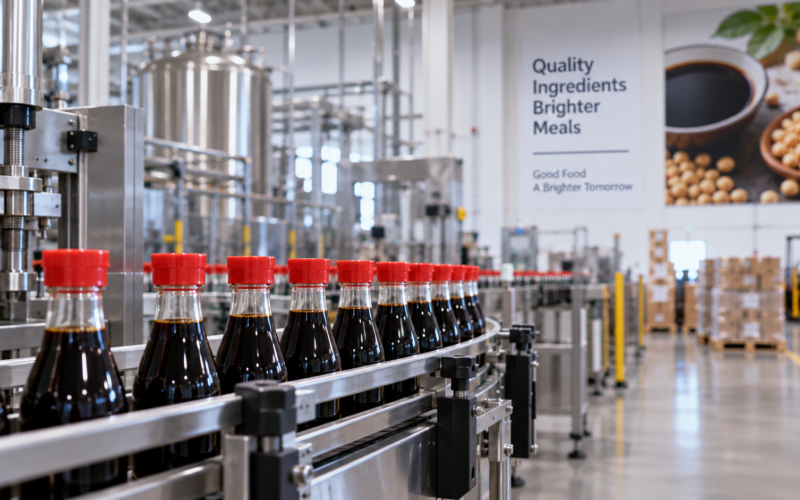
Kikkoman Corporation (Tokyo Stock Exchange: 2801), the Japanese food group best known globally for traditionally brewed soy sauce, has officially opened a new $560 million production facility in Jefferson, Wisconsin, as it expands manufacturing capacity for a North American business that has grown at an average annual rate of more than 6% over the past decade. The 240,000-square-foot plant is Kikkoman’s third U.S. production facility and is expected to begin shipping products during fall 2026, adding capacity alongside its established plants in Walworth, Wisconsin, and Folsom, California. The facility will manufacture soy sauce, teriyaki sauce and other seasonings for retail, foodservice and food-manufacturing customers, giving Kikkoman additional flexibility as Asian flavours move deeper into mainstream American cooking.
The Jefferson project represents approximately $560 million of investment over 10 years, although Kikkoman’s broader Wisconsin expansion is even larger. Wisconsin Economic Development Corporation documents show that the company’s planned investment across Jefferson and an expansion of its existing Walworth brewing operation totals at least $800 million, supported by up to $15.5 million in performance-based state tax credits tied to investment and employment targets. The latest Jefferson opening therefore marks the start of production from a much wider manufacturing commitment rather than the conclusion of Kikkoman’s capital programme in the state.
The timing is commercially important because Kikkoman is entering this additional capacity from a position of underlying growth rather than trying to manufacture its way out of a stagnant category. The company said its North American soy sauce business has expanded at an average annual rate above 6% during the past decade and that it has maintained the leading share of the U.S. soy sauce market for more than 10 years. That creates a different investment equation: Jefferson is designed not merely to defend an established franchise, but to provide production flexibility for further penetration of retail kitchens, restaurants and industrial food manufacturers.
Why is Kikkoman spending $560 million on another U.S. plant after more than 50 years in Wisconsin?
Kikkoman’s American manufacturing story began in Walworth in 1973, when the Japanese company made what was then an unusually ambitious commitment to manufacture traditionally brewed soy sauce inside the United States rather than simply export finished product from Japan. The original Wisconsin operation subsequently expanded dramatically, with Wisconsin Economic Development Corporation reporting that production at the site has increased roughly twentyfold over the decades. The decision to build another facility reflects both the maturity of that original plant and the scale Kikkoman believes the North American market can still support.
The Jefferson plant also gives Kikkoman greater geographic and operational resilience. A manufacturer selling to supermarkets, restaurant groups and industrial customers needs reliable supply in multiple formats, and the new facility has been designed to handle glass packaging, BPA-free plastic containers, industrial formats and bulk products. That matters because the commercial requirements of a household buying a bottle of soy sauce are completely different from those of a food manufacturer ordering ingredients at industrial scale, even when the underlying flavour platform is related.
Kikkoman has consequently designed Jefferson around flexibility rather than a single narrowly defined production line. The company says the plant can handle multiple products and viscosities and includes digital manufacturing tools for paperless operations, real-time data visualisation and improved traceability. That makes the investment as much about modernising the manufacturing architecture behind Kikkoman’s North American business as it is about simply adding more gallons of soy sauce.
The scale of spending is especially notable for a category that might superficially appear mature. Soy sauce has been sold in the United States for generations, but Kikkoman is effectively arguing through its capital allocation that usage occasions can continue expanding as Asian cuisines, fusion cooking, marinades and globally influenced packaged foods become increasingly normal parts of American diets. A $560 million factory is a fairly expensive way of saying management does not believe U.S. soy sauce demand has reached its ceiling.
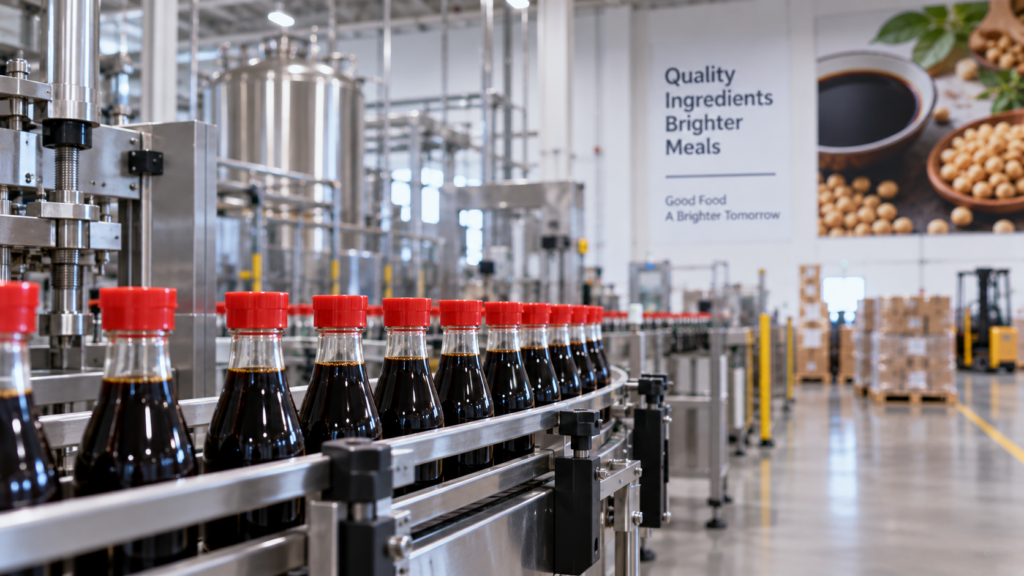
How could Kikkoman’s Jefferson factory help it capture growth beyond traditional soy sauce bottles?
The plant’s product mix provides one of the clearest clues to Kikkoman’s wider strategy. Jefferson will manufacture traditional soy sauce, but it will also produce teriyaki sauce and non-soy-sauce seasonings for retail, foodservice and food manufacturing. This allows Kikkoman to monetise the same brand recognition, fermentation expertise, agricultural supply relationships and distribution infrastructure across a wider universe of products.
That diversification matters because the next phase of growth may come less from convincing existing soy sauce users to consume dramatically more and more from placing Kikkoman flavours into additional meals and formats. Marinades, glazes, stir-fry sauces, prepared meals, restaurant recipes and industrial food applications all enlarge the addressable opportunity without requiring soy sauce to remain confined to its traditional role as a table condiment.
Foodservice and food manufacturing are particularly valuable because they can generate repeat volume without requiring Kikkoman’s name to appear prominently on every final product. A restaurant chain, prepared-food manufacturer or packaged-food company using Kikkoman ingredients can create large recurring demand even when the consumer never sees the ingredient supplier’s branding. Jefferson’s ability to handle bulk and industrial packaging suggests that business-to-business demand is an important part of the capacity strategy, not an afterthought.
There is also a broader demographic tailwind behind the investment. American food preferences have become progressively more international, while flavours that were once associated with specialised ethnic-food aisles increasingly sit inside mainstream grocery categories. Kikkoman Chairman and Honorary Chief Executive Officer Yuzaburo Mogi said in connection with the opening that changing global culinary influences were expanding consumer demand, with Jefferson intended to help the business respond more quickly.
Why did Kikkoman choose Jefferson after reportedly evaluating dozens of Midwestern locations?
Wisconsin was not automatically guaranteed the investment simply because Kikkoman already operated there. Wisconsin Economic Development Corporation said the company considered 64 Midwestern sites during its expansion search, including a shovel-ready location in Ohio, before selecting Jefferson. The decision therefore offers useful insight into what Kikkoman considers important for long-term food manufacturing: agricultural inputs, water availability, labour, logistics and an established state relationship all appear to have weighed in Wisconsin’s favour.
Soy sauce manufacturing has unusually specific physical requirements because traditionally brewed production depends on fermentation and significant volumes of raw ingredients and water. Kikkoman has pointed to Jefferson’s proximity to agricultural suppliers and access to suitable water as important reasons for locating there. Those inputs become increasingly consequential when a manufacturer is planning decades of production rather than leasing a distribution warehouse for a relatively short period.
The state incentive package sweetened the economics but should be placed in context. Wisconsin Economic Development Corporation approved up to $15.5 million in performance-based tax credits linked to Kikkoman’s wider $800 million investment programme, meaning the public incentives amount to a relatively small share of planned capital spending and depend on agreed job and investment milestones. The statewide project was expected to create 83 new jobs over 12 years, while Kikkoman’s latest announcement describes more than 80 high-paying positions associated with its Jefferson and Walworth investments.
This is a highly automated manufacturing investment rather than a labour-intensive factory employing thousands, and that distinction matters when assessing its economic impact. The value proposition for Wisconsin comes from the combination of direct manufacturing employment, construction spending, purchases from agricultural suppliers, logistics activity and the long-term anchoring of a global food company’s production network. For Kikkoman, automation potentially allows a very large capital base to generate incremental capacity without creating an equally large fixed labour burden.
How does the new U.S. factory fit Kikkoman Corporation’s wider growth and financial strategy?
Kikkoman entered the Jefferson opening with relatively strong recent financial momentum. For the three months ended June 30, 2026, the company reported revenue of ¥202.03 billion, up 15% from a year earlier, while business profit increased 29.3% to ¥25.26 billion. Profit attributable to owners of the parent rose 24.3% to approximately ¥19.02 billion, although foreign-exchange movements contributed materially to the reported revenue increase.
The company’s full-year outlook points to another period of top-line expansion. Kikkoman is forecasting revenue of ¥799.1 billion for the year ending March 2027, representing expected growth of 7.2% from ¥745.54 billion in fiscal 2026, while business profit is forecast to increase 3.5% to ¥82.3 billion. The difference between revenue and profit growth also highlights an important issue for investors: new capacity can support longer-term sales expansion but contributes depreciation, staffing and other fixed costs before utilisation reaches mature levels.
Kikkoman has already acknowledged that costs associated with its new U.S. plant are among the factors affecting its near-term outlook. That creates a familiar manufacturing trade-off. Jefferson may initially pressure margins through depreciation and operating expenses, but if North American volumes continue rising, the additional capacity can eventually create operating leverage and reduce the risk that supply constraints limit growth.
The company’s medium-term strategy reinforces this interpretation. Kikkoman has targeted approximately 5% annual sales growth for its North American soy sauce business while seeking to improve its supply structure and optimise logistics, with the third U.S. plant explicitly identified as part of establishing capacity for the expanding market. Across its overseas soy sauce business, management is targeting 6% annual sales growth excluding foreign-exchange effects through fiscal 2028.
What does Kikkoman’s recent share-price weakness say about investor sentiment despite stronger earnings?
Kikkoman Corporation shares closed at ¥1,655 on September 18, 2026, down 1.72% for the session. The stock had closed at ¥1,824.50 on September 3, meaning it declined roughly 9.3% over that period despite the company’s strong first-quarter profit growth and the completion of the Jefferson plant. The shares nevertheless remain well above their 52-week low of ¥1,202, while the recent 52-week high stands at ¥1,867.50.
That price action suggests investors are looking beyond the headline growth rates and weighing valuation, foreign-exchange exposure and the cost of Kikkoman’s capacity programme. Currency translation amplified first-quarter growth, with the weaker yen accounting for a sizeable part of the reported revenue increase, meaning the underlying operating trend is healthier than a stagnant business but less dramatic than the 15% headline revenue increase alone would imply.
The Jefferson opening should therefore not be viewed as an immediate earnings catalyst. Its financial significance is more likely to emerge over several years as utilisation increases, customer volumes build and the company spreads fixed costs across a larger production base. Investors assessing Kikkoman are effectively being asked to balance near-term capital intensity against management’s conviction that North American demand can keep compounding.
That makes shipments from Jefferson more important than the ribbon-cutting itself. If the new plant quickly gains utilisation while Kikkoman preserves pricing and margins, the investment could strengthen the argument that the company still has significant runway in a category where it already holds leadership. If growth slows while fixed costs rise, the same facility could become a drag on returns.
Could Kikkoman’s $800 million Wisconsin commitment become a template for global food manufacturing expansion?
The wider significance of Jefferson lies in the way a multinational food company is combining local production with a globally recognised product. Kikkoman could serve the United States through imports, but manufacturing close to customers reduces transportation complexity, shortens supply chains and gives the company more control over product formats and industrial customer requirements. More than five decades after opening its first Wisconsin plant, Kikkoman is doubling down on that localisation model rather than retreating from it.
The environmental design also points toward how future food plants may be built. Kikkoman says its manufacturing programme is intended to reduce carbon dioxide emissions by more than 50%, cut water consumption per unit by more than 30% and achieve a 100% recycling rate by 2030. For a fermentation-based food producer that depends heavily on water and agricultural raw materials, improvements in resource efficiency can eventually matter economically as well as environmentally.
There are still risks. Agricultural costs can fluctuate, tariffs and currency movements can disrupt reported profitability, consumer demand can weaken and additional manufacturing capacity only creates value when it is sufficiently utilised. Kikkoman is also competing in an increasingly crowded sauce and seasoning market where established packaged-food groups, private-label suppliers and smaller speciality brands are all chasing consumers seeking international flavours.
Even so, the Jefferson facility represents a unusually tangible expression of management confidence. Kikkoman has operated in the United States long enough that this is not an experimental market-entry investment, and its decision to commit hundreds of millions of dollars to incremental capacity follows decades of demand data from the same region.
The more interesting question is therefore no longer whether soy sauce has become mainstream in America. Kikkoman’s new factory suggests that management considers that transition largely established. The strategic question now is how much further the company can extend its manufacturing platform into sauces, seasonings, restaurant kitchens and industrial food production as global flavours continue migrating into everyday American meals.
Discover more from Business-News-Today.com
Subscribe to get the latest posts sent to your email.