



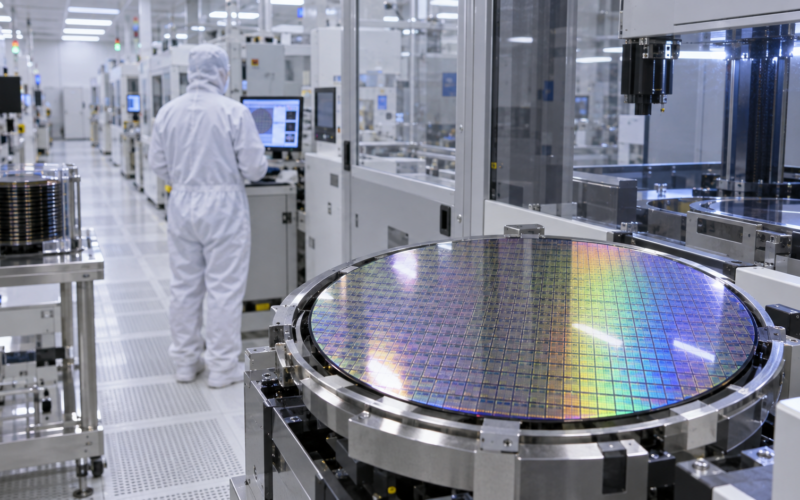
CXMT Corp. (Shanghai STAR Market: 688825), China’s leading domestic DRAM manufacturer, is preparing to expand into NAND flash memory as artificial-intelligence infrastructure tightens supply across the global memory market. Reuters reported on September 18, citing three people familiar with the plans, that CXMT intends to establish a NAND research and development production line at a new Beijing plant and has already discussed the technology with prospective customers. CXMT did not publicly confirm a commercial-production timetable, and Reuters said it remained unclear whether the programme would progress beyond research and trial production into full-scale manufacturing.
The initiative would significantly broaden CXMT beyond its existing DRAM business and place the company into direct competition with global NAND suppliers including Samsung Electronics, SK Hynix and Micron Technology, as well as domestic Chinese specialist Yangtze Memory Technologies Corporation. NAND provides non-volatile storage used across smartphones, computers, enterprise storage and AI data centres, while DRAM serves as working memory for processors.
Why is CXMT entering NAND when DRAM demand is already booming?
The current memory shortage has created an unusually strong pricing environment across both categories. AI servers consume enormous amounts of DRAM and high-bandwidth memory, encouraging manufacturers to prioritise capital spending toward those products. That has constrained investment in NAND capacity at a time when storage demand from data centres is also expanding.
Reuters reported that industry executives expect memory tightness to persist through at least 2027, with SK Hynix Chief Executive Kwak Noh-jung warning that 2027 could become particularly difficult from a supply perspective. TrendForce expects NAND conditions to begin easing only later next year.
That creates an attractive opening for a manufacturer with fresh capital and rapidly expanding fabrication infrastructure. CXMT can continue benefiting from DRAM demand while developing technology that gives it exposure to storage, widening both its customer base and strategic relevance to China’s semiconductor ecosystem.
The timing is also important because AI systems require both computing memory and storage. A Chinese supplier capable of producing multiple memory categories would become more useful to domestic server, device and cloud companies seeking to reduce reliance on imported components.
How strong has CXMT become in DRAM before entering NAND?
CXMT has moved from a relatively small domestic producer into the world’s fourth-largest DRAM manufacturer. Reuters estimated its 2025 market share at approximately 7.7%, behind Samsung Electronics, SK Hynix and Micron but significantly ahead of where the Chinese company stood only a few years earlier.
Its financial growth has been extraordinary during the current memory upcycle. First-quarter 2026 revenue reached approximately 50.8 billion yuan, rising more than sevenfold from a year earlier, while the company moved from losses to substantial profitability.
CXMT then completed Asia’s largest IPO of 2026, raising 57.92 billion yuan, approximately $8.6 billion, through its Shanghai STAR Market listing. The company sold 6.69 billion shares at 8.66 yuan and said proceeds would support production expansion, research and development and working capital.
That equity funding materially changes what CXMT can attempt. Semiconductor research programmes and fabrication plants require billions of dollars before commercial revenue begins, making public-market capital a strategic resource rather than merely a liquidity event for existing shareholders.
How difficult would it be for CXMT to compete with established NAND manufacturers?
NAND is not simply another product that can be added to a DRAM factory. Modern NAND uses vertically stacked memory cells that require specialised manufacturing processes, equipment, controllers and engineering expertise developed over successive generations.
Samsung and SK Hynix have decades of manufacturing experience and enormous research budgets, while Micron and SanDisk remain major global competitors. YMTC has also developed strong domestic capabilities using its own NAND architecture and already holds a significant share of the global market.
CXMT therefore faces both international and domestic incumbents. Reuters said the company has created a Beijing research institute with NAND among its development projects, suggesting the first objective is building technical capability rather than immediately chasing market share.
The absence of a disclosed mass-production timetable reinforces that interpretation. Investors should distinguish a research production line from a qualified, high-volume factory capable of supplying data-centre or smartphone customers reliably.
Why could CXMT’s biggest competitor initially be another Chinese company rather than Samsung?
YMTC already specialises in NAND and has become one of China’s most important semiconductor companies. CXMT’s entry breaks an informal division in which China’s two major memory champions concentrated on different categories: CXMT on DRAM and YMTC on flash storage.
If CXMT moves into commercial NAND production, the two could begin competing for the same domestic server manufacturers, storage-system companies and consumer-electronics customers.
That competition could benefit Chinese buyers by increasing supply and accelerating technological improvement, but it may also duplicate enormous capital expenditure in an industry known for severe boom-and-bust cycles.
The current shortage makes additional capacity look highly attractive. Memory economics can change quickly, however, and factories approved during a shortage can begin production after market conditions have weakened.
How does US technology policy affect CXMT’s expansion?
CXMT has faced US restrictions and has been identified by Washington as strategically sensitive because China is seeking greater semiconductor self-sufficiency. Restrictions on advanced manufacturing tools can make it harder for Chinese chipmakers to access equipment used by global leaders.
Those barriers do not prevent progress, but they influence how quickly Chinese producers can adopt the most advanced processes and how efficiently they can manufacture competitive chips.
CXMT’s domestic importance has consequently increased alongside the restrictions. Chinese customers want alternatives to imported memory, while Beijing and local governments have supported companies capable of reducing external dependence.
Reuters also reported that CXMT is planning another DRAM plant in Beijing following its IPO, demonstrating that the NAND research effort is being pursued alongside continued expansion of the company’s core business rather than replacing it.
What should investors watch before treating CXMT as a NAND competitor?
The first milestone is actual operation of the Beijing R&D line. The second is evidence of a working NAND product capable of meeting customer requirements, followed by qualification with device or data-centre manufacturers.
Commercial capacity would come later. CXMT would need to disclose or demonstrate factory investment, production volumes and competitive yields before the programme can be compared directly with established NAND suppliers.
Market conditions will also matter. If memory shortages persist through 2027, CXMT could enter an unusually supportive pricing environment. If the industry moves into oversupply before meaningful production begins, the economics could look very different.
The September development therefore represents strategic intent rather than finished market entry. CXMT has already proved it can become a significant DRAM supplier. NAND will test whether China’s newest semiconductor-market giant can repeat that rise in a second, technically distinct memory category.
Discover more from Business-News-Today.com
Subscribe to get the latest posts sent to your email.