



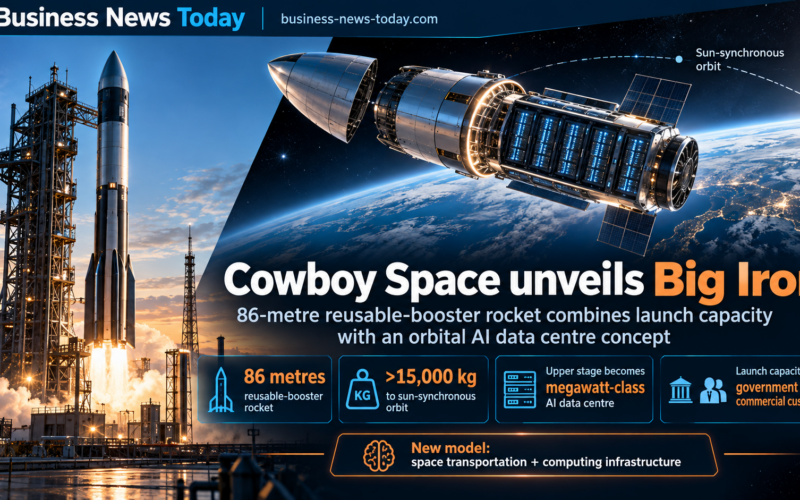
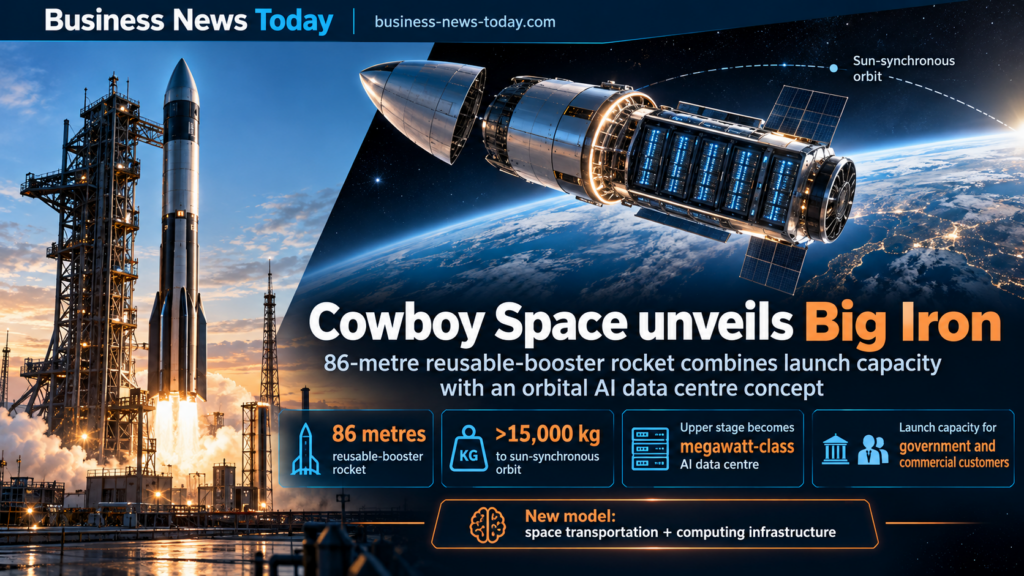
Cowboy Space Corporation, the California-based orbital infrastructure developer founded by Robinhood co-founder Baiju Bhatt, has unveiled Big Iron, a new launch vehicle designed to combine rocket transportation with the deployment of large-scale computing infrastructure in space. Announced on October 26, 2026, the 86-metre rocket is intended to carry more than 15,000 kilograms into sun-synchronous orbit while retaining its upper stage as a megawatt-class orbital data centre. The company simultaneously introduced Big Iron Express, a commercial launch offering aimed at government agencies and third-party customers seeking access to orbital power and payload capacity. The announcement represents an ambitious attempt to integrate two capital-intensive businesses, although the rocket has not yet flown and its proposed operating economics remain unproven.
Big Iron is designed around an unconventional premise: the spacecraft that delivers computing equipment to orbit can also become the structure housing that equipment. Instead of launching a separate satellite and subsequently discarding the upper rocket stage, Cowboy Space intends to transform the stage into part of its planned orbital computing network. Each successful deployment would therefore add computing infrastructure rather than merely transporting a payload.
The vehicle will use a reusable first-stage booster and a second stage that remains in orbit. Cowboy Space plans to integrate power generation, thermal management and computing systems into the spacecraft’s structure, reducing the need for a separate satellite platform. The architecture is intended to support increasingly powerful artificial intelligence workloads while making greater use of components normally associated with launch operations.
Bhatt has argued that the shortage of launch capacity suitable for large orbital computing installations encouraged the business to develop its own rocket. Management believes combining launch and computing infrastructure could eventually reduce orbital computing costs toward parity with terrestrial data centres. That remains a company development objective rather than a demonstrated cost advantage, and its credibility will depend on successful flight testing, commercial deployment and sustained operating performance.
How does the Big Iron rocket turn its upper stage into a one-megawatt orbital AI data centre?
Big Iron’s main technical distinction is the dual use of the upper stage after orbital insertion. Conventional launch vehicles generally deliver a spacecraft or payload to its destination before the upper stage is disposed of or remains as an inactive object. Cowboy Space instead intends to design the upper stage as a functioning orbital data centre from the beginning.
The planned spacecraft would carry five computing racks using NVIDIA Vera Rubin graphics processing technology. Cowboy Space describes each deployed upper stage as a megawatt-class computing installation, allowing successive launches to add capacity to its proposed Stampede orbital network. The announcement establishes the intended configuration but does not disclose completed system-level tests demonstrating one-megawatt continuous operation in orbit.
The company’s design incorporates several components serving different purposes during launch and orbital operation. According to Cowboy Space, the rocket’s external structure will become part of the data centre’s radiator system, while ammonia used in the propulsion architecture will subsequently serve as a coolant. Nitrogen associated with second-stage pressurisation will also support deployment of the spacecraft’s solar arrays.
Using existing structural and mechanical systems for more than one purpose could reduce duplicated mass. Every kilogram assigned to supporting infrastructure affects the mass available for computing hardware, energy systems and other equipment. Designing the launch vehicle and orbital installation together may therefore offer advantages compared with developing the two systems independently.
However, the architecture introduces substantial engineering dependencies. Components designed to survive launch loads must also function reliably throughout the spacecraft’s operating life. Thermal systems, power distribution, structural connections and deployment mechanisms must remain effective after exposure to acceleration, vibration and the transition to the orbital environment.
Cowboy Space has disclosed a deployed configuration measuring approximately 132 metres by 73 metres. These dimensions describe the planned orbital installation after deployment, not the rocket’s dimensions on the launchpad. The large structure is intended to support solar power generation and thermal management, both of which become central requirements for running high-performance computing hardware outside Earth’s atmosphere.
Why is Cowboy Space designing a reusable 86-metre rocket with more than 15,000 kg of launch capacity?
Big Iron’s announced launch performance places it within the market for substantial orbital payload delivery rather than small satellite launch services. The vehicle is designed to carry more than 15,000 kilograms into sun-synchronous orbit, an orbital regime used by many Earth-observation and other spacecraft missions. However, its advertised payload capability is a design target and has not yet been demonstrated through a completed flight.
The rocket’s first stage will use nine Clydesdale engines powered by liquid oxygen and methane. Each engine is designed to generate approximately 300,000 pounds of thrust, according to Cowboy Space. The company selected a gas-generator engine cycle, a propulsion architecture with established historical use, as part of its effort to reduce development complexity.
Methane fuel is intended to support booster reusability. Recovering and reflying a booster can potentially spread manufacturing costs across multiple missions, provided refurbishment requirements, reliability and launch frequency make reuse economical. Big Iron has not yet demonstrated booster recovery or reflight, so the extent of any cost advantage remains theoretical.
The vehicle will incorporate a stainless-steel structure, with dimensions selected partly around practical transportation requirements. Cowboy Space believes designing within road-transport constraints will simplify manufacturing and logistics. This could reduce certain infrastructure requirements, although no independent manufacturing cost comparison has been published.
The planned architecture combines conventional rocket engineering decisions with less conventional orbital reuse of the upper stage. Methane propulsion, reusable boosters and gas-generator engines are recognizable approaches within the launch industry. Using a rocket stage as a permanently operating data centre is the more distinctive and less commercially validated component.
Developing an independent launch system may eventually reduce Cowboy Space’s reliance on outside launch providers. It also creates the possibility of coordinating rocket design, computing hardware and deployment schedules within one organization. Nevertheless, launch vehicle development brings expensive testing requirements and significant failure risks before revenue-generating operations can begin.
What is Big Iron Express, and how could government and commercial customers use the new launch platform?
Big Iron Express is Cowboy Space’s proposed launch offering for external customers. Instead of reserving all launch capability exclusively for its own Stampede computing network, the company intends to make the rocket available to government agencies and third-party payload operators. The service is positioned around access to substantial orbital power and the flexibility to support different mission requirements.
The business model potentially addresses two separate markets. One consists of organizations requiring transportation of spacecraft or other payloads into orbit. The other includes customers that may want access to powered orbital infrastructure, including applications involving computing or processing data close to where it is collected.
Commercial satellite operators, research organizations and government customers have different requirements involving payload mass, destination orbit, deployment conditions and mission assurance. A launch system designed to accommodate third-party configurations could broaden the company’s customer base beyond its own computing deployments. However, the announcement does not establish that every mission will support the same payload configuration or computing capacity.
Cowboy Space has not published a standard launch price, contracted launch backlog or customer list for Big Iron Express. The opening of the commercial offering therefore indicates that the company is seeking outside customers, not that it has already secured government launch awards. Any future commitments would need to be assessed according to their contractual terms, mission requirements and launch schedule.
Government customers represent a potentially significant opportunity because space access is relevant to communications, intelligence, Earth observation and national security activities. Nevertheless, meeting these requirements involves reliability, security and procurement considerations that extend beyond demonstrating launch capability. An unflown vehicle would need to establish the necessary performance history and qualifications before competing for many operational government missions.
The dual-purpose approach also raises a commercial allocation question. Capacity assigned to third-party payloads may affect the resources available for Cowboy Space’s own orbital computing infrastructure, depending on the final mission configuration. The company has not disclosed the mass reserved for outside customers when the upper stage carries its full planned computing installation.
Big Iron Express could eventually diversify revenue by allowing launch-related income to complement orbital computing services. But until customers, pricing and flight performance are established, the additional revenue opportunity cannot be quantified.
Can Big Iron’s orbital data-centre architecture overcome the power and cooling problems facing space-based AI?
High-performance computing infrastructure requires sustained electricity, effective cooling and reliable communications. These requirements are challenging on Earth and become more complicated in space, where hardware must operate under radiation exposure, thermal extremes and limited opportunities for maintenance.
Cowboy Space intends to use solar energy to power its orbital installations. Its planned dawn-dusk orbital configuration is designed to support substantial sunlight exposure, which may improve energy availability compared with orbital arrangements involving frequent periods in Earth’s shadow. However, the final energy output will depend on solar array performance, orientation, operating conditions and system losses.
Thermal management is another demanding aspect of the design. Terrestrial data centres can transfer heat using cooling systems that interact with surrounding air or water. In the vacuum of space, waste heat ultimately must be rejected through radiation, making radiator capacity and thermal-system efficiency especially important.
Cowboy Space’s plan to use the vehicle’s outer structure as part of the thermal management system seeks to avoid carrying a completely separate radiator structure. That approach could reduce mass if successfully engineered. However, it also increases the need to validate how the structure performs under the combined requirements of launch, orbital exposure and sustained computing heat loads.
Electrical capacity should also be distinguished from computing performance. A one-megawatt power system does not by itself establish the number of artificial intelligence computations a spacecraft can perform or the cost of delivering those computations to customers. The actual service depends on processor efficiency, supporting hardware, thermal limits, software utilization and data communications.
Communications represent an additional constraint. Moving substantial amounts of data between Earth and orbit requires sufficient transmission capacity, reliable connectivity and appropriate ground infrastructure. Applications that process information already collected in space may have different economic characteristics from workloads requiring large amounts of data to be transmitted from terrestrial facilities.
Cowboy Space’s strongest initial opportunities may therefore depend on selecting workloads suited to orbital processing rather than assuming every terrestrial AI application can be moved into space without additional cost. The company has not published a verified commercial cost-per-computation comparison supporting its claimed route toward terrestrial price parity.
How do Reason-1, Reason-2 and the Stampede constellation fit Cowboy Space’s 2028 rocket timetable?
Cowboy Space’s development strategy includes several stages intended to validate technologies before the planned first Big Iron flight. The earliest disclosed milestone was achieved on October 1, 2026, when the company’s Reason-1 satellite launched aboard a SpaceX Falcon 9 through the Transporter-18 rideshare mission. The spacecraft represents Cowboy Space’s first hardware placed into orbit.
Reason-1 was developed to demonstrate technologies associated with laser power transmission from orbit to Earth. Its payload includes optical systems, beam steering equipment and elements of the company’s power and thermal architecture. Successfully reaching orbit is a verified milestone, but it should not be confused with confirmation that the planned laser power-beaming demonstration has been successfully completed.
The next mission, Reason-2, is planned for 2027. Cowboy Space intends to operate graphics processing hardware aboard the spacecraft and evaluate its ability to support commercial and government computing workloads. The mission is expected to test processing data in orbit and transmitting relevant results to Earth.
These missions provide an incremental testing approach before the company attempts to deploy much larger installations through Big Iron. Power management, optical communications and hardware operation can be evaluated on smaller spacecraft before committing to a vehicle that combines launch and megawatt-class computing infrastructure.
Cowboy Space is targeting the first flight of Big Iron in 2028. The announcement does not establish a completed development vehicle, launch licence or fixed launch date. The company will need to progress through engine testing, integrated vehicle qualification, manufacturing and regulatory requirements before the system can be demonstrated in flight.
The longer-term plan is to build Stampede, a constellation of orbital computing installations. Cowboy Space has filed an application with the Federal Communications Commission relating to a proposed network of 20,000 satellites. Filing an application is not equivalent to receiving approval, and the proposed constellation should not be described as an authorized or operational network.
The scale of the filing also introduces long-term operational questions involving orbital coordination, communications, space debris and spacecraft disposal. A proposed constellation of that size would require extensive regulatory and technical evaluation. The company has not established that all proposed satellites will be deployed or that they will operate with identical computing configurations.
How does Cowboy Space’s $275 million financing support its proposed orbital computing business?
Cowboy Space announced a $275 million Series B financing round in May 2026 at a reported $2 billion valuation. The financing was led by Index Ventures, with participation from IVP, Blossom Capital and SAIC, alongside existing investors including Breakthrough Energy Ventures, Construct Capital, Andreessen Horowitz, NEA and Interlagos.
The funding followed the company’s evolution from Aetherflux, which was founded in 2024 with a focus on space-based solar energy. The rebranding to Cowboy Space Corporation reflected a broader strategy encompassing power generation, launch systems, optical communications and orbital computing infrastructure. The business is privately held and has not disclosed publicly traded shares.
The Series B valuation represents the terms associated with a private financing transaction, not an independently established market value or cash available for expenditure. Cowboy Space has not published a detailed balance sheet, current liquidity position or development budget for Big Iron. Its financing provides resources for engineering and deployment work but does not establish that the entire planned launch and constellation program is funded.
The company has also announced a collaboration with NVIDIA involving NVIDIA Space-1 Vera Rubin Modules for orbital computing. That relationship supports the technological direction of its planned hardware infrastructure. However, the announcement does not disclose a binding processor purchase value, guaranteed deployment volumes or revenue commitments involving NVIDIA.
For investors supporting Cowboy Space, the financial proposition depends on several linked achievements. The company must develop a reliable launch vehicle, operate power-intensive computing hardware in orbit and attract customers willing to pay for those services. Difficulty in one part of the architecture could affect the economics of the entire platform.
Vertical integration can potentially reduce reliance on suppliers and allow engineering decisions to be coordinated across different systems. It can also concentrate capital requirements and execution risk within one company. Cowboy Space’s ability to manage those trade-offs will determine whether its integrated approach becomes a competitive advantage.
The next financing and commercial milestones will therefore matter alongside technical progress. Evidence of contracted customers, controlled development spending and successful demonstrations would strengthen the financial case. Additional funding may be necessary as the program advances, but no new financing requirement has been quantified in the latest announcement.
Why could Cowboy Space’s rocket strategy matter for the future launch and orbital computing markets?
Big Iron introduces a business model that combines launch transportation with the continued commercial use of a major rocket component. If successful, it could change how the cost of placing computing infrastructure in orbit is allocated between the launch system and the final spacecraft. The upper stage would become part of the revenue-producing infrastructure rather than simply a transportation expense.
The opportunity is not limited to competing with terrestrial data centres. Government agencies and commercial satellite operators may have applications requiring power, processing or other services in orbit. A platform capable of providing such infrastructure could potentially support new mission architectures, although demand and customer willingness to pay remain uncertain.
Competition will extend across several industries. Established launch providers have significant operational experience, while terrestrial data-centre operators benefit from mature infrastructure, large customer networks and established hardware supply chains. Cowboy Space must demonstrate advantages sufficient to overcome the costs and constraints associated with orbital operations.
Regulatory execution will also be central. A new launch vehicle must satisfy applicable licensing and safety requirements, while communications and constellation operations involve separate regulatory considerations. The company’s proposed technology and commercial services cannot become operational simply because the underlying architecture has been disclosed.
The clearest near-term test is whether Reason-1 and Reason-2 deliver useful technical evidence supporting the company’s larger objectives. Successful engine development and an integrated Big Iron flight would then establish whether the launch architecture can function as intended. Sustained operation of a megawatt-class orbital computing installation would represent a further milestone beyond the rocket’s initial success.
Cowboy Space has introduced a distinctive approach to the economics of orbital infrastructure, supported by substantial private investment and an ambitious development schedule. Its commercial proposition remains conditional on engineering performance, customer adoption and capital efficiency. The project will become more credible as the company demonstrates each component independently and then proves that the combined launch-and-compute system can operate at a competitive cost.
What are the key takeaways from Cowboy Space’s Big Iron rocket and orbital data-centre announcement?
Cowboy Space revealed Big Iron on October 26, 2026, with a planned payload capacity exceeding 15,000 kilograms to sun-synchronous orbit and an 86-metre vehicle configuration. Its reusable first stage will use nine liquid oxygen and methane Clydesdale engines, while the upper stage is intended to become a one-megawatt orbital computing installation using NVIDIA Vera Rubin technology. The new Big Iron Express offering opens the proposed launch platform to government and commercial payload customers, although contracts and launch prices have not been disclosed.
The company raised $275 million in Series B financing at a reported $2 billion valuation in May 2026 and launched Reason-1 on October 1. Reason-2 is planned for 2027, followed by Big Iron’s targeted first flight in 2028. Cowboy Space has also applied for a 20,000-satellite Stampede constellation, but approval, deployment and operating economics remain unestablished. The decisive milestones will be successful flight testing, sustained computing operations and evidence that orbital infrastructure can achieve commercially attractive costs.
Discover more from Business-News-Today.com
Subscribe to get the latest posts sent to your email.