




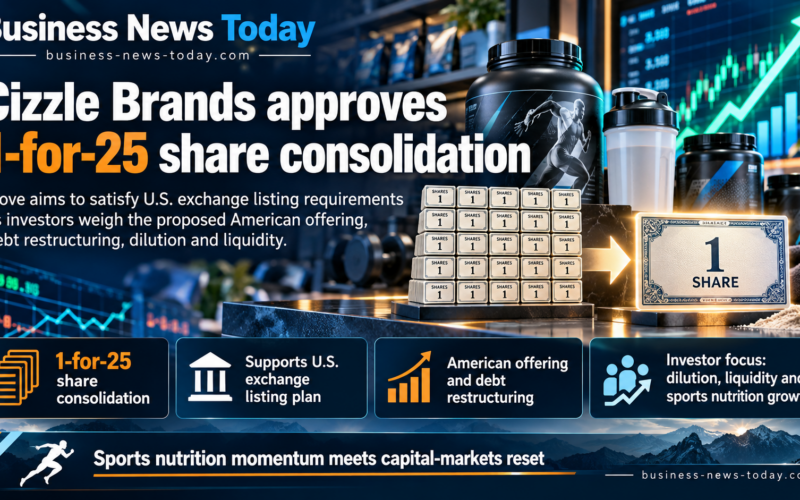
Cizzle Brands Corporation (Cboe Canada: CZZL; OTCQB: CZZLF; Frankfurt: 8YF), the Canadian sports nutrition and beverage business behind CWENCH Hydration, has approved a 1-for-25 consolidation of its outstanding common shares as it advances plans to list on a U.S. national securities exchange. Announced on October 26, 2026, the consolidation is expected to take effect on October 29, subject to final approval from Cboe Canada, and is intended to help satisfy minimum share-price requirements associated with the proposed American listing. The decision follows an October 14 announcement of a planned U.S. underwritten share offering and agreements that could restructure portions of the company’s outstanding debt. Although the proposed listing may broaden access to institutional investors, its financial consequences will depend on offering terms, share dilution, regulatory approval and whether Cizzle Brands can translate rapid revenue expansion into sustainable profitability.
The company expects its consolidated shares to begin trading on Cboe Canada under the existing CZZL ticker on or around October 29. Its current Canadian trading symbol is not expected to change, while adjustments will be made to the exercise prices and share entitlements associated with outstanding convertible securities. Registered and beneficial shareholders generally will not be required to take action to receive consolidated shares.
Cizzle Brands is seeking to strengthen its position in the United States, where its sports hydration and nutritional products have been expanding through retail, distributor and e-commerce channels. Chief Executive Officer John Celenza has positioned the proposed U.S. listing as a means of increasing market visibility and improving access to institutional capital. Management also expects a more suitable share structure to support its broader capital markets strategy.
The announcement confirms approval of the consolidation by the board, not completion of the U.S. exchange listing. The American listing and associated offering remain subject to applicable securities requirements, exchange approval and market conditions. Investors therefore face a sequence of separate events rather than one completed transaction.
How will Cizzle Brands’ 1-for-25 reverse stock split affect existing shareholders and market valuation?
Under the approved structure, every 25 existing Cizzle Brands common shares will be consolidated into one new common share. An investor holding 2,500 shares before the consolidation would ordinarily hold 100 afterward, assuming no fractional adjustment. The investor’s proportionate ownership would remain unchanged by the consolidation itself, provided no other share issuance or conversion occurs.
Cizzle Brands previously reported 230,434,141 common shares outstanding in connection with its October capital markets preparations. Applying the 1-for-25 ratio to that disclosed share count produces approximately 9.22 million post-consolidation shares, before fractional adjustments and any subsequent issuance. The company has indicated that no fractional common shares will be issued and that fractional interests will be rounded down to the nearest whole share.
The consolidation does not automatically increase the underlying value of the business. A shareholder who owns the same economic proportion of a company after a reverse split does not acquire additional enterprise assets or earnings simply because the quoted price per share is higher. The transaction changes the number of shares and their theoretical price relationship, while market trading ultimately determines the actual post-consolidation quotation.
For illustration, Cizzle Brands shares closed at approximately C$0.34 on Cboe Canada on October 26. Multiplying that price by 25 produces a mechanically adjusted reference price of approximately C$8.50 per consolidated share. This is an arithmetic illustration, not a forecast of the opening quotation on October 29 or evidence that the company will satisfy every applicable U.S. listing requirement.
The market price after consolidation may be affected by investor demand, currency movements, financing announcements and other company developments. The conversion from Canadian-dollar trading to a potential U.S.-dollar quotation introduces an additional distinction because American exchange minimum-price requirements are expressed under the relevant exchange’s rules. A higher Canadian-dollar price does not independently establish compliance with the full set of U.S. listing standards.
The more consequential ownership changes could arise from transactions accompanying the listing. New shares issued through an underwritten offering or the conversion of outstanding debt could increase the total share count and reduce the percentage ownership of existing investors. Unlike the consolidation itself, those transactions can cause economic dilution, depending on their final terms.

What remains unresolved in Cizzle Brands’ proposed U.S. exchange listing and underwritten public offering?
Cizzle Brands announced on October 14 that it had commenced an underwritten public offering process in the United States in connection with its proposed exchange listing. Joseph Gunnar & Co. is acting as lead underwriter, with D. Boral Capital serving as co-underwriter. The company has applied to list its shares on a U.S. national securities exchange under the symbol CZZL.
The October announcement did not establish that the listing had been approved or that the offering had been priced and completed. The offering remains subject to market conditions, applicable exchange approvals and the securities registration process. Consequently, investors cannot treat the proposed transaction as cash already received by Cizzle Brands.
On October 23, the company also announced the filing of an offering document under Canada’s Listed Issuer Financing Exemption framework. Research Capital Corporation will act as an agent for Canadian sales associated with the offering. The Canadian component forms part of the previously announced financing rather than representing a separate, independently completed capital raise.
The company has not disclosed definitive pricing, final share issuance or completed gross proceeds for the offering. These details will determine how much capital becomes available and the extent of any dilution. A financing structured at a discount to the prevailing market price could have different shareholder implications from one completed at a premium, even if both improve liquidity.
A U.S. national exchange listing could potentially increase visibility among investors whose mandates or trading systems place restrictions on securities quoted through over-the-counter markets. It may also improve accessibility through institutional brokerage infrastructure and broader market data services. However, institutional ownership and stronger liquidity are possible outcomes rather than guaranteed consequences.
Exchange listing requirements also extend beyond share price. Companies must satisfy applicable standards involving shareholder distribution, governance, financial condition and other listing criteria. The reverse split addresses one element of the process, while formal approval and continued compliance remain separate obligations.
For Cizzle Brands, the financial benefits would be strongest if the offering provides sufficient capital on acceptable terms and the expanded investor audience supports a durable improvement in trading conditions. A listing achieved through substantial dilution without corresponding improvements in operating performance could produce a less favorable outcome for existing shareholders.
How could the proposed U.S. financing and creditor agreements change Cizzle Brands’ debt burden?
The planned equity offering is linked to agreements with certain existing creditors that could materially change Cizzle Brands’ capital structure. Management has announced arrangements involving conversion of all or part of specified convertible notes into common shares. It has also disclosed plans for partial repayment and a maturity extension of the vendor take-back note associated with its acquisition of the CWENCH Hydration Factory.
These arrangements are conditional on completion of the offering. They should not be described as completed debt repayments or conversions merely because the parties have reached agreements about the intended restructuring. The final amount of debt eliminated, the shares issued and the remaining repayment obligations will depend on the implemented transaction terms.
The company’s financial statements for April 30, 2026, demonstrate why balance-sheet restructuring is commercially important. Cizzle Brands reported approximately C$2.49 million in cash against C$45.35 million in current liabilities. These liabilities included approximately C$29.52 million in short-term loans, while long-term loans totaled approximately C$63.20 million.
Total liabilities were approximately C$124.05 million, exceeding reported assets of C$122.73 million at the same date. The difference resulted in negative book shareholders’ equity of approximately C$1.31 million. These figures describe the April financial position and do not represent a verified post-financing balance sheet for October.
Converting debt into equity could reduce repayment and interest obligations while increasing the number of common shares outstanding. Extending a vendor note’s maturity may provide additional time to generate cash from manufacturing and branded product sales. However, both outcomes involve trade-offs between near-term financial flexibility and the future claims of lenders or equity holders.
The acquisition-related financing is particularly relevant because Cizzle Brands expanded its operating scale substantially through the purchase of Flow Water’s co-manufacturing business in December 2025. The facility established a manufacturing platform capable of producing the company’s hydration products and beverages for third-party customers. That strategic expansion increased revenue capacity while introducing a much larger asset and liability base.
A successful capital restructuring could improve the company’s ability to finance inventory, customer growth and manufacturing operations. Yet a reverse split combined with debt conversion and a new share offering does not automatically improve underlying profitability. Investors will need to evaluate the revised share count, net debt and recurring cash generation after the transactions are completed.
Why does Cizzle Brands’ 253% quarterly revenue growth require closer examination of manufacturing margins?
Cizzle Brands’ most recent published quarterly operating results showed a substantial increase in business scale. Revenue for the three months ended April 30, 2026, reached approximately C$12.6 million, compared with C$3.6 million a year earlier. The company reported growth of 253%, reflecting the first full quarter of operations following the acquisition of its manufacturing business.
The manufacturing operation contributed approximately C$9.3 million during the quarter, representing roughly 74% of consolidated revenue. That contribution explains much of the headline expansion and indicates that manufacturing has become a central component of the company’s financial performance. It also demonstrates why year-over-year growth cannot be interpreted exclusively as accelerating consumer demand for CWENCH Hydration or other branded products.
Gross profit increased from approximately C$1.9 million to C$5.4 million, but gross margin declined from 52% to 43%. The change reflected the addition of contract manufacturing activity, which has a different margin profile from branded consumer products, together with investment supporting retail expansion. The lower percentage margin is not necessarily evidence of deteriorating operations, but it changes how revenue growth should be evaluated.
Cizzle Brands reported positive adjusted EBITDA of approximately C$0.3 million, compared with negative C$2.4 million in the corresponding prior-year quarter. Management described this as its first quarter of positive adjusted EBITDA. The achievement indicates an improvement in the company’s preferred measure of operating profitability, although adjusted EBITDA is not equivalent to GAAP net income or free cash flow.
The difference between sales growth and cash generation remains important. Manufacturing requires working capital for production inputs, staffing and customer order fulfillment, while consumer brands require inventory and marketing expenditure to secure retail sales. A fast-growing business can generate higher reported revenue while still requiring external financing to support operations.
The company reported approximately C$21 million in revenue for the first nine months of fiscal 2026, more than double the preceding year’s level. Its next full-year reporting cycle will provide a broader view of how manufacturing and branded products perform across a complete fiscal period. Sustainable improvement would involve maintaining revenue growth while strengthening cash conversion and controlling financing costs.
Can CWENCH Hydration, Spoken Nutrition and HappiEats justify the push for U.S. institutional capital?
Cizzle Brands operates across three consumer-facing product platforms: CWENCH Hydration, Spoken Nutrition and HappiEats. The company has also integrated manufacturing through the CWENCH Hydration Factory, creating a combination of consumer brands and third-party beverage production. This structure exposes the business to different revenue sources and competitive conditions.
CWENCH Hydration is the company’s principal sports hydration brand and has been expanding through retail and sporting partnerships. The business previously announced distribution at 109 Target stores in the United States, alongside additional locations in Canada. More recent disclosures indicate that Cizzle Brands products are carried at over 6,900 locations across Canada, the United States and Europe.
Distribution breadth can support consumer discovery, but store count does not establish sell-through, average revenue per outlet or recurring customer demand. A product may be available through thousands of locations while generating different levels of sales across retailers. The commercial value of expansion depends on product movement, replenishment orders and the economics of maintaining shelf space.
Spoken Nutrition targets customers seeking sports nutrition and supplement products, while HappiEats includes products such as Sport Pasta and SnakStars Sport Bites. These categories potentially extend the company’s relationships with health-conscious consumers beyond beverages. However, expanding across several product categories also requires investment in product development, inventory and marketing.
Cizzle Brands has strengthened brand exposure through sporting relationships, including agreements associated with the Toronto Maple Leafs, USA Lacrosse and other athletic organizations. Such partnerships can support credibility and customer awareness within sports communities. Their financial effectiveness depends on whether recognition translates into additional sales at commercially attractive margins.
The manufacturing business introduces another dimension. Cizzle Brands reported that the facility had approximately C$184 million in remaining contracted production volume at the time of acquisition, including minimum purchase commitments under certain arrangements. That amount relates to a multiyear manufacturing pipeline rather than revenue already recognized or a guarantee of immediate cash receipts.
Institutional investors evaluating the company may distinguish between the margin potential of branded products and the scale associated with contract manufacturing. Both activities can contribute to the business, but their financial characteristics differ. Greater disclosure of segment profitability and operating cash flow would help establish which parts of the platform generate the strongest economic returns.
How did CZZL shares perform before the proposed October 29 consolidation, and what could influence sentiment?
Cizzle Brands shares closed at approximately C$0.34 on Cboe Canada on October 26, 2026, unchanged from the previous trading session. The reported annual trading range extended from approximately C$0.26 to C$0.51. The closing price placed the shares below the upper end of that range and provides a reference point for understanding the planned consolidation.
Trading activity was relatively limited, with approximately 5,500 shares reported traded during the October 26 session by one market-data provider. Low trading volume can make quoted prices sensitive to relatively small transactions and may complicate the process of establishing a consistent market valuation. A proposed U.S. listing could potentially broaden the trading audience, but greater liquidity remains an objective rather than a demonstrated outcome.
The October 29 consolidation represents the next announced capital markets milestone. Its completion would adjust the number of outstanding shares, but the central financial questions would remain unresolved until the offering and proposed debt arrangements are finalized. The timing and terms of those transactions could exert a greater influence on shareholder economics than the mechanical consolidation itself.
An optimistic interpretation would focus on improved institutional accessibility, a reduced debt burden and the company’s expanding manufacturing and branded product operations. A more cautious assessment would emphasize potential dilution, historical balance-sheet pressure and the difference between adjusted EBITDA improvement and sustainable cash generation. These interpretations are linked to disclosed facts rather than unverified claims about investor positioning.
The next measurable evidence will come from final offering pricing, exchange approval and a post-transaction capital structure showing the amount of new equity and remaining debt. Subsequent financial results should demonstrate whether the company can maintain growth while improving cash flow and margins. Without those developments, a higher nominal share price would represent a change in trading structure rather than proof of additional shareholder value.
What are the key takeaways from Cizzle Brands’ U.S. listing strategy and share consolidation?
Cizzle Brands approved a 1-for-25 share consolidation intended to take effect on October 29, 2026, subject to Cboe Canada approval. The transaction is designed to help meet U.S. exchange minimum share-price criteria, but the American listing has not yet been completed. The company is pursuing an underwritten share offering alongside conditional creditor agreements involving convertible debt and its manufacturing acquisition financing.
The business reported 253% quarterly revenue growth to C$12.6 million, with C$9.3 million generated by the acquired manufacturing operation. Adjusted EBITDA turned positive at approximately C$0.3 million, while gross margin declined to 43%. CZZL shares closed at C$0.34 on October 26, implying a purely mechanical post-consolidation reference price of C$8.50. The investment case will depend on the financing terms, dilution, debt restructuring and evidence that expanding revenue can support sustainable profitability.
Discover more from Business-News-Today.com
Subscribe to get the latest posts sent to your email.

