



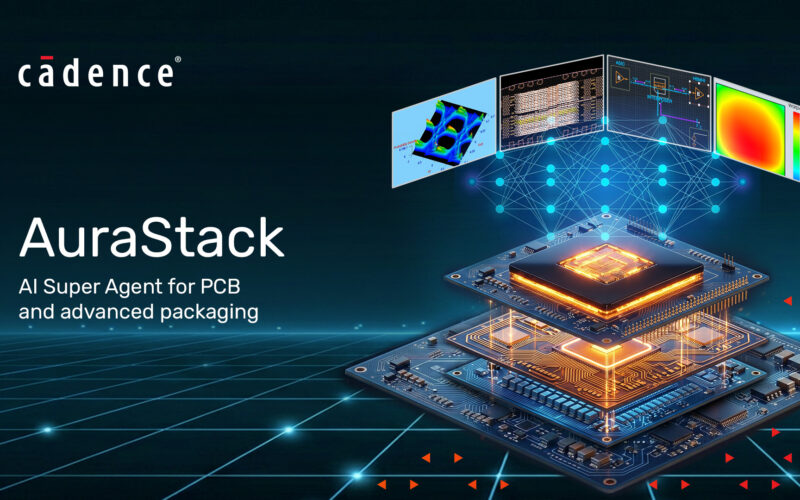
Cadence Design Systems, Inc. (NASDAQ: CDNS) introduced the AuraStack AI Super Agent on July 15, 2026, extending its agentic artificial intelligence portfolio into printed circuit board and advanced semiconductor packaging design. Running on Allegro AI Studio and accelerated by NVIDIA Blackwell and NVIDIA CUDA-X, AuraStack coordinates specialised agents across system planning, physical implementation, manufacturability and multiphysics analysis. Cadence described the platform as the first agentic artificial intelligence environment spanning printed circuit board and advanced packaging workflows, while claiming it completes an agent portfolio extending from digital and analog silicon to entire electronic systems. Strategically, the product strengthens Cadence’s effort to become the orchestration layer for increasingly complex electronics development rather than remaining a supplier of separate design tools. The tension is that AuraStack will only become commercially available later in 2026, and its claims of up to twice the speed to market and 15 times higher productivity still require broader evidence from production deployments.
How does AuraStack extend Cadence’s agentic AI strategy from chip design into complete systems?
AuraStack fills an important gap in the agentic artificial intelligence architecture Cadence has assembled during 2026. ChipStack handles front-end chip design and verification, ViraStack supports analog and custom design, and InnoStack targets digital implementation and signoff. AgentStack provides the higher-level orchestration framework through which these specialised systems can share knowledge and coordinate work.
AuraStack extends that structure beyond the semiconductor die into the package and printed circuit board. It brings system planning, constraints management, physical structure definition, intellectual property reuse, component placement, routing, manufacturability and multiphysics analysis into one artificial intelligence-guided environment.
This matters because semiconductor development does not end when a chip reaches signoff. The device must still be integrated into a package, connected to other components, powered, cooled and placed within an electronic system that can survive its intended operating environment. A high-performance chip that cannot be cooled efficiently or connected without signal degradation will not deliver its theoretical capabilities at the system level.
Cadence is therefore moving from automating individual engineering tasks toward coordinating the complete chain of decisions connecting silicon, packages and circuit boards. AuraStack uses a shared representation of design intent, which Cadence calls a mental model, to provide different agents with consistent information about specifications, constraints, architecture and earlier engineering decisions.
The distinction between an assistant and a super agent is commercially significant. A conventional assistant may answer questions or generate scripts when prompted. An agentic platform can determine which tools should be invoked, evaluate intermediate results, identify conflicts and iterate toward defined engineering objectives. Engineers remain responsible for architecture, constraints and approval, but repetitive exploration and execution can be distributed across multiple artificial intelligence agents.

Why are advanced packaging and PCB workflows becoming a strategic bottleneck for AI hardware?
Artificial intelligence infrastructure is increasing the amount of computing, memory, networking and power that must be concentrated within individual systems. Advanced accelerators increasingly depend on high-bandwidth memory, chiplets, complex substrates and high-speed interconnects. The challenge is no longer confined to improving transistor density.
Electrical, thermal and mechanical behaviour now interact throughout the design. A routing decision can influence signal integrity, power delivery and heat distribution. Packaging materials and physical geometry can affect mechanical stress, vibration resistance and long-term reliability. Cooling requirements can change placement decisions elsewhere in the system.
Traditional engineering processes often address these domains through separate teams and sequential reviews. Electrical designers may complete significant work before thermal or mechanical specialists identify an issue that requires the layout to be changed. The later the problem is found, the more expensive the redesign and verification cycle becomes.
AuraStack attempts to reduce this sequential delay by continuously feeding electrical, thermal and mechanical analysis into the design process. Cadence said the platform can model and optimise signal integrity, power integrity, temperature, mechanical stress, drop, vibration and fatigue within a closed-loop environment.
The company is targeting up to twice the speed to market and 15 times higher productivity through automation and expanded design exploration. Those figures should be understood as performance claims rather than universal outcomes. Actual improvement will depend on the starting workflow, design complexity, amount of reusable intellectual property, integration quality and the level of manual work already automated.
The larger strategic opportunity is not merely completing the same design faster. Artificial intelligence could allow engineering teams to evaluate more alternatives before committing to a final architecture. That may improve reliability, performance and manufacturability while reducing late-stage changes. For customers developing expensive AI servers, automotive electronics or aerospace systems, preventing a package or circuit-board respin may carry greater value than reducing the time required for an individual task.
How does AuraStack turn Cadence’s multiphysics acquisitions into an integrated product advantage?
AuraStack also provides an early demonstration of how Cadence intends to monetise its expansion beyond traditional electronic design automation. In February 2026, Cadence completed its approximately €2.7 billion acquisition of Hexagon AB’s Design and Engineering business, adding structural analysis, acoustics and multibody dynamics technologies to its System Design and Analysis portfolio.
The acquisition brought products including MSC Nastran and other mechanical simulation technologies into Cadence. AuraStack now combines MSC Nastran and Marc mechanical solvers with existing Cadence technologies such as the Celsius Thermal Solver, Clarity 3D Solver, Sigrity X Platform and Allegro AI Studio.
This integration has strategic importance because it connects the acquired mechanical-analysis capabilities with Cadence’s installed electronic-design workflows. Instead of selling mechanical simulation as a separate product category, Cadence can embed it into an agentic design loop that begins with system planning and continues through implementation and signoff.
A unified environment could increase cross-selling across the Cadence portfolio. Printed circuit board customers may gain access to thermal and mechanical analysis earlier in development, while simulation customers may become more deeply connected to Cadence’s package and circuit-board tools. Successful integration would also make customer workflows more dependent on shared data, automation and design history across the Cadence platform.
AuraStack is therefore part product launch and part capital-allocation test. The Hexagon Design and Engineering acquisition expanded Cadence’s addressable market, but the transaction will create greater strategic value if those assets improve the performance of the wider portfolio rather than operating as an adjacent software collection.
Integration remains an execution challenge. Different simulation tools may use distinct models, data structures and specialist workflows. Cadence must provide a consistent source of design truth without oversimplifying the physics required for reliable signoff. Faster iteration only creates value if customers retain confidence in the accuracy and traceability of the underlying engineering results.
What do NVIDIA, TSMC and early industrial collaborators reveal about AuraStack adoption?
Cadence disclosed collaborations with NVIDIA Corporation, Taiwan Semiconductor Manufacturing Company Limited, Socionext Inc., FORVIA HELLA and Schneider Electric SE. The range of participants indicates that AuraStack is aimed at more than one semiconductor workflow.
NVIDIA is using Cadence technology to automate and optimise complex system-design processes. The company said the combination of AuraStack and the Cadence Millennium M2000 Supercomputer can provide up to 20 times faster multiphysics performance. That claim relates to accelerated simulation capacity and should not be treated as a direct measure of total engineering-cycle reduction.
Cadence is also working with Taiwan Semiconductor Manufacturing Company Limited on advanced package implementation and the TSMC 3DFabric ecosystem. Taiwan Semiconductor Manufacturing Company Limited said an existing multi-year collaboration on substrate auto-routing had enabled productivity improvements of up to 100 times while producing results comparable with manual routing. That benchmark validates a specific automation workflow, not every function within the full AuraStack environment.
FORVIA HELLA supplied another tangible example involving Cadence’s artificial intelligence-assisted placement technology. According to the automotive supplier, placing 300 components previously required as long as four days, while the automated process completed the task in approximately four minutes. Again, the example demonstrates the capability of an underlying workflow rather than proving the performance of the entire newly introduced platform.
Socionext is applying Cadence technology to package and printed circuit board automation, including signal integrity, power integrity and thermal workflows. Schneider Electric is examining how design automation can preserve and distribute engineering knowledge across teams.
These collaborations improve the credibility of Cadence’s strategic direction because they connect agentic artificial intelligence with real engineering problems. However, they do not yet establish general commercial adoption. Cadence did not disclose AuraStack pricing, customer numbers, recurring revenue expectations or the proportion of the announced collaborators that will become paying production users.
Can Cadence defend its competitive positioning as rival engineering platforms converge?
Cadence characterised AuraStack as the world’s first agentic artificial intelligence platform for printed circuit board and advanced packaging design and said it is the only provider with agentic solutions spanning the full electronic system flow. Those are company claims that should be viewed within a rapidly changing competitive market.
Synopsys, Inc. completed its acquisition of Ansys, Inc. in 2025, combining semiconductor design software with a broad simulation and analysis portfolio. Synopsys is now developing agentic artificial intelligence workflows and integrated multiphysics products covering silicon, multi-die systems and wider engineering applications.
Siemens Digital Industries Software is also expanding Fuse, its generative and agentic artificial intelligence system for semiconductor and printed circuit board design. These competitors are pursuing a similar strategic destination: integrating electronic design, simulation, artificial intelligence and system-level engineering within fewer platforms.
Cadence’s potential advantage is the breadth of working tools available to AuraStack and the company’s ability to connect them through a common representation of design intent. Trusted signoff engines, foundry relationships and integration with existing customer environments may provide barriers that a general-purpose artificial intelligence company would struggle to reproduce.
The competitive moat will nevertheless depend on execution rather than the timing of a product announcement. Customers are unlikely to transfer critical engineering workflows merely because one provider used the agentic artificial intelligence label first. They will assess accuracy, integration effort, security, computing requirements, interoperability and whether productivity improvements are repeatable across multiple projects.
Cadence must also balance platform integration with customer flexibility. Engineering organisations often use products from several vendors. If AuraStack works effectively only inside a fully Cadence-controlled environment, it may deepen adoption among existing customers but face resistance from mixed-tool organisations. Strong integration with external data and established customer processes could widen its addressable market.
What does the AuraStack launch mean for Cadence revenue growth and operating leverage?
AuraStack arrives while Cadence is reporting strong demand across its existing artificial intelligence portfolio. First-quarter 2026 revenue reached $1.474 billion, up approximately 19% from $1.242 billion in the prior-year period. GAAP operating margin was 29.3%, while non-GAAP operating margin increased to 44.7%.
Quarter-end backlog reached a record $8 billion, with $4 billion of remaining performance obligations expected to be recognised within the following 12 months. Cadence raised its full-year 2026 revenue guidance to between $6.125 billion and $6.225 billion, implying approximately 17% growth at the midpoint.
Both Core Electronic Design Automation and System Design and Analysis revenue increased 18% year on year during the first quarter. AuraStack connects those two categories by combining circuit-board implementation, package design and multiphysics simulation. That creates a potential route to larger customer deployments and higher portfolio attachment.
The immediate financial contribution remains unclear because AuraStack will only become available later in 2026. Cadence has not said whether it will be sold as a premium Allegro AI Studio capability, included within broader enterprise contracts or licensed through separate agent, compute or workflow-based arrangements.
Artificial intelligence products may improve operating leverage if Cadence can charge for higher-value automation without a comparable increase in customer-support costs. However, advanced deployments may initially require engineering services, integration work and accelerated computing capacity. The eventual margin impact will depend on product packaging, cloud usage, deployment complexity and customer support requirements.
The upcoming second-quarter results on July 27 will not provide a full AuraStack revenue test because commercial availability is still ahead. They can nevertheless show whether broader demand for Cadence’s artificial intelligence portfolio, System Design and Analysis products and acquired Hexagon technologies remains consistent with the company’s raised guidance.
Why did $CDNS shares weaken before AuraStack and what does sentiment signal now?
Cadence Design Systems shares closed at $371.50 on July 15, down 1.41% during the regular session and marking a fourth consecutive decline. The AuraStack announcement was released after the closing bell, meaning the session’s fall should not be interpreted as a response to the product launch.
The stock was approximately 3.7% below its July 9 close and about 5.8% below its June 15 level. It remained 10.8% beneath its 52-week high of $416.69 but approximately 41.4% above its 52-week low of $262.75.
After-hours trading produced only a marginal move, with the shares last indicated at approximately $371.81, up around 0.08%. Such a limited after-hours change is not sufficient to establish a durable market verdict, particularly when trading liquidity is lower outside the regular session.
At the July 15 close, Cadence carried a market capitalisation of approximately $101.7 billion and a trailing price-to-earnings multiple near 87. That valuation reflects substantial confidence in long-term growth, recurring customer relationships and Cadence’s position within semiconductor and artificial intelligence infrastructure development.
Sentiment therefore appears strategically positive but valuation-sensitive. AuraStack reinforces the narrative that Cadence can expand from chip design into package, circuit-board and system-level engineering. A sustained share-price rerating, however, will likely require commercial adoption, continued backlog growth and evidence that artificial intelligence products support revenue expansion without weakening margins.
What evidence will show whether AuraStack becomes a durable Cadence growth platform?
Cadence has completed an important architectural step by extending its agentic artificial intelligence portfolio from silicon design into advanced packaging, printed circuit boards and multiphysics analysis. AuraStack also creates a practical connection between Allegro AI Studio, NVIDIA accelerated computing and the mechanical-simulation assets acquired from Hexagon.
What remains unresolved is commercial scale. Cadence must demonstrate availability on schedule, repeatable customer productivity, reliable design convergence and clear economic value across more than a small group of development partners.
The strongest evidence would include broader production deployments, measurable reductions in design-cycle duration, fewer late-stage respins and increased use of System Design and Analysis products among existing electronic-design customers. Higher enterprise adoption and improving portfolio attachment would strengthen the strategic thesis.
Delays, inconsistent results across complex designs or heavy implementation requirements could weaken the proposition. AuraStack has expanded Cadence’s technological reach, but the next test is turning an ambitious silicon-to-system architecture into recurring revenue and defensible operating leverage.
What are the key takeaways from Cadence AuraStack for $CDNS investors and engineering customers?
- Cadence Design Systems introduced AuraStack as an agentic artificial intelligence platform for printed circuit board and advanced packaging workflows.
- AuraStack extends Cadence’s AI Super Agent portfolio beyond digital and analog chip design into full electronic systems.
- The company claims up to twice the speed to market and 15 times higher productivity, although broader production evidence is still required.
- The platform combines electrical, thermal and mechanical analysis within a closed-loop design environment intended to reduce late-stage rework.
- AuraStack integrates acquired Hexagon technologies such as MSC Nastran and Marc with Cadence products including Celsius, Clarity, Sigrity X and Allegro AI Studio.
- NVIDIA Corporation, Taiwan Semiconductor Manufacturing Company Limited, Socionext Inc., FORVIA HELLA and Schneider Electric SE are collaborating with Cadence on related workflows.
- Competition remains active as Synopsys, Inc. integrates Ansys capabilities and Siemens Digital Industries Software expands its Fuse artificial intelligence platform.
- Cadence entered the launch with $8 billion of backlog and full-year revenue guidance of $6.125 billion to $6.225 billion.
- $CDNS closed at $371.50 before the announcement, around 10.8% below its 52-week high, while the limited after-hours move did not establish a clear market reaction.
- Commercial availability, customer adoption, realised productivity and the July 27 earnings update are the next measurable catalysts.
Discover more from Business-News-Today.com
Subscribe to get the latest posts sent to your email.