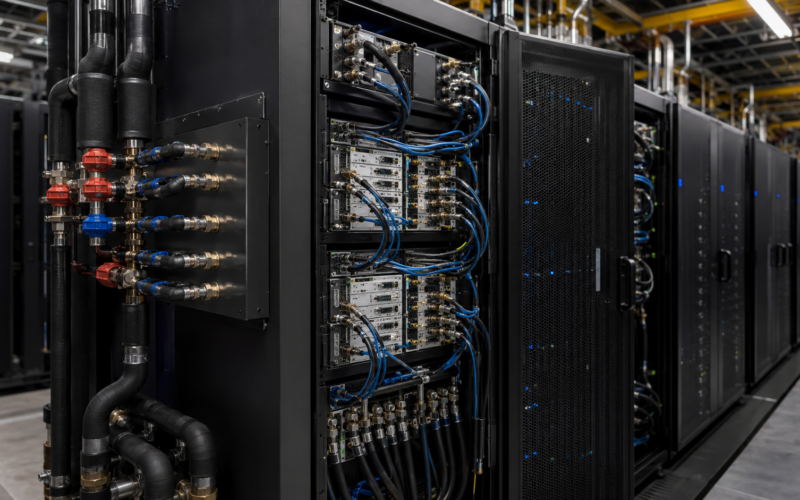
Ecolab Inc. (NYSE: ECL) has completed its approximately $4.75 billion cash acquisition of CoolIT Systems, bringing direct liquid cooling hardware for high-density data centers into its expanding Global High-Tech business. The transaction closed on July 2, 2026, earlier than initially expected, after Ecolab secured financing and regulatory approvals for one of the largest acquisitions in its history. CoolIT Systems adds coolant distribution units, cold plates and direct-to-chip cooling technology used to remove heat from artificial intelligence processors more efficiently than conventional air-based systems. Ecolab now plans to combine those technologies with its existing water treatment, chemistry, digital monitoring and global service capabilities. The strategic question is whether Ecolab can justify a premium acquisition valuation by becoming an essential infrastructure provider across semiconductor manufacturing, power generation and AI data center operations.
Why has Ecolab paid a premium valuation to acquire CoolIT Systems now?
Artificial intelligence infrastructure is becoming constrained by factors that extend well beyond the availability of processors. Data centers must obtain sufficient electricity, connect to transmission networks, manage heat and secure access to water without creating unacceptable costs or environmental pressure.
As computing racks become denser, traditional air cooling becomes less effective. Fans and air-conditioning equipment must work harder to move heat away from processors, increasing electricity consumption while limiting the number of chips that can operate within a given space.
Direct liquid cooling moves specially managed fluid closer to the processors generating heat. Liquid can absorb and transport heat more efficiently than air, allowing operators to deploy higher-density systems while potentially reducing the electricity required for cooling.
CoolIT Systems designs coolant distribution units, cold plates and direct-to-chip cooling systems that support this transition. The company is expected to generate approximately $550 million in sales over the 12 months following the original transaction announcement, while year-to-date sales had increased by more than 100% by the time the acquisition closed.
Ecolab is paying approximately 29 times CoolIT Systems’ estimated next-12-month adjusted EBITDA and 24 times estimated 2027 adjusted EBITDA. Those multiples are high for an industrial technology acquisition and indicate that Ecolab is pricing the target according to anticipated AI infrastructure growth rather than its current earnings alone.
The valuation therefore leaves limited room for ordinary execution. CoolIT Systems must maintain strong sales growth, protect its technology position and expand alongside hyperscale and semiconductor customers. A respectable industrial performance would not be enough to justify a price built around exceptional growth.
However, waiting for the liquid cooling market to mature could have been equally costly. Once direct liquid cooling becomes standard equipment across advanced data centers, established suppliers may become more expensive, strategically unavailable or tied more closely to competing infrastructure groups.
Ecolab has chosen to pay for early strategic control rather than risk entering the market after customer relationships, technical standards and preferred-vendor positions become more difficult to change.

How does CoolIT transform Ecolab from a water-treatment supplier into an AI infrastructure platform?
Ecolab’s historic position has centred on water, sanitation, industrial treatment chemistry and operational services. The company supplies customers across food production, hospitality, healthcare, manufacturing, energy and other water-intensive industries.
That background may appear distant from artificial intelligence, but the physical AI supply chain depends heavily on water. Semiconductor factories require ultra-pure water to manufacture advanced chips. Power plants require water systems to generate electricity reliably. Data centers require thermal management systems to remove heat from computing equipment.
Ecolab strengthened the first part of this chain through its $1.8 billion acquisition of Ovivo Electronics, which added ultra-pure water technologies used in semiconductor manufacturing. CoolIT Systems now adds direct liquid cooling at the data center level.
The combined portfolio gives Ecolab exposure to three connected stages of AI infrastructure. It can support the factories producing advanced processors, the power systems supplying data centers and the cooling systems protecting operating hardware.
This is strategically more valuable than owning a standalone cooling-equipment company. Ecolab can combine hardware with water chemistry, fluid monitoring, treatment programmes, digital optimisation and field service.
A coolant distribution unit requires more than mechanical installation. Operators must monitor fluid quality, corrosion, leaks, temperature, pressure and system performance across the operating life of the data center. Ecolab already has service infrastructure and customer relationships built around continuous industrial monitoring.
The acquisition therefore shifts Ecolab’s value proposition from supplying treatment products to managing a critical operating system. Recurring service, chemistry and monitoring revenue could eventually become as important as the initial sale of cooling hardware.
The platform strategy also increases customer relevance. Semiconductor companies, hyperscale cloud providers and data center developers may prefer suppliers capable of coordinating water and cooling performance across several facilities rather than purchasing isolated components from multiple vendors.
Can Ecolab’s planned cooling platform reduce the power and water burden of AI data centers?
Ecolab plans to introduce an integrated cooling platform combining CoolIT Systems hardware with its 3D TRASAR digital technology, advanced cooling fluids and water-management expertise. The company expects to present the platform at the Supercomputing event in Chicago in November 2026.
The proposed system is intended to provide real-time visibility into cooling performance, water conditions and power efficiency. Coolant distribution units and cold plates would manage heat removal, while digital tools would monitor operating conditions and identify performance issues.
This could produce three forms of customer value. Better thermal control can improve computing reliability, lower cooling electricity consumption and support higher processor density within existing facilities.
Water efficiency is equally important. Many communities are becoming more sensitive to the water requirements of large data center developments, particularly in regions already facing drought, population growth or competing industrial demand.
Closed-loop liquid cooling systems can recirculate fluid rather than continuously consuming large volumes of fresh water. Ecolab believes its combined technology can help move data centers toward a near-zero water footprint for cooling.
That objective will depend on system design and local operating conditions. A data center’s total water consumption may also include electricity-generation requirements, humidity management and other facility processes that are not eliminated by direct liquid cooling.
Ecolab must therefore avoid presenting liquid cooling as a universal solution to the environmental impact of artificial intelligence. The technology can improve efficiency, but rapidly expanding computing capacity may still increase total electricity and water demand.
The commercial opportunity arises from that tension. Customers need to add computing capacity, but they face tighter limits on power, water and community acceptance. A supplier capable of reducing resource use per unit of computing may become increasingly important even if absolute consumption continues to rise.
What does the $5 billion debt financing reveal about Ecolab’s capital-allocation risk?
Ecolab financed the acquisition through an approximately $5 billion bond offering completed in May 2026. The financing included $1.2 billion of notes due in 2029, $900 million due in 2031, $1.5 billion due in 2033 and $1.4 billion due in 2036.
The four tranches carry interest rates ranging from 4.6% to 5.35%. This spreads repayment obligations across several years and reduces the refinancing risk that would arise if the entire acquisition debt matured at one time.
The financing also demonstrates Ecolab’s willingness to place a significant balance-sheet commitment behind its high-tech strategy. CoolIT Systems was not funded with excess cash or a small bolt-on allocation. It required a capital-markets transaction comparable in size to the acquisition price.
Debt financing avoids immediate shareholder dilution, but it creates a fixed cost that must be supported regardless of whether CoolIT Systems meets its growth targets. Interest expense will reduce near-term earnings and absorb cash that could otherwise support dividends, repurchases or additional investment.
Ecolab has said the transaction will reduce adjusted diluted earnings per share by approximately $0.20 in both the third and fourth quarters of 2026, primarily because of financing costs and non-cash amortisation. The company consequently expects full-year adjusted diluted earnings per share of $8.03 to $8.23, representing growth of 7% to 9%.
The reduction does not necessarily indicate that CoolIT Systems is operationally unprofitable. Acquisition accounting creates amortisation expenses, while the debt cost is incurred immediately even though commercial synergies and customer expansion take longer to develop.
Ecolab expects earnings growth to return to its longer-term 12% to 15% range as the acquired business contributes more strongly and certain historical amortisation expenses decline after 2027.
The capital-allocation test will therefore extend beyond initial revenue growth. CoolIT Systems must generate sufficient cash returns to cover the cost of debt, compensate for the acquisition premium and produce returns above Ecolab’s alternative uses of capital.
Why is Ecolab targeting $4 billion in Global High-Tech revenue by 2030?
Ecolab’s Global High-Tech business generated approximately $150 million in annual sales in 2021. Following the acquisitions of Ovivo Electronics and CoolIT Systems, the division is approaching approximately $1.5 billion in annualised 2026 sales.
Management now targets $4 billion of annual revenue by 2030 with operating income margins of approximately 25%. That would require the business to add about $2.5 billion in annual sales over roughly four years.
CoolIT Systems is central to that ambition because its sales are growing much faster than Ecolab’s traditional businesses. Ecolab expects the Global High-Tech unit to grow at more than 25% annually and contribute more than two percentage points to company-wide annual sales growth.
The 25% margin target also indicates that management does not view CoolIT Systems as a conventional equipment manufacturer. Hardware businesses often face component costs, manufacturing investment and pricing pressure that limit margins.
Ecolab expects to create higher economics through technology, services, chemistry, digital monitoring and customer integration. Initial hardware sales may open the relationship, but lifecycle service and optimisation should increase the value generated from each installation.
The target is ambitious because the cooling market is becoming crowded. Vertiv Holdings, Schneider Electric, Johnson Controls International, Carrier Global and several specialist providers are expanding liquid-cooling capabilities.
Server manufacturers and chip companies are also influencing technical standards. Customers may select systems based on compatibility with particular processors, rack designs or data center architectures, limiting the ability of one supplier to control the full solution.
Ecolab’s advantage is that it does not compete primarily as a server or processor company. It can position itself as a neutral provider focused on thermal performance, water efficiency and operational reliability across several computing architectures.
The risk is that the company becomes dependent on an industry where product cycles move far faster than in its traditional water and hygiene markets. Ecolab must preserve CoolIT Systems’ engineering speed while applying the controls of a large industrial organisation.
How could integration determine whether Ecolab captures or destroys CoolIT’s growth premium?
CoolIT Systems was attractive partly because it operates with the focus and speed of a specialist company. Its engineers develop products around changing processor designs, higher rack densities and evolving customer requirements.
Ecolab is a far larger organisation with operations across more than 170 countries and approximately $16 billion in annual sales. Its systems, approval processes and risk controls are designed for scale and consistency.
The integration challenge is to combine these strengths without allowing one to weaken the other. CoolIT Systems needs Ecolab’s customer reach, financial resources, chemistry expertise and service network. Ecolab needs CoolIT Systems’ technical speed, hardware capabilities and data center credibility.
Excessive centralisation could slow product development or make it harder for engineers to respond directly to hyperscale customers. Insufficient integration could prevent the expected cross-selling, digital optimisation and recurring service opportunities from materialising.
Employee retention will also matter. Cooling hardware, fluid design and thermal engineering require specialised knowledge. Intellectual property remains useful after employees leave, but the ability to develop the next generation of products depends on retaining the people who understand the technology and customers.
Manufacturing capacity presents another execution risk. CoolIT Systems expanded production substantially before the acquisition, but AI infrastructure demand is growing rapidly and unevenly. Ecolab must invest enough to avoid supply constraints without building excessive capacity before customer demand becomes firm.
The target’s customer concentration has not been disclosed in detail. Large hyperscale and semiconductor customers can create significant revenue growth, but they also possess strong purchasing power and can demand rapid product changes.
Successful integration would produce faster global deployment, stronger service revenue and broader customer penetration. Weak integration could leave Ecolab carrying high acquisition debt while competing in a hardware market with shortening product cycles and demanding customers.
What does Ecolab’s stock performance indicate about investor sentiment after the acquisition closed?
Ecolab shares closed at $283.36 on July 2, increasing 1.79% during the session in which the company confirmed completion of the acquisition. The stock was approximately 0.8% higher across the latest five trading sessions and about 10.6% above its June 2 close.
The shares remain within a 52-week range of $243.15 to $309.27 and trade around 8.4% below the February high. Ecolab’s market capitalisation is approximately $80 billion.
The market response suggests investors have become more constructive on the acquisition than they were when it was initially announced in March. Ecolab shares weakened around the original announcement as investors considered the high valuation, additional debt and near-term earnings dilution.
Since then, investor focus has shifted toward the growth of CoolIT Systems, the scale of Ecolab’s high-tech platform and management’s longer-term earnings targets. The earlier-than-expected closing also removes regulatory and completion uncertainty.
Analyst sentiment remains broadly positive, with most tracked analysts carrying buy-equivalent recommendations and an average price target above the July 2 closing price. However, the range of targets shows that investors remain divided over how much value should be assigned to the AI infrastructure opportunity before execution is proven.
The company’s next major test will be its second-quarter earnings report scheduled for July 28. Investors will examine updated debt metrics, acquisition accounting, CoolIT Systems’ revenue contribution and any changes to integration expectations.
Short-term share strength should not be interpreted as final approval of the transaction. The stock already trades at a premium earnings multiple, meaning Ecolab must deliver both traditional business growth and rapid high-tech expansion to support the valuation.
The market is currently willing to treat CoolIT Systems as a strategic growth asset. Continued support will depend on evidence that the acquisition improves revenue growth without permanently weakening cash flow, margins or balance-sheet flexibility.
Could Ecolab’s CoolIT acquisition accelerate consolidation across liquid cooling and data center infrastructure?
The $4.75 billion purchase price creates a visible valuation benchmark for private liquid-cooling companies. Competitors, private equity owners and strategic buyers can now compare their assets with a transaction valued at 29 times forward adjusted EBITDA.
That benchmark may encourage owners of other cooling businesses to consider sales, partnerships or capital raises while demand remains strong. It may also push large industrial groups to acquire specialised technology rather than build capabilities internally.
Data center infrastructure is increasingly converging. Power distribution, cooling, water management, software and facility controls can no longer be treated as completely separate systems when rack density and energy demand continue to rise.
Companies capable of offering several connected layers may gain an advantage because customers want fewer integration failures and clearer accountability. This logic could drive deals between cooling specialists, power-equipment companies, water-treatment providers and software platforms.
However, consolidation also raises the risk that customers become dependent on a small group of integrated infrastructure suppliers. Hyperscale operators may respond by developing more internal technology or maintaining relationships with several vendors.
Ecolab’s acquisition demonstrates that AI infrastructure opportunities extend beyond semiconductor companies. Water technology, industrial chemistry and thermal management are becoming investable components of the AI supply chain.
The deal may therefore change how investors classify Ecolab itself. The company remains a diversified water, hygiene and industrial-services group, but a growing share of future revenue and valuation could depend on semiconductor and data center capital expenditure.
That creates upside when AI investment remains strong, but it also introduces greater exposure to technology cycles. Ecolab has purchased a faster growth engine. It has also purchased some of the volatility that comes with it.
Key takeaways on what Ecolab’s CoolIT acquisition means for AI data center infrastructure
- Ecolab completed its approximately $4.75 billion acquisition of CoolIT Systems on July 2, earlier than originally expected.
- CoolIT Systems adds coolant distribution units, cold plates and direct-to-chip cooling technology for high-density artificial intelligence data centers.
- The acquisition was completed entirely in cash and supported by a $5 billion bond offering across four maturity tranches.
- Ecolab paid approximately 29 times estimated next-12-month adjusted EBITDA and 24 times estimated 2027 adjusted EBITDA.
- CoolIT Systems is expected to generate about $550 million in sales over the 12 months following the original transaction announcement.
- Ecolab now has capabilities spanning ultra-pure semiconductor water, power-generation water systems and direct data center cooling.
- The transaction is expected to reduce adjusted diluted earnings per share by approximately $0.40 during the second half of 2026.
- Ecolab is targeting $4 billion in Global High-Tech annual sales by 2030 with operating income margins of approximately 25%.
- Integration success will depend on retaining CoolIT Systems’ engineering speed while using Ecolab’s global customer and service network.
- Investors will watch revenue growth, debt reduction, recurring service income and cooling-platform adoption to determine whether the premium valuation was justified.
Discover more from Business-News-Today.com
Subscribe to get the latest posts sent to your email.