




James Hardie Industries plc (ASX: JHX) shares jumped 5.78% to A$43.18 on August 7 after the building products group reported first quarter fiscal 2027 sales of US$1.475 billion, adjusted EBITDA of US$422.1 million and raised its full year outlook. The result strengthens the case that James Hardie is extracting early benefits from its acquisition of The AZEK Company while restoring organic growth in its core North American fiber cement business. However, the combination also left James Hardie with more than US$4.2 billion of debt, making free cash flow, synergy delivery and deleveraging central to the next stage of the investment case. The next major strategic catalyst is James Hardie’s Investor Day in New York on September 15, when management is expected to provide a deeper view of long term growth and value creation.
The August 7 rally extended a strong week for JHX. The stock gained about 16% from its July 31 close and approximately 18% from its July 7 close, while trading volume on Friday reached nearly 2.7 million shares. At A$43.18, James Hardie carried a market capitalisation of roughly A$25.1 billion and stood only about 6% below its 52 week high of A$45.98.
What does James Hardie Industries now own after integrating The AZEK Company?
James Hardie has evolved from a predominantly fiber cement manufacturer into a broader exterior building products group. Its portfolio now spans fiber cement siding and trim, fiber gypsum products, composite and PVC decking, railings, exterior trim, pergolas and related outdoor living products across North America, Australia, New Zealand and Europe.
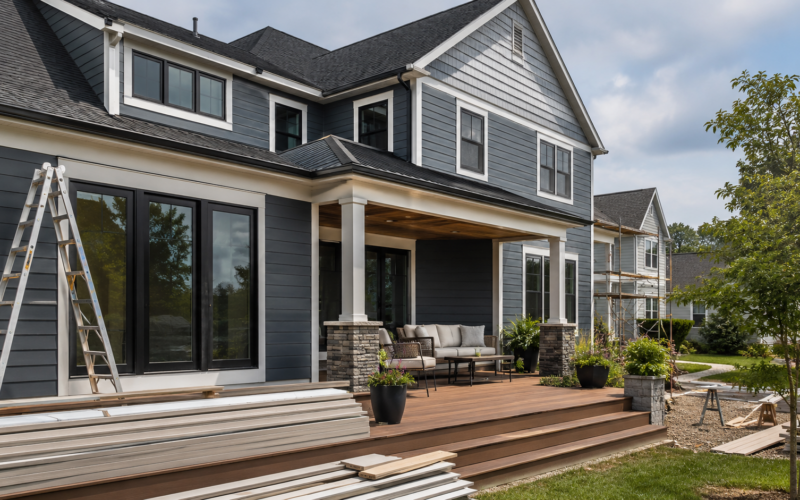
The most important change came from the acquisition of The AZEK Company, which added TimberTech decking, AZEK Exteriors, Versatex and other outdoor living products to James Hardie’s established fiber cement platform. Management is attempting to use the combined distribution network to sell a wider range of exterior products through building product distributors, lumberyards, home improvement retailers and professional contractors.
The company now reports four main operating areas. Siding & Trim is the largest and includes North American fiber cement alongside AZEK exterior products. Deck, Rail & Accessories contains the acquired composite and PVC outdoor living portfolio. Australia & New Zealand remains a high margin fiber cement business, while Europe includes fiber gypsum and fiber cement products.
The strategic rationale is straightforward. James Hardie wants to capture more of the spending associated with the exterior of a home rather than supplying only siding. That creates cross selling potential and allows the group to target material conversion from traditional products such as wood and vinyl.
The challenge is that the expanded portfolio came with substantially greater financial leverage and integration requirements. The investment case therefore depends not only on sales growth but on whether the combined business generates enough incremental cash to justify the acquisition price and reduce debt.

Why did the August 7 results strengthen the James Hardie share price outlook?
First quarter net sales increased 64% to US$1.475 billion from US$899.9 million a year earlier. Operating income increased 57% to US$217.7 million, net income rose 67% to US$104.3 million and adjusted EBITDA increased 79% to US$422.1 million. The adjusted EBITDA margin improved 230 basis points to 28.6%.
Those headline growth rates need context because the prior year comparison does not contain a full contribution from AZEK. On a pro forma basis, treating AZEK as though it had already been part of James Hardie in the comparable quarter, group sales increased approximately 12%. This is still a strong result and gives investors a clearer picture of underlying momentum than the reported 64% increase alone.
Siding & Trim provided the strongest evidence of organic improvement. Segment revenue reached US$859.8 million, up 34% on a reported basis, while organic sales increased 20%. North American fiber cement volumes returned to growth, helped by market share gains, stronger pricing and better performance across single family and multi family applications.
The comparison also benefited from channel destocking in the prior year. James Hardie said inventories are now normalised, meaning this favourable comparison should moderate over the remainder of fiscal 2027. That distinction matters because investors cannot simply extrapolate the first quarter growth rate across another three quarters.
Deck, Rail & Accessories recorded US$305.1 million of sales and US$82.8 million of adjusted EBITDA. Pro forma revenue declined 5% as James Hardie deliberately reduced shipments to bring distributor inventory closer to end market demand, while consumer sell through improved through the quarter.
The market appears to have rewarded the combination of stronger organic fiber cement demand, improving decking sell through and better than expected margins rather than the acquisition driven revenue increase alone.
How much does the raised FY27 outlook change the earnings story for JHX investors?
James Hardie raised its fiscal 2027 planning assumptions following the stronger first quarter. The company now expects total net sales of US$5.564 billion to US$5.723 billion and adjusted EBITDA of US$1.536 billion to US$1.625 billion. It continues to target at least US$500 million of free cash flow for the year.
For the second quarter, management expects revenue of US$1.485 billion to US$1.575 billion and adjusted EBITDA of US$420 million to US$455 million. The guidance indicates that management expects the earnings base established in Q1 to continue rather than reverse immediately.
The quality of the raised outlook is important. Management has not assumed a meaningful recovery in the United States housing market. Instead, the guidance is based on market share gains, material conversion, pricing, manufacturing efficiencies and synergies from the AZEK combination.
That conservative housing assumption gives the company potential operating upside if repair activity, housing completions or broader residential construction conditions improve. It also means James Hardie is promising above market execution during a period when underlying housing indicators remain mixed.
There is one caution for investors following the earnings numbers. James Hardie changed its definition of adjusted EBITDA from the first quarter to exclude share based compensation costs, with prior comparable figures recast. The measure remains useful for understanding management’s view of operating performance, but investors should keep the definition change in mind when comparing adjusted figures across historical periods.
A sustained revaluation would likely require James Hardie to deliver within or above the new guidance rather than simply maintaining the improved outlook through the next quarter.
Are AZEK synergies appearing quickly enough to justify the enlarged business?
Management said cost synergies are running ahead of schedule while revenue synergies remain on track. The commercial strategy includes combining sales relationships, increasing shelf space, expanding distribution partnerships and offering customers a broader portfolio spanning siding, trim, decking and outdoor living products.
Recent expanded distribution relationships, including broader cooperation with Boise Cascade and regional distributors, provide one pathway for the combined portfolio to reach more customers. The logic is that a distributor already purchasing James Hardie fiber cement can potentially add TimberTech decking or other AZEK products, while existing AZEK channels can create opportunities for the traditional Hardie portfolio.
Siding & Trim adjusted EBITDA increased 40% to US$287.7 million and the margin improved to 33.5%. Management attributed the expansion to pricing, lower raw material costs, greater manufacturing utilisation and continuing productivity savings.
Deck, Rail & Accessories produced a 27.1% adjusted EBITDA margin despite reporting a GAAP operating loss of US$3.3 million. The difference partly reflects amortisation of acquired intangible assets and other adjustments associated with the acquisition. Investors therefore need to watch both statutory and adjusted performance rather than relying on one measure.
The strongest evidence for the acquisition will eventually be revenue that would not have existed without the combination, accompanied by lower costs and rising free cash flow. Early synergy progress is encouraging, but one quarter is insufficient to establish the long term return on a major acquisition.
Retail attention around JHX has remained unusually sensitive to AZEK because the transaction materially changed the company’s size, share count and debt profile. The first quarter gives the more optimistic interpretation fresh evidence, but the question has shifted from whether AZEK can add revenue to whether the combined platform can earn attractive returns on the capital committed.
Why is James Hardie’s debt reduction now as important as its sales growth?
James Hardie ended June with US$289.9 million in cash and cash equivalents. Current and long term debt totalled approximately US$4.28 billion, although the company reduced long term debt from US$4.49 billion at the end of March to US$4.23 billion at June 30.
The balance sheet is a direct consequence of the expanded business and the financing associated with AZEK. High leverage does not mean the company lacks operating cash generation, but it changes capital allocation priorities and increases exposure to interest costs.
Net interest expense was US$61.5 million during the first quarter, compared with US$37.8 million a year earlier. That difference illustrates how financing costs can absorb part of the earnings generated from the enlarged operating portfolio.
The encouraging figure was cash generation. Operating cash flow increased to US$344 million from US$206.9 million and first quarter free cash flow reached US$254.2 million after US$89.8 million of capital expenditure. That was more than twice the prior year level.
Management has reaffirmed its target of at least US$500 million of fiscal 2027 free cash flow and wants net leverage below 2.0 times by the end of the second quarter of fiscal 2028. Capital expenditure for the remainder of fiscal 2027 is expected to equal approximately 6% to 7% of sales.
This creates a measurable roadmap. If earnings rise while cash is consistently directed towards debt reduction, the acquisition risk should gradually decline. If free cash flow underperforms, the enlarged debt burden becomes more significant because the balance sheet will take longer to normalise.
Is the market already pricing in much of the James Hardie earnings recovery?
James Hardie Industries plc (ASX: JHX) closed at A$43.18 on August 7, up 5.78% for the session. The stock opened at A$42.05 and finished at the session high, while nearly 2.7 million securities changed hands.
The shares gained approximately 16% from the July 31 close of A$37.21 and roughly 18% from the July 7 close of A$36.50. JHX now sits about 6% below its 52 week high of A$45.98 and approximately 77% above its 52 week low of A$24.41.
The rally lifted James Hardie’s market capitalisation to about A$25.1 billion. The company’s share count is also materially larger than before the AZEK transaction, with approximately 580.5 million shares outstanding.
Post results analyst sentiment has improved. Several United States brokerages raised their price targets on the New York listed shares following the earnings beat and guidance increase, although their assessments remain varied and should not be treated as a single valuation consensus.
The share price now reflects substantially greater confidence than it did several months ago. Investors are paying for a scenario in which fiber cement continues taking market share, AZEK synergies materialise, decking demand stabilises and cash generation steadily reduces leverage.
The risk is that the stock is approaching its annual high while United States housing conditions remain uncertain. Management itself has emphasised that Q1 outperformance did not result from a broad housing recovery. If housing completions weaken, repair spending slows or the easier inventory comparison disappears faster than expected, future growth could look less exceptional.
What are the next catalysts and what evidence could strengthen or weaken the JHX thesis?
The next clearly identified strategic event is James Hardie’s Investor Day in New York City on September 15. Management plans to provide investors with greater detail on long term strategy and value creation across the enlarged group.
Investors should expect attention to focus on AZEK revenue and cost synergies, distribution expansion, organic fiber cement growth, Deck, Rail & Accessories margins and the path towards lower leverage. More detailed long term targets could become especially important now that the market has reacted strongly to the first quarter.
The investment case would strengthen if second quarter revenue and adjusted EBITDA remain within or above the new guidance, free cash flow stays strong and net debt continues declining. Continued organic growth in Siding & Trim after the prior year destocking benefit fades would provide particularly useful evidence that the recovery is not simply a favourable comparison.
Improving Deck, Rail & Accessories sales would provide another proof point. Management has already normalised channel inventory, so future results should increasingly reflect underlying customer demand rather than shipment adjustments.
The thesis would weaken if synergies require substantially more spending than expected, decking demand softens, United States housing conditions deteriorate or cash generation fails to translate into faster deleveraging. Higher freight, raw material or financing costs could also limit margin expansion.
James Hardie has delivered a first quarter strong enough to change the near term earnings narrative. The unresolved question is whether that performance marks the beginning of durable value creation from AZEK or simply an unusually strong opening quarter aided by easier comparisons. September’s Investor Day and the second quarter results should provide the next measurable evidence.
Key takeaways for investors watching James Hardie Industries after the August rally
- James Hardie Industries plc (ASX: JHX) rose 5.78% to A$43.18 on August 7 after Q1 FY27 results exceeded earlier guidance and management raised its full year outlook.
- First quarter reported sales increased 64% to US$1.475 billion, while pro forma growth was approximately 12% after accounting for the AZEK acquisition.
- Siding & Trim delivered 20% organic sales growth, providing evidence that the improvement extended beyond acquisition driven revenue.
- James Hardie now expects fiscal 2027 sales of US$5.564 billion to US$5.723 billion and adjusted EBITDA of US$1.536 billion to US$1.625 billion.
- First quarter free cash flow more than doubled to US$254.2 million, an important development given the company’s more than US$4.2 billion of debt.
- JHX gained about 16% across the five sessions following July 31 and now trades only around 6% below its 52 week high.
- The September 15 Investor Day and subsequent Q2 results will test whether AZEK synergies, organic growth and deleveraging can sustain the revaluation.
Discover more from Business-News-Today.com
Subscribe to get the latest posts sent to your email.

