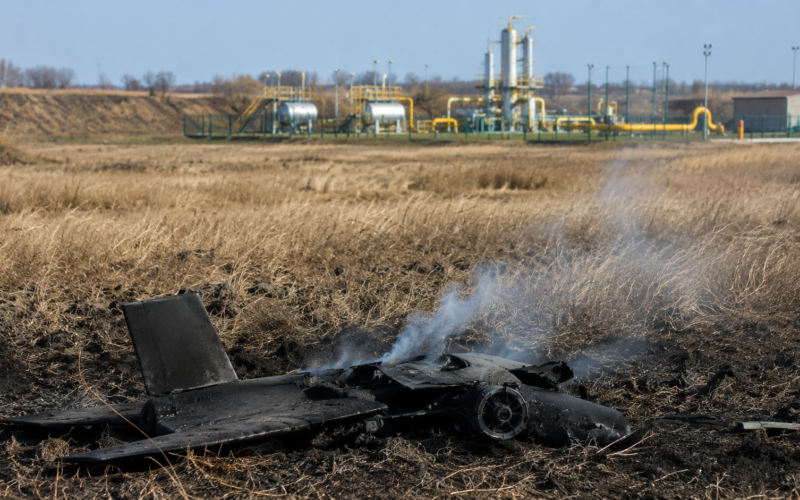
A drone carrying explosives entered Bulgarian airspace from Romania and detonated near the border village of Kardam on Saturday, August 8, 2026, triggering an urgent security response after authorities revealed that neither country’s air-defence systems detected the aircraft before it crossed into NATO territory.
The drone exploded in a sunflower field approximately 100 metres inside Bulgaria, causing no casualties or infrastructure damage. However, its location has intensified concern because the impact site was around one kilometre from a Bulgarian compressor station on the Trans-Balkan gas pipeline and only about 200 metres from a Romanian compressor facility associated with the same network.
Bulgaria’s Defence Ministry said its preliminary examination indicated that the aircraft was most likely a Maya decoy drone, a type widely used by Ukraine’s armed forces. Sofia stressed that there was no evidence the incursion had been intentional, meaning the incident should not currently be characterised as a deliberate Ukrainian attack on Bulgaria.
The more troubling issue for NATO is how the drone crossed Romanian territory and reached Bulgaria without apparently being identified or intercepted. Prime Minister Rumen Radev acknowledged that neither Romanian nor Bulgarian systems had detected the unmanned aircraft and said the episode demonstrated continuing difficulties in identifying small drones flying at low altitude.
The incident follows a series of drone incursions across NATO’s eastern and northern borders during the Russia-Ukraine war, including a Russian drone that struck an apartment building in the Romanian city of Galați in May and injured two people. The latest Bulgarian explosion therefore adds urgency to a wider alliance debate over whether existing radar, fighter and ground-based air-defence networks are sufficiently equipped to detect relatively small unmanned aircraft.
What happened when the drone crossed from Romania into Bulgaria near Kardam?
Bulgarian authorities said the drone entered the country from the north at approximately 8:10 a.m. local time on August 8 before exploding shortly after crossing the border.
The aircraft came down near the former Kardam border crossing, an area connecting northeastern Bulgaria with southeastern Romania. Police, border officers and defence personnel secured the site and examined the wreckage after the explosion.
There were no injuries and no buildings, pipelines or other infrastructure were damaged. That fortunate outcome does not diminish the significance of the location.
The drone detonated near compressor stations serving the Trans-Balkan gas pipeline, a major regional energy system stretching between Turkey and Ukraine. Compressor stations maintain the pressure needed to move gas efficiently through long-distance pipelines, making them strategically important pieces of energy infrastructure.
Had an explosive drone directly struck such a facility, the consequences could have extended well beyond the immediate border region. Damage could potentially interrupt gas flows, require lengthy safety inspections and trigger concern over whether energy infrastructure was being deliberately targeted.
Bulgarian officials currently say there is no evidence of such intent.
That distinction is essential. The fact that the drone landed near important infrastructure does not prove that the compressor stations were its target, particularly when initial analysis suggests the aircraft may have been a Ukrainian decoy that strayed from its intended mission.

Why does Bulgaria believe the drone was a Ukrainian Maya decoy rather than a Russian attack drone?
Bulgaria’s Defence Ministry said its initial technical assessment pointed towards a Maya decoy drone commonly used by Ukrainian forces.
Decoy drones are designed primarily to complicate an opponent’s air defence rather than function in the same way as expensive precision-strike weapons. They can force radar operators and surface-to-air missile units to identify, track or engage targets, potentially exposing defensive positions or exhausting costly interceptor missiles.
Ukraine has relied increasingly on large numbers of unmanned aircraft as it conducts long-range operations against Russian military, industrial and energy targets.
The Bulgarian assessment remains preliminary, however. Authorities will need to examine surviving components, electronics, navigation systems and other forensic evidence before the drone’s precise origin and mission can be established conclusively.
The possibility that a Ukrainian drone crossed NATO territory also does not necessarily indicate negligence or hostile intent by Kyiv.
Modern long-range drones can be pushed off course by navigation errors, mechanical failures, weather or electronic warfare. Russia deploys sophisticated jamming and satellite-navigation interference systems designed to disrupt Ukrainian unmanned aircraft, creating the possibility that drones aimed at Russian targets could deviate substantially from planned routes.
Ukraine and NATO states have encountered similar problems before.
Latvia, Lithuania and other countries have reported drones apparently connected with Ukrainian operations entering their airspace after travelling through or near Russia. Kyiv has said it works to minimise such incidents and has previously offered technical assistance to neighbouring countries dealing with drone incursions.
Why is the drone’s proximity to the Trans-Balkan gas pipeline causing particular alarm?
Europe’s energy infrastructure has acquired significantly greater strategic importance since Russia’s invasion of Ukraine transformed gas flows across the continent.
The Trans-Balkan pipeline historically carried Russian natural gas southwards through Ukraine, Moldova, Romania and Bulgaria towards Turkey and other southeastern European markets. Changes in European supply patterns have altered how sections of the system are used, but the infrastructure remains an important component of regional gas transportation.
Energy infrastructure has also become an increasingly prominent security concern.
The sabotage of the Nord Stream pipelines in 2022 demonstrated that energy networks can become targets during geopolitical confrontations. Since then, European governments have increased surveillance around pipelines, electricity cables, offshore installations and telecommunications infrastructure.
Bulgaria, Romania and Turkey agreed in July to expand their joint Black Sea mine-clearing cooperation to include broader protection of critical infrastructure, including energy and telecommunications assets. NATO increasingly views the Black Sea as a strategically important region where military threats, commercial shipping and major infrastructure intersect.
The Kardam incident therefore lands directly inside an existing security debate.
There is no evidence that the gas installations were deliberately targeted, but an explosive drone travelling undetected until it detonated within hundreds of metres of critical energy infrastructure demonstrates how little margin for error exists.
A future aircraft could land differently.
That is the scenario Bulgarian and NATO planners now have to address.
How did the drone evade Romanian and Bulgarian air-defence systems?
The absence of detection may ultimately become the most important part of the investigation.
Radev said the drone was not identified earlier in either Romanian or Bulgarian airspace. He acknowledged that detecting and identifying small unmanned aircraft remains difficult and drew attention to delays involving the delivery of high-precision radar systems for Bulgaria’s armed forces.
Traditional national air-defence systems were designed primarily around threats such as fighter aircraft, helicopters and larger missiles.
Small drones create a different challenge.
They can fly at low altitude, move relatively slowly and present a much smaller radar cross-section than conventional combat aircraft. Terrain, buildings and vegetation can further complicate radar coverage.
A system powerful enough to detect a fighter aircraft hundreds of kilometres away may still struggle to distinguish a small low-flying drone from background clutter.
Constantly launching fighter aircraft or expensive surface-to-air missiles against every suspected unmanned target is also economically unsustainable.
The cost imbalance is dramatic. A relatively inexpensive decoy drone can potentially force defenders to consider using an interceptor costing hundreds of thousands or millions of dollars.
That means NATO requires a layered approach involving conventional radar, specialised counter-drone sensors, electronic warfare, cheaper interceptors and systems capable of identifying small aircraft much closer to the ground.
Bulgaria says it will increase monitoring around strategic installations and strengthen surveillance along its border with Romania following Saturday’s explosion.
Is NATO treating the Bulgaria drone explosion as an attack on alliance territory?
There is currently no indication that Bulgaria regards the incident as a deliberate armed attack requiring activation of NATO’s collective-defence provisions.
That conclusion is consistent with Sofia’s preliminary assessment that the drone was likely Ukrainian and that there is no evidence it intentionally entered Bulgarian territory.
The incident is nevertheless expected to be discussed within NATO.
The Associated Press reported that Bulgarian authorities intend for the matter to be raised at the North Atlantic Council, the alliance’s principal political decision-making body. Sofia has also started strengthening drone monitoring along the border.
NATO members routinely consult over potentially dangerous airspace incursions without invoking Article 5.
Article 5 applies when an ally suffers an armed attack and the alliance collectively determines that the circumstances warrant mutual defence. An accidental or uncontrolled drone crossing does not automatically meet that threshold.
The more relevant issue in this case is preparedness.
NATO needs to understand how an explosive aircraft crossed the territory of one member state and entered another without detection, particularly when the route passed close to strategically important energy infrastructure.
The alliance will also need to assess whether similar gaps exist elsewhere along its eastern frontier.
How does the Bulgaria incident compare with the Russian drone that struck Romania in May?
The August 8 explosion comes little more than two months after a much more serious incident in neighbouring Romania.
On May 29, Romania said a Russian drone entered its airspace during an attack on Ukrainian targets and struck a residential apartment building in Galați, injuring two people.
The drone exploded on the roof of a 10-storey building and damaged a top-floor apartment. NATO condemned what it described as Russian recklessness and reaffirmed its commitment to defending alliance territory.
Romania’s Defence Ministry said at the time that Russian drones had breached Romanian airspace dozens of times since Moscow began attacking Ukrainian port facilities near the Danube.
The Bulgarian incident is materially different because Sofia currently believes the drone was Ukrainian and accidental.
Yet both cases illustrate the same strategic problem.
Modern drone warfare does not remain neatly contained within political borders.
Russia and Ukraine are launching large numbers of unmanned aircraft across an increasingly contested electromagnetic environment. Some are destroyed, some malfunction and some may be diverted by electronic interference.
NATO countries bordering the conflict consequently face a persistent possibility that armed or explosive aircraft will enter their territory even when neither belligerent deliberately targets them.
The danger grows as the number and range of drones increase.
Could electronic warfare be pushing Ukrainian drones towards NATO territory?
Electronic warfare is one possible explanation, though Bulgarian authorities have not established that it caused the Kardam incident.
Russia uses powerful systems to interfere with satellite navigation signals relied upon by unmanned aircraft. Such interference can disrupt a drone’s understanding of its position or prevent it from following its programmed route accurately.
Ukraine has previously suggested electronic warfare may explain cases in which Ukrainian drones crossed into Baltic countries after passing through Russian-controlled or contested areas.
The issue has become politically sensitive.
Lithuania warned on August 6 that Russia could potentially use captured Ukrainian drones for false-flag operations designed to create tension between Kyiv and NATO governments. Lithuania’s defence minister said Moscow could attempt to exploit Ukrainian equipment to weaken alliance unity or reduce political support for Ukraine. Russia rejected those allegations.
There is no evidence that the Bulgaria incident was such an operation.
However, the Lithuanian warning demonstrates how complicated attribution has become.
Finding a Ukrainian-made or Ukrainian-operated drone on NATO territory does not automatically explain why it arrived there.
Investigators need to establish flight paths, navigational data and whether electronic interference occurred before reaching firm conclusions.
That forensic burden will become increasingly important as drones proliferate across Europe’s eastern frontier.
Why are small drones becoming one of NATO’s hardest air-defence problems?
NATO built much of its air-defence architecture around technologically sophisticated and comparatively expensive threats.
The Ukraine war has shown that inexpensive mass-produced drones can create a very different form of pressure.
An attacker can launch decoys alongside genuine strike drones, forcing defenders to decide which targets justify interception.
Drones can also approach from directions where conventional radar coverage is weaker or operate at altitudes where terrain interferes with detection.
When dozens or hundreds are launched simultaneously, the challenge becomes even harder.
Ukraine and Russia have both learned to treat unmanned systems as consumable battlefield equipment. Losing large numbers of inexpensive drones can be acceptable if even a small proportion reach strategically important targets.
European NATO governments now need similarly scalable defensive technologies.
Systems capable of jamming drones, using directed energy, deploying inexpensive interceptor drones or firing cheaper ammunition may eventually supplement traditional surface-to-air missile systems.
The Kardam explosion makes that investment question tangible for Bulgaria.
A drone did not have to destroy the gas pipeline to reveal the vulnerability.
Simply reaching the area undetected was enough.
What are the key takeaways from the drone explosion near Bulgaria’s Trans-Balkan gas pipeline?
- An explosive drone entered Bulgarian airspace from Romania on August 8 and detonated approximately 100 metres inside Bulgaria near the village of Kardam, without causing casualties or infrastructure damage.
- The explosion occurred roughly one kilometre from Bulgaria’s Trans-Balkan gas pipeline compressor station and about 200 metres from a Romanian compressor facility, placing the incident unusually close to critical energy infrastructure.
- Bulgaria’s Defence Ministry said preliminary analysis indicates the aircraft was most likely a Maya decoy drone commonly used by Ukrainian forces and said there was no evidence the incursion was intentional.
- Neither Romanian nor Bulgarian air-defence systems detected the drone before the explosion, prompting Prime Minister Rumen Radev to acknowledge continuing difficulties in identifying small low-flying unmanned aircraft.
- Bulgaria is strengthening monitoring along the Romanian border and around strategic installations, while the incident is expected to be discussed within NATO’s North Atlantic Council.
- The episode follows a May incident in which Romania said a Russian drone struck an apartment building in Galați and injured two people, highlighting the growing risk that the Ukraine war will spill physically into neighbouring NATO countries.
- NATO members around the Black Sea have already expanded cooperation to protect pipelines, telecommunications links and other critical infrastructure as the region becomes increasingly exposed to drones, mines and other wartime threats.
- The Bulgarian incident does not currently appear to constitute an intentional attack on NATO territory, but the failure to detect the drone raises a broader question about whether alliance air-defence systems are prepared for inexpensive, low-altitude unmanned threats.
Why the Kardam explosion may matter more for NATO than the absence of physical damage suggests
Bulgaria was fortunate on August 8.
The drone fell into a sunflower field. No one was injured, and the nearby gas infrastructure escaped damage.
That outcome could make the incident appear minor.
Strategically, it is not.
The important fact is that an explosive unmanned aircraft apparently travelled through Romanian airspace, crossed an international NATO border and reached an area containing critical energy infrastructure without being identified by either country’s surveillance network.
If the same flight path ended a few hundred metres differently, Europe could be discussing damage to an international gas system rather than an empty field.
That is precisely why NATO cannot treat every accidental incursion as insignificant simply because intent is absent.
Deterrence against deliberate attacks is only one part of territorial defence. Alliance states must also protect their populations and infrastructure from malfunctioning weapons, navigational errors and electronic warfare created by conflicts occurring immediately beyond their borders.
The challenge is becoming more urgent as drone warfare scales up.
Russia and Ukraine are building and launching unmanned aircraft in quantities that would have seemed extraordinary only a few years ago. NATO countries bordering the conflict therefore have to assume that further incursions will occur.
The policy question is no longer whether every small drone can be prevented from crossing a border.
It is whether NATO can detect those aircraft early enough to determine what they are, where they are heading and whether interception is necessary before they reach a city, military installation, airport or pipeline.
The explosion near Kardam provided that warning without causing casualties.
The next drone may not.
Discover more from Business-News-Today.com
Subscribe to get the latest posts sent to your email.