



BP p.l.c. (LSE: BP.; NYSE: BP) has agreed to acquire Woodside Energy Group Ltd.’s (ASX: WDS; NYSE: WDS) 70% participating interest in the Calypso deepwater natural gas project offshore Trinidad and Tobago. The transaction will increase BP’s ownership from 30% to 100%, giving the British energy company complete control of several gas discoveries estimated to contain approximately 3.5 trillion cubic feet of resources. Financial terms were not disclosed, and completion is expected by the end of 2026, subject to government and regulatory approvals. The acquisition is strategically important because Trinidad and Tobago’s declining gas supply has constrained liquefied natural gas and petrochemical production, while BP already operates extensive upstream infrastructure and owns 45% of Atlantic LNG. The central tension is whether BP’s local scale and full ownership can accelerate Calypso toward a final investment decision without allowing deepwater costs and development complexity to overwhelm the project’s domestic strategic value.
Why does acquiring Woodside Energy’s 70% interest materially change the Calypso development process?
BP’s move from minority partner to sole owner removes one of the structural complications surrounding Calypso. Under the previous arrangement, Woodside Energy was operator with a 70% interest, while BP held the remaining 30%. Development decisions therefore required alignment between two global companies with different project portfolios, capital priorities and investment thresholds. Full ownership gives BP control over engineering, commercial negotiations, development timing and eventual capital allocation.
That control can make decision-making faster, but it also transfers the entire financial exposure to BP. The company will no longer be responsible for only 30% of appraisal, engineering and development spending if the acquisition closes. It will have to fund 100% of future expenditure unless it later introduces another partner, sells a project interest or develops a commercial structure involving Trinidad and Tobago’s state energy entities.
The acquisition should therefore not be interpreted as a final investment decision. BP has purchased greater control over an early-stage opportunity, not an operating asset with established production and cash flow. No development capital estimate, production start date or final project configuration was disclosed with the transaction.
The strategic advantage is optionality. BP can now assess Calypso against its own Trinidad and Tobago infrastructure, gas-marketing position and regional project portfolio without negotiating every major decision with a separate operator. The financial test is whether that strategic fit produces a lower-cost and faster development than Woodside Energy could justify within its own global portfolio.
What has already been established about the Calypso gas discoveries offshore Trinidad and Tobago?
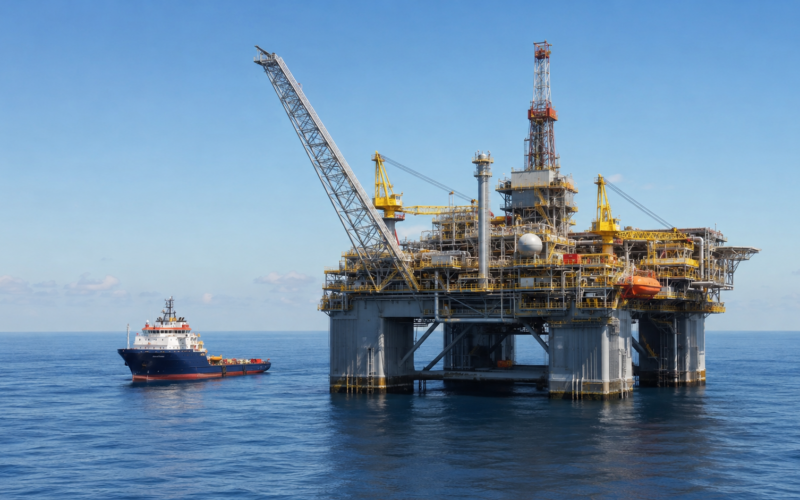
Calypso is located approximately 220 kilometres off Trinidad in water depths of about 2,100 metres. The resource includes several gas discoveries across Blocks 23(a) and TTDAA 14, placing the project in a technically demanding deepwater environment considerably farther offshore than many of Trinidad and Tobago’s established producing fields.
The appraisal programme included the Bongos-3, Bongos-3X and Bongos-4 wells and concluded in December 2021. Woodside Energy reported that all three wells encountered hydrocarbons, supporting continued technical and commercial evaluation. The discoveries provide evidence of a substantial gas system, but the widely cited 3.5 Tcf estimate should not be treated as equivalent to proved developed reserves or immediately marketable production.
Woodside Energy completed conceptual studies during the first half of 2023 and selected an in-field host as the preferred development concept. Pre-front-end engineering and design work began later that year, while commercial discussions continued with potential customers and other stakeholders. The project had therefore progressed beyond early exploration, but it had not reached the level of technical and commercial maturity required for sanction.
The preferred concept may still change under BP ownership. A sole owner can reconsider facilities, subsea architecture, processing arrangements and the destination of the gas if it identifies a configuration that better integrates with existing infrastructure. Any redesign would need to balance lower capital costs against reservoir performance, production reliability and the ability to supply customers over a sufficiently long period.
Could Calypso materially reduce Trinidad and Tobago’s gas shortage and restore industrial utilisation?
Trinidad and Tobago has built a substantial industrial economy around natural gas, including Atlantic LNG, ammonia, methanol and other petrochemical facilities. Declining upstream output has left parts of that infrastructure operating below capacity and contributed to the shutdown or idling of industrial plants and Atlantic LNG’s Train 1. This creates an unusual commercial environment in which a large new gas project may find demand from existing facilities rather than depending entirely on construction of new downstream infrastructure.
The Trinidad and Tobago government previously projected that the deepwater resource could add approximately 700 million standard cubic feet per day to domestic gas production. That figure is a government projection rather than current BP guidance, and it remains dependent on the final development configuration, well performance and investment decision. Even a lower sustained rate could be meaningful in a market where feedstock shortages have affected LNG and petrochemical output.
Calypso’s potential value therefore extends beyond the revenue from selling gas. Additional supply could improve utilisation at liquefaction plants, stabilise feedstock for downstream manufacturers and support export earnings and government revenue. It could also reduce competition among domestic customers for declining volumes from mature fields.
The existence of demand does not automatically guarantee attractive economics. Domestic gas buyers must be able to support prices that justify deepwater development, while fiscal terms must allow the project to compete against BP’s global upstream opportunities. Calypso’s strategic importance to Trinidad and Tobago may help commercial negotiations, but BP will still require a return that compensates for technical, construction and reservoir risk.
How could BP’s existing Trinidad infrastructure lower Calypso’s development risk and cost?
BP is already the largest supplier of natural gas to Trinidad and Tobago’s domestic market and produced approximately one billion cubic feet per day in the country during 2025. It also owns a 45% interest in Atlantic LNG, giving the company exposure to both upstream supply and one of the main downstream destinations for Trinidadian gas.
That position provides BP with detailed knowledge of local reservoirs, offshore operations, customer requirements, fiscal structures and gas-balancing constraints. The company may also be able to coordinate Calypso with its existing project pipeline and infrastructure maintenance programme. Such integration can reduce commercial uncertainty compared with a new entrant developing an isolated project.
However, Calypso’s distance from shore and water depth limit the amount of existing infrastructure that can be reused without major new investment. A deepwater development may require subsea wells, flowlines, control systems, a production host and a long export route. Existing onshore processing and LNG demand can improve the downstream case, but they do not remove the cost of bringing gas from the reservoir to the established network.
BP will need to determine whether Calypso can be connected to an existing host, developed around a new offshore facility or delivered through another configuration. Each option carries different capital, operating and schedule implications. A technically simpler concept may produce less gas, while a larger standalone development could improve resource recovery but require considerably more upfront investment.
Full ownership allows BP to optimise the development around its own infrastructure and marketing position. The next evidence required is a clearly defined concept showing that integration benefits are large enough to offset the challenges of ultra-deepwater construction.
Why did Woodside Energy sell Calypso after years of appraisal and pre-FEED work?
Woodside Energy said in its second-quarter report that it was continuing to assess Calypso’s relative value within its portfolio. The company also expected to recognise between $160 million and $200 million of impairment losses relating to Calypso and other items in its 2026 half-year results. The disclosure did not allocate the entire impairment range to Calypso, but it signalled that the project’s carrying value and portfolio competitiveness were under review before the transaction was announced.
The disposal completes Woodside Energy’s exit from Trinidad and Tobago. In 2025, the Australian producer agreed to sell its producing Greater Angostura assets, including interests in the Angostura and Ruby fields and associated facilities, to Perenco. Calypso was excluded from that earlier transaction and remained Woodside Energy’s principal exposure to the country.
Woodside Energy’s decision should not automatically be interpreted as evidence that Calypso lacks commercial value. Portfolio decisions depend on the alternatives available to each owner. Woodside Energy is funding major developments including Louisiana LNG, Trion and Scarborough, while also progressing Browse and other opportunities. An early-stage Trinidad project requiring substantial future capital may have ranked below projects with clearer schedules or stronger strategic alignment.
Selling the stake removes future Calypso capital requirements and allows management to concentrate resources elsewhere. The financial terms will determine whether Woodside Energy also recovered meaningful value for the technical work and appraisal investment completed to date, but those terms were not disclosed.
For BP, the same asset may be more valuable because of its existing Trinidad production, LNG ownership and domestic customer relationships. The transaction is therefore an example of portfolio fit creating different values for the buyer and seller rather than one company necessarily having a superior view of the geology.
What must BP resolve before Calypso can reach a final investment decision?
The first unresolved issue is the development concept. BP must confirm the number and location of production wells, reservoir deliverability, offshore host, export route and processing configuration. Pre-FEED work provides a starting point, but full front-end engineering and design will be required before costs and schedule can be estimated with sufficient confidence.
The second issue is the gas-sales framework. A project of Calypso’s scale may supply several customers, including Atlantic LNG and domestic petrochemical facilities. BP will need agreements covering volumes, pricing, delivery obligations and credit protections. Long-term commercial arrangements are particularly important because deepwater developments require substantial capital before production begins.
The third issue is fiscal and regulatory approval. The acquisition itself is subject to government and regulatory consent, while a subsequent development will require separate environmental, technical and commercial authorisations. BP must also establish whether existing production-sharing and tax terms support an economically competitive project under realistic gas-price and cost assumptions.
The final issue is capital competition inside BP. Calypso must compete with upstream projects in the Gulf of America, the Middle East, Africa and other regions. Its strategic value to Trinidad and Tobago may be substantial, but BP’s investment committee will still compare expected returns, execution risk and cash-flow timing with other opportunities.
The acquisition gives BP the ability to accelerate these decisions. It does not guarantee that the project will pass every commercial and technical threshold.
Can BP fund a full Calypso development while pursuing debt reduction and portfolio restructuring?
BP reported second-quarter 2026 underlying replacement cost profit of approximately $5.7 billion, up from $3.2 billion in the preceding quarter. Stronger commodity prices, refining margins and trading performance supported the result, while net debt declined by around $3 billion to approximately $22.5 billion.
The company expects 2026 capital expenditure of approximately $13.5 billion to $14 billion. It is also pursuing a broad portfolio restructuring and asset-sale programme intended to reduce debt and concentrate investment in businesses with stronger returns. Calypso therefore enters BP’s portfolio at a time when management is emphasising financial discipline rather than unconstrained upstream expansion.
Because transaction terms were not disclosed, the acquisition’s immediate balance-sheet effect cannot be assessed. The larger financial exposure would arise after project sanction, when BP would need to fund engineering, subsea equipment, drilling and offshore facilities. Those expenditures would probably be spread across several years, giving BP time to align the project with cash flow and debt targets.
BP could later reduce its exposure by bringing in a partner, although there is no indication that it intends to do so. Retaining 100% would maximise control and future cash flow, while a sell-down could reduce capital concentration and provide external validation of the project’s value.
The company’s stronger second-quarter cash generation improves its ability to acquire and evaluate Calypso. The real capital-discipline test will occur when management presents a development plan and decides whether the expected return justifies full ownership through construction.
How did BP and Woodside Energy shares trade after the Calypso transaction was announced?
BP’s New York-listed American depositary shares traded around $42.08 late in the August 6 session, approximately 2.1% above the previous close. The shares remained about 12.8% below their 52-week high of $48.27 and roughly 33% above the 52-week low of $31.59. The movement followed BP’s strong second-quarter results earlier in the week as well as the Calypso announcement, making it inappropriate to attribute the full gain to the acquisition.
Woodside Energy’s New York-listed shares traded near $22.67, around 3% higher during the same session. The price was approximately 10% below the 52-week high of $25.19 and nearly 59% above the 52-week low of $14.27. Woodside Energy’s primary Australian listing was trading near A$31.78, within a 52-week range of A$21.96 to A$35.82.
The positive trading in both companies does not establish that investors viewed the transaction identically. BP shareholders may see strategic consolidation around a country where the company already has infrastructure and customers. Woodside Energy shareholders may value the removal of future spending from a project that had been undergoing a relative-value assessment.
The undisclosed price limits market analysis. Investors cannot yet determine whether BP acquired the interest at a discount to its long-term value or whether Woodside Energy received enough consideration to compensate for surrendering a large discovered resource. Future regulatory filings or financial statements may provide greater clarity.
What milestones will show whether BP can convert Calypso’s resource into commercial gas?
The first milestone is completion of the acquisition by the end of 2026. Government and regulatory approval will confirm BP’s legal ownership and operatorship, allowing it to proceed without the previous joint-venture structure.
The second milestone is an updated development concept. BP must explain whether it will retain Woodside Energy’s preferred in-field host approach, connect Calypso to existing infrastructure or adopt another configuration. A credible concept should include expected production capacity, project cost, development schedule and the route through which gas will reach customers.
The third milestone is commercial alignment with Trinidad and Tobago’s government, Atlantic LNG and domestic gas users. A resource can be technically recoverable without being commercially developable. Binding gas-sales agreements and supportive fiscal terms will be essential before BP commits construction capital.
The final proof point is a final investment decision accompanied by transparent economics. BP must show that the project can deliver reliable gas at returns competitive with its other upstream investments. Calypso’s strategic importance will strengthen the case, but it cannot substitute for a bankable cost and revenue structure.
BP has improved the project’s governance by consolidating ownership and aligning the resource with an established Trinidad and Tobago business. What remains unresolved is the cost of developing gas in 2,100 metres of water and the price customers can support. The acquisition thesis will strengthen if BP advances Calypso through engineering and commercial agreements without materially increasing its capital burden. It will weaken if full ownership produces years of additional evaluation without a competitive path to first gas.
What are the key takeaways from BP’s acquisition of Woodside Energy’s Calypso stake?
- BP has agreed to acquire Woodside Energy’s 70% interest in the Calypso deepwater gas project.
- The transaction will increase BP’s ownership from 30% to 100% if regulatory approvals are received.
- Calypso includes several discoveries across Blocks 23(a) and TTDAA 14 offshore Trinidad and Tobago.
- The project is located approximately 220 kilometres offshore in water depths of around 2,100 metres.
- The resource is estimated at approximately 3.5 Tcf, but it remains an early-stage development rather than producing reserves.
- Woodside Energy previously selected an in-field host concept and began pre-FEED work in 2023.
- Trinidad and Tobago has projected potential production of approximately 700 MMscf/d, although BP has not confirmed a development rate.
- BP’s existing upstream operations and 45% Atlantic LNG interest provide strategic integration opportunities.
- Woodside Energy’s sale completes its exit from Trinidad and Tobago following the disposal of Greater Angostura.
- Acquisition completion, concept selection, gas-sales agreements and a final investment decision are the next measurable catalysts.
Discover more from Business-News-Today.com
Subscribe to get the latest posts sent to your email.