




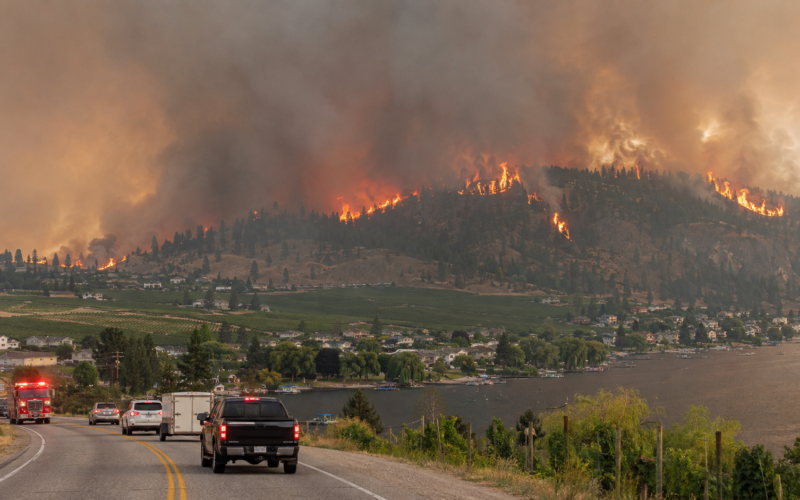
British Columbia has declared a provincewide state of emergency after a fast-moving wildfire swept towards communities around Okanagan Lake, forcing more than 20,000 people from their homes in the largest evacuation event of the province’s wildfire season so far.
The Bald Range wildfire expanded dramatically during the night of August 7 into August 8, reaching roughly 9,500 hectares as powerful winds, extreme dryness and intense fire behaviour pushed flames towards Summerland, Peachland and nearby rural communities. British Columbia Premier David Eby said homes and other properties had been destroyed, while some residents became trapped and required rescue as conditions changed with extraordinary speed.
The entire community of Summerland, which has a population of roughly 12,000, was ordered to evacuate, while approximately 8,000 people in and around Peachland were also told to leave. Residents moved towards Penticton, Kelowna and other nearby communities as highways became congested and sections of the regional road network faced closure.
The emergency is particularly significant because the Okanagan is one of British Columbia’s most important agricultural and tourism regions. The area surrounding Okanagan Lake produces much of the province’s wine, contains extensive orchards and farms and attracts large numbers of domestic and international visitors during the summer season. Damage to homes, vineyards, agricultural property and tourism infrastructure could therefore produce economic consequences that continue long after firefighters contain the immediate blaze.
How quickly did the Bald Range wildfire spread towards Summerland and Peachland?
The speed of the Bald Range wildfire has emerged as the defining feature of the emergency.
The fire was first reported on Friday evening before expanding across approximately 50 square kilometres within hours and advancing roughly 15 kilometres towards Summerland. Emergency officials described the blaze as among the fastest-moving wildfires the region had experienced, with the fire overwhelming smaller communities before residents had much time to prepare.
By Saturday, estimates placed the fire at around 9,500 hectares, almost twice its previous size. Fire officials reported extreme behaviour capable of generating its own weather conditions, including strong convection and lightning that could ignite additional fires ahead of the main front.
This type of fire behaviour makes conventional containment extraordinarily difficult. Firefighters may establish lines intended to slow the blaze, only for wind-driven embers to cross those barriers and ignite vegetation kilometres away. Extreme heat can also create powerful columns of rising air that produce unpredictable changes in direction and intensity.
The result is a wildfire capable of transforming an evacuation alert into an immediate evacuation order within a very short period. Several residents left around midnight as flames moved across nearby hills, highlighting why authorities repeatedly urge people under evacuation alerts to prepare vehicles, medication, documents and emergency supplies before an order is issued.

Why has British Columbia declared a provincewide state of emergency over the wildfires?
The provincial state of emergency gives British Columbia additional powers to coordinate resources and respond quickly as multiple communities face simultaneous wildfire threats.
Authorities can use emergency powers to support evacuations, restrict travel where necessary, protect essential supplies, secure accommodation for displaced residents and prevent practices such as excessive price increases during a disaster. The declaration also allows provincial agencies to coordinate more directly with local governments, First Nations and federal authorities.
The decision reflects the scale of the broader wildfire situation rather than the Bald Range blaze alone.
More than 100 fires were burning across British Columbia as of August 8, with around 1,500 firefighting personnel involved in suppression operations. The province had issued dozens of evacuation orders and alerts before the Bald Range fire triggered the largest single displacement of the summer.
British Columbia had already been warning residents for weeks that drought and hotter-than-normal conditions were increasing wildfire risks. Provincial emergency authorities said in June that parts of the province faced elevated wildfire and water-scarcity threats during the summer, while late-July preparedness warnings urged residents to register with emergency-support systems before they were forced to evacuate.
The declaration therefore represents an escalation of an emergency that had been developing across the province throughout the summer rather than an unexpected isolated event.
What has happened to homes, farms and essential services in Summerland?
The full extent of structural losses remains unclear because firefighters and emergency personnel have not yet been able to conduct complete damage assessments in the most heavily affected areas.
Provincial officials confirmed that homes and properties had been destroyed, while Summerland Mayor Doug Holmes warned that farms had also been affected. Local authorities said they could not yet determine how many structures had been lost because active firefighting remained the immediate priority.
Summerland also lost electricity during the emergency, adding another complication for residents and emergency crews.
Municipal authorities issued a boil-water notice after untreated water entered part of the system when wildfire conditions forced water to bypass normal treatment processes. Such infrastructure disruptions can continue even after the immediate fire front has moved away because damaged power lines, pumping systems and treatment facilities require inspection before normal services can safely resume.
Agricultural losses could become particularly important.
The Okanagan Valley supports vineyards, fruit orchards, farms and food-processing businesses that depend on irrigation, reliable electricity and seasonal labour. Wildfire damage does not have to destroy an entire farm to create losses. Smoke exposure, irrigation disruption, burned fencing, damaged machinery and temporary loss of access can all affect production.
The timing in August also places farms in a vulnerable period when many crops are approaching or entering harvest.
Why is the Okanagan wildfire threatening one of Canada’s most important wine-producing regions?
British Columbia’s Okanagan Valley is widely recognised as the centre of the province’s wine industry and ranks behind Ontario as Canada’s second-largest wine-producing region.
The landscape around Summerland and Peachland contains vineyards alongside orchards, residential developments and tourism properties. This creates a classic wildland-urban interface where vegetation capable of carrying fire exists close to homes and commercial infrastructure.
Wildfire creates several risks for wine producers beyond direct flame damage.
Vines can be destroyed by intense heat even when flames do not physically reach every row. Irrigation equipment and utility connections can fail, while wineries and storage facilities may lose power or become inaccessible during evacuation orders.
Smoke exposure presents another potential problem. Depending on timing, concentration and grape variety, smoke compounds can affect fruit and create unwanted flavours during fermentation, a phenomenon often described as smoke taint.
Tourism losses can also be substantial.
The Okanagan attracts visitors for wineries, lakes, restaurants, outdoor recreation and holiday accommodation. Evacuation orders, road closures and persistent smoke can cause cancellations across an area considerably larger than the actual burned zone.
Businesses may therefore experience revenue losses even when their own buildings remain untouched.
How serious is Canada’s wider 2026 wildfire season?
The British Columbia emergency forms part of another severe Canadian wildfire season.
Around four million hectares had burned across Canada by August 8, according to figures cited from the Canadian Interagency Forest Fire Centre. Fires have affected several provinces, including British Columbia, Ontario and Quebec, while hot and dry conditions have repeatedly increased the likelihood that new fires will spread rapidly.
Canada has increasingly relied on international firefighting assistance during particularly demanding seasons.
Personnel from Mexico, Australia, France and New Zealand have been deployed to support Canadian crews during 2026. International assistance allows provinces to rotate exhausted personnel and reinforce areas where simultaneous large fires exceed domestic staffing capacity.
The scale of Canadian wildfire seasons has changed dramatically over the past decade.
The country’s forests naturally experience fire, and wildfire is an important ecological process in many ecosystems. However, hotter temperatures, prolonged drought and unusually dry vegetation can create conditions in which fires become larger, more intense and more difficult to control.
British Columbia has repeatedly experienced mass evacuations during severe fire seasons, meaning emergency planning increasingly assumes communities may need to move tens of thousands of residents within hours.
The August 8 emergency demonstrates how quickly that planning can be tested.
Why can wildfires such as Bald Range create their own weather?
One of the most alarming descriptions of the Bald Range fire involved reports that the blaze was producing its own atmospheric conditions.
Extremely intense wildfires release enormous quantities of heat. The heated air rises rapidly and can create powerful convection columns containing smoke, ash and water vapour.
Under the right atmospheric conditions, those columns can develop into pyrocumulus or pyrocumulonimbus clouds.
These fire-generated storm systems can create strong winds and lightning. Lightning may ignite new fires away from the original blaze, while sudden changes in wind direction can send flames towards areas that previously appeared relatively safe.
This feedback mechanism creates exceptionally dangerous conditions for firefighters.
A fire may effectively produce weather that makes itself more difficult to control, creating new ignition points while spreading embers far beyond established containment lines.
Extreme behaviour also reduces the effectiveness of aircraft. Water bombers and helicopters may be unable to operate safely in dense smoke, high winds or unstable atmospheric conditions, forcing crews to depend more heavily on ground operations.
That explains why emergency officials sometimes shift from aggressive suppression towards protecting communities and evacuation routes until fire behaviour becomes more manageable.
How could the British Columbia wildfires affect tourism and the regional economy?
The economic impact is likely to develop in several stages.
The immediate losses include destroyed structures, damaged vehicles, lost crops and emergency-response expenditure. Businesses located inside evacuation zones may remain closed even when they suffer no direct physical damage.
Tourism businesses face a second layer of disruption.
Visitors frequently cancel trips when smoke, wildfire warnings or road closures create uncertainty, even when hotels or attractions remain operational. Those cancellations can spread into neighbouring communities that are not directly threatened.
The Okanagan summer season is particularly important for hotels, restaurants, wineries, outdoor recreation operators and short-term accommodation providers.
Reconstruction creates another long-term cost.
Insurance claims can place pressure on homeowners and insurers, while communities must repair roads, utility networks, water systems and public buildings. Housing markets can also tighten when displaced residents require temporary accommodation for extended periods.
Agricultural operators face a different recovery cycle because vineyards and orchards cannot always replace damaged plants quickly.
A building can potentially be rebuilt within months. Mature vines or fruit trees may require several years before returning to full productivity.
The economic consequences of the Bald Range fire could therefore remain visible long after evacuation orders are lifted.
What happens after residents are evacuated from Summerland and Peachland?
Evacuation is only the first stage of emergency management.
Residents who leave their homes must register for accommodation, food and other support while authorities determine when particular neighbourhoods can safely reopen.
British Columbia’s Emergency Support Services programme provides temporary assistance to evacuees who cannot immediately meet basic needs. Provincial authorities had already urged residents throughout British Columbia to register with the system before wildfire activity intensified because advance registration can reduce delays during large evacuations.
Returning home can take substantially longer than expected.
Firefighters must first reduce immediate fire danger. Utility crews then inspect electrical systems, gas lines, water networks and roads. Engineers may need to assess damaged bridges, retaining structures and public buildings.
Even residents whose homes survive may encounter smoke contamination, spoiled food, unsafe drinking water or prolonged electricity outages.
Those realities explain why authorities can maintain evacuation orders after visible flames have moved away.
The priority is preventing residents from returning to an area where falling trees, damaged power lines or renewed fire activity could create additional casualties.
What are the key takeaways from British Columbia’s August 2026 wildfire emergency?
- British Columbia declared a provincewide state of emergency on August 8, 2026, after the Bald Range wildfire expanded rapidly around Okanagan Lake and forced more than 20,000 residents to evacuate.
- The entire community of Summerland, with roughly 12,000 residents, was ordered to leave, while around 8,000 people in Peachland and nearby areas were also evacuated.
- The Bald Range wildfire expanded to approximately 9,500 hectares, with extreme fire behaviour allowing it to spread rapidly through dry vegetation towards populated communities.
- Homes and other properties have been destroyed, while authorities are still determining the full extent of structural and agricultural losses.
- Summerland experienced a power outage and issued a boil-water notice after wildfire conditions disrupted its normal water-treatment system.
- The Okanagan is a major centre for British Columbia’s wine, orchard and tourism industries, meaning the wildfire could create substantial economic effects beyond immediate property damage.
- Around 1,500 firefighting personnel were battling more than 100 fires across British Columbia, while international crews from Mexico, Australia, France and New Zealand have been assisting Canada during the severe 2026 wildfire season.
- Approximately four million hectares have burned across Canada in 2026, showing that the British Columbia emergency is part of a much broader national wildfire challenge.
Why the Bald Range wildfire could become one of British Columbia’s defining emergencies of 2026
The most disturbing feature of the Bald Range fire is not simply its size. British Columbia has dealt with substantially larger wildfires.
What stands out is how quickly the blaze moved from ignition into populated communities.
A fire reported on Friday evening became a mass-evacuation emergency within hours, forcing residents from entire towns during the night. That speed drastically reduces the time available for authorities to move vulnerable people, protect livestock, secure businesses and redirect traffic.
It also highlights how wildfire risk increasingly intersects with urban planning.
Communities across western Canada have expanded into landscapes containing forests, grasslands and agricultural vegetation. Those areas offer attractive places to live and visit, but they also create more locations where extreme fires can transition rapidly from wilderness events into urban disasters.
The provincewide state of emergency gives British Columbia stronger tools for the immediate response, but the longer-term challenge will be considerably harder.
Governments will have to invest in fuel reduction, community firebreaks, emergency routes, resilient electricity systems and building standards capable of reducing losses when another fast-moving fire arrives.
The Okanagan will also need to assess how repeated wildfire seasons affect tourism and agriculture. Industries built around summer travel and long-lived crops face particular exposure when smoke and evacuation threats become recurring rather than exceptional.
For now, the priority remains protecting people and giving firefighters enough time and space to contain the Bald Range fire.
More than 20,000 residents have already been displaced. Whether the emergency becomes significantly worse will depend on wind, temperature, humidity and whether crews can prevent the blaze from making another rapid run towards communities surrounding Okanagan Lake.
Discover more from Business-News-Today.com
Subscribe to get the latest posts sent to your email.



