

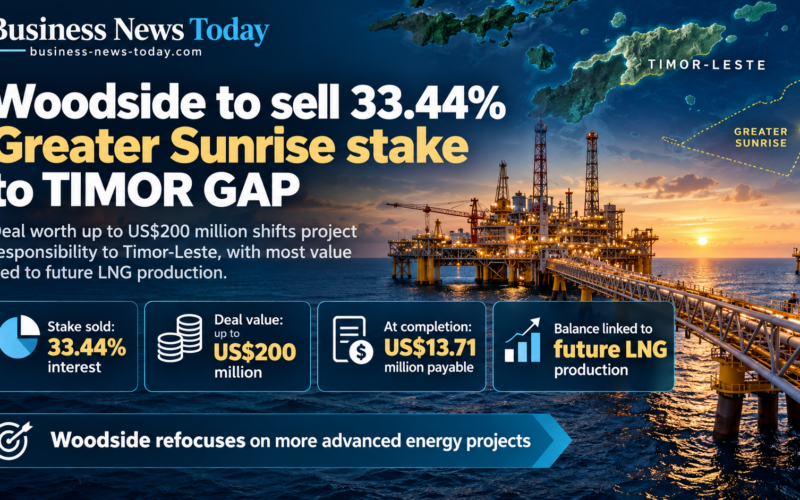
Woodside Energy Group Ltd (ASX: WDS; NYSE: WDS), the Australian oil and gas producer, has agreed to sell its entire 33.44% participating interest in the Greater Sunrise gas project to Timor-Leste’s state-owned energy company, TIMOR GAP, for total consideration of up to US$200 million. Announced on October 27, 2026, the transaction covers Woodside’s interests in the Sunrise Joint Venture and the petroleum titles containing the Greater Sunrise fields in the Timor Sea. Only US$13.71 million will be payable when the transaction completes, while the remaining US$186.29 million depends on the project reaching specified development and production milestones. The agreement marks a significant change in the ownership of one of the region’s longest-delayed gas developments, while allowing Woodside to direct management attention and capital towards projects with clearer production schedules.
Completion is targeted for the first half of 2027, subject to government, regulatory and joint venture approvals. The transaction includes Woodside’s interests in Australian retention leases NT/RL2 and NT/RL4, along with production-sharing contracts JPDA 03-19 and JPDA 03-20.
Woodside Chief Executive Officer Liz Westcott described the disposal as part of a disciplined approach to portfolio management and capital allocation. Although management continues to recognise the resource potential of Greater Sunrise, the company has decided that other opportunities offer a more attractive allocation of resources.
For TIMOR GAP, the acquisition represents an opportunity to consolidate control over the project and advance its preferred development concept involving gas processing on Timor-Leste’s southern coast. However, ownership consolidation does not automatically resolve the substantial financing, engineering and commercial requirements needed to transform the undeveloped gas fields into an operating LNG business.
Why is Woodside Energy selling its 33.44% Greater Sunrise stake after decades without commercial production?
Greater Sunrise consists of the Sunrise and Troubadour gas and condensate fields, located approximately 150 kilometres southeast of Timor-Leste and 450 kilometres northwest of Darwin, Australia. The fields were discovered in 1974, but their development has been repeatedly delayed by disagreements over production infrastructure, commercial arrangements and the treatment of resources within the Timor Sea.
The development contains an estimated 5.1 trillion cubic feet of gas and 226 million barrels of condensate, according to TIMOR GAP. These quantities are classified as contingent resources and should not be treated as proved commercial reserves or production volumes. Their economic value depends on establishing a viable development scheme.
One of the most persistent issues has been the location of the proposed LNG processing infrastructure. Timor-Leste has advocated bringing gas to its southern coast, where a liquefaction project could support employment, industrial development and domestic infrastructure. Alternative proposals have considered transporting gas towards existing Australian facilities around Darwin.
The disagreement has involved more than the construction cost of a pipeline. The location of LNG processing would influence employment, infrastructure investment, national economic development and the distribution of commercial benefits between Timor-Leste and Australia.
Woodside has remained involved in efforts to develop Greater Sunrise through successive negotiations and technical assessments. However, the project has not reached a final investment decision, and its commercial timetable remains uncertain.
The company’s decision to exit indicates that holding a large undeveloped resource is not necessarily consistent with its current investment priorities. Woodside has several major projects approaching production or construction milestones, creating competition for capital and management resources.
The sale also follows progress in negotiations concerning a new production-sharing contract and fiscal framework for Greater Sunrise. Woodside said the parties reached alignment on key principles in August 2026, providing a suitable point for transferring its interest to TIMOR GAP.
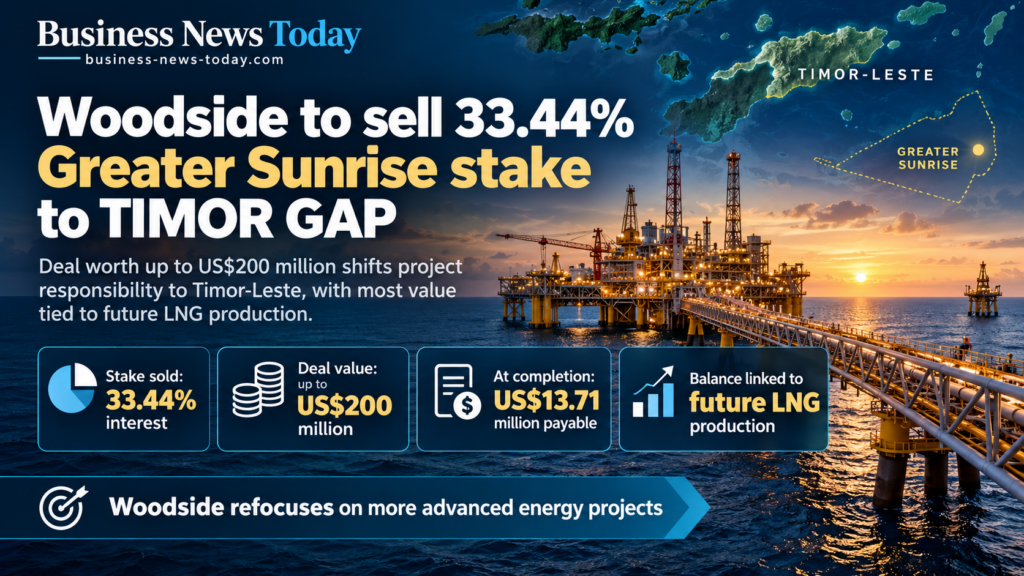
How much cash will Woodside actually receive from the $200 million Greater Sunrise transaction?
The headline consideration of US$200 million is divided into three payments, each associated with a different stage of the project’s development. This structure is central to evaluating the financial consequences for Woodside shareholders.
The first payment is US$13.71 million, payable upon completion of the transaction. This represents approximately 6.9% of the maximum announced consideration. The amount remains subject to an adjustment covering cash calls and working capital between the transaction’s effective date of November 1, 2026, and completion.
The second payment is US$11.29 million, payable following an affirmative final investment decision concerning the development of Greater Sunrise resources for LNG production. A final investment decision would demonstrate that the project sponsors have formally committed to proceeding with a defined development.
The largest payment is US$175 million, representing 87.5% of the maximum consideration. It becomes payable within 365 days after loading begins for the first LNG cargo produced from the Greater Sunrise area and intended for sale to a customer.
This means Woodside is not receiving US$200 million immediately. The overwhelming majority of the potential proceeds remains conditional on a project that has not yet reached its final investment decision.
If the sale completes but Greater Sunrise never advances to commercial production, the payment structure would produce a materially different financial outcome from the headline transaction value. The eventual consideration depends on the achievement of the specified contractual milestones.
Conversely, the arrangement allows Woodside to retain a financial interest in the project’s eventual progress without continuing as an equity participant responsible for future development expenditure.
The distinction between ownership and contingent consideration matters. Following completion, Woodside will no longer hold a participating interest in the Sunrise Joint Venture, even though it may become entitled to additional payments if the project advances.
The company has not provided a revised balance-sheet valuation, gain or loss on disposal, or earnings forecast associated with the transaction. Those accounting outcomes will depend on the carrying value of its investment and the applicable recognition of contingent consideration.
How will TIMOR GAP’s acquisition of Woodside and Osaka Gas interests change ownership of Greater Sunrise?
Before the announced transactions, TIMOR GAP held 56.56% of the Sunrise Joint Venture, Woodside held 33.44%, and Osaka Gas held the remaining 10%.
On September 2, 2026, TIMOR GAP announced a binding agreement to acquire Osaka Gas Australia’s 10% participating interest. The latest agreement will add Woodside’s 33.44% stake, potentially consolidating the entire project under the national oil company.
Assuming both transactions complete on their agreed terms, TIMOR GAP will hold 100% of the participating interests in Greater Sunrise. However, neither acquisition should be confused with ownership consolidation already completed on October 27.
Woodside’s transaction remains subject to the necessary approvals and customary conditions, while TIMOR GAP’s agreement with Osaka Gas also has outstanding closing requirements.
Full equity ownership would give TIMOR GAP greater control over the commercial direction of the project and the selection of development partners. It could potentially reduce disagreements among existing shareholders over the preferred development concept.
However, the removal of other equity owners also changes the distribution of development responsibilities. TIMOR GAP would need to determine how to finance and execute a major offshore gas and LNG development, including whether to introduce new investors or technical partners.
The national oil company has indicated that it intends to accelerate consideration of the Timor LNG development concept, involving a pipeline towards Natarbora on Timor-Leste’s southern coast.
This would support the government’s ambition to establish industrial and energy infrastructure within the country. Nevertheless, ownership consolidation does not establish that the project has secured the financing or engineering commitments required for construction.
There is also an important distinction between participating interests and sovereign revenue entitlements. Even if TIMOR GAP owns 100% of the joint venture interests, the petroleum development remains subject to the maritime treaty framework governing revenue sharing between Timor-Leste and Australia.
Why does the Timor-Leste LNG pipeline proposal remain the central development challenge after Woodside’s exit?
The location of Greater Sunrise’s processing infrastructure has been one of the main obstacles to development. Timor-Leste has consistently advocated transporting gas to its southern coast, where liquefaction facilities and associated infrastructure could create domestic employment and industrial opportunities.
TIMOR GAP’s October announcement reinforces that ambition. Its leadership considers the project an opportunity to transform the southern coast into an energy and industrial hub rather than simply export offshore gas through infrastructure outside the country.
A Timor-Leste-based LNG development would involve offshore production facilities, a gas transportation pipeline, processing infrastructure and export arrangements. The overall project would require substantial engineering work, environmental assessment, financing and commercial commitments.
The alternative of connecting Greater Sunrise with infrastructure around Darwin has historically featured in development discussions. Such an approach could potentially use established industrial capacity, although its feasibility would depend on the technical configuration, available facilities and commercial terms.
The choice between these concepts has consequences beyond capital expenditure. Timor-Leste attaches significant importance to the employment, infrastructure and broader economic benefits associated with developing LNG facilities domestically.
The 2018 maritime boundary treaty between Australia and Timor-Leste contains a specific framework reflecting those differences. Under its provisions, Timor-Leste would receive 70% of upstream revenue if the fields are developed through a pipeline to Timor-Leste.
If the project is developed through a pipeline to Australia, Timor-Leste’s share of upstream revenue would increase to 80%, reflecting the downstream economic benefits expected to arise in Australia. These percentages refer to upstream revenue sharing between the governments, not TIMOR GAP’s shareholder ownership.
The arrangement illustrates why the most commercially efficient technical option and the preferred national development outcome may not be identical. A final development decision will need to address both project economics and the treaty framework.
TIMOR GAP’s greater ownership control may accelerate the selection of a preferred route, but building the associated infrastructure remains a separate challenge. The company has not announced a completed financing package or sanctioned construction programme for the full development.
What do Woodside’s latest production and financial results reveal about the decision to simplify its portfolio?
Woodside’s third-quarter 2026 operational report provides an important financial backdrop to the Greater Sunrise disposal. The company generated operating revenue of US$4.28 billion during the three months ended September 30, increasing approximately 2% from the preceding quarter.
Production increased 12% sequentially to 46.2 million barrels of oil equivalent, or approximately 503,000 barrels of oil equivalent per day. Higher output from Pluto LNG following maintenance activity contributed to the recovery.
Woodside also reported an average realised LNG price of US$84 per barrel of oil equivalent, representing a 27% increase from the second quarter. The improvement reflected stronger pricing conditions and the effects of LNG portfolio optimisation.
During the first half of 2026, Woodside reported operating revenue of US$7.45 billion, an increase of 13% from a year earlier. Underlying net profit after tax increased 7% to US$1.33 billion, while reported net profit rose 27% to US$1.67 billion.
Operating cash flow for the first half declined approximately 10% to US$3.01 billion. Free cash flow, under the company’s reported measure, increased to US$352 million from US$136 million. These figures demonstrate that the group continues to generate substantial cash while funding major development commitments.
Woodside’s third-quarter guidance maintained expected 2026 capital expenditure of US$4 billion to US$4.5 billion. That investment requirement provides context for the decision to dispose of an asset without a defined production timetable.
The Greater Sunrise interest does not represent an existing source of operating revenue comparable with Woodside’s producing LNG and oil assets. Consequently, its disposal should not be expected to reduce current production volumes materially.
The more significant potential benefit involves limiting future development commitments and simplifying the portfolio. However, the company has not quantified the capital expenditure that would otherwise have been required to retain its Greater Sunrise interest.
How does the Greater Sunrise disposal fit Woodside’s Scarborough, Trion and Louisiana LNG investment priorities?
Woodside is managing several large projects with development milestones considerably closer than those of Greater Sunrise. The Scarborough Energy Project in Western Australia was 99% complete at the end of September 2026, with management continuing to target its first LNG cargo during the year.
Scarborough represents a substantial investment in future gas supply and is supported by associated infrastructure at Pluto LNG. Its advanced construction status distinguishes it from Greater Sunrise, where the final development concept and sanction remain outstanding.
The Trion oil project in Mexico was approximately 71% complete at the end of September, with first oil targeted for 2028. The project’s floating production unit was approximately 96% complete, indicating progress towards a defined development schedule.
Woodside’s Louisiana LNG project in the United States was approximately 32% complete, with the first train 41% complete. Management continues to target initial LNG production in 2029, positioning the development as a future contributor to the company’s international gas portfolio.
These projects require substantial financial and operational attention. Construction management, equipment delivery, commissioning and commercial arrangements must progress together for the expected production schedules to be achieved.
Woodside has also been adjusting other parts of its portfolio. During the third quarter, the company entered into an agreement to sell its 70% operated interest in the Calypso project to bp. It also completed a strategic review of Beaumont New Ammonia and announced plans to initiate a process to reduce its investment.
Taken together, the developments indicate an emphasis on capital allocation and portfolio concentration. Management is seeking to balance near-term production, sanctioned projects and future growth opportunities while reducing exposure to assets it considers less strategically attractive.
Greater Sunrise fits that broader pattern. The asset contains substantial resources but lacks the certainty of a final investment decision and a defined construction schedule. Exiting allows management to focus on developments where progress can be measured against established execution milestones.
What does Woodside’s withdrawal mean for Timor-Leste’s energy security and long-term economic development?
Greater Sunrise has unusual national importance for Timor-Leste because petroleum revenues have played a central role in public finances and economic development. The country has accumulated revenue from offshore oil and gas production, particularly through previously developed fields such as Bayu-Undan.
As those resources mature or become depleted, the government faces pressure to establish new sources of economic activity. Greater Sunrise represents one of the most significant potential projects available, with implications for public revenue, infrastructure, employment and energy-sector investment.
TIMOR GAP’s acquisition strategy seeks to increase the country’s control over how the resource is developed. Ownership consolidation may strengthen its ability to select commercial partners and negotiate arrangements aligned with domestic development priorities.
The company’s leadership has identified construction of a pipeline and LNG facilities on the southern coast as a means of creating a wider industrial ecosystem. Such infrastructure could support employment and associated services, provided the project proceeds and the expected economic activity materialises.
However, direct control of the upstream asset does not eliminate the need for outside expertise and capital. Large offshore LNG developments require engineering, project management, financing and long-term sales arrangements that may exceed the resources available to a national oil company acting alone.
The potential involvement of international energy developers, infrastructure investors or lenders will therefore remain important. Their participation would depend on project economics, contractual protections, regulatory stability and expected returns.
The transaction may also affect the relationship between Timor-Leste and Australia as the parties continue implementing the maritime treaty framework. Cooperation on regulatory and fiscal arrangements will remain relevant regardless of the nationality of the equity owner.
For Timor-Leste, ownership consolidation is an important institutional milestone. The more demanding economic milestone will be achieving an approved, financed and operational development capable of generating sustainable returns.
How did Woodside Energy shares react to the Greater Sunrise sale, and what should WDS investors monitor?
Woodside Energy shares closed at A$33.18 on the Australian Securities Exchange on October 27, 2026, increasing approximately 0.27% from the previous session’s A$33.09 closing price. The stock traded between A$32.97 and A$33.34 during the session.
The increase indicates a modest positive movement on the day of the announcement, but it does not establish that the Greater Sunrise transaction was the principal cause. Oil and gas prices, broader equity market conditions and expectations surrounding Woodside’s major projects also influence the share price.
The stock had closed at A$32.86 on October 23 and A$33.14 on October 16. This suggests relatively limited movement over the preceding period compared with the potential long-term significance of the company’s ongoing project portfolio.
For investors, the immediate proceeds from Greater Sunrise are relatively modest compared with Woodside’s quarterly revenue and annual capital expenditure. The US$13.71 million payable at completion would represent a small addition to liquidity for a business generating billions of dollars in operating cash flow.
The larger potential consideration has a different financial profile. The US$175 million production-related payment would become available only after the first LNG cargo reaches the contractual milestone. That event could occur years after Woodside relinquishes ownership, if development proceeds.
An investor interpretation supportive of the disposal would emphasise the removal of long-duration development uncertainty and management’s ability to focus on more advanced assets. The transaction also allows Woodside to retain some financial participation in potential future project success through contingent payments.
A more cautious interpretation would question whether selling a substantial gas resource for a limited upfront payment sacrifices long-term optionality. That concern depends on the cost, schedule and commercial risks Woodside would have faced by remaining involved.
The company’s valuation is therefore more likely to be influenced by production reliability, LNG pricing, construction costs and future cash generation from sanctioned developments than by the immediate proceeds from Greater Sunrise.
What milestones will determine whether the Greater Sunrise transaction creates value for Woodside and TIMOR GAP?
The first milestone is completion of the share transfer in the first half of 2027. Both parties must satisfy the relevant governmental, regulatory and joint venture conditions. Any delay would postpone the initial payment and the formal transfer of Woodside’s participating interest.
TIMOR GAP must also complete its separate acquisition of Osaka Gas Australia’s 10% stake to achieve the full ownership position contemplated in its consolidation strategy. The timing of that transaction remains subject to its own conditions.
The next major development milestone will be the selection of an economically viable project concept and approval of the associated production-sharing and fiscal arrangements. These decisions will influence the development cost, financing requirements and distribution of future revenue.
A final investment decision would trigger Woodside’s US$11.29 million contingent payment. More importantly, it would signal that the project had progressed beyond planning into a formally sanctioned development programme.
Construction, commissioning and eventual LNG production would then determine whether the largest contingent payment becomes payable. Woodside’s US$175 million entitlement depends on the commencement of loading of the first LNG cargo intended for commercial sale, not simply the discovery, development or processing of gas.
For TIMOR GAP, the financial test will involve obtaining suitable partners and funding while preserving the expected economic benefits for Timor-Leste. Full equity ownership can improve decision-making control, but it also concentrates responsibility for advancing the project.
For Woodside, the disposal’s value lies principally in portfolio simplification and avoiding future capital commitments to an undeveloped asset. Its potential contingent proceeds provide additional upside without requiring the company to remain a joint venture participant.
The agreement therefore represents two different strategic decisions within one transaction. Woodside is prioritising capital discipline and more advanced investments, while Timor-Leste is accepting greater project responsibility in pursuit of domestic LNG development.
The ultimate outcome will depend on whether TIMOR GAP can convert ownership consolidation into a commercially viable gas project and whether Woodside can deliver stronger returns from the assets retained in its portfolio.
What are the key takeaways from Woodside Energy’s Greater Sunrise sale to TIMOR GAP?
- Woodside Energy has agreed to sell its entire 33.44% participating interest in the Greater Sunrise gas project to TIMOR GAP.
- Maximum transaction consideration is US$200 million, but the payment is heavily dependent on future project milestones.
- Only US$13.71 million is payable at completion, subject to applicable adjustments.
- A further US$11.29 million depends on an affirmative final investment decision.
- The remaining US$175 million, representing 87.5% of the maximum consideration, depends on the first LNG cargo intended for sale.
- Completion is targeted for the first half of 2027, subject to the necessary approvals.
- TIMOR GAP already owns 56.56% of Greater Sunrise and separately agreed to acquire Osaka Gas Australia’s 10% stake.
- Successful completion of both acquisitions would consolidate 100% of the participating interests under TIMOR GAP.
- The fields contain estimated contingent resources of 5.1 trillion cubic feet of gas and 226 million barrels of condensate.
- Woodside is concentrating capital and management resources on projects including Scarborough, Trion and Louisiana LNG, while TIMOR GAP faces the larger challenge of financing and executing Greater Sunrise.
Discover more from Business-News-Today.com
Subscribe to get the latest posts sent to your email.