




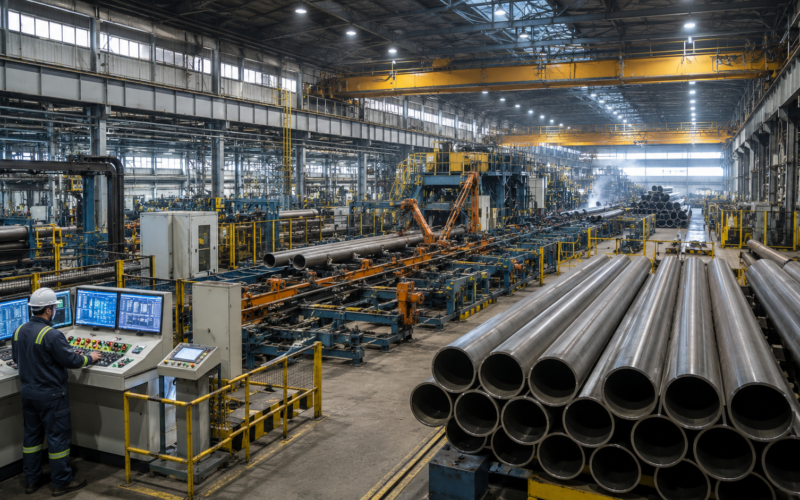
Tenaris S.A. (NYSE: TS; Mexico: TS; EXM Italy: TEN) has announced a C$306 million modernization of its Sault Ste. Marie Industrial Centre in Ontario, backed by Canada’s federal government and the Government of Ontario. The investment will expand production, improve material flows, extend product capability and add equipment across seamless and electric resistance welded pipe manufacturing. For Tenaris S.A., the project strengthens domestic Oil Country Tubular Goods supply at a time when Canada is placing greater emphasis on energy security, industrial resilience and tariff-exposed manufacturing capacity. The announcement also lands while Tenaris S.A. ADRs trade close to the upper end of their 52-week range, giving investors a useful test of whether long-cycle industrial investment can support an already strong stock narrative.
Why is Tenaris investing C$306 million in Sault Ste. Marie at this point in the Canadian energy cycle?
Tenaris S.A. is not merely refreshing equipment in Northern Ontario. The C$306 million investment is a capacity, productivity and supply chain control move designed to make the Sault Ste. Marie Industrial Centre more relevant to Canada’s upstream oil and gas operators, particularly those requiring higher-performance pipe for shale, thermal and offshore drilling applications. The modernization covers key production stages, including hot rolling, stretch reduction, heat treatment, testing capabilities, finishing and an additional threading line for semi-premium and API connections.
The timing matters because Oil Country Tubular Goods have become a strategic industrial category rather than a routine commodity input. Canadian oil and gas producers need dependable casing, tubing and line pipe supply, while governments are increasingly sensitive to import dependence, tariff uncertainty and domestic manufacturing employment. For Tenaris S.A., the investment gives the company a stronger local production story in a market where customers value availability, quality control and logistics certainty almost as much as price.

There is also a defensive logic. North American pipe markets are cyclical, and Tenaris S.A. knows better than most that drilling activity can move faster than steel capacity decisions. By modernizing Sault Ste. Marie now, Tenaris S.A. is positioning itself for a market in which fewer but more productive drilling programs still require technically demanding pipe, better testing and faster fulfilment. The bet is not that every rig count metric will climb in a straight line. The bet is that the Canadian energy supply chain will increasingly reward integrated suppliers that can deliver reliable, traceable, locally produced pipe without making customers perform procurement gymnastics.
How does the Sault Ste. Marie modernization strengthen Tenaris S.A.’s Canadian OCTG supply chain?
The Sault Ste. Marie Industrial Centre is central to Tenaris S.A.’s Canadian manufacturing model because it anchors both seamless and welded steel pipe production for energy customers. The planned upgrades will improve material flow across the facility, which is a less glamorous phrase than capacity expansion but often more important in industrial economics. Better internal flow can reduce bottlenecks, improve throughput, lower handling inefficiencies and support more consistent production quality.
The added threading line is particularly significant because connections are a high-value part of OCTG performance. Drilling environments in shale, thermal oil and offshore projects place pressure on pipe integrity, connection reliability and field readiness. By expanding semi-premium and API connection capability, Tenaris S.A. can strengthen its ability to serve operators that need more than basic commodity pipe. That gives the company a stronger argument in commercial discussions where reliability, technical support and delivery timelines are decisive.
The modernization also connects directly to the Rig Direct model, under which Tenaris S.A. ships pipe through service centres and delivers closer to drilling operations. That model becomes more powerful when domestic production, threading, testing and logistics are aligned. If Sault Ste. Marie can produce a broader range of high-performance OCTG and feed service centres more efficiently, Tenaris S.A. can convert manufacturing investment into customer stickiness. In oilfield services, stickiness is not a small thing. It is the part of the business where procurement teams stop shopping only on price and start caring about who prevents costly wellsite delays.
Why does government backing make the Tenaris Sault Ste. Marie project more than a corporate capital expenditure story?
The participation of the federal Strategic Response Fund and the provincial Invest Ontario Fund turns the Tenaris S.A. investment into a broader industrial policy signal. Canada and Ontario are supporting the project because domestic steel pipe capacity sits at the intersection of manufacturing employment, energy development, trade exposure and infrastructure competitiveness. This is not just about one company upgrading a mill. It is about keeping a critical industrial capability inside Canada while global trade rules, tariffs and energy politics remain unsettled.
For Ontario, the project reinforces Sault Ste. Marie’s role as a steel and advanced manufacturing centre. Tenaris S.A. already employs approximately 800 people in Sault Ste. Marie and more than 1,200 people across Canada, and the modernization is expected to generate up to 200 direct and indirect skilled jobs. That matters for regional economic policy because industrial upgrades of this scale can support subcontractors, maintenance providers, logistics firms and technical labour demand beyond the plant gates.
For Canada, the strategic question is whether domestic supply chains can support energy production without becoming overdependent on imported steel pipe during moments of trade disruption. The answer will not be decided by a single investment, but Tenaris S.A.’s project gives policymakers a concrete asset to point to. It supports the narrative that Canada can remain an energy producer while building more domestic manufacturing depth around that production. The political slogan writes itself, although the execution will still have to do the heavy lifting.
What does this investment signal about Tenaris S.A.’s North American strategy and capital allocation discipline?
Tenaris S.A.’s C$306 million Ontario modernization fits a larger pattern of selective investment in regions where the company can combine manufacturing, service infrastructure and customer proximity. The company has also been active in strengthening its footprint elsewhere, including its planned acquisition of Artrom Steel Tubes S.A. in Romania, which is intended to expand industrial pipe capability in Europe. The Canadian project is therefore not an isolated upgrade. It reflects a broader strategy of placing capital where local supply resilience and product specialization can protect margins.
From a financial perspective, Tenaris S.A. has the balance sheet profile to support this type of investment. The company reported first-quarter 2026 net sales of $3.1 billion, EBITDA of $735 million and net income of $564 million, while maintaining strong cash generation. That context matters because investors are more willing to tolerate capital spending when it is tied to productivity, higher-value product mix and customer retention rather than unfocused expansion.
The risk is that industrial capacity investments can look brilliant at the top of a cycle and heavy at the bottom of one. OCTG demand depends on oil and gas drilling activity, commodity prices, project approvals and operator capital budgets. Tenaris S.A. is trying to reduce that risk by focusing on product range, productivity and logistics rather than simply adding tonnage for the sake of tonnage. Still, investors will judge the project by whether it improves margins, supports Canadian sales and protects Tenaris S.A. from lower-cost or import-led competition when demand softens.
How should investors read Tenaris S.A. stock performance after the Ontario modernization announcement?
Tenaris S.A. ADRs were trading around $61.61 on May 22, 2026, close to a 52-week range that runs roughly from the low $32 area to $64.33. The stock has had a strong one-year run and remains near its recent highs, even though short-term performance has been mixed over the past five trading days and one-month window depending on the data source and closing basis used. That makes the Sault Ste. Marie announcement strategically important, but not necessarily an immediate rerating catalyst by itself.
The market already appears to be giving Tenaris S.A. credit for resilient earnings, North American exposure and disciplined shareholder returns. The modernization announcement adds quality to that story because it supports domestic production in a strategically important region, but it also raises the bar. When a stock is near its 52-week high, investors tend to ask sharper questions about execution, returns on capital and whether the next phase of growth is already priced in. No free lunch, not even when it comes wrapped in steel pipe.
A neutral reading is that the investment supports long-term competitiveness rather than changing the near-term earnings profile overnight. The plant upgrade should strengthen Tenaris S.A.’s Canadian operating base, but the stock will still be influenced by oil prices, drilling activity, tariff costs, North American OCTG pricing and global industrial demand. For long-term investors, the project is best viewed as an infrastructure-backed reinforcement of Tenaris S.A.’s strategic moat. For short-term traders, it may be less of a spark and more of a support beam.
What could go wrong with the Tenaris Sault Ste. Marie modernization despite the strong policy and market logic?
Execution risk is the obvious first hurdle. Modernizing a working industrial centre across hot rolling, heat treatment, testing, finishing and threading requires careful sequencing. If installation disrupts production more than expected, Tenaris S.A. could face temporary inefficiencies just when customers expect stronger delivery performance. Industrial upgrades rarely fail because the strategy is wrong on paper. They usually get messy because integration, timing and labour coordination are harder than the boardroom slide suggests.
Demand risk is the second issue. Canada’s oil and gas sector remains strategically important, but capital spending in upstream energy can still shift quickly if commodity prices weaken, regulatory timelines stretch or operators become more cautious. Tenaris S.A. is targeting shale, thermal and offshore applications, which offer meaningful demand pools, but those markets do not remove cyclicality. The modernization improves Tenaris S.A.’s ability to serve demand. It does not guarantee that demand will arrive in a smooth, spreadsheet-friendly line.
The third risk is policy durability. Government support helps anchor the investment, but industrial policy can change with fiscal pressure, election cycles and shifting public priorities. Canada wants energy security, manufacturing jobs and cleaner industrial competitiveness at the same time. Those goals can complement each other, but they can also create tension. Tenaris S.A.’s challenge is to make the Sault Ste. Marie upgrade commercially compelling even if the policy spotlight moves elsewhere.
How could this project reshape competition in Canadian steel pipe and oilfield supply chains?
The modernization should strengthen Tenaris S.A.’s position against imported OCTG and regional competitors by giving Canadian customers a more complete local supply option. In oilfield procurement, the supplier that can combine production, threading, testing, technical services and delivery support has an advantage over vendors offering narrower capabilities. Tenaris S.A. is effectively deepening that integrated model in Canada.
For competitors, the message is uncomfortable but clear. If customers begin to place a higher value on domestic supply reliability and service-centre integration, competing only on price becomes harder. Suppliers with weaker local footprints may need to improve logistics, product certification, field support or partnership models to stay relevant. The Sault Ste. Marie investment could therefore pressure the broader Canadian OCTG market toward higher service expectations.
The second-order effect may be felt in regional infrastructure planning. If Canada wants more pipelines, LNG-related infrastructure, offshore development or thermal oil resilience, domestic steel supply becomes part of the project-readiness conversation. Tenaris S.A. is placing itself inside that conversation. The company is not just selling pipe into energy projects. It is trying to become part of the industrial base that makes those projects politically and operationally easier to defend.
Key takeaways on what the Tenaris Sault Ste. Marie modernization means for Canada’s steel pipe and energy supply chain
- Tenaris S.A.’s C$306 million investment is best understood as a strategic reinforcement of Canadian OCTG capacity rather than a routine equipment refresh.
- The Sault Ste. Marie Industrial Centre upgrade strengthens seamless and electric resistance welded pipe production across key process stages, including hot rolling, heat treatment, testing, finishing and threading.
- Government backing through federal and Ontario support signals that steel pipe manufacturing is being treated as part of Canada’s energy security and industrial resilience agenda.
- The additional threading line for semi-premium and API connections should help Tenaris S.A. serve more demanding shale, thermal and offshore drilling applications.
- The project is expected to support up to 200 direct and indirect skilled jobs, reinforcing Sault Ste. Marie’s position as a Northern Ontario manufacturing hub.
- For Tenaris S.A. investors, the modernization adds strategic depth but may not create an immediate earnings inflection unless it improves margins, throughput and customer retention.
- The stock’s position near the upper end of its 52-week range means execution quality will matter more than announcement optics.
- Competitors in Canadian OCTG and line pipe markets may face higher expectations around domestic supply, testing capability, logistics and field readiness.
- The project also reduces some supply chain risk for Canadian oil and gas operators, particularly those exposed to import uncertainty and time-sensitive drilling schedules.
- The biggest risks are execution disruption, cyclical oilfield demand and the challenge of proving that government-supported industrial investment can deliver durable commercial returns.
Discover more from Business-News-Today.com
Subscribe to get the latest posts sent to your email.
