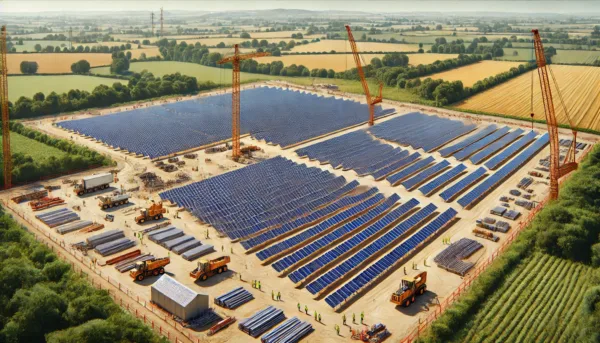
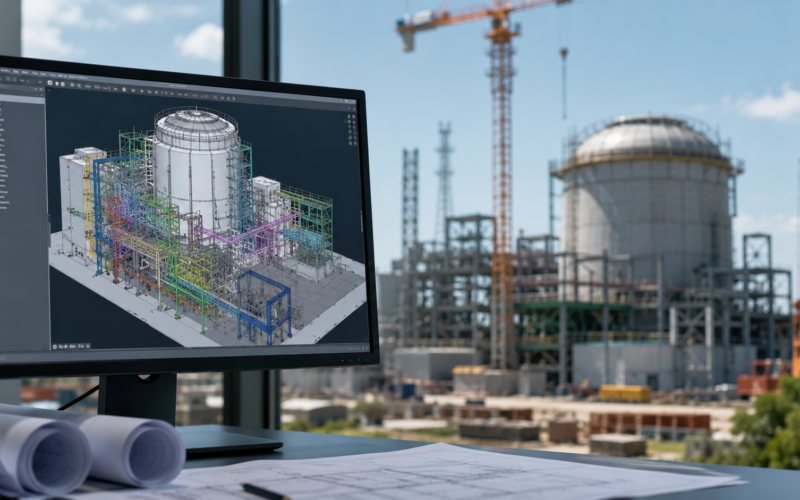
Nuclear Power Corporation of India Limited has opened another engineering stage in the 220 MWe Bharat Small Reactor programme, inviting specialist support for plant engineering and three-dimensional modelling of the proposed nuclear configuration. The procurement follows NPCIL’s earlier Request for Proposal inviting energy-intensive public and private industries to participate in deploying 220 MWe Pressurised Heavy Water Reactor-based Bharat Small Reactors at brownfield or greenfield industrial sites.
The latest tender should not be interpreted as an order to construct a new reactor. It covers engineering and digital-design work required to standardise and develop the plant configuration, while actual Bharat Small Reactor projects will depend on participating industrial customers, site suitability, project approvals, financing and the nuclear regulatory process.
What exactly is NPCIL trying to standardise with the 220 MWe Bharat Small Reactor design?
The Bharat Small Reactor is based on India’s established 220 MWe Pressurised Heavy Water Reactor technology rather than an entirely unproven reactor concept. Government material describes the programme as an adaptation of a reactor design with an existing safety and operating record, with changes intended to reduce land requirements and make deployment more suitable for industrial captive-power applications.
Plant engineering and 3D modelling are important because moving a reactor from a conventional nuclear generating station into a more standardised industrial deployment model requires detailed coordination of civil structures, piping, equipment, electrical systems and maintenance access. A digital three-dimensional model can help identify interfaces before construction and establish a repeatable engineering baseline for future sites.
The tender therefore sits upstream of physical reactor construction but is important to the scalability of the programme. A more standardised design can potentially reduce engineering duplication when multiple industrial customers pursue similar reactors, although site-specific work would still be required.
NPCIL’s own documentation confirms that engineering design activity for Bharat Small Reactors has been progressing alongside the industry-participation process.

Why is India adapting the proven 220 MW PHWR for captive industrial power?
The programme is aimed particularly at energy-intensive industries such as steel, aluminium and metals that require large quantities of reliable electricity and face growing pressure to decarbonise their operations. Nuclear generation provides continuous baseload electricity, making it fundamentally different from variable solar and wind resources that require storage or complementary generation to provide round-the-clock industrial supply.
Under the government’s proposed business model, industrial participants can provide land, cooling water and capital while NPCIL retains responsibilities linked to reactor design, quality assurance and operation and maintenance within the existing legal framework. This creates a route for private capital to participate economically in nuclear projects without immediately transferring core reactor-operation responsibility away from the public-sector nuclear operator.
The model could be particularly relevant for large industrial sites where decarbonisation through renewable electricity alone would require extensive storage or transmission investment. A 220 MW reactor operating at high utilisation could provide a stable power source close to an industrial load.
The challenge is cost and complexity. Nuclear assets carry long development cycles, strict regulatory requirements and significant upfront capital expenditure, meaning industrial customers must evaluate them against renewable power, grid supply, captive thermal generation and emerging storage technologies.
How far has NPCIL’s industry partnership model progressed beyond the original RFP?
NPCIL issued its industry RFP on December 31, 2024 for 220 MWe Bharat Small Reactors at brownfield or greenfield sites offered by industries for their own electricity consumption. The company subsequently held a pre-proposal meeting and published responses to extensive technical and commercial questions from prospective participants.
Government disclosures later confirmed that the proposal deadline had been extended to March 31, 2026 after requests from interested industries. That process demonstrates active market engagement, but it does not yet mean commercial reactors have been awarded or construction has begun.
The distinction is important because Bharat Small Reactor headlines can easily be confused with India’s separate Bharat Small Modular Reactor research programme. The 220 MWe BSR is based on established PHWR technology and is intended for deployment with industrial partners, while the government is separately developing smaller modular reactor technologies including a roughly 200 MWe Bharat Small Modular Reactor and other advanced concepts.
The current plant-engineering tender is consequently a technical-enablement milestone inside the 220 MWe BSR programme rather than evidence that the separate indigenous SMR research programme has entered commercial construction.
Could Bharat Small Reactors materially change industrial decarbonisation in India?
A single 220 MWe reactor would be small compared with India’s utility-scale power system but substantial for an individual industrial complex. Ten such units would represent 2.2 GW of nuclear capacity, while 20 would reach 4.4 GW, illustrating how repeated deployment could become meaningful if multiple steel, aluminium, chemical or other energy-intensive companies adopt the model.
The government sees nuclear power as part of a much larger expansion toward 100 GW of nuclear capacity by 2047, supported by conventional large reactors as well as smaller technologies and greater private-sector participation. Bharat Small Reactors are one mechanism for extending nuclear generation beyond traditional utility sites and closer to industrial consumption centres.
The concept could also reduce transmission requirements where reactors are located near major loads, although nuclear siting is constrained by safety, cooling-water and regulatory requirements in ways that conventional captive power plants are not.
Economics will ultimately determine adoption. Industrial customers will need confidence in construction costs, financing, electricity pricing, outage risk and long-term regulatory certainty before committing capital to nuclear facilities whose operating lives can span several decades.
What are the next milestones before a Bharat Small Reactor can reach construction?
The engineering tender is only one element of a much broader pathway. NPCIL must complete design and standardisation work, assess industrial proposals and sites, finalise commercial structures and progress each project through statutory and nuclear-safety approvals before physical reactor construction can commence.
Legal reform is also part of the wider nuclear-sector discussion. Government disclosures earlier in 2026 said legislative changes supporting greater private-sector participation remained under processing, while the existing Bharat Small Reactor RFP itself was structured to operate within the prevailing legal framework.
This means the programme is advancing technically even before every aspect of India’s future nuclear-market structure is settled. That sequencing is significant: completing standardised engineering now could shorten later development timelines if industrial projects receive approvals.
The latest NPCIL procurement is therefore a modest contract milestone inside a potentially much larger industrial programme. Its significance lies not in the value of the consultancy tender but in the engineering groundwork required to turn the 220 MWe Bharat Small Reactor from a policy concept and industry RFP into a repeatable nuclear-power product for Indian industry.
Discover more from Business-News-Today.com
Subscribe to get the latest posts sent to your email.