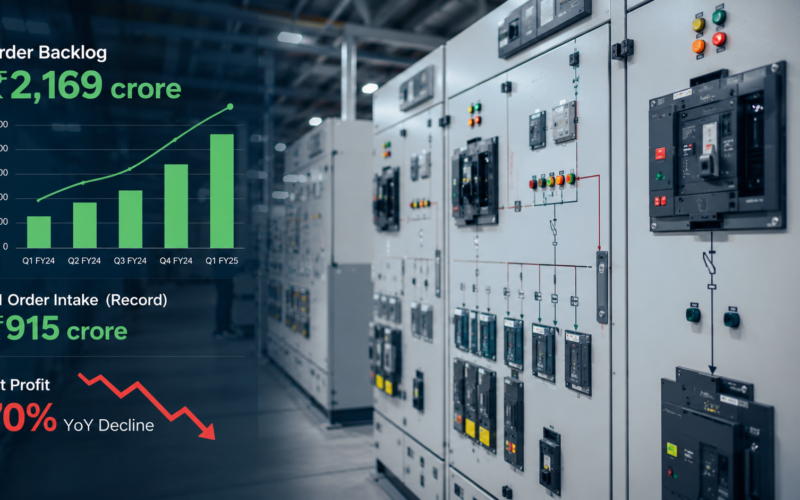
Schneider Electric Infrastructure Limited (NSE: SCHNEIDER) entered FY27 with a striking divergence between demand and profitability, recording its highest-ever quarterly order intake of ₹915 crore while net profit fell about 70% year on year to ₹12 crore. Revenue from operations increased around 5% to ₹651.4 crore, but EBIT fell to ₹32.1 crore from ₹66.7 crore as commodity-price volatility and delayed cost pass-through on older contracts compressed earnings.
The demand side remains considerably stronger than the profit number suggests. Schneider Electric Infrastructure ended June with an order backlog of ₹2,169 crore, up 32.7% year on year, after closing FY26 with ₹1,911 crore of backlog, ₹3,430 crore of annual order intake and ₹2,891 crore of revenue. The company has therefore continued adding orders faster than it is converting them into sales, increasing revenue visibility but also raising the importance of contract quality and execution economics.
How much revenue visibility does Schneider Electric Infrastructure’s ₹2,169 crore backlog provide?
The June order book is approximately 3.3 times Q1 FY27 revenue and about 75% of Schneider Electric Infrastructure’s entire FY26 revenue of ₹2,891 crore. Neither comparison establishes a precise backlog-conversion period because individual electrical-distribution projects can run across different schedules, but both show that the company has a substantial amount of contracted work awaiting execution.
Order momentum has also remained unusually strong. FY26 intake increased 27.4% to ₹3,430 crore, while backlog grew 50.1% to ₹1,911 crore at March 31. Another ₹915 crore of orders in Q1 FY27 pushed the June backlog to ₹2,169 crore despite revenue being recognised during the quarter.
That growth provides a relatively strong demand signal for products and systems used in electricity distribution. Schneider Electric Infrastructure operates across medium-voltage switchgear, transformers and associated electrical-distribution solutions, giving it exposure to industrial capex, utilities, infrastructure, data centres and power-system modernisation.
The more difficult question is whether the economics attached to that backlog are improving quickly enough to offset cost pressure.
Why did Schneider Electric Infrastructure’s Q1 profit fall 70% despite record orders?
The immediate problem is the timing mismatch between input-cost inflation and the company’s ability to recover those increases from customers. Management attributed Q1 pressure partly to commodity-price volatility and delays in passing on higher costs on certain legacy orders, while EBIT more than halved despite modest revenue growth.
Fixed-price or slower-reset contracts can become less profitable when copper, steel and other electrical-equipment inputs rise after commercial terms have already been agreed. Schneider Electric Infrastructure may still deliver the full contracted revenue, but gross profit can be significantly weaker if procurement costs exceed the assumptions embedded in the original bid.
This explains why record order intake and a larger backlog cannot automatically be interpreted as equivalent earnings growth. The value of the ₹2,169 crore pipeline depends on product mix, pricing discipline and the degree to which newer orders contain commercial terms that better reflect current commodity costs.
The company’s FY26 numbers already indicated this tension. Revenue grew 9.6% and orders 27.4%, but the business entered FY27 needing to improve profitability on the enlarged pipeline rather than simply accelerate order intake further.

Does the record ₹915 crore Q1 order intake suggest the demand cycle is still intact?
The order performance indicates that customers continue investing heavily in electrical-distribution infrastructure despite the earnings setback. A ₹915 crore quarterly intake is equivalent to roughly 31.7% of Schneider Electric Infrastructure’s entire FY26 revenue, making it a meaningful demand signal rather than a marginal booking increase.
India’s electrification and industrial-capex cycle provides several structural demand drivers. New manufacturing plants, renewable generation, grid reinforcement, metro systems, data centres and commercial infrastructure all require switchgear, transformers, protection equipment and electrical-distribution systems.
Schneider Electric Infrastructure also benefits from the broader technology and manufacturing network of Schneider Electric, giving it access to products and engineering expertise across energy management and automation. That competitive position can support order growth, but shareholders of the listed Indian entity ultimately need those orders to produce adequate margins.
The next several quarters will consequently provide a clearer indication of whether Q1 represents temporary legacy-contract pressure or a more persistent profitability issue.
Can Schneider Electric Infrastructure rebuild margins as newer orders enter execution?
The strongest path to margin recovery would be a gradual decline in the share of older, lower-quality orders combined with better pricing on new business. Because the company has been booking substantial fresh work, the commercial terms attached to FY26 and Q1 FY27 orders may increasingly shape the earnings profile as those projects move into revenue.
Operational execution will also matter. Higher factory utilisation can spread fixed costs over greater output, but rapid order-book growth can create procurement, scheduling and working-capital pressures if projects do not move through production smoothly.
Schneider Electric Infrastructure ended FY26 with ₹1,911 crore of backlog and increased it to ₹2,169 crore by June. The company therefore does not face an obvious shortage of work; it faces the more demanding task of converting that work at acceptable profitability.
That distinction is central to the investment case. A strong order book can support revenue growth for several quarters, but margin recovery is what determines whether the additional sales create proportionate shareholder value.
What did the market’s reaction to Schneider Electric Infrastructure’s Q1 reveal?
The shares fell 11.47% on August 17 after the earnings release and closed August 21 at about ₹1,224, leaving the stock roughly 10.6% below its August 14 pre-result close of ₹1,369.20. The August 21 session itself was down around 1.5%, showing that the initial profit shock had not been fully reversed by the end of the week.
The reaction is notable because investors had previously rewarded the company for its exposure to India’s electrification and capital-expenditure cycle. Even after the correction, the stock remains associated with a long period of substantial rerating, meaning expectations for growth and operating quality were already elevated before Q1.
The market is therefore sending a relatively clear message: order growth remains valuable, but the valuation increasingly depends on the quality of those orders. Schneider Electric Infrastructure has ₹2,169 crore of backlog and record quarterly intake; what investors now need is evidence that the expanding pipeline can restore rather than dilute profitability.
Discover more from Business-News-Today.com
Subscribe to get the latest posts sent to your email.