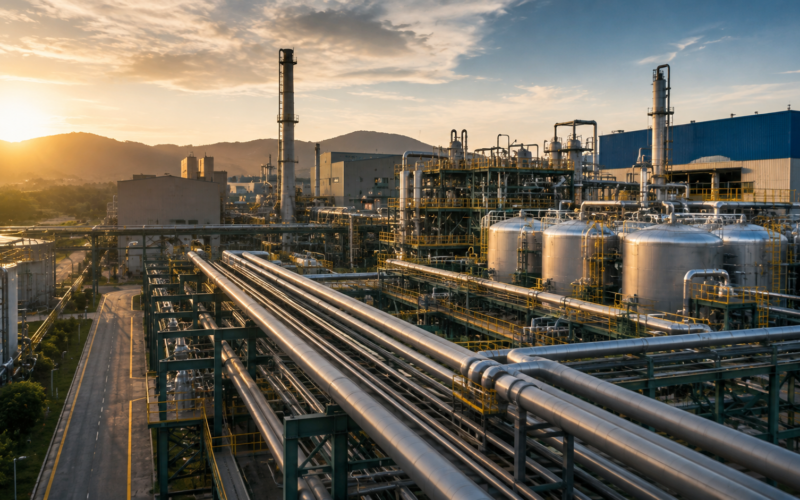
Novonesis A/S is preparing to invest between ₹2,500 crore and ₹3,000 crore in Maharashtra over the next 24 to 36 months, with a significant portion of the programme expected to expand its manufacturing operations at Patalganga near Mumbai. The Danish biosolutions group is targeting rising Indian demand across biofuels, food and health, agriculture and other biological applications, while remaining approvals and project sign-offs are expected to be completed before the investment programme is fully detailed.
The proposed investment represents a major increase in the scale of Novonesis’ Indian manufacturing footprint. The company’s legacy Novozymes business originally committed approximately ₹300 crore to establish the Patalganga site, which was designed for enzyme production and regional supply-chain operations. A new programme approaching ₹3,000 crore would therefore be roughly ten times that initial disclosed investment, although the new capex is expected to cover a much broader expansion than the first phase of the site.
What will Novonesis’ ₹2,500-3,000 crore Maharashtra investment actually fund?
Novonesis has not yet released a complete package-by-package capex breakdown, making it important not to treat the entire ₹3,000 crore upper estimate as committed plant and machinery expenditure at Patalganga. Current disclosures indicate that the investment will be deployed over two to three years, with a major portion expected to support manufacturing expansion at the Maharashtra site as the company completes remaining approvals.
The project is nevertheless more advanced than a purely conceptual market-entry plan. Novonesis already operates at Patalganga, has previously prepared for expansion at the site and maintains an environmental-clearance reference for a Patalganga expansion project on its corporate website. The company has also advertised engineering roles connected with designing and constructing additional enzyme-production and waste-treatment infrastructure at the facility.
That combination suggests the latest capital programme is intended to deepen an established manufacturing base rather than create an entirely new Indian operation. Final capacity, product configuration and commissioning phases will become clearer only after the company completes the remaining approvals and formally details the investment.

Why is Patalganga becoming central to Novonesis’ India manufacturing strategy?
Patalganga was originally chosen because of its access to customers, industrial infrastructure, ports, airports and highway connectivity around the Mumbai region. The facility was initially designed to produce enzymes through solid-state fermentation while also handling formulation and supply-chain functions for imported products, creating a platform that could subsequently be enlarged as regional demand increased.
Novonesis now operates a broader Indian footprint that includes manufacturing locations associated with Patalganga, Wada and other legacy businesses, together with corporate and technical operations in Bengaluru and Mumbai. Company information confirms multiple Indian subsidiaries and production-related entities, while management has repeatedly identified India as an important emerging market for the group.
The proposed expansion therefore reflects a shift from using India primarily as a sales and support market toward making it more important within Novonesis’ regional production network. A larger Patalganga plant could serve growing local demand while potentially increasing India’s role in supplying surrounding markets.
How could India’s ethanol programme drive demand for Novonesis biosolutions?
Bioenergy is one of the clearest industrial demand drivers. Enzymes and yeast technologies can improve the conversion of feedstocks into ethanol by increasing fermentation efficiency, reducing processing time or improving yields, giving biosolutions suppliers an opportunity as India expands ethanol blending and alternative feedstocks.
Recent industry commentary attributed to Novonesis points to double-digit Indian growth and rising demand from bioenergy, food and health, animal nutrition and biological agriculture. The company is also developing technologies intended to improve fermentation performance and agricultural productivity, widening the addressable market beyond one end-use industry.
This diversification is important because a ₹3,000 crore manufacturing programme would be harder to justify if demand depended on a single policy cycle. Food processing, household care, probiotics, agriculture and industrial biotechnology provide additional markets capable of supporting capacity utilisation as the Indian biosolutions sector develops.
The opportunity still depends on regulatory acceptance and customer adoption. Biological alternatives often compete with established chemical processes, and new agricultural or food applications may require approvals and validation before large-scale commercialisation.
How does the Maharashtra project fit Novonesis’ global growth and capex strategy?
Novonesis entered the proposed Indian investment cycle with strong global operating momentum. The company reported 8% organic sales growth for the first half of 2026 and an adjusted EBITDA margin of 37.7%, prompting management to raise its full-year organic-growth outlook to 7%-8% from 5%-7%.
The group has also explicitly signalled that capital expenditure will remain elevated during the early years of its 2030 strategy as it builds capacity for sustained growth. Its long-term financial framework envisages investment across regions before capex gradually moderates toward a high-single-digit percentage of sales later in the strategy period.
India therefore fits a wider global capacity-expansion thesis rather than operating as an isolated project. Emerging markets have been a particularly important growth source for Novonesis, and management is directing manufacturing investment toward regions where local demand can support both volume growth and supply-chain resilience.
The strategic logic is straightforward: biological products often require specialised fermentation and formulation capacity, and proximity to customers can reduce logistics complexity while allowing products to be adapted to local feedstocks and manufacturing processes.
What must happen before the full ₹3,000 crore Novonesis programme becomes executable?
The company has indicated that remaining approvals and sign-offs are expected before the end of 2026, meaning the current ₹2,500-3,000 crore figure remains a planned investment envelope rather than money already deployed. Detailed production capacity, construction phases, employment and equipment requirements have not yet been fully disclosed.
That project-stage distinction matters because large industrial MoUs can evolve as land, environmental requirements, product demand and engineering design are finalised. The existing Patalganga manufacturing base lowers greenfield execution risk, but expansion within an operating biotechnology site still requires careful management of utilities, effluent treatment and specialised fermentation systems.
If the programme advances near its upper ₹3,000 crore estimate, it would represent one of the more significant recent investments in India’s industrial biotechnology and biosolutions sector. The next major signals will be final approvals, a formal capex breakdown and disclosure of how much new production capacity Novonesis intends to create at Patalganga.
Discover more from Business-News-Today.com
Subscribe to get the latest posts sent to your email.