


Veolia Environnement (Euronext Paris: VIE) is deepening its position in semiconductor manufacturing through long-duration ultrapure-water and wastewater-treatment contracts, including a $550 million agreement covering a major fabrication plant in the United States Midwest. The contract requires Veolia to design, construct and operate the water infrastructure for 16 years, linking the company’s revenue opportunity to the operating life of the semiconductor facility rather than a one-off equipment delivery. Veolia has also renewed a five-year operations and maintenance agreement for the ultrapure-water system at SK hynix’s M15 fabrication plant in Cheongju, South Korea. These contracts strengthen the company’s ambition to generate more than €1 billion in annual revenue from semiconductor manufacturers and data centres by 2030. The central question is whether Veolia can convert rising demand for industrial water security into recurring margins and cash flow while managing complex project execution and a substantially enlarged group balance sheet.
Why do Veolia’s semiconductor fab water contracts matter beyond their headline value?
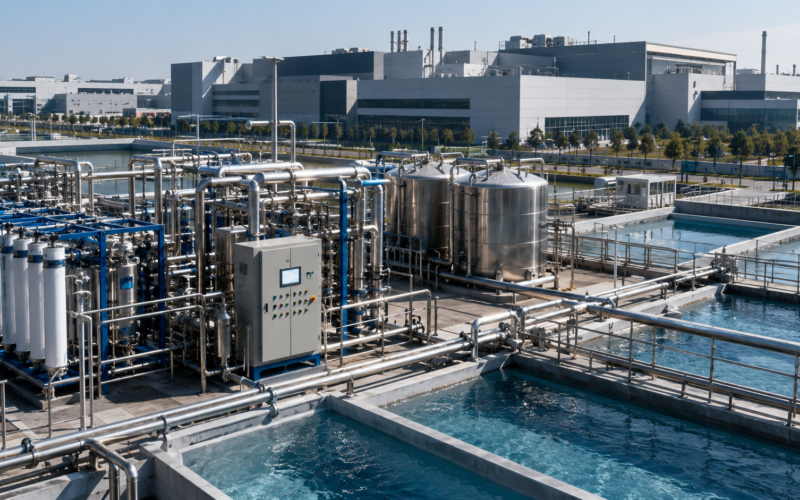
The $550 million Midwest contract is one of Veolia’s most important water-technology awards because it combines engineering, construction, technology deployment and long-term operations within a single commercial relationship. The facility will use ultrafiltration and reverse-osmosis membrane systems, including Veolia’s ZeeWeed hollow-fibre membranes, and is expected to recycle approximately 8,000 cubic metres, or 2.1 million gallons, of water each day.
This structure gives Veolia several potential sources of economic value. Engineering and construction generate project revenue during development, proprietary membranes and treatment equipment provide technology exposure, and the 16-year operating obligation can create a longer-duration service stream after commissioning. The commercial importance therefore cannot be assessed only by dividing the announced contract value across the construction period. The larger strategic benefit is the opportunity to remain embedded in a customer’s manufacturing infrastructure for much of the fab’s productive life.
Climate Adaptive Infrastructure disclosed a related $66 million Water-as-a-Service investment for a Midwest semiconductor facility, under which it will finance and own the water-treatment plant while Veolia provides design support and operates the wastewater-processing and reuse system. The structure converts part of the semiconductor manufacturer’s infrastructure requirement from capital expenditure into an operating expense. The $66 million investment should not be added to Veolia’s $550 million contract as though it were a separate contract award, because the disclosures appear to describe financing and service components within the broader project ecosystem. The plant was targeted to become operational in late 2026.
That financing model could become strategically useful for other semiconductor manufacturers. New fabs require billions of dollars of investment before producing commercial wafers, so outsourcing part of the water infrastructure can preserve capital for clean rooms, lithography tools, advanced packaging and production equipment. Veolia gains a long-duration customer relationship, while the manufacturer receives access to specialist infrastructure without carrying every asset directly on its balance sheet.
How does ultrapure-water infrastructure affect semiconductor yield and factory uptime?
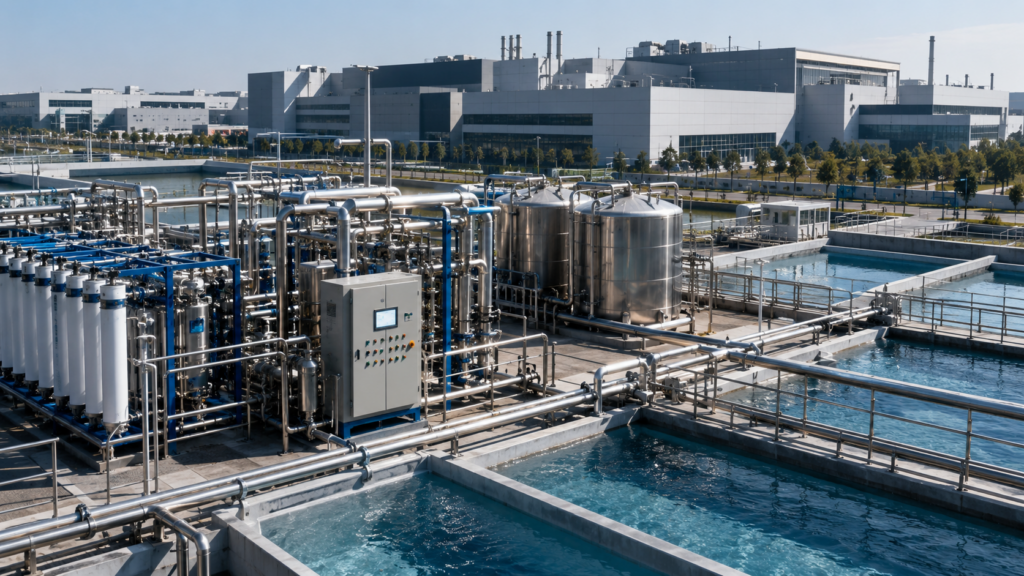
Water treatment in semiconductor manufacturing is not simply a utility or environmental-compliance function. Ultrapure water is repeatedly used to clean wafers between fabrication stages, and even trace contamination can contribute to defects, lower yields or process instability. Veolia’s existing semiconductor systems have been designed to achieve extremely demanding purity specifications, including resistivity of approximately 18.2 megohm-centimetres and very low levels of organic carbon, silica, boron and particles.
This makes water-system reliability commercially important. A conventional industrial customer may be able to tolerate temporary variation in water quality, but an advanced semiconductor fab requires consistent water chemistry across continuous manufacturing operations. The water provider must manage purification, monitoring, analyser maintenance, wastewater segregation, chemical treatment, reuse and regulatory discharge requirements without interrupting production.
Veolia’s renewed agreement with SK hynix illustrates the recurring-service opportunity. Veolia has operated the ultrapure-water system at the M15 fabrication plant since April 2018 and will continue providing water-quality management, analyser maintenance and safety, health and environmental support under the new five-year contract. The renewal provides evidence that the relationship can survive beyond construction and move into a repeat operating cycle.
Semiconductor wastewater also presents a recovery opportunity. Different production streams can contain acids, fluoride, silica, solvents, metals and other materials that require specialised separation. Better segregation and treatment can allow comparatively clean water to be reused in cooling towers or manufacturing support systems, reducing freshwater purchases and wastewater-disposal costs. Veolia has previously reported a programme at a United States microelectronics facility that enabled the reuse of nearly 15 million gallons annually while reducing chemical consumption and sludge generation.
Can Veolia turn semiconductor reshoring into recurring revenue instead of volatile project sales?
Veolia is targeting more than €1 billion in annual revenue from data centres and semiconductor customers by 2030, compared with approximately €560 million in 2025. Meeting that objective would require the combined business to grow by almost 80% over five years. The target reflects management’s view that artificial intelligence infrastructure, cloud computing and semiconductor sovereignty programmes will increase demand for water, energy and hazardous-waste services.
The company has identified microelectronics as a priority area within Water Technologies, and its customer portfolio already includes relationships with TSMC, Micron Technology, Samsung Electronics, Intel Corporation, STMicroelectronics and SK hynix across different combinations of water, wastewater and hazardous-waste services. Veolia also serves major data-centre customers, allowing it to approach digital infrastructure as a broader resource-management market rather than a narrow water-equipment opportunity.
The quality of future growth will depend on the revenue mix. Large engineering contracts can produce substantial order intake, but revenue recognition may fluctuate depending on equipment deliveries, construction milestones and customer schedules. Operations, maintenance, consumables, membranes, monitoring and digital optimisation services can provide more predictable recurring income after a facility begins operating.
Veolia’s first-quarter 2026 figures demonstrated this distinction. Group Water Technologies revenue was affected by the timing of project activity, while the underlying service and technology businesses performed more strongly when project movements were excluded. At group level, first-quarter revenue reached €11.43 billion, EBITDA increased organically by 5.1% to €1.77 billion, and the EBITDA margin rose by 73 basis points to 15.5%.
For the semiconductor strategy, the strongest model would combine selective large-project wins with a growing base of long-term operating contracts. Winning construction work expands the installed base. Renewals such as the SK hynix agreement then demonstrate whether that installed base can be converted into repeat revenue, operational data and deeper customer integration.
What do Veolia’s latest results reveal about its capacity to execute the fab strategy?
Veolia reported revenue of €22.19 billion for the first half of 2026, representing reported growth of 0.8% and growth of 1.5% when energy-price effects were excluded. EBITDA increased by 5% to €3.55 billion, while reported net income rose 3.8% to €682 million. Current net income, excluding specified acquisition-related effects, increased 10.4% to €837 million.
The operating performance supports the argument that Veolia can grow earnings faster than revenue through pricing, efficiency improvements and portfolio management. Management subsequently indicated organic EBITDA growth of 5% to 6% for 2026 and growth of at least 8% in current net income attributable to the group, including Clean Earth.
However, balance-sheet demands have increased. Net financial debt stood at €24.55 billion at the end of the first half, while investments totalled €1.63 billion. Net free cash flow was negative €288 million, although that represented an improvement from negative €451 million in the comparable period. Veolia is also pursuing a disposal programme exceeding €2 billion through mid-2028 as it absorbs the Clean Earth acquisition and manages leverage expected to remain equal to or slightly above three times EBITDA.
This matters for semiconductor projects because large design-and-build contracts can create working-capital requirements before operating cash flows mature. Veolia’s use of infrastructure partners such as Climate Adaptive Infrastructure may reduce the amount of capital it must commit directly, but the group still needs disciplined contract pricing, procurement control and milestone management.
The semiconductor opportunity therefore supports Veolia’s strategic move towards technology-driven environmental services, but it does not remove the need for capital discipline. A large backlog can look impressive while consuming cash if construction costs rise, customer schedules move or contractual milestones are delayed.
How is the market pricing Veolia’s semiconductor growth and higher financial leverage?
Veolia’s official investor website recently displayed the shares at €35.80, up 1.85% for the quoted session. Third-party market data showed the stock had gained roughly 20% during 2026 before pulling back from a July high of approximately €37.66. The performance suggests broadly constructive sentiment toward Veolia’s earnings resilience, technology positioning and portfolio transformation, although the late-July decline indicates that expectations are no longer undemanding.
The semiconductor contracts are strategically positive but are unlikely to determine the group valuation independently. Veolia remains a diversified environmental-services company with exposure to municipal water, waste, hazardous waste, energy services and industrial technologies. Investors will therefore evaluate the semiconductor opportunity alongside debt reduction, Clean Earth integration, planned disposals, margin expansion and free-cash-flow conversion.
Business News Today’s assessment is that the market is beginning to recognise Veolia as more than a defensive utility-style operator. Its proprietary membranes, ultrapure-water systems and industrial service contracts provide exposure to artificial intelligence and semiconductor capital expenditure without requiring Veolia to manufacture chips or own data centres.
The valuation argument will become stronger only if Water Technologies produces sustained organic growth, recurring service revenue and improving margins. Another large contract announcement may support sentiment, but operating evidence will carry greater weight than additional headline order values.
What could weaken the Veolia semiconductor water investment case despite rising demand?
Execution risk begins during design and construction. Semiconductor fabs have demanding commissioning schedules, and water systems must achieve specified purity levels before production equipment can operate reliably. Delays in customer construction, equipment installation, permitting or validation could shift Veolia’s revenue recognition and increase project-management costs.
Operational risk continues after commissioning. A water-quality interruption could affect a customer’s production, which means Veolia must maintain redundancy, monitoring and rapid-response capabilities. Long-term contracts can create recurring revenue, but they also create long-term performance obligations and potential cost exposure if operating assumptions prove inaccurate.
Customer concentration is another consideration. Large semiconductor projects can carry substantial values, and the loss, postponement or downsizing of one major fab could affect project revenue. The customer behind the $550 million Midwest contract has not been formally identified in Veolia’s public announcement, so speculation linking the project to a particular chipmaker should not be presented as verified fact.
Competition is also intensifying. Ecolab agreed to acquire Ovivo’s electronics water business for approximately $1.8 billion, while Kurita Industries has expanded its semiconductor water-treatment presence through partnerships and joint ventures. These moves indicate that specialist ultrapure-water capabilities are becoming strategically valuable, but they also increase competition for engineering talent, intellectual property and long-duration customer contracts.
Finally, water reuse does not eliminate public-policy scrutiny. Semiconductor plants can remain major water consumers even when recycling rates are high. Municipalities and regulators will increasingly examine the source of incoming water, wastewater chemistry, discharge requirements, watershed impact and the distinction between water recycled within a factory and water actually returned to the local system.
Which milestones will show whether Veolia’s semiconductor water strategy is delivering?
The first measurable test is the commissioning of the Midwest water-treatment and reuse facility targeted for late 2026. Progress toward operation would move the project from engineering and construction into the phase where Veolia can demonstrate reliability, water-recycling performance and long-term service economics.
The second test will be the performance of the Water Technologies business in upcoming financial disclosures. Investors should look for improving project activity, continued growth in service revenue, evidence of margin progression and clearer disclosure around semiconductor and data-centre revenue.
The third test is whether Veolia can replicate the SK hynix pattern by renewing or expanding contracts after initial operating periods. Repeat awards would indicate that customers regard Veolia’s service as operationally embedded rather than easily replaceable.
The final test is cash conversion. Semiconductor water infrastructure can become an attractive recurring-growth platform, but the investment thesis will be stronger if contract expansion occurs alongside lower leverage, delivery of the planned disposal programme and positive group free cash flow.
Veolia has secured a credible position in one of the less visible but indispensable layers of semiconductor manufacturing. The opportunity has improved because chipmakers require more sophisticated water systems, governments want domestic semiconductor capacity, and manufacturers are seeking ways to reuse water while protecting production yields. What remains unresolved is whether Veolia can convert that structural demand into repeatable cash returns without allowing construction complexity and acquisition-related leverage to dilute the benefits. The next decisive proof point will be successful commissioning and operating performance, not merely the announcement of another large contract.
What are the key takeaways from Veolia’s semiconductor fab water contracts?
- Veolia’s $550 million Midwest contract covers the design, construction and operation of semiconductor water infrastructure for 16 years.
- The facility is expected to recycle approximately 2.1 million gallons of water per day using ultrafiltration and reverse-osmosis technologies.
- A related $66 million Water-as-a-Service structure allows an infrastructure investor to own the treatment facility while Veolia operates it.
- Veolia renewed a five-year ultrapure-water operations contract at SK hynix’s M15 fab in Cheongju.
- The company aims to increase annual semiconductor and data-centre revenue from €560 million in 2025 to more than €1 billion by 2030.
- Long-term operations and maintenance contracts could provide more predictable revenue than stand-alone equipment projects.
- First-half 2026 EBITDA rose 5% to €3.55 billion, while current net income increased 10.4%.
- Net financial debt of €24.55 billion means semiconductor expansion must be balanced against leverage and cash-flow discipline.
- Competition is strengthening as environmental-services groups and specialist water companies invest in ultrapure-water capabilities.
- Commissioning of the Midwest facility and subsequent Water Technologies growth will be the next measurable tests of the strategy.
Discover more from Business-News-Today.com
Subscribe to get the latest posts sent to your email.