



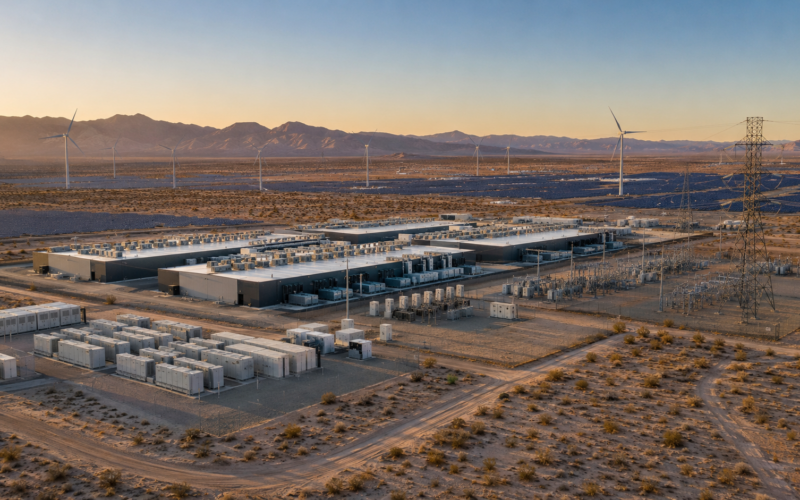
Australia’s federal government is preparing to push ahead with national energy rules for power-hungry data centres even without support from Queensland and the Northern Territory, setting up a significant federal-state confrontation over how the country accommodates the rapid expansion of artificial intelligence infrastructure.
National Cabinet is expected to consider the broader data centre framework this week. Climate Change and Energy Minister Chris Bowen has already said Canberra is prepared to legislate nationally if agreement cannot be reached, arguing that new data centres should bring additional renewable generation backed by firming capacity rather than increasing household electricity bills or weakening grid reliability.
The scale of the electricity challenge explains the intensity of the debate. Data centres currently consume about 2% of Australian electricity, according to Bowen, but the government expects the share could reach roughly 6% by 2030, equivalent to the electricity consumption of all homes in Victoria.
What energy rules does Canberra want to impose on new AI data centres?
The federal approach is based on a “causer pays” principle. New data centres would be required to support additional electricity generation rather than relying entirely on capacity already serving households and other businesses.
Bowen has said that means bringing new renewable energy into the system together with appropriate firming arrangements capable of delivering power when wind or solar generation is unavailable. Water usage is being considered through a parallel federal process because large data centres can require substantial cooling resources.
Canberra’s concern is that states competing aggressively for major AI and cloud investments could offer approval pathways without accounting fully for the cost of new transmission, generation or water infrastructure.
The federal government welcomes data centre investment and wants Australia to participate in the global AI supply chain. Its argument is that the economic benefits should not be effectively subsidised through higher electricity bills or reduced reliability for other users.
Why is Queensland opposing the proposed national approach?
Queensland Premier David Crisafulli’s government wants developers to retain greater flexibility over their energy mix rather than being required to link new projects specifically to additional renewable generation.
Queensland’s approach would allow projects to use sources including gas while placing approval conditions around social, environmental and infrastructure impacts. The Northern Territory has also opposed the federal energy model.
The disagreement partly reflects the different economic strategies of the jurisdictions. Queensland and the Northern Territory have substantial gas resources and see potential opportunities to attract data centres by combining reliable conventional generation with renewable energy and other technologies.
Canberra believes that model risks creating competition in which states lower energy requirements to win investment, leaving national electricity consumers to absorb the resulting costs.
How much electricity could Australia’s AI infrastructure require?
Bowen’s 2%-to-6% projection illustrates why data centres have moved rapidly from a specialist planning issue into national energy policy.
Individual facilities can consume electricity at industrial scale. Bowen cited one proposed project in his own electorate whose expected consumption would slightly exceed that of the Tomago aluminium smelter, currently one of New South Wales’ largest individual electricity users.
Unlike many traditional industrial projects, data centre demand can also expand rapidly because global technology companies are racing to add computing capacity for generative artificial intelligence, cloud services and increasingly sophisticated digital workloads.
The commercial opportunity is substantial. New facilities bring construction spending, high-value infrastructure and digital capacity. Their employment footprint after construction can, however, be relatively small compared with their extraordinary demands on electricity networks.
That mismatch is one reason governments increasingly want developers to internalise more of the infrastructure cost.
Could federal legislation really override Queensland’s preferred policy?
Bowen has said the Commonwealth intends to pursue national legislation if necessary and does not believe one or two dissenting jurisdictions should determine the lowest common denominator for the country.
Exactly how any federal law interacts with state planning and energy powers will depend on legislation not yet introduced. The current statements therefore establish political intent rather than the final legal mechanism.
A negotiated National Cabinet agreement remains Canberra’s preferred outcome. The immediate meeting could narrow differences even if Queensland refuses the complete federal model.
If agreement fails, the legislative battle could become an important test of how Australia governs infrastructure created by AI. Data centres are physical facilities located within states, but their electricity needs increasingly have consequences for an interconnected national market.
Why could Australia’s policy become a model for other AI markets?
Countries around the world are wrestling with the same contradiction. Governments want domestic AI capacity and investment but are discovering that digital infrastructure ultimately depends on very physical resources: electricity, transmission lines, land and water.
Australia’s proposed model attempts to make that relationship explicit by requiring data centre developers to support additional supply instead of competing invisibly with existing consumers.
The policy could also alter project economics. A location offering inexpensive land may become less attractive if the developer must simultaneously finance new electricity generation and grid connections.
For technology companies, regulatory consistency across Australia would simplify some investment decisions but could raise upfront costs. For households, the government argues that those additional costs are preferable to spreading the burden through electricity prices.
National Cabinet therefore faces a policy issue whose significance extends far beyond one disagreement with Queensland. Australia is deciding who should pay for the infrastructure behind the AI boom, and that question will become harder as data centre electricity consumption moves towards the scale of an entire state’s residential demand.
Discover more from Business-News-Today.com
Subscribe to get the latest posts sent to your email.