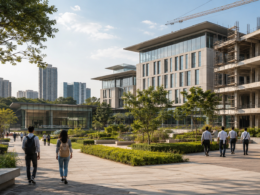





PepsiCo India Capability Center LLP has leased 91,314 square feet of office space at Laxmi Infobahn Tower 4 in Kokapet, extending the multinational food and beverage group’s corporate and capability-centre footprint in Hyderabad’s fast-growing western business corridor. The five-year agreement covers the sixth and seventh floors, carries an initial rent of ₹52.96 lakh per month, or ₹58 per square foot, and includes a 5% annual escalation. Property-registration information cited in market reports places the total rental commitment at roughly ₹35 crore and the security deposit at ₹4.76 crore.
The transaction is less about the absolute ₹35 crore rental value than the operating signal behind it. PepsiCo India Capability Center already has an established Hyderabad presence and is using the city for functions extending into technology, analytics, finance and enterprise operations. A newly advertised senior finance role, for example, describes the India Capability Center as supporting global and regional businesses through forecasting, analytics and decision support rather than functioning merely as a back-office processing unit.
What are the economics of PepsiCo’s 91,314 sq ft Kokapet office lease?
The starting monthly rent of ₹52.96 lakh equates to approximately ₹6.36 crore annually before escalation. At ₹58 per square foot per month, the lease provides a useful market benchmark for large Grade-A space in Kokapet, although negotiated rent depends on building quality, fit-out, tenure, parking and other contractual terms.
A 5% annual escalation means the rent burden rises progressively rather than remaining flat throughout the five-year term. The reported ₹35 crore total rental value is therefore consistent with a contract in which later years carry higher annual payments than the first.
PepsiCo also placed a ₹4.76 crore security deposit, equivalent to roughly nine months of initial rent. That is meaningful working capital for the tenant but relatively standard economics for a large corporate lease where landlords want security around a multi-year commitment.
The lease commenced on March 13, 2026, meaning the recent disclosure is a property-registration discovery rather than evidence that PepsiCo only decided in August to enter the building. That timeline distinction matters because the office commitment has already moved beyond planning and into an active lease period.
Why does PepsiCo need more space for its India Capability Center in Hyderabad?
PepsiCo has been building India as a base for global capability work spanning strategy, transformation, analytics, digital operations and corporate functions. Existing company-linked communications have described Hyderabad and Gurugram capability-centre offices as hubs for Strategy and Transformation teams, while current recruitment points to financial planning and analytical functions serving global businesses.
That changes how the lease should be interpreted. A 91,314-square-foot requirement is not simply another regional sales office; it represents infrastructure supporting global enterprise functions that can employ specialised technology, finance and analytics professionals.
Capability centres have become strategically important because multinationals are moving more sophisticated work into India rather than limiting the model to transactional services. Functions increasingly include engineering, cybersecurity, artificial intelligence, finance, research, digital product development and global process ownership.
PepsiCo’s expansion therefore adds another consumer-sector multinational to a Hyderabad GCC market that already spans technology, banking, healthcare and industrial companies.
Why is Kokapet attracting GCC occupiers that once concentrated around HITEC City and Gachibowli?
Kokapet sits immediately west of Hyderabad’s established Financial District and Gachibowli employment belt, giving it access to the same broader professional-talent ecosystem while offering newer Grade-A office developments and larger contemporary floorplates.
PepsiCo’s legal entity is already registered at Laxmi Infobahn in Kokapet, demonstrating that the area is not a completely new location for the group. The latest lease extends that relationship within the same wider office campus ecosystem.
The western corridor has also benefited from large-scale residential development, Outer Ring Road connectivity and expanding hospitality and retail infrastructure. These factors are increasingly important for GCC employers competing for skilled workers because commute, amenities and access to housing can influence recruitment and retention.
Kokapet’s growth therefore reflects a geographic extension of Hyderabad’s existing technology corridor rather than the creation of an isolated office district from scratch.
How does the PepsiCo deal fit Hyderabad’s broader large-office leasing cycle?
Recent market data indicates that transactions above 100,000 square feet accounted for about 4.9 million square feet of Hyderabad office leasing during the first half of 2026, up from around 3 million square feet a year earlier. Large-format deals represented approximately 65% of total leasing, compared with 51% in H1 2025.
PepsiCo’s 91,314-square-foot deal falls just below that 100,000-square-foot threshold, but commercially it belongs to the same large-enterprise demand trend. One occupier taking nearly two full floors for five years creates a materially different demand signal from a collection of small office tenants.
GCC expansion has been one of the major forces behind this shift because global enterprises frequently need large contiguous floorplates for teams that can scale over several years.
That demand has implications beyond landlords. Facility-management firms, staffing companies, managed-transport operators, hotels, food-service providers and residential developers can all benefit as employment clusters become denser.
What does the ₹35 crore lease tell property investors about Kokapet office demand?
The transaction gives landlords another real rental benchmark: approximately ₹58 per square foot per month at commencement, with 5% annual escalation and a multinational tenant willing to commit for five years.
That does not mean every Kokapet office can command identical economics. Building specification, tenancy profile, vacancy, floor efficiency and fit-out requirements all affect achieved rents, and one corporate lease should not be used as a universal valuation multiple for the market.
The stronger signal is tenant quality and duration. Large multinational occupiers typically conduct detailed assessments of building infrastructure, business continuity, security, commuting patterns and expansion capacity before signing long leases.
PepsiCo’s commitment therefore strengthens Kokapet’s credibility as a GCC location. The ₹35 crore headline captures the rental economics, but the more durable consequence could be the clustering effect created when additional global companies become comfortable placing sophisticated operations in the same western Hyderabad corridor.
Discover more from Business-News-Today.com
Subscribe to get the latest posts sent to your email.