



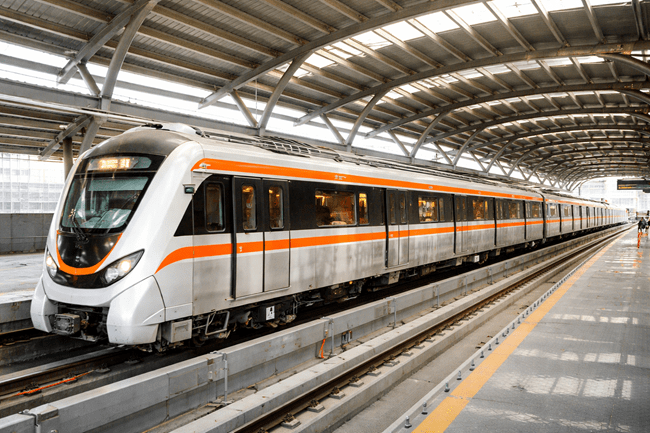
Gujarat Metro Rail Corporation Limited has invited bids for an ₹879.27 crore civil construction package forming the core of Ahmedabad Metro Phase 2A, the airport-extension corridor intended to improve rail connectivity toward Sardar Vallabhbhai Patel International Airport. The tender covers 4.97 kilometres of elevated viaduct, four elevated stations and a 1.01-kilometre underground section including a single underground station, with completion required within 36 months.
The project remains firmly at tender stage. GMRC has not yet selected a contractor, and the ₹879.27 crore figure is the estimated tender value excluding taxes rather than an awarded contract price. Bids are scheduled to close on September 28, 2026, with an ₹8.79 crore tender security and a pre-bid meeting scheduled for September 5.
The package is especially notable because it combines conventional elevated metro construction with a cut-and-cover underground section. That increases engineering complexity compared with an entirely elevated corridor and creates a single contract interface across viaducts, stations, ramps and subterranean works.
What exactly will the ₹879.27 crore Ahmedabad Metro Phase 2A contractor build?
Tender GMRC/CONS/STNS+VDCT+UG/PH-2A/2026 covers an elevated viaduct running approximately 4.97 kilometres from the Koteshwar Road dead end to the beginning of the underground ramp. Four elevated stations are identified as Ashram Road, Koteshwar Prachin Mandir, Sabarmati River and Sardar Nagar.
The underground component extends approximately 1.01 kilometres and includes twin cut-and-cover tunnels, a ramp and one underground Metro station. The civil package therefore totals almost six kilometres of principal alignment before accounting for the exact chainage treatment at transitions and terminal works.
The ₹879.27 crore estimate works out to roughly ₹147 crore per kilometre if divided mechanically across the approximately 5.98 kilometres of elevated and underground work identified in the package. That ratio should not be treated as a standard Metro construction cost because underground works and stations are far more expensive per kilometre than simple elevated viaducts, while the contract also includes architectural, civil and associated station infrastructure.
The better interpretation is that GMRC is packaging both construction types under one contractor to reduce interfaces at the transition between elevated and underground sections.
How does the tender fit Ahmedabad Metro’s 6.03 km airport-extension corridor?
GMRC officially identifies Ahmedabad Phase 2A as the Airport Extension. Its website lists the broader Phase 2A and 2B expansion at 9.36 kilometres with eight stations, comprising seven elevated stations and one underground station.
Industry project information places Phase 2A itself at approximately 6.032 kilometres, connecting the existing network toward Sardar Vallabhbhai Patel International Airport. The tender’s 4.97 kilometres of elevated infrastructure plus 1.01 kilometres underground therefore covers the great majority of that corridor’s civil alignment.
Airport connectivity changes the economic role of the Metro extension. Conventional urban lines primarily serve daily commuters, while an airport connection must also handle passengers carrying luggage, workers travelling outside conventional peaks and visitors unfamiliar with the system.
The commercial benefit does not depend only on airport passengers. The stations between the existing network and airport can improve access for surrounding neighbourhoods and employment zones, potentially increasing utilisation throughout the day.
Why is GMRC putting an underground section inside an otherwise elevated airport corridor?
Elevated Metro is generally cheaper and faster to build when sufficient right of way exists, but dense urban areas, airport-related constraints and surface infrastructure can make an elevated alignment impractical in selected locations. Cut-and-cover construction allows a relatively shallow underground structure to be built from the surface where tunnelling with a tunnel-boring machine would not necessarily be economical for a short section.
The 1.01-kilometre underground portion therefore represents a targeted engineering solution rather than an attempt to turn the entire airport extension into a subterranean line. The rest of the package remains elevated.
This mixed configuration also concentrates execution risk. Cut-and-cover work can require utility shifting, traffic diversions, excavation support, groundwater management and careful restoration of the surface environment, while elevated construction has its own foundation, pier and launching requirements.
The contractor selected by GMRC will need to manage both work types within the same 36-month programme. That makes technical capability and project sequencing potentially as important as the final bid price.
How does the 36-month construction deadline shape competition for the ₹879 crore package?
The three-year completion requirement gives the future contractor limited room for prolonged pre-construction delays. A project combining nearly five kilometres of elevated viaduct, five stations in total and an underground section will require multiple work fronts to operate concurrently if GMRC is to keep the schedule intact.
For major Indian infrastructure contractors, the tender is sizeable but not unprecedented. The package is large enough to attract established Metro EPC players with experience in elevated and underground urban rail construction, while the mixed scope could narrow the field compared with a straightforward viaduct contract.
The final award price will also be informative. Competitive Metro tenders can come in below or above authority estimates depending on contractor workload, material prices and perceived construction risk.
Until GMRC completes technical and financial evaluation, no company should be described as having won the ₹879.27 crore project. The September 28 submission deadline is therefore an intermediate procurement milestone, not a construction start date.
Why is the airport extension strategically important after Ahmedabad Metro Phase 2 became operational?
Ahmedabad already has an expanding operational Metro system. GMRC lists Phase 1 at 40.03 kilometres and Phase 2 at 28.25 kilometres, with the latter connecting Ahmedabad more deeply with Gandhinagar. Phase 2A and 2B extend the network by another 9.36 kilometres toward the airport and GIFT City respectively.
These shorter extensions can produce network value disproportionate to their length because they connect major destinations to infrastructure already in operation. An airport station gives existing Metro passengers a direct public-transport option for air travel, while the GIFT City extension links the network with one of Gujarat’s most important emerging business districts.
The ₹879.27 crore tender therefore represents more than another six kilometres of civil construction. It is part of the effort to turn Ahmedabad Metro from a collection of urban corridors into an integrated regional mobility system connecting the city centre, Gandhinagar, airport and business districts.
The next concrete milestone is bidder selection. Until then, the opportunity belongs to contractors rather than any particular construction company, and the project remains a tendered plan rather than an awarded ₹879 crore order.
Discover more from Business-News-Today.com
Subscribe to get the latest posts sent to your email.