

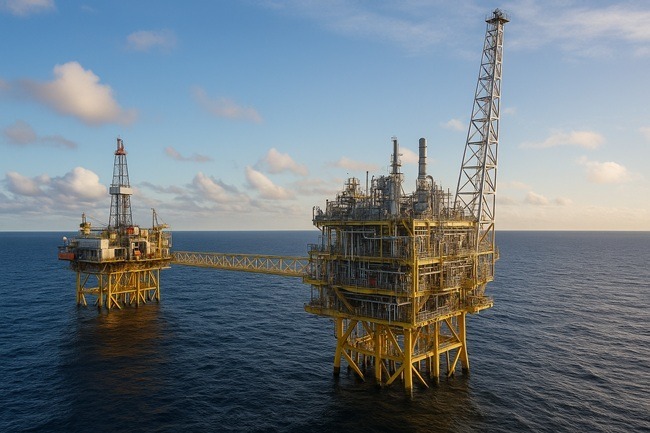


The United Kingdom has approved production at the long-delayed Jackdaw natural gas field in the North Sea, allowing a major offshore development to move forward after years of legal challenges and policy debate. The government announced on October 21, 2026, that the North Sea Transition Authority had granted production consent following agreement from Energy Secretary Miatta Fahnbulleh. Gas supplies could begin as early as the end of October, while the government has simultaneously announced a £2 billion Energy Wealth Fund designed to direct energy-related revenues toward renewable and low-carbon investment.
Jackdaw is operated by Adura, the joint venture between Shell and Norway’s Equinor, and is expected to increase British domestic gas production by approximately 6% at peak output. The government estimates that the project could operate for up to 11 years, contribute around £2.9 billion to the British economy and support hundreds of jobs. These figures are projections rather than production volumes or economic benefits already realised.
The decision comes amid high energy costs connected with the wider conflict involving Iran, increasing political pressure to strengthen domestic energy supplies. Prime Minister Andy Burnham has defended the approval as a pragmatic approach that can support energy security while Britain continues pursuing its longer-term target of net-zero emissions by 2050.
Why has the British government approved the Jackdaw gas field now?
Jackdaw had already received approval under the previous Conservative government in 2022, but subsequent legal challenges required the authorities to reconsider the environmental assessment supporting production. The latest decision provides the consent needed to proceed under the revised legal framework.
The timing has acquired additional importance because international energy disruptions have increased costs for British households and industry. Government officials argue that domestically produced gas can reduce some dependence on imported supplies and support economic activity.
However, the field’s approval does not establish that Britain will become independent of imported gas. The country’s energy system relies on multiple supply sources, and North Sea production has experienced a long-term decline.
The government is therefore presenting Jackdaw as a contribution to energy security rather than a complete solution to high energy prices. Its practical impact will depend on production rates and the wider market.
How much gas could Jackdaw produce once operations begin?
The project is expected to produce up to approximately 40,000 barrels of oil equivalent per day at peak output, according to figures reported for the development. Although expressed in oil-equivalent units, the project primarily concerns natural gas rather than a comparable daily volume of crude oil.
Government estimates indicate that peak output could increase total domestic gas production by around 6%. Reuters calculations suggest that the field would cover just under 4% of Britain’s daily gas demand at its peak.
These measures have different denominators and should not be confused. A 6% increase in domestic production is not equivalent to supplying 6% of national gas demand.
The government’s long-term estimates envisage operations over a period of up to 11 years, with lifetime production equivalent to around 40 million barrels of oil. Actual performance may differ from the forecasts according to operational and geological conditions.
Why did environmental groups challenge the Jackdaw project?
Environmental organisations argued that the original approval did not adequately consider the greenhouse-gas emissions associated with burning the gas produced by the field. Their challenge became especially important following the United Kingdom Supreme Court’s 2024 ruling in the Finch case.
The ruling required relevant environmental impact assessments to consider downstream emissions associated with the combustion of extracted hydrocarbons. The government subsequently updated its guidance, requiring revised information before development consent could be granted.
The latest approval followed consideration of that additional assessment. The government concluded that Jackdaw would not prevent Britain from meeting its legally binding emissions limits or its 2050 net-zero objective.
Climate campaigners continue to dispute the policy justification for new fossil fuel production, arguing that further development could slow the energy transition. Their opposition is a policy and legal position that remains separate from the government’s formal consent decision.
What is the new £2 billion Energy Wealth Fund?
The government announced a new Energy Wealth Fund with an initial £2 billion allocation. The fund is intended to reinvest revenues associated with North Sea oil and gas into renewable energy, low-carbon infrastructure and industries involved in the transition away from fossil fuels.
The structure is designed to connect continued domestic hydrocarbon production with investment in cleaner energy systems. Officials argue that this approach can support employment and industrial development while reducing long-term exposure to volatile fossil-fuel prices.
The initial allocation is an announced public funding commitment rather than evidence that £2 billion has already been spent on completed projects. The eventual returns will depend on investment selection, delivery and the performance of supported industries.
The fund also highlights the government’s attempt to reconcile competing policy priorities. It is supporting existing oil and gas developments while maintaining a stated commitment to reducing emissions over the longer term.
Will Jackdaw lower energy bills for British households?
Additional domestic gas production may strengthen supply security and reduce reliance on some imports. However, British wholesale gas prices are influenced by wider international conditions, making a substantial direct reduction in bills from one field uncertain.
A relatively modest increase in domestic supply does not necessarily change the price paid by consumers, particularly during a global energy shock. The government’s claim concerning energy security should therefore be distinguished from a guaranteed reduction in household bills.
The planned fund is intended to reduce long-term exposure to gas prices by supporting alternative energy generation and infrastructure. Those potential benefits will depend on the pace and effectiveness of future investment.
Jackdaw’s immediate commercial significance lies in supplying gas, preserving industrial activity and moving a delayed project into production. Its effect on consumer bills remains less certain.
What are the key takeaways from the Jackdaw approval?
Britain granted production consent for the Jackdaw North Sea gas field on October 21, with output expected to begin as early as the end of the month. The Adura-operated project could increase domestic gas production by approximately 6% at peak and contribute an estimated £2.9 billion to the economy over its development life.
The government also announced a £2 billion Energy Wealth Fund to support renewable and low-carbon investment. Environmental groups continue opposing the development, while officials argue that it is compatible with the country’s climate commitments and current energy security requirements.
What does the decision signal about Britain’s energy policy?
The approval demonstrates that the government is prepared to support production from existing licensed offshore fields while maintaining restrictions on new exploration licences. That distinction is central to understanding the policy rather than describing the announcement as a wholesale abandonment of climate commitments.
The more important long-term test will be whether domestic production and new low-carbon investment can reduce energy insecurity without compromising the country’s legal emissions obligations. Jackdaw has received consent, but its economic and environmental outcomes will become measurable only as the project operates.
Discover more from Business-News-Today.com
Subscribe to get the latest posts sent to your email.
