



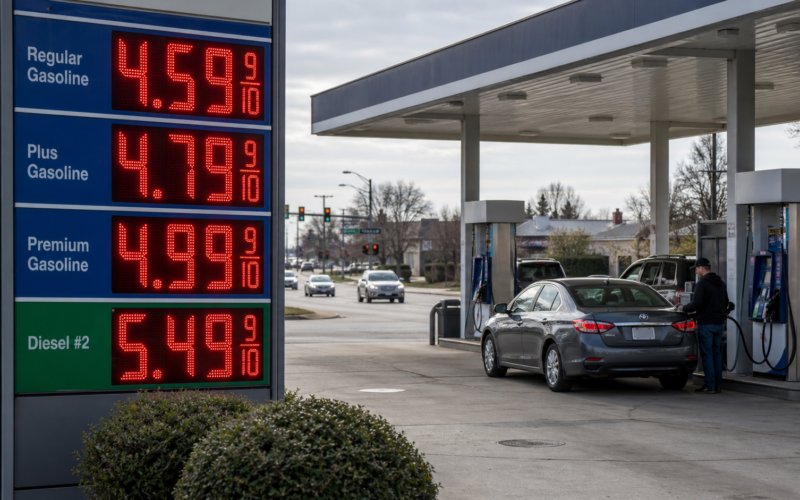
Average United States gas prices have climbed above $4.50 a gallon, marking the highest national level in nearly four years and sharply raising pressure on American households just as the summer driving season approaches.
The national average for regular unleaded gasoline reached roughly $4.51 a gallon on Tuesday, with fuel-price tracking data placing the move at its highest point since July 2022. The increase has come during a period of intense volatility in global oil markets, as the war involving Iran continues to restrict energy flows through the Strait of Hormuz, one of the world’s most important oil transit corridors.
The latest pump-price shock has turned gasoline back into a front-line cost-of-living issue in the United States. Drivers are facing higher commuting costs, trucking companies are absorbing steeper fuel bills, airlines are dealing with higher aviation fuel exposure, and retailers may face renewed pressure from freight costs if diesel and gasoline prices remain elevated.
The price rise is not limited to one region. California has seen some of the highest retail gasoline prices in the country, with average prices above $6 a gallon, while several states in the South and Midwest remain below the national average but are still feeling the broader upward pressure from crude oil and refining markets.
Why does the Strait of Hormuz matter so much for United States gasoline prices in 2026?
The Strait of Hormuz has become central to the latest United States gasoline price surge because the waterway is a critical passage for global crude oil and refined-product trade. When shipping through the Strait of Hormuz becomes restricted, delayed, or riskier, global oil prices can rise quickly, even for countries that produce large volumes of their own oil.
The United States is one of the world’s largest oil producers, but American drivers are still exposed to global crude benchmarks. Gasoline prices at American pumps are shaped by crude oil costs, refinery conditions, regional inventories, transportation costs, taxes, and market expectations. When crude oil prices rise because of geopolitical risk, the effect can move through wholesale gasoline markets and eventually reach consumers at filling stations.
The Iran war has intensified this dynamic. Restrictions and disruption around the Strait of Hormuz have tightened energy-market sentiment and pushed refiners, shippers, and traders to price in greater risk. Even when physical supply is not fully cut off, the threat of disruption can raise insurance costs, freight costs, and replacement costs across the global oil system.
For United States consumers, the result is visible in a number that is politically and economically sensitive: the retail price printed on gas station signs. Gasoline is one of the most frequently observed prices in the economy, which means a spike above $4.50 a gallon can shape public perception of inflation even before broader consumer-price data reflects the full impact.

How are low gasoline inventories and refinery issues intensifying the price increase?
The pressure on United States gasoline prices is not coming from geopolitics alone. Domestic fuel inventories have also become a key issue. Gasoline stocks have fallen to low seasonal levels, reducing the cushion available to absorb demand shocks, refinery outages, or sudden crude-price moves.
A tight inventory environment matters because gasoline markets are highly sensitive before the Memorial Day period, which traditionally marks the start of the peak summer driving season in the United States. As millions of Americans prepare for road travel, refiners and distributors need enough supply to meet seasonal demand. When inventories are low, even short disruptions can have outsized effects on wholesale and retail prices.
Refinery issues have added another layer of pressure. A brief outage at the BP Whiting refinery in Indiana has been cited as one of the domestic factors contributing to regional tightness. The Whiting refinery is one of the largest refining facilities in the United States and plays an important role in Midwest fuel supply. Even temporary disruptions at major refineries can influence local and regional gasoline pricing when inventories are already stretched.
The market is therefore facing a combination that rarely feels gentle at the pump: higher crude prices, lower gasoline inventories, seasonal demand growth, and refinery vulnerabilities. That combination explains why the latest move has been swift rather than gradual.
What does the $4.50 gasoline threshold mean for inflation, households, and transport costs?
A national gasoline average above $4.50 a gallon has consequences beyond drivers filling their tanks. Gasoline and diesel prices influence household budgets, business margins, shipping costs, airline pricing, agricultural logistics, and retail supply chains.
For households, gasoline is a direct and visible expense. Commuters who cannot easily switch to public transport, remote work, or electric vehicles face immediate budget pressure. Lower and middle-income households often feel the effect more sharply because fuel takes up a larger share of monthly spending.
For businesses, the impact depends on fuel exposure. Trucking companies, delivery firms, airlines, construction operators, farms, and field-service companies are more vulnerable to sustained fuel-price increases. If companies pass higher fuel costs to customers, the shock can spread into goods and services prices. If companies absorb the costs, margins may weaken.
The inflation risk is also psychological. Gasoline prices are not the largest component of household spending, but they are among the most visible. When prices at the pump rise quickly, consumers often become more sensitive to broader price increases. That can weaken consumer confidence and complicate the economic narrative for policymakers.
The timing is particularly important because the summer driving season can amplify demand. If prices remain high through May and June, consumer travel patterns, discretionary spending, and political debate over energy policy may all become more intense.
Why are United States energy exports under scrutiny as domestic fuel prices rise?
Rising United States energy exports have added another policy dimension to the gasoline-price debate. The United States has become a major exporter of crude oil, liquefied natural gas, gasoline, diesel, jet fuel, and other energy products. In normal market conditions, exports support producers, trade balances, and global supply stability.
The political problem emerges when exports are rising while domestic consumers are paying more at the pump. In 2026, Middle East disruptions have increased global demand for United States energy cargoes, making American barrels and refined products more valuable abroad. That can benefit energy producers and exporters, but it can also sharpen domestic concerns about whether enough supply is being retained for American consumers.
This tension is not new, but it becomes more visible during price spikes. Policymakers often face pressure to consider temporary relief measures, such as fuel blending waivers, tax suspensions, or emergency supply actions. Those measures can reduce pressure in specific circumstances, but they do not always offset the global crude-price shock that sits underneath the retail gasoline price.
The export debate also reveals a deeper contradiction in the United States energy position. The country is more energy-secure than many import-dependent economies, but it is not insulated from global oil-price shocks. American production strength can reduce vulnerability, yet it cannot fully detach American retail fuel prices from global energy-market stress.
How could elevated gasoline prices shape United States politics before the midterm elections?
Gasoline prices are already becoming a political risk in the United States because they affect nearly every household and are easy for voters to track. A national average above $4.50 a gallon gives opponents of the administration a straightforward cost-of-living argument, while forcing federal officials to explain why global energy disruption is feeding into domestic pump prices.
The political pressure is sharper because the price increase is happening before the summer travel season and ahead of the November midterm elections. Fuel-price spikes can quickly become a symbol of broader economic frustration, even when the drivers include global conflict, shipping disruption, and refining constraints that no administration can control entirely.
Energy policy may therefore move higher on the campaign agenda. The debate could include domestic drilling, refinery capacity, fuel taxes, strategic petroleum reserves, sanctions policy, Middle East strategy, clean-energy transition timelines, and export controls. Each policy option carries trade-offs. Expanding supply takes time. Fuel-tax relief can reduce government revenue. Export restrictions may unsettle allies and markets. Emergency releases can offer temporary relief but cannot solve a prolonged chokepoint disruption.
The most important political question is whether the gasoline spike proves temporary or persistent. A short-lived surge may be absorbed as a conflict-related shock. A prolonged period above $4.50 a gallon would likely have wider effects on household sentiment, business costs, and the national inflation debate.
What happens next if United States gasoline prices remain above $4.50 a gallon?
The near-term direction of United States gasoline prices will depend on three linked factors: the conflict trajectory involving Iran, the flow of energy shipments through the Strait of Hormuz, and the ability of United States refiners to maintain output during peak seasonal demand.
If shipping risks ease and crude oil prices fall, gasoline prices could retreat from current levels. If the Strait of Hormuz remains constrained, traders may continue to price in a risk premium, keeping fuel prices elevated even if domestic production remains strong.
Inventory rebuilding will also matter. Low gasoline inventories leave little room for error. Strong refinery runs could help stabilize regional markets, but any additional outage would increase pressure. Demand destruction is another possible stabilizer, although it is usually painful. If prices rise enough to discourage driving, gasoline demand can soften, but that relief comes at the cost of consumer confidence and economic activity.
For now, the $4.50 threshold has made energy inflation impossible to ignore. The United States gasoline market is being pulled between domestic supply strength and global oil insecurity. That is the central tension of the moment: America can produce more energy than most countries, but American drivers still pay when the world’s most important oil corridors become unstable.
What are the key takeaways from average United States gas prices topping $4.50 a gallon?
- Average United States gasoline prices have moved above $4.50 a gallon, the highest national level in nearly four years.
- The increase has been linked to pressure on global oil markets from the Iran war and disruption around the Strait of Hormuz.
- California has recorded some of the highest average gasoline prices in the country, with prices above $6 a gallon.
- Low United States gasoline inventories and refinery issues have added domestic pressure to the global crude-price shock.
- Higher fuel prices may affect household budgets, shipping costs, airline costs, inflation expectations, and United States political debate before the midterm elections.
Discover more from Business-News-Today.com
Subscribe to get the latest posts sent to your email.