


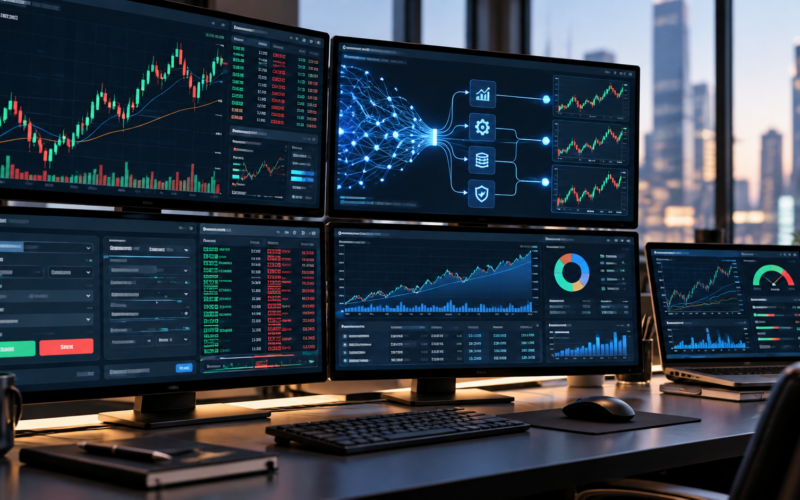
TruTrade LLC is pushing further into automated retail trading with technology designed to execute trades and manage open positions according to predefined parameters, reducing the amount of manual intervention required during a trading session. The Scottsdale, Arizona-based trading software company announced the development on October 2, 2026, positioning automation not simply as a system for identifying market opportunities but as a tool capable of carrying more of the trading process from execution through position management. The expansion potentially strengthens TruTrade’s proposition to traders seeking less screen time and more systematic execution, while increasing the importance of risk controls, operational reliability and clarity around how automated decisions are implemented. The commercial test is therefore moving beyond whether automation can place trades to whether users are comfortable allowing software to manage a larger portion of their live-market activity.
TruTrade said its software can automatically execute and manage trades after activation, following predefined parameters whether markets are moving higher or lower. Co-founder Brian Nutt indicated that the company sees automation as extending beyond alerts that merely tell traders when something is happening, with TruTrade instead developing technology that can handle execution and position management as part of a broader automated experience. The company also said the system is intended to reduce dependence on constant chart monitoring, potentially allowing traders to remain away from their screens for longer portions of a session. Prospective customers can request recorded demonstrations of the technology operating during market sessions, according to the company.
How does TruTrade’s automated execution platform change what retail trading software actually does?
The distinction between automated market alerts and automated execution is commercially significant because an alert leaves the final decision with the trader, while execution software can act within the parameters already established by the user. Adding ongoing position management pushes automation another step forward because the system can influence what happens after a position has been opened rather than simply determining an entry. TruTrade’s current software portfolio already emphasizes automated trade management, customizable risk settings and varying degrees of user control, creating an ecosystem in which different customers can choose between more interactive and more automated approaches.
TruTrade’s R400 product, for example, is positioned for personal cash brokerage accounts and combines AI-driven trade management with customizable risk controls. R400 Pro targets larger brokerage accounts and adds what the company describes as enhanced automation, expanded risk-management controls and intelligent market adaptation. RipperX offers both one-click and fully automated execution alongside chart-based functionality and features including automated stop and target management, trading-time controls and maximum profit and loss settings. These products suggest the October announcement is part of a continuing shift toward making automation a core layer across TruTrade’s software portfolio rather than a standalone feature attached to one trading application.
The company’s wider platform also connects automation with multiple account structures. TruTrade’s website says its ecosystem supports brokered accounts and compatible proprietary trading firms, customer-controlled risk settings and scaling across multiple trading accounts. Its funded-capital offering says users can select a strategy for AI-driven execution, change risk settings and start, stop or pause the system. The combination potentially broadens TruTrade’s addressable audience because the same underlying automation concept can be applied to customers trading their own capital and those using eligible funded-account structures.
Why could position management become more valuable than another AI-generated trading signal?
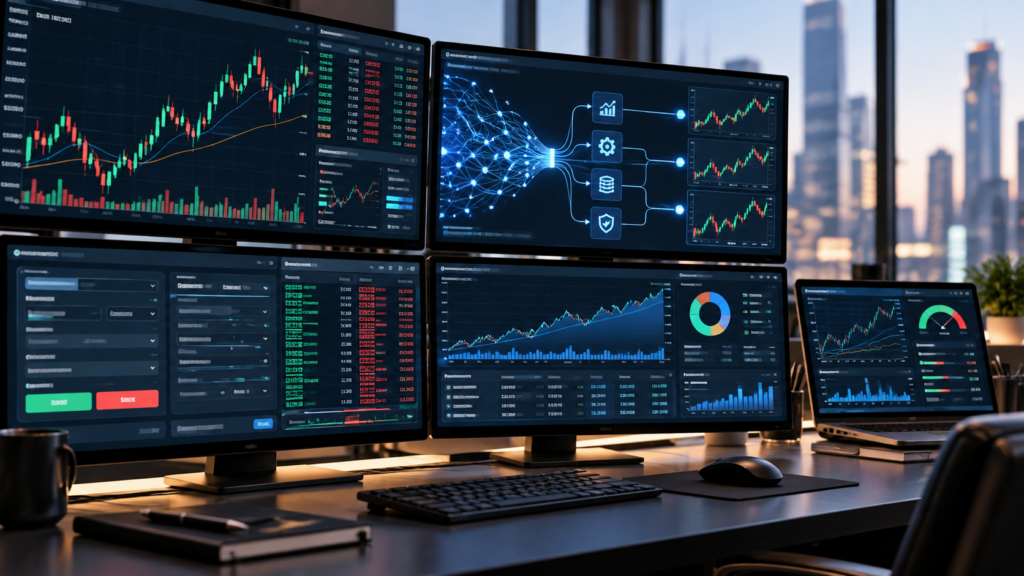
Retail trading software has no shortage of tools that generate alerts, technical indicators or algorithmic trade ideas. The more consequential step is converting a signal into an execution workflow that can remain consistent after the trade has been opened, particularly when market conditions change quickly. Position management can reduce the need for users to make repeated discretionary decisions during a trade, potentially limiting the tendency to deviate from predetermined rules because of short-term market movements or emotion.
Automation does not, however, eliminate trading risk. It relocates part of the process from repeated human decisions into software rules, making the quality of those rules and the reliability of their implementation more important. A system that follows its programmed methodology consistently can improve procedural discipline, but consistent execution cannot guarantee that the underlying methodology will be profitable under every market condition.
TruTrade itself makes that distinction in its disclosures. The company states that all trading involves risk, past performance does not guarantee future results and examples or marketing materials should not be interpreted as promises of returns. It also says traders remain responsible for decisions based on their circumstances, objectives, risk tolerance and liquidity needs, while TruTrade provides technology tools rather than investment advice, brokerage services or financial advisory services. Those qualifications are especially relevant as the company markets technology capable of performing more of the trading workflow automatically.
What will TruTrade need to prove as automated trading becomes easier for retail users?
The October announcement establishes the platform’s intended functionality, but it does not disclose customer numbers, transaction volumes, revenue generated by the automated products, retention rates or independently audited trading performance. That means the available information supports a technology-expansion story rather than a conclusion about the commercial scale or investment performance of the platform. Recorded demonstrations can help prospective customers understand how the system operates, but demonstrations are different from independently verified evidence showing how strategies perform over extended periods and across different market environments.
For a retail automation platform, operational quality may ultimately matter as much as the trading methodology. Users need to understand what triggers an entry, what happens when market conditions change, how risk parameters interact with individual positions, how the system behaves during volatility and whether automation can be stopped quickly when necessary. TruTrade’s existing product pages emphasize user-controlled risk settings and varying degrees of execution control, which suggests the company recognizes that automation must coexist with trader oversight rather than simply replace it.
A second challenge is communicating artificial-intelligence capabilities with enough specificity to distinguish functional automation from marketing terminology. The retail financial-technology market increasingly uses AI language across research, portfolio tools, trading applications and automated execution, making it harder for customers to determine what part of a system is genuinely adaptive, what part is rules-based and what role human configuration still plays. For TruTrade, clearer explanation of those boundaries could become a competitive advantage as customers become more sophisticated about automated-trading claims.
Why is regulatory scrutiny becoming more important as retail auto-trading platforms expand?
The expansion of retail auto-trading is occurring alongside greater regulatory attention to how automated services are marketed and used. The Financial Industry Regulatory Authority warned investors in July 2025 about risks associated with auto-trading services offered by unregistered entities, including unsupported profitability claims, inappropriate trading, data-security concerns and exaggerated descriptions of artificial intelligence. FINRA defined auto-trading broadly as a third party sending trading instructions directly to an investor’s brokerage account for immediate execution and encouraged investors to understand who is providing the service and how their accounts are being accessed.
FINRA’s warning was industry-wide and should not be interpreted as an allegation against TruTrade. Its relevance is that retail automated-trading companies operate in a market where regulators are increasingly focused on claims surrounding AI, performance and account access. FINRA specifically cautioned against vague or unsupported performance claims and what it described as AI washing, where providers exaggerate the capabilities of artificial-intelligence systems to make a product appear more sophisticated or profitable than the evidence supports.
TruTrade’s current disclosures explicitly state that its tools do not guarantee profits or prevent losses, which is a materially different proposition from marketing an automated system as a low-risk route to predictable returns. The stronger long-term commercial position for the company would therefore come from demonstrating what the technology does in measurable operational terms rather than relying on broad AI terminology. Transparent controls, clear user responsibilities and evidence of reliable software behavior can become differentiators as scrutiny of the automated-trading category increases.
How does TruTrade’s broader software ecosystem support its automated trading strategy?
TruTrade is not building the October functionality in isolation. Its current software catalogue includes RipperONE AI, R400, R400 Pro and RipperX, while its funded-capital products extend the ecosystem toward compatible proprietary trading firms. The website also promotes lifetime software licensing, future software updates, multiple-account functionality and customer-controlled risk settings as elements included across parts of the TruTrade offering.
That breadth could help the company create a more durable relationship with traders if customers can remain inside the TruTrade ecosystem as their account structures, capital levels and preferred degree of automation change. A customer beginning with interactive chart-based trading could potentially move toward more automated execution, while a trader using a personal brokerage account could explore funded-account compatibility without learning an entirely different software environment. The strategic value lies in reducing the friction involved in moving between trading modes rather than depending on a single automated strategy.
There is also an important legal-entity distinction in TruTrade’s current website disclosure. TruTrade LLC says it provides advertising, marketing, sales and customer-acquisition services for certain software products offered by Tru AI Solutions LLC, which is identified as a separate legal entity responsible for development, implementation, maintenance, updates, applications and technical support for its software products. Customers purchasing products from Tru AI Solutions LLC may contract with and remit payment directly to that entity, meaning users should pay attention to the specific contractual provider associated with the product they are buying.
Can TruTrade turn greater trading automation into a defensible retail fintech position?
Automated execution alone is unlikely to become a lasting competitive moat because numerous trading platforms can incorporate rule-based orders, risk settings and algorithmic workflows. The stronger moat would come from a combination of execution reliability, useful proprietary trading logic, broker and platform integrations, customer retention, transparent controls and a software experience that simplifies trading without obscuring risk. TruTrade’s growing product range gives it more opportunities to build that ecosystem, but product breadth becomes valuable only if customers see consistent quality across the different applications.
The October 2 announcement therefore represents a meaningful product-development step rather than proof that the commercial model has already been validated. TruTrade is giving retail users the option to delegate more of execution and position management to software, which could appeal to traders seeking systematic processes and less continuous screen monitoring. The next measurable proof point is whether that convenience translates into sustained user adoption while the company demonstrates that automation remains controllable, understandable and reliable under live-market conditions.
If TruTrade can combine those elements with credible disclosure and visible operating evidence, the company could strengthen its position as retail trading moves toward more software-directed execution. If the industry instead becomes crowded with increasingly similar AI-branded automation tools, differentiation will depend less on how much of a trade can be automated and more on whether customers trust the platform handling it.
What are the key takeaways from TruTrade’s fully automated trading platform launch?
- TruTrade announced on October 2, 2026 that its technology can automate trade execution and ongoing position management using predefined parameters.
- The system is intended to reduce manual interaction and dependence on continuous chart monitoring during trading sessions.
- TruTrade’s existing software portfolio includes automated and interactive products for personal brokerage accounts and other supported trading structures.
- R400 and R400 Pro include customizable risk controls, while RipperX supports both interactive and fully automated execution.
- Greater automation potentially increases convenience, but it also makes software reliability and understandable risk controls more important.
- TruTrade states that trading involves risk and that its technology does not guarantee profits or eliminate the possibility of losses.
- The October release does not disclose customer numbers, revenue contribution, trading volumes or independently audited performance information.
- FINRA has separately warned retail investors about unsupported auto-trading performance claims and exaggerated AI capabilities across the broader market.
- TruTrade LLC and Tru AI Solutions LLC have separate roles for certain software products, according to the company’s current disclosures.
- Sustainable differentiation will depend on live-market reliability, customer adoption and transparent automation rather than additional AI terminology alone.
Discover more from Business-News-Today.com
Subscribe to get the latest posts sent to your email.