


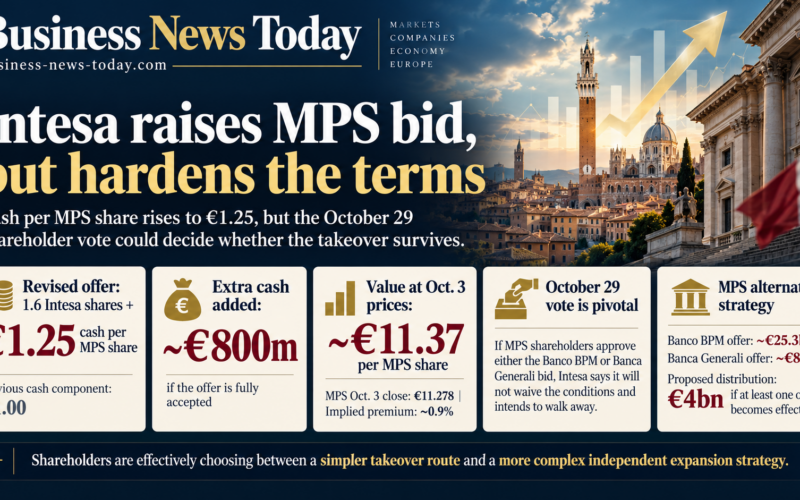
Intesa Sanpaolo S.p.A. (BIT: ISP) has increased the cash portion of its takeover offer for Banca Monte dei Paschi di Siena S.p.A. (BIT: BMPS) by €0.25 per share, adding roughly €800 million to the potential consideration while simultaneously warning that it intends to walk away if MPS shareholders approve either of the bank’s proposed acquisitions of Banco BPM S.p.A. or Banca Generali S.p.A.
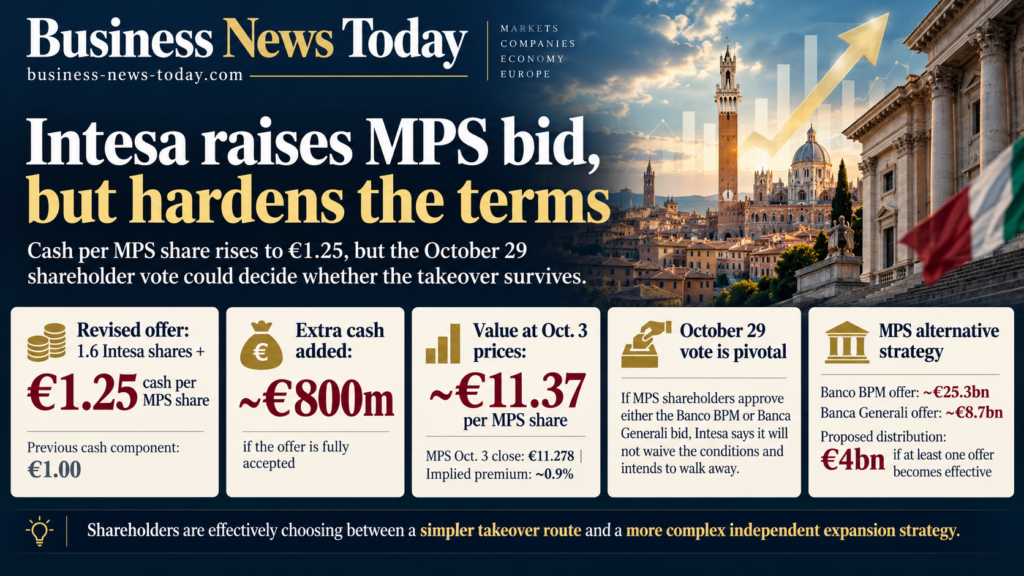
The revised terms leave Intesa offering 1.6 newly issued Intesa Sanpaolo shares plus €1.25 in cash for every MPS share tendered, compared with the previous €1 cash component. Reuters described the broader share-and-cash proposal as worth approximately €34 billion at prevailing valuations, although that figure should not be confused with a fixed cash acquisition price because most of the consideration consists of Intesa shares whose market value changes.
The additional cash creates an unusual strategic contradiction. Intesa Sanpaolo is making its offer financially more attractive at precisely the moment it is drawing a harder line around the conditions under which the transaction can proceed. If MPS shareholders approve either of Chief Executive Officer Luigi Lovaglio’s proposed all-share bids for Banco BPM or Banca Generali at an extraordinary meeting scheduled for October 29, Intesa has said it does not intend to waive the relevant conditions attached to its own offer.
That effectively turns the shareholder meeting into a choice between competing futures for one of Italy’s most closely watched banks. MPS investors can pursue Lovaglio’s attempt to construct a larger independent Italian financial group around MPS, Mediobanca, Banco BPM and Banca Generali, or preserve Intesa’s route toward absorption into Italy’s largest banking group.
How much has Intesa Sanpaolo actually increased its offer for Monte dei Paschi?
Intesa’s original June offer provided 1.6 Intesa shares and €1 in cash for each MPS share tendered. Using Intesa’s June 5 reference price of €5.682, the bank initially calculated the proposal at €10.091 per MPS share and approximately €30.6 billion in aggregate consideration.
That initial valuation included about €27.6 billion in Intesa shares and approximately €3 billion in cash if the offer were accepted in full. The June terms represented a 12.5% premium to MPS’s official June 5 closing price and larger premiums against its three-month and six-month volume-weighted average prices.
The October revision increases the cash component to €1.25 per MPS share. Reuters calculated that the additional €0.25 would provide shareholders with roughly another €800 million in aggregate cash if the offer were fully accepted.
The distinction between the original €30.6 billion figure and subsequent descriptions of the deal at around €34 billion matters. The former was Intesa’s official transaction valuation using the June 5 reference share price, while the latter reflects the changing market value of the stock-based consideration. Because 1.6 Intesa shares remain the dominant part of the offer, its euro value moves with Intesa Sanpaolo’s share price.
Using the October 3 closing price of €6.328 for Intesa, the revised consideration would be worth approximately €11.37 per MPS share before considering any applicable dividend-related adjustment. MPS closed the same session at €11.278, meaning the simple implied premium at those prices was only around 0.9%.
That narrow spread shows why the October 29 vote has become more important than the headline premium alone. MPS shares are already pricing substantial strategic optionality, leaving investors to decide not merely whether Intesa’s offer is attractive but whether Lovaglio’s alternative could ultimately create greater value.
Why can MPS’s Banco BPM and Banca Generali bids kill the Intesa offer?
Intesa built defensive-action conditions into its takeover proposal from the beginning. Its June documentation specifically stated that the offer was conditional on MPS not adopting measures inconsistent with the transaction’s objectives, including defensive actions even if those measures were authorised by MPS shareholders.
MPS subsequently responded with an ambitious counterstrategy. In August, its board approved two parallel voluntary all-share exchange offers, one for Banco BPM and another for Banca Generali, effectively proposing to transform MPS into the centre of a much larger Italian banking and wealth-management group instead of allowing Intesa to acquire it.
Italian takeover rules require MPS to obtain shareholder approval before advancing those defensive transactions. The extraordinary meeting on October 29 therefore provides the trigger that Intesa has now highlighted explicitly.
Intesa said that approval of either takeover proposal would result in non-fulfilment of conditions attached to its MPS offer and that it does not intend to waive those conditions. In practical terms, shareholders cannot assume they can approve Lovaglio’s expansion strategy and still preserve Intesa’s bid indefinitely as a fallback option.
That changes the game theory around the vote. Investors are being asked to choose between a relatively defined Intesa consideration and a more complex independent strategy whose future value depends on completing multiple transactions, integrating several major financial institutions and delivering ambitious synergy targets.
What exactly is Luigi Lovaglio proposing instead of selling MPS to Intesa?
MPS’s alternative is significantly larger than a conventional defence against an unwanted takeover.
The bank proposed an all-share offer worth approximately €25.3 billion for Banco BPM based on August 19 prices and a separate approximately €8.7 billion offer for Banca Generali. Together, the headline transaction values were roughly €34 billion when announced.
For Banco BPM, MPS offered 1.567 newly issued MPS shares for each Banco BPM share, which implied an offer price of €16.729 per share based on the specified reference prices and no premium after taking account of MPS’s proposed extraordinary distribution.
For Banca Generali, MPS proposed 6.958 new shares for each Banca Generali share, implying €74.284 per share and a 10% premium based on August 19 reference prices after the same distribution adjustment.
MPS also proposed distributing €4 billion to its own shareholders if at least one of the offers becomes effective. The planned distribution consists of about €1 billion in cash and roughly €3 billion of Assicurazioni Generali S.p.A. shares held indirectly through Mediobanca.
If both offers were completed in full after the Mediobanca integration, existing MPS shareholders would hold approximately 50.1% of the enlarged group, Banco BPM shareholders around 37.2% and Banca Generali shareholders approximately 12.7%, according to MPS.
The resulting institution would have had approximately €466 billion of pro-forma assets and about €810 billion of total financial assets based on 2025 figures used by MPS. Management estimates annual pre-tax run-rate synergies of approximately €2.6 billion, including about €800 million associated with the ongoing Mediobanca integration, against estimated one-time integration costs of roughly €2.5 billion before tax.
Those are management targets rather than guaranteed outcomes, and delivering them would require integrating several substantial franchises at the same time.
Why does Intesa believe its MPS combination is financially simpler?
Intesa’s pitch rests heavily on scale, integration experience and a more direct path to synergy capture.
The bank estimates approximately €2.9 billion of annual pre-tax run-rate synergies from combining with MPS by 2029. Around €1.5 billion is expected to come from costs and roughly €1.4 billion from revenue opportunities, particularly wealth management, protection, advisory and corporate and investment banking.
Intesa estimates approximately €2.1 billion of integration charges before tax, or roughly €1.4 billion after tax. Management has projected that the enlarged group could generate more than €16 billion of annual net income by 2029 and achieve a return on equity exceeding 20%.
Those remain forecasts, and a transaction of this scale would still carry meaningful execution and regulatory risk. Italy’s competition authority opened an investigation into Intesa’s MPS proposal in September, adding another layer of scrutiny to a transaction that would further strengthen the country’s dominant banking group.
What Intesa can credibly point to is its own profitability and capital generation. The bank recorded €5.6 billion of net income during the first half of 2026, up 6.5% year over year, and raised its full-year net-income outlook to more than €10 billion.
That gives Intesa considerably more financial capacity than a typical bidder attempting a transformative acquisition. The strategic debate is therefore less about whether Intesa can finance the MPS transaction and more about whether regulators and shareholders believe further consolidation around Italy’s largest bank creates more value than allowing an alternative banking pole to emerge around MPS.
Is MPS strong enough to justify remaining independent and pursuing more acquisitions?
MPS’s operating recovery is one reason shareholders now face a genuine choice rather than an obvious rescue transaction.
The bank reported second-quarter 2026 net profit of €610 million, taking first-half net profit above €1.1 billion. On a comparable basis cited by MPS, first-half profit was up 25.3% year over year.
First-half revenues reached approximately €4.02 billion, up 4.1%, while net operating profit rose 8.2% to slightly above €2 billion. MPS also reported a fully loaded Common Equity Tier 1 ratio of 16.3%, providing a substantial capital buffer above regulatory requirements.
The bank’s balance sheet is therefore dramatically different from the crisis-era Monte dei Paschi that required repeated recapitalisation and government intervention. MPS now has enough capital and earnings momentum for management to argue that it should be treated as a consolidator rather than merely a takeover target.
Its strategy has already expanded through Mediobanca. MPS owned approximately 86.35% of Mediobanca when Intesa launched its June offer, and the integration has increased exposure to wealth management, corporate and investment banking and Assicurazioni Generali.
The question is whether adding Banco BPM and Banca Generali creates a coherent national champion or introduces too many simultaneous integration risks.
Why is Banco BPM so important to the battle for Italy’s banking system?
Banco BPM has become a pivotal asset in Italian bank consolidation because of its strong position in wealthy northern regions and its strategic importance to multiple potential combinations.
MPS argues that Banco BPM would add commercial scale, product capabilities and exposure to some of Italy’s economically strongest territories. Banca Generali would add a wealth-management network and recurring fee income, while Mediobanca contributes corporate and investment banking capabilities.
That combination could create a more diversified competitor to both Intesa Sanpaolo and UniCredit S.p.A.
The strategic appeal also explains why Banco BPM has repeatedly appeared at the centre of competing banking scenarios. Credit Agricole is Banco BPM’s largest investor, while Reuters recently reported that Credit Agricole and UniCredit had discussed the possibility of a joint approach involving the lender.
MPS is therefore not pursuing an uncontested asset. Its October 29 shareholder vote sits inside a much larger reshaping of Italian finance in which multiple institutions are simultaneously testing combinations across commercial banking, investment banking, insurance and wealth management.
For Intesa, allowing MPS to complete its Banco BPM strategy could create a materially stronger domestic rival. That adds strategic logic to Intesa’s refusal to leave its own MPS bid outstanding while Lovaglio pursues a competing consolidation architecture.
Why does Banca Generali make the MPS strategy more complicated?
Banca Generali adds an attractive wealth-management franchise but introduces additional ownership and strategic relationships.
MPS already has exposure to Assicurazioni Generali through its control of Mediobanca, historically one of Generali’s most influential shareholders. The proposed Banca Generali acquisition would deepen that relationship while giving the enlarged group access to an advisor-led wealth-management platform.
MPS has argued that the combination would create additional recurring fee income and open opportunities for wider industrial collaboration with Generali.
However, Intesa characterises the overall proposal as complex and carrying challenging synergy and execution assumptions. Integrating Mediobanca while simultaneously attempting to buy Banco BPM and Banca Generali would create multiple layers of governance, technology, distribution and capital-allocation work.
That complexity is probably the strongest argument behind Intesa’s revised offer. Rather than competing only by adding another €0.25 in cash, Intesa is effectively asking MPS shareholders to compare execution certainty with the potentially greater but less certain upside of Lovaglio’s expansion strategy.
What does the October 3 share price tell investors about the takeover battle?
MPS shares closed October 3 at €11.278, down 0.3%, while Intesa Sanpaolo finished at €6.328, down 0.78%. Banca Generali fell 1.35% to €62, while Mediobanca was unchanged at €27.41.
Those movements should not be attributed solely to Intesa’s revised terms because the offer update emerged around the close of the session and European bank shares are influenced by interest rates, bond markets and broader equity sentiment.
The more informative signal is the relationship between MPS’s trading price and the implied Intesa consideration. At October 3 closing prices, 1.6 Intesa shares plus €1.25 in cash equated to approximately €11.37, leaving only a modest premium over MPS’s €11.278 close before considering any future adjustment associated with Intesa’s interim dividend.
That suggests investors are already assigning significant value to the possibility of alternative outcomes rather than treating Intesa’s bid as a large guaranteed premium.
A widening spread could indicate rising doubts that the takeover will complete. A narrowing spread after the October 29 vote would indicate greater confidence that shareholders have cleared the path for Intesa, assuming other conditions remain satisfied.
What happens if MPS shareholders vote for Lovaglio’s strategy on October 29?
If shareholders approve either of the Banco BPM or Banca Generali proposals, Intesa has said it intends to invoke the resulting failure of its offer conditions rather than waive them.
That could effectively end Intesa’s current takeover attempt, subject to the formal mechanics of the offer and applicable regulatory process. MPS would then need to pursue its alternative transactions through their own regulatory, shareholder and execution hurdles.
Approval would not guarantee that MPS ultimately acquires Banco BPM or Banca Generali. Both offers remain subject to regulatory conditions, market dynamics and acceptance by the relevant shareholders.
Conversely, rejection of the counterstrategy would remove one of the largest obstacles facing Intesa’s bid and leave MPS investors with a clearer path toward accepting the revised share-and-cash consideration.
The vote therefore has unusually high strategic leverage. It will determine not merely whether MPS can attempt two acquisitions, but which institution is most likely to control the next phase of consolidation around MPS itself.
Is Intesa’s extra €800 million enough to win the shareholder showdown?
The answer may depend less on €800 million than on how shareholders assess execution risk.
An additional €0.25 per MPS share is tangible and increases the certain cash component of the consideration by 25%. Yet the majority of the offer remains stock-based, leaving MPS investors exposed to the future performance of Intesa Sanpaolo after completion.
Lovaglio’s competing strategy offers something fundamentally different. It seeks to preserve MPS as the centre of a larger group in which existing MPS shareholders would retain just over half of the combined institution if both transactions were completed in full, while also receiving a proposed €4 billion extraordinary distribution.
The trade-off is substantially greater complexity. MPS would be integrating Mediobanca while attempting two additional major combinations and trying to realise approximately €2.6 billion of annual synergies.
Intesa offers a clearer industrial destination and estimates €2.9 billion of synergies inside an already much larger and highly profitable banking platform. MPS offers shareholders more direct participation in the creation of a new Italian banking pole, but the eventual value depends on several transactions succeeding.
That is why the October 29 vote has become more consequential than the latest cash sweetener. Intesa has effectively forced shareholders to stop treating the rival strategies as parallel options and choose which consolidation story they actually want to own.
Discover more from Business-News-Today.com
Subscribe to get the latest posts sent to your email.