


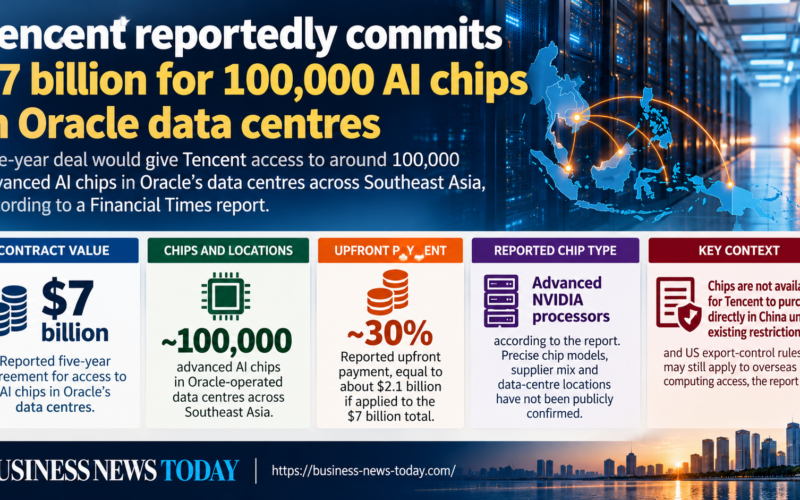
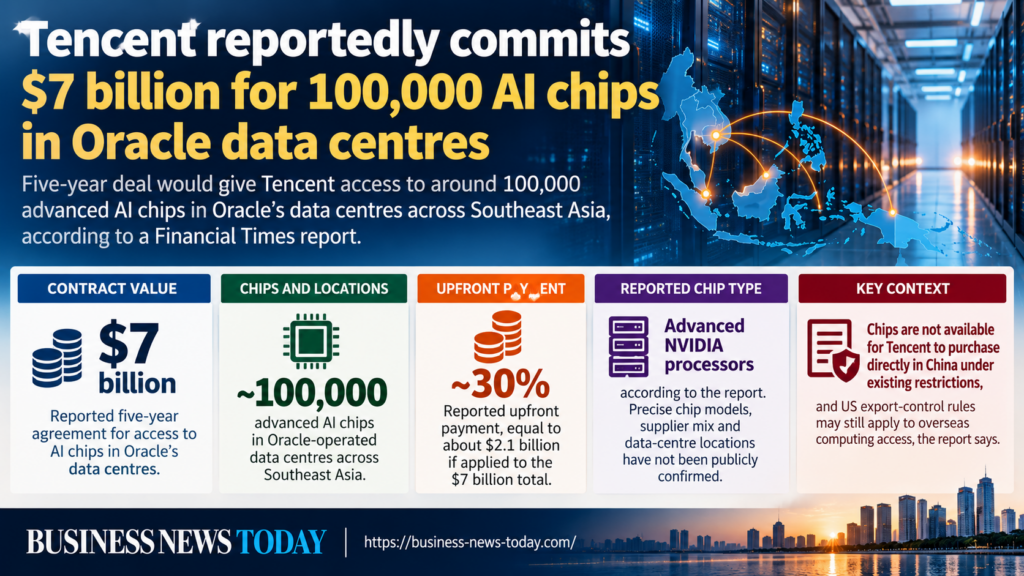
Tencent Holdings Limited (HKEX: 0700) has reportedly agreed to spend about $7 billion over five years for access to approximately 100,000 advanced artificial intelligence chips housed in Oracle Corporation (NYSE: ORCL) data centres across Southeast Asia, highlighting how the US-China semiconductor contest is increasingly moving from ownership of processors toward access to computing capacity.
The Financial Times reported that the arrangement is Tencent’s largest overseas compute lease and requires an upfront payment of approximately 30% of the contract value. That would equate to roughly $2.1 billion if applied to the reported $7 billion total, although neither Tencent nor Oracle has publicly confirmed the contract value, payment structure, chip count or precise data-centre locations.
Reuters subsequently reported the Financial Times findings and said the advanced processors are not available for Tencent to purchase directly in China under existing restrictions. Oracle and Tencent did not respond to Reuters requests for comment, meaning the core commercial terms remain reported information rather than company-confirmed contractual disclosure.
The distinction is particularly important because the arrangement should not automatically be described as a circumvention of US export controls. American rules have increasingly been expanded to address overseas placement of advanced computing hardware, China-headquartered end users and remote access through Infrastructure-as-a-Service providers. The more important question is whether large-scale cloud leasing changes how effective semiconductor controls can be when the restricted hardware remains physically outside China.
What exactly is Tencent reportedly getting from Oracle for $7 billion?
The reported agreement does not involve Tencent importing 100,000 advanced processors into mainland China.
Instead, Tencent would gain access to approximately 100,000 advanced AI chips installed in Oracle-operated data centres across multiple locations in Southeast Asia. The Financial Times described the hardware as primarily involving advanced NVIDIA processors, although neither Oracle nor Tencent has publicly identified the precise accelerator models or supplier mix.
That difference between owning a chip and renting the computing output of a chip is increasingly important. Artificial intelligence companies ultimately require processing capability rather than legal title to individual graphics processors, meaning cloud access can deliver much of the practical value of advanced hardware while the equipment remains in another jurisdiction.
The reported five-year term also suggests Tencent is securing more than temporary overflow capacity. A $7 billion commitment with roughly 30% reportedly paid upfront would represent a substantial strategic infrastructure decision, particularly for a company that has sharply increased spending on artificial intelligence during 2026.
However, the $7 billion should not be treated as immediate Oracle revenue. Cloud-contract revenue recognition depends on contractual terms, service delivery and usage, while the reported upfront payment describes cash economics rather than necessarily determining when Oracle records revenue.
Does the Oracle arrangement allow Tencent to bypass US AI chip export controls?
The available evidence does not support that conclusion.
US semiconductor controls no longer depend solely on where an advanced processor is physically shipped. In May 2026, the US Department of Commerce’s Bureau of Industry and Security clarified that a licence remains required for certain advanced computing items exported outside the United States when the items are for entities headquartered in China or other specified jurisdictions, even when those entities themselves operate outside China.
The Export Administration Regulations also contain provisions addressing Infrastructure-as-a-Service remote end users. Licensing procedures require disclosure of certain intended remote users located in China or entities headquartered there when advanced AI commodities covered by the rules are involved.
Those rules make the legal picture significantly more complicated than saying Tencent has simply placed restricted chips in Southeast Asia instead of China. Depending on the hardware classification, end-user arrangement, end use, licences, exceptions and Oracle’s role as the infrastructure operator, US authorisation requirements may still apply.
No public disclosure currently establishes which licences or exceptions, if any, support the reported Tencent arrangement. It would therefore be inappropriate either to declare the transaction an export-control loophole or to state definitively that every aspect has received a particular regulatory approval.
What can be said is that the deal illustrates the next enforcement challenge. Controlling the physical sale of an advanced processor is relatively straightforward compared with controlling the global delivery of computing services produced by that processor.
Why has Tencent suddenly committed so much money to AI computing infrastructure?
Tencent’s own second-quarter results show how dramatically its infrastructure requirements are changing.
Capital expenditure reached RMB52.8 billion during the three months ended June 30, up 176% from RMB19.1 billion a year earlier. Tencent explicitly said it had substantially increased compute procurement to support its artificial intelligence strategy.
The company also recorded negative free cash flow of RMB13.8 billion during the quarter. Operating activities generated RMB52.7 billion of cash, but Tencent made RMB59.3 billion of capital-expenditure payments alongside media-content and lease-liability payments.
Tencent said its operating cash flow included large AI-related prepayments supporting improvements to its Hy models, inference requirements for WorkBuddy and CodeBuddy, artificial intelligence initiatives within Weixin, broader AI capabilities across its products and growing external demand for Tencent Cloud.
The Financial Times reported that the Oracle commitment contributed to Tencent’s cash-flow pressure. Tencent itself did not identify Oracle by name in its second-quarter results, so the precise amount of the reported Oracle payment included in those figures cannot be established from the company’s disclosure.
Tencent said free cash flow would have been RMB37.6 billion excluding prepayments associated with compute procurement. That makes infrastructure access one of the most financially consequential components of Tencent’s current artificial intelligence strategy.
Can Tencent afford a reported $7 billion overseas compute commitment?
Tencent retains substantial liquidity despite the sharp increase in artificial intelligence spending.
The company ended June with RMB511.2 billion of total cash and a net cash position of RMB58.2 billion. Second-quarter revenue increased 11% year over year to RMB204.8 billion, while non-IFRS profit attributable to shareholders increased 9% to RMB68.4 billion.
The issue is therefore less about whether Tencent can fund one reported contract and more about how much capital the AI race may continue consuming.
Tencent is simultaneously investing in its own data infrastructure, cloud services, proprietary models and artificial intelligence products while securing external compute. That combination can accelerate product development but increases the amount of cash required before all of those investments generate corresponding revenue.
The company is already attempting to monetise AI through several channels. Tencent said WorkBuddy and CodeBuddy were experiencing rapid user growth, while Xiaowei, an agentic AI system inside Weixin, had entered small-scale prototype testing. Its cloud business was also benefiting from increased demand for AI-related services.
If those applications generate substantial incremental revenue, today’s infrastructure spending could create an attractive return. If monetisation develops more slowly than compute commitments, free cash flow could remain under pressure even while reported profits continue growing.
Why is Tencent buying Chinese memory while renting advanced compute overseas?
Tencent’s semiconductor strategy appears increasingly dual-track.
In June, Reuters reported that Chinese memory manufacturer ChangXin Memory Technologies had secured a multi-year agreement worth more than RMB20 billion, or roughly $2.94 billion at the time, to supply Tencent with server DRAM. Neither company publicly confirmed that agreement, but the reported transaction illustrated Tencent’s willingness to support domestic semiconductor supply where Chinese manufacturers can meet its requirements.
Server memory and advanced AI accelerators perform very different functions. DRAM stores and rapidly supplies data to processors, while advanced accelerators perform the intensive computations required to train and operate large artificial intelligence models.
China has made considerably more progress building domestic alternatives in some memory and conventional semiconductor categories than in the highest-performance AI accelerator segment. US controls have specifically targeted access to advanced computing hardware capable of supporting frontier artificial intelligence.
That creates a rational two-track procurement model. Tencent can increase domestic sourcing where Chinese technology is competitive while using overseas computing infrastructure to access performance that may not yet be available domestically at the same scale.
The Oracle arrangement, if completed on the reported terms, would therefore not necessarily contradict China’s semiconductor self-sufficiency ambitions. It may instead show how Chinese technology groups are bridging the period between current domestic capabilities and the computing requirements of increasingly demanding AI models.
Why would Oracle want Tencent as a major AI infrastructure customer?
Oracle is pursuing one of the fastest cloud-infrastructure expansions in the technology industry.
In its fiscal first quarter ended August 31, Oracle reported cloud infrastructure revenue of $7.4 billion, up 121% year over year. Total cloud revenue reached $11.6 billion, while overall quarterly revenue increased 30% to $19.3 billion.
Oracle’s remaining performance obligations climbed to $664 billion, reflecting years of contracted future business across cloud and other services. The company also said it signed more than $30 billion of additional AI cloud contracts during the quarter.
The reported $7 billion Tencent agreement would equal only around 1% of Oracle’s $664 billion RPO balance if compared directly. However, Oracle has not identified Tencent as a customer in connection with that backlog, so it cannot be assumed that the reported contract is included in the August figure or determine when it may have entered Oracle’s books.
Oracle also delivered more than 300,000 GPUs to AI cloud customers between the end of its fourth quarter and the end of its first quarter, while adding approximately 850 megawatts of data-centre capacity during the quarter.
Those figures help explain why Tencent might view Oracle as an unusually scalable supplier. Oracle is building AI infrastructure at a rate that allows large customers to obtain dedicated pools of computing capacity without constructing every data centre themselves.
How expensive is Oracle’s own AI infrastructure expansion becoming?
Oracle’s rapid cloud growth is creating substantial financial pressure of its own.
Capital expenditure reached approximately $28.5 billion in the fiscal first quarter alone. Despite generating $23.1 billion of operating cash flow, Oracle reported negative free cash flow of approximately $5.4 billion for the quarter because infrastructure investment exceeded operating cash generation.
For fiscal 2026, Oracle spent approximately $55.7 billion on capital expenditure and recorded negative free cash flow of $23.7 billion. The company has raised tens of billions of dollars through debt and equity to fund the data-centre expansion needed to meet contracted AI demand.
Oracle has also changed the economics of some large cloud agreements by requiring customers to prepay for GPUs or supply hardware themselves. At the end of fiscal 2026, Oracle said the prepaid and customer-supplied hardware component of large AI contracts totalled approximately $75 billion.
A reported 30% upfront payment from Tencent would therefore fit the general financing architecture Oracle has described for large AI customers, although Oracle has not publicly confirmed that the Tencent contract follows precisely the same accounting or hardware-ownership structure.
That model helps transfer part of the enormous upfront infrastructure burden toward customers that require the capacity. In return, those customers can secure access to computing resources that might otherwise remain unavailable for years.
Why is Southeast Asia becoming strategically important in the AI chip race?
The reported Tencent transaction gives Southeast Asia a potentially important role as neutral physical infrastructure between US semiconductor suppliers and Chinese technology demand.
The region already hosts expanding data-centre markets in countries including Singapore, Malaysia, Indonesia and Thailand, supported by growing electricity infrastructure, submarine cable connectivity and government efforts to attract digital investment.
The Financial Times report did not publicly identify the specific Oracle locations involved in Tencent’s reported 100,000-chip arrangement. It would therefore be speculative to assign the capacity to particular countries.
The broader geographic logic is nonetheless clear. Data centres located outside mainland China can connect Chinese companies to international computing resources while remaining within infrastructure operated by US or other foreign cloud providers.
That same feature is precisely why export-control authorities increasingly care about end users rather than simply the shipping destination. A processor installed in Southeast Asia can potentially support workloads originating thousands of kilometres away, making traditional customs-based enforcement less sufficient on its own.
Southeast Asia could consequently become one of the most important places where AI industrial policy, cloud investment and US-China technology restrictions intersect.
What does the reported deal mean for NVIDIA and other advanced chip suppliers?
The first point is that the exact hardware composition has not been confirmed by either party.
The Financial Times described the reported capacity as relying primarily on NVIDIA advanced processors, but Oracle and Tencent have not disclosed the chip models, quantities by vendor or whether all approximately 100,000 units are identical.
If NVIDIA hardware forms the majority of the deployment, the commercial effect is still different from a direct sale to Tencent. Oracle would remain the cloud infrastructure provider operating the hardware, while Tencent purchases computing capacity.
That distinction could become increasingly important to semiconductor companies. Export restrictions can reduce direct sales into China while overseas cloud deployments continue generating demand for the same processors through customers legally located and operated elsewhere.
The regulatory risk is that Washington may decide remote access needs tighter limits if policymakers conclude that cloud services allow restricted compute capabilities to reach entities they intended to constrain.
Conversely, overly broad restrictions on legitimate cloud use could reduce revenue for American semiconductor and cloud companies while encouraging Chinese firms to accelerate development of domestic alternatives.
That tension makes remote AI compute one of the most difficult parts of semiconductor policy.
How did Tencent and Oracle shares respond after the report?
The market reaction was mixed and should not be attributed solely to the reported agreement.
Tencent shares closed at HK$421.20 on October 2, down 2.27% from the September 30 close of HK$431. The stock traded between HK$419.80 and HK$425 during the session, showing that investors did not immediately reward the company for securing additional overseas compute capacity.
The decline could reflect numerous factors, including the enormous cost of Tencent’s AI programme, broader Hong Kong technology sentiment and uncertainty around regulation. There is not sufficient evidence to attribute the session’s fall specifically to the Oracle report.
Oracle moved in the opposite direction. Its shares gained 0.56% to $138.07 on October 1 and another 3.06% to $142.30 on October 2.
The reported Tencent contract may have contributed positively to sentiment because it provides another example of customer demand for Oracle Cloud Infrastructure, but the stock also reacts to broader technology-market movements, interest rates and investor views of Oracle’s huge capital requirements. A two-day move cannot establish a single cause.
The divergence nevertheless captures the economic tension surrounding the agreement. For Oracle, another multibillion-dollar infrastructure customer could help validate an enormous data-centre expansion. For Tencent, the same contract represents another substantial call on cash as it attempts to close the AI compute gap.
What should investors watch next in the Tencent–Oracle AI chip arrangement?
The most important development would be direct confirmation from either company.
A formal disclosure could clarify whether the reported $7 billion represents committed minimum spending, maximum potential usage or another form of contractual value. It could also establish which Oracle regions are involved, what classes of processors Tencent can access and how the 30% reported upfront payment is structured.
The second issue is regulatory treatment. Because current US rules already contain controls addressing China-headquartered users and remote Infrastructure-as-a-Service access, investors should watch whether the Bureau of Industry and Security comments on the arrangement or whether future rulemaking further tightens remote access to advanced computing.
The third issue is Tencent’s cash flow. The company’s RMB13.8 billion negative second-quarter free cash flow was heavily influenced by compute procurement and artificial intelligence prepayments. Future quarters will show whether that represents a temporary step-up in infrastructure investment or the beginning of a more persistent period of elevated cash consumption.
Oracle faces the mirror-image question. Its AI cloud revenue and backlog are expanding extraordinarily quickly, but capital expenditure has already pushed free cash flow deeply negative. Large customer prepayments can improve the funding equation, but Oracle still has to construct and operate enough infrastructure to fulfil the enormous commitments accumulating in its backlog.
The strategic implication extends beyond either company. US semiconductor controls were initially designed around restricting access to physical chips. Cloud computing increasingly separates the location of the processor from the location of the customer using its output.
Tencent’s reported $7 billion Oracle agreement shows why that distinction is becoming difficult to ignore. The future of AI export policy may depend not simply on who is allowed to buy an advanced processor, but who is allowed to rent the intelligence-producing capacity of one located somewhere else.
Discover more from Business-News-Today.com
Subscribe to get the latest posts sent to your email.