




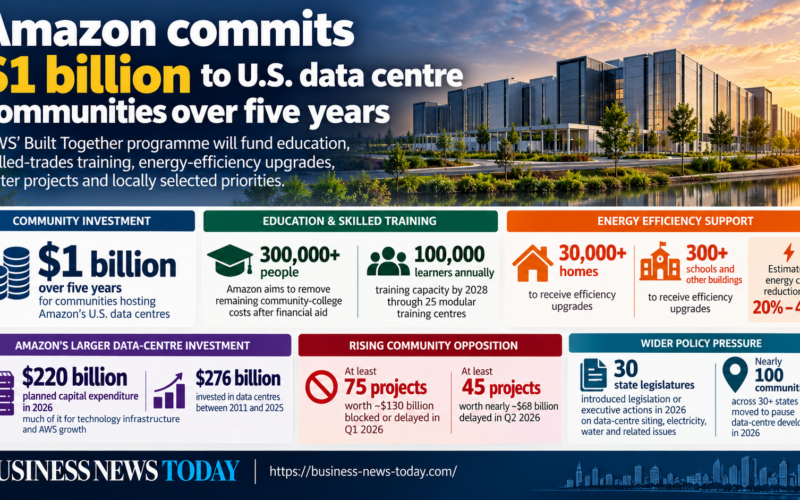
Amazon.com, Inc. (NASDAQ: AMZN) is committing more than $1 billion over five years to communities hosting its U.S. data centres, an investment that says as much about the changing economics of artificial-intelligence infrastructure as it does about corporate philanthropy. The Amazon Web Services Built Together programme will fund education, skilled-trades training, household energy-efficiency improvements, water projects and locally selected priorities while the company simultaneously promises greater transparency and protection for residential electricity customers. Amazon is making the commitment while planning approximately $220 billion of capital expenditure in 2026, much of it associated with technology infrastructure and Amazon Web Services growth. The contrast is revealing: physical computing capacity remains enormously expensive, but winning permission and public acceptance to build that capacity is becoming a strategic problem of its own.
Amazon Web Services is not alone in reaching that conclusion. Meta Platforms, Inc. has launched its own $1 billion community fund for U.S. data-centre locations, while an industry coalition representing companies across the AI infrastructure stack has adopted principles covering electricity costs, water stewardship, local hiring and community engagement. At the same time, independent polling shows that majorities of Americans have become uncomfortable with new data centres being built near them, while projects worth tens of billions of dollars have been delayed or blocked amid local disputes over power, water, land use, noise and infrastructure costs.
The result is a new layer of competition in the AI buildout. Hyperscalers have spent years competing for semiconductors, fibre, electricity, construction labour and suitable land. They increasingly also have to compete for something that cannot simply be ordered from a supplier: local political consent.
Why is Amazon Web Services putting more than $1 billion into data-centre communities?
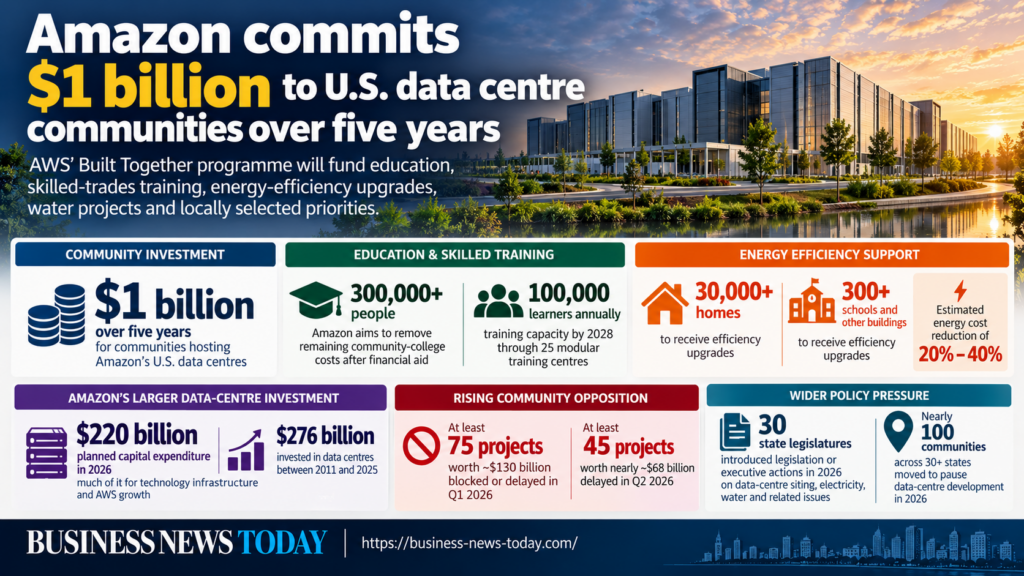
Amazon describes Built Together as an additional investment rather than a replacement for existing community programmes. The company says it has already spent more than $1 billion in communities with significant data-centre operations during the previous three years, while Reuters reported that Amazon invested about $276 billion in data centres between 2011 and 2025. The new commitment therefore represents an attempt to institutionalise community spending alongside the much larger capital programme required to build AI infrastructure.
Built Together has several unusually concrete targets. Amazon aims to remove remaining community-college costs after financial aid for more than 300,000 people living near its U.S. data centres, covering programmes in fields including electrical trades, heating and cooling, fibre optics, information technology, healthcare, public safety and advanced manufacturing. By the end of 2028, Amazon also plans to have the capacity to train as many as 100,000 learners annually through a network of 25 modular training centres located on or close to data-centre sites.
Energy affordability is another large component. Amazon intends to support efficiency upgrades for more than 30,000 homes and more than 300 schools and other buildings during the next five years, with the upgrades designed to reduce energy costs by an estimated 20% to 40% depending on the property. Other funding will flow through local philanthropic foundations, allowing communities to direct money toward priorities such as roads, affordable housing, schools, parks, emergency services and disaster preparedness.
The programme therefore appears designed around the specific objections that increasingly emerge during data-centre approval battles. Instead of relying primarily on promises of broad economic development, Amazon is offering benefits that residents can potentially see directly in education costs, employment skills, utility consumption and public infrastructure.
Has community opposition really become large enough to threaten the U.S. AI buildout?
Recent evidence suggests the answer is increasingly yes, although measuring the exact number of disrupted projects remains difficult because delays can result from several overlapping causes. Data Center Watch counted at least 75 data-centre projects worth approximately $130 billion that were blocked or delayed during the first quarter of 2026 amid local opposition, followed by at least 45 projects worth nearly $68 billion during the second quarter. Those figures should not automatically be treated as permanently cancelled investment because some projects can be redesigned, relocated or eventually approved, but they demonstrate that local resistance has become capable of altering development schedules.
The political activity is spreading beyond individual planning meetings. Data Center Watch found that 30 state legislatures introduced legislation, resolutions or executive actions during 2026 dealing with data-centre siting, electricity, water or infrastructure cost allocation. Separate research by American Buildout identified nearly 100 communities across more than 30 states that had moved to pause data-centre development through moratoriums or similar measures.
Amazon Web Services Chief Executive Officer Matt Garman has warned that more than 100 data-centre moratoriums are being considered across the country. His framing is explicitly competitive, arguing that extensive restrictions could weaken the United States in the global AI race. Yet the fact that Amazon is simultaneously spending more than $1 billion on community benefits suggests the company recognises that simply arguing for national competitiveness may no longer be enough to persuade local residents.
That tension is fundamental to hyperscale infrastructure. The economic and national-security benefits of AI may accrue nationally or globally, while the power lines, substations, construction traffic, water requirements, noise and land conversion are experienced locally. Communities are effectively being asked to host industrial-scale infrastructure whose biggest customers and beneficiaries may be hundreds or thousands of miles away.
What do recent polls say about America’s willingness to host new data centres?
The deterioration in public sentiment has been unusually rapid. A Pew Research Center survey conducted from late July through early August found that 60% of U.S. adults would be not too comfortable or not at all comfortable with a new data centre operating in their area. Only 26% described themselves as somewhat, very or extremely comfortable.
More important for developers, negative perceptions are becoming broader rather than remaining confined to a single environmental issue. Pew found that 54% of Americans considered data centres mostly bad for the environment, up from 39% at the beginning of 2026. Half considered them mostly bad for home energy costs, compared with 38% previously, while 49% viewed them as mostly bad for the quality of life of people living nearby, up sharply from 30%.
The resistance also crosses conventional political lines. Majorities of both Republican-leaning and Democratic-leaning respondents told Pew they would be uncomfortable with a new data centre in their area, although opposition remained higher among Democrats. Separate polling from the Annenberg Public Policy Center similarly found that roughly three in five Americans opposed construction of new data centres near them during the summer.
For technology companies, this creates an awkward mismatch. Investors reward hyperscalers for demonstrating access to increasingly large quantities of computing capacity, but residents may evaluate the same project through the much narrower question of what happens to their electricity bill, water supply, landscape and neighbourhood. The ability to reconcile those two constituencies could increasingly determine which announced gigawatts become operating gigawatts.
Why have electricity costs become the most dangerous issue for data-centre developers?
Electricity has become the centre of the debate because the scale of projected data-centre demand is no longer marginal relative to the U.S. grid. Lawrence Berkeley National Laboratory’s 2025 update estimates that data centres could consume approximately 11.8% of total U.S. electricity by 2030 in its reference case, with scenarios ranging from 9.5% to 15.3%. The reference case equates to roughly 649 terawatt-hours of annual electricity consumption.
The U.S. Energy Information Administration is already seeing the shift in shorter-term forecasts. It expects electricity sales to reach record levels in 2026 and 2027, with data-centre development and manufacturing contributing heavily to growth in commercial and industrial demand. After years in which American electricity consumption barely moved, utilities are suddenly planning for large loads that can resemble heavy industrial plants.
The controversy is not simply about the electricity used inside a data centre. A facility may require new generating capacity, transmission lines, substations and distribution equipment, creating difficult questions about who pays for infrastructure that could remain useful for decades but is initially required by one enormous customer. If those costs enter the wider rate base, households and smaller businesses can reasonably ask whether they are subsidising the expansion of trillion-dollar technology companies.
Amazon is trying to address that concern directly. The company says it works with utilities and regulators so that the rates it pays cover its electricity needs and the infrastructure required to serve them, and it has signed the U.S. Ratepayer Protection Pledge. Amazon has also cited studies of selected locations where large data-centre loads contributed enough utility revenue to spread fixed grid costs across a larger customer base.
Those examples do not establish that every data centre will lower electricity costs everywhere. Power-market structures, generating capacity, transmission constraints, rate design and project timing vary significantly between regions. The strategic importance of Amazon’s commitment is that it effectively accepts the principle that hyperscalers must increasingly demonstrate that households will not be left paying for infrastructure built primarily for AI.
Is Amazon’s water commitment addressing another genuine constraint?
Water has become the second major local concern, particularly in regions where communities are already dealing with drought or competing agricultural and municipal needs. Data centres can use water directly for cooling and indirectly through electricity generation, although consumption varies substantially according to climate, cooling architecture, operating conditions and the source of electricity.
Amazon says its data centres averaged water-use effectiveness of approximately 0.12 litres per kilowatt-hour in 2025, a 52% improvement from 2021, and that the company was 75% of the way toward its goal of becoming water positive across its data-centre operations by 2030. Built Together adds a community-facing dimension to that strategy.
The company now says it has contracted more than 65 water-replenishment projects expected to return more than 8 billion gallons annually to communities, more than twice the water Amazon says all of its data centres consumed during 2025. Those projects include watershed restoration, water-efficiency improvements and alternative water sources rather than simply offsetting consumption at the precise site where a data centre operates.
That distinction will matter to local acceptance. National or global water efficiency is useful for measuring overall progress, but a community considering a large new facility will care most about its own aquifer, reservoir or municipal system. Hyperscalers may therefore increasingly have to demonstrate water resilience at the project level rather than relying solely on company-wide sustainability ratios.
Why does the $1 billion programme look small financially but large strategically?
If Amazon’s more than $1 billion Built Together commitment were distributed evenly across five years, it would represent at least $200 million annually. Compared with Amazon’s current approximately $220 billion 2026 capital-spending plan, that annualised amount is about 0.09%. The comparison is imperfect because Amazon’s capital expenditure includes more than U.S. data centres, but it illustrates why the community programme is unlikely to meaningfully alter Amazon’s financial capacity.
Its strategic value could nevertheless be much larger than its accounting cost. A multibillion-dollar data-centre campus delayed for a year by permitting disputes can leave expensive land, power agreements, equipment commitments and customer demand waiting for capacity. If relatively modest spending on training, public infrastructure, energy efficiency and transparent community engagement reduces the probability of those delays, the return can be meaningful even without treating the programme as a direct profit-generating investment.
The same logic appears to be spreading across the industry. Meta Platforms has established a separate $1 billion Future is for Everyone Fund for U.S. data-centre communities, while the AI Infrastructure Coalition announced community principles requiring members to cover their full energy costs, minimise water impacts, invest in local workers and seek community buy-in. Community spending is consequently beginning to resemble an ordinary component of hyperscale infrastructure development rather than an optional corporate-social-responsibility programme.
This could alter project economics at the margin. Developers may have to include community-benefit agreements, grid contributions, water infrastructure, workforce training and transparency obligations in the effective cost of securing a site. The amounts are small compared with the billions invested in chips and buildings, but their absence can create risks much larger than their upfront price.
Does Amazon’s Built Together programme change the investment case for Amazon shares?
Amazon shares closed at $251.52 on October 2, up 1.33% during a broadly positive session for U.S. equities. The stock has gained roughly 9% during 2026 but has traded more cautiously in recent weeks, leaving it below September highs. There is no credible basis for attributing the October 2 share move specifically to Built Together, given the much larger macroeconomic and AI-investment forces driving Amazon’s valuation.
Investor attention remains focused primarily on whether Amazon can convert unprecedented infrastructure spending into durable Amazon Web Services revenue and cash flow. Amazon Web Services generated $42.2 billion of second-quarter revenue, up 37% year on year and representing its fastest growth in 18 quarters, prompting Amazon to increase its expected 2026 capital expenditure to around $220 billion. Management has argued that substantial customer commitments underpin much of the capacity currently being built.
That makes community opposition financially relevant even if the $1 billion programme itself is immaterial to earnings. Customer contracts can justify building capacity, but they do not eliminate planning disputes, utility negotiations or local political resistance. If capacity cannot be energised and commissioned on schedule, revenue recognition can move later even when customer demand already exists.
From that perspective, Built Together is best viewed as infrastructure-risk management. Amazon is spending extraordinary amounts to secure chips, power, fibre and land; protecting the timetable on which those assets become productive is part of protecting the return on that capital.
Could community consent become the next scarce resource in America’s AI race?
The AI infrastructure boom has already moved through several bottlenecks. NVIDIA Corporation accelerators were initially the most visible constraint, followed increasingly by power generation, transformers, transmission equipment, electrical interconnections, construction labour and financing. Public acceptance now appears capable of joining that list.
Unlike semiconductors or transformers, community support cannot be manufactured centrally and shipped to whichever market needs it most. Each county, town and state has its own politics, water resources, utility structure, tax priorities and tolerance for large industrial development. A model that works in Mississippi may not work in Virginia, Texas, Arizona or New York.
That makes the new generation of community programmes strategically interesting. Amazon Web Services, Meta Platforms and the wider data-centre industry are effectively experimenting with a new bargain in which hyperscalers promise to absorb infrastructure costs, share more information, fund local priorities and create visible pathways into skilled employment in return for permission to continue building at unprecedented scale.
Whether that bargain works remains uncertain. Residents may still conclude that individual projects consume too much land, power or water, while some communities may prefer other forms of development regardless of the financial package offered. Greater transparency could also reveal costs that make opposition stronger rather than weaker.
The direction of travel is nevertheless clear. Amazon expects AI demand to justify one of the largest capital programmes in corporate history, yet the company is now devoting additional money and executive attention to the neighbourhoods surrounding the infrastructure. That suggests the next battle in artificial intelligence may not be fought only over who owns the best models or the most advanced chips. Increasingly, it will also be fought over which companies can persuade communities to let them build.
Discover more from Business-News-Today.com
Subscribe to get the latest posts sent to your email.