
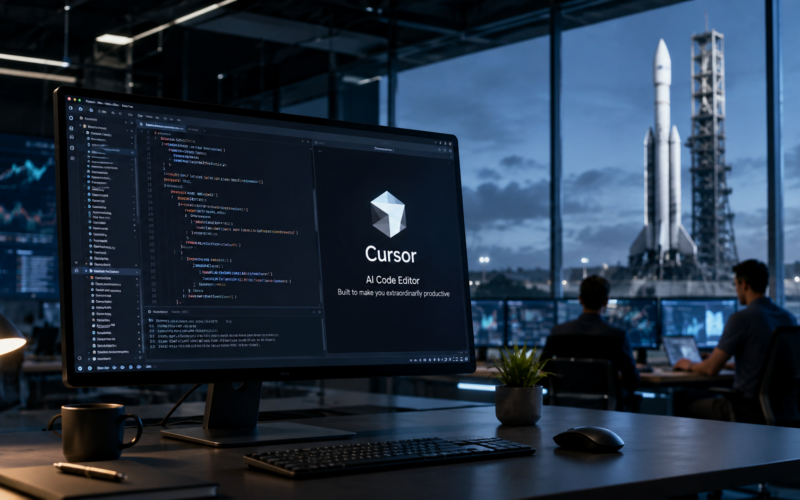
Space Exploration Technologies Corp. (SpaceX, NASDAQ: SPCX) has closed its acquisition of Anysphere, the company behind the Cursor AI coding platform, in an all-stock transaction valued at $60 billion. The deal became effective on August 14, according to a regulatory filing, roughly two months after the definitive merger agreement was signed and four months after SpaceX first secured an option over the company in April. The completed transaction adds Cursor to the SpaceXAI unit and issues approximately 389.3 million new SPCX shares as consideration, a dilution that the company previously described as around 3.4 percent of its post-listing share count. SPCX shares traded roughly 3 percent lower around midday on the closing date. The controlling question for investors is no longer whether the price is defensible in isolation; it is whether SpaceXAI can use its compute advantage to reverse a category share slide that saw Cursor drop from 41 percent of the AI-coding market in June 2025 to around 26 percent by May 2026, with Anthropic taking most of the ground.
How does the completed Cursor acquisition change SpaceXAI’s competitive position against Anthropic and OpenAI?
The strategic intent behind the transaction is straightforward. Cursor is the most recognisable dedicated AI code editor in the enterprise developer market and reported crossing $1 billion in annualised revenue in November 2025. SpaceX, having absorbed xAI earlier in the year and completed its Nasdaq listing in June, needed a credible enterprise software vehicle to justify the AI portion of its post-IPO valuation. Cursor provides that vehicle, alongside an installed developer base that Grok Build, Grok Bot and the Grok API can be sold into with immediate distribution.
What complicates the intent is the underlying category data. According to spending data from Ramp cited around the time of the June announcement, Cursor’s share of enterprise AI-coding spend had fallen from 41 percent in June 2025 to approximately 26 percent by May 2026. Anthropic is understood to now control roughly half of that category. In other words, SpaceX is paying a headline $60 billion in stock for an asset whose commercial trajectory in its core market has been moving in the wrong direction for close to a year. The strategic bet is that the two conditions responsible for the share loss, model quality and compute cost, can be addressed by placing Cursor inside a company that operates one of the largest GPU fleets in the world. Whether that bet is correct will be measurable in Cursor’s spend share numbers over the next two to three quarters, not in the closing announcement itself.
Why does the all-stock structure matter more than the $60 billion headline number?
The $60 billion figure has attracted most of the attention, but the more consequential feature of the transaction is the currency. SpaceX is paying in newly issued Class A common stock, not cash, and the merger consideration was issued under the Section 4(a)(2) private-placement exemption. The company has previously indicated that the consideration represented approximately 3.4 percent dilution at the IPO valuation. That structure protects SpaceX’s cash position, which is already under pressure from its capital-spending programme on AI compute infrastructure, but it transfers valuation risk to existing SPCX holders. If SpaceXAI fails to convert Cursor into a durable revenue engine, the dilution becomes permanent while the strategic return diminishes.
The share issuance also anchors Cursor shareholders, including its venture backers, to SpaceX equity rather than a cash exit. That alignment is analytically important. It means the sellers now have a direct financial interest in the combined entity’s ability to execute the integration, which reduces near-term overhang risk from insider selling only to the extent that lock-up arrangements are in place. The specific lock-up terms have not been disclosed in the summary regulatory filings surfaced so far, and any subsequent Form 4 or 13G filings from former Cursor shareholders will be watched for signs of early distribution.

What does the Cursor deal reveal about SpaceX’s transition from a launch business to a compute business?
Elon Musk has publicly stated that he expects SpaceXAI revenue to surpass all other SpaceX revenue by September. That guidance, if realised, would mark one of the fastest revenue-mix transitions in the history of large-cap technology. The Cursor transaction is central to making that guidance plausible. Rocket launches, Starlink connectivity subscriptions and defence contracts grow at rates governed by physical infrastructure build-out and government procurement cycles. Enterprise AI software subscriptions can scale faster if the underlying product is competitive.
The transaction should therefore be read as the second half of a two-part corporate restructuring. The first part was the earlier absorption of xAI into SpaceX, which gave the combined company a model-development capability and the Grok product line. The second part is Cursor, which supplies the enterprise distribution channel and a recognised end-user product. What remains missing from public disclosure is a segmented view of AI revenue, cost of revenue and gross margin. Until SpaceX begins reporting the AI unit as a distinct segment with its own margin structure, investors have limited ability to independently verify Musk’s September revenue-mix statement or to model the return on the $60 billion in stock consideration.
Why does SpaceX renting compute to Anthropic and Google create a structural conflict inside the combined business?
One of the least discussed features of the deal is the customer relationship SpaceX already has with the companies Cursor is now expected to compete against. SpaceX has been renting AI compute capacity to major customers, including Anthropic and Google. Anthropic is Cursor’s most significant competitor in the AI coding market. Google, through its Gemini and internal coding tool efforts, is another. The completed acquisition therefore creates a structural situation in which SpaceX earns revenue from customers whose commercial success directly reduces the revenue potential of a company it now owns.
This is not necessarily an operational problem in the short term. Cloud infrastructure providers have long served customers who compete with their own downstream services, and Amazon Web Services is the most obvious historical example. But it does create a set of governance and disclosure questions. If Anthropic’s compute usage on SpaceX infrastructure grows at the same time that Cursor loses further market share to Anthropic, SPCX investors will need transparency on whether the AI infrastructure business is being run at arm’s length from SpaceXAI. Any perceived preferential treatment for internal AI workloads over external customer workloads could accelerate customer diversification away from SpaceX compute, particularly given the ongoing lawsuit the company is defending over pollution from data-centre gas turbines.
What integration risks does SpaceX carry as Cursor joins the SpaceXAI product roadmap?
The company has indicated that the Cursor team will work within SpaceXAI on Cursor itself alongside Grok Build, Grok Bot and Grok API. That product roadmap is broad, and it implies that a team known primarily for building a code editor is now being asked to contribute to a general-purpose model deployment stack. Integration risk in software acquisitions of this scale is well documented, and the specific risks here fall into three categories.
The first is talent retention. AI coding is a labour market in which senior engineers can move to competitors quickly, and Anthropic and OpenAI have the financial resources to make targeted offers. The all-stock structure will help retain those who received significant consideration, but it will not necessarily hold engineers whose primary motivation is proximity to a specific model roadmap.
The second is product prioritisation. Cursor’s brand strength rests on being the best dedicated code editor. If engineering resources are redirected to broader Grok products, the risk is that Cursor loses further ground in its core market even as the combined portfolio expands.
The third is customer perception. Enterprise buyers of AI coding tools evaluate vendor stability, model neutrality and data-handling terms. Cursor’s inclusion within a company that also operates a public-facing consumer chatbot and a large satellite business will require careful communication to keep enterprise procurement pipelines intact.
What are the next measurable proof points that will show whether the deal is working?
Investors have a relatively clean set of near-term tests to apply. The most important is Cursor’s share of enterprise AI-coding spend as measured by third-party trackers such as Ramp. A stabilisation of that share in the mid-20s would suggest the compute integration is arresting the slide. A recovery towards the mid-30s would validate the strategic thesis. Continued decline would be difficult to reconcile with the acquisition rationale.
The second is any segment disclosure from SpaceX on AI revenue, cost structure and margin. The September revenue-mix inflection Musk has referenced will be either substantiated or complicated by the company’s next quarterly reporting cycle. The third is the pace and quality of any new product releases across the Grok Build, Grok Bot and Cursor lines, with the recently released Grok 4.6 model already cited as an early indicator of what the combined compute base can produce.
Additional watchpoints include the retention of key Cursor personnel, the specific commercial terms of SpaceX’s compute contracts with Anthropic and Google, any disclosure of enterprise customer concentration for Cursor, and the outcome of the pending data-centre pollution litigation, which could affect the operating cost of the compute assets that underpin the entire strategy.
What has improved, what remains unresolved, and what would strengthen or weaken the thesis?
Completion of the transaction removes execution uncertainty around the deal itself and gives SpaceXAI a distribution channel into the enterprise developer market that it did not previously own. It also crystallises the dilution at approximately 3.4 percent, which is now a known cost rather than a range. What remains unresolved is whether the combined entity can convert Cursor’s compute-advantaged product roadmap into share recovery against Anthropic in a market that has been moving away from Cursor for close to a year. The thesis would be strengthened by segment-level revenue disclosure showing accelerating AI growth, by Ramp or comparable data showing Cursor share stabilising or recovering, and by evidence of successful cross-selling into the Cursor customer base. The thesis would be weakened by continued share loss, by senior engineer departures, or by any signal that internal AI workloads are receiving preferential treatment over external compute customers. The next measurable test is the company’s post-close quarterly reporting cycle, in which the first partial-period contribution from Cursor will appear and Musk’s September revenue-mix statement will meet the disclosed numbers.
Key takeaways for SpaceX (SPCX) investors on the completed Cursor acquisition
- SpaceX completed the acquisition of Anysphere and its Cursor AI coding platform on August 14, using approximately 389.3 million newly issued Class A shares as consideration for a headline $60 billion transaction value.
- The deal represents roughly 3.4 percent dilution at the IPO valuation, transferring valuation risk to existing SPCX holders while protecting the company’s cash position.
- Cursor’s share of enterprise AI-coding spend had fallen from 41 percent in June 2025 to about 26 percent in May 2026, with Anthropic taking most of that ground, according to Ramp spending data.
- Cursor joins SpaceXAI and will work on Cursor itself, Grok Build, Grok Bot and the Grok API, giving SpaceX an enterprise developer distribution channel it did not previously own.
- Musk has publicly stated he expects SpaceXAI revenue to surpass all other SpaceX revenue by September, a claim that will be measurable in the next quarterly reporting cycle.
- SpaceX rents AI compute capacity to Anthropic and Google, creating a structural situation in which the company earns revenue from Cursor’s most significant competitors.
- The transaction was issued under the Section 4(a)(2) private-placement exemption; specific lock-up terms for former Cursor shareholders have not been detailed in the summary filings.
- Near-term proof points include Cursor market-share stabilisation, segment-level AI revenue disclosure, retention of senior Cursor engineers and the ongoing data-centre gas turbine pollution litigation.
- SPCX shares traded approximately 3 percent lower around midday on the closing date, a reaction consistent with a completed all-stock transaction rather than a positive re-rating catalyst.
- The core investment question has shifted from whether the deal would close to whether SpaceXAI’s compute advantage can reverse a category share trend that has been moving against Cursor for close to a year.
Discover more from Business-News-Today.com
Subscribe to get the latest posts sent to your email.