


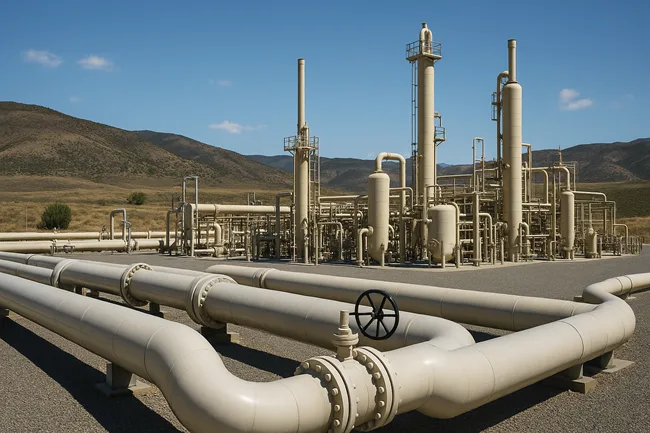
Southwest Gas Holdings, Inc. (NYSE: SWX) has increased the estimated capital cost of the Great Basin 2028 Expansion Project to approximately $2.3 billion after binding shipper commitments reached around one billion cubic feet per day. Great Basin Gas Transmission Company plans to install a 48-inch pipeline designed to serve the contracted capacity while preserving the ability to add further throughput through future compression. Southwest Gas Holdings expects the project to generate between $270 million and $300 million of annual incremental margin once it enters service, compared with its previous estimate of $215 million to $245 million. The expansion has become one of the largest growth opportunities in the company’s portfolio, potentially changing Great Basin from a comparatively small interstate transmission subsidiary into a more material earnings contributor. The central tension is whether 20-year transportation contracts and strong Northern Nevada demand can compensate for a capital requirement that has risen faster than the project’s expected annual margin.
Why has the Great Basin 2028 Expansion Project increased from $1.7 billion to $2.3 billion?
The project’s estimated investment has risen by approximately $600 million from the $1.7 billion figure disclosed in December 2025. That represents an increase of roughly 35%, reflecting the expansion of contracted capacity and the associated changes required in pipeline size, engineering and system design. The original commercial structure was based on capacity requests of nearly 800 MMcf/d, while additional binding precedent agreements signed during the second quarter of 2026 increased contracted demand to approximately 1 Bcf/d.
Southwest Gas Holdings now expects the pipeline to use a 48-inch design capable of serving the contracted volume and accommodating further capacity through compressor additions. A larger-diameter pipeline can provide more long-term flexibility than constructing a system tightly sized around initial demand, but it also requires more steel, heavier equipment, larger construction spreads and potentially more complex crossings and facilities. The company has not provided a detailed reconciliation showing how much of the $600 million increase relates to pipe diameter, route work, compression, labour, inflation or additional customer requirements.
The revised economics deserve careful attention. At the midpoint, expected annual incremental margin has increased from approximately $230 million to $285 million, a rise of about 24%. Capital expenditure has increased by about 35%, meaning the amount of investment required for each dollar of expected annual margin has become less favourable than under the previous estimate. This does not make the project unattractive, particularly because the disclosed margin is not the same as net income or cash flow, but it raises the importance of controlling further cost escalation.
The new figure is also based on current engineering and design assumptions rather than a completed construction contract. Environmental findings, final routing, material prices and contractor bids could still affect the project budget before Southwest Gas Holdings reaches full construction. The company has appropriately described the estimate as projected capital investment rather than a fixed final cost.
How do 20-year transportation agreements reduce commercial risk for Southwest Gas Holdings?
The project’s strongest commercial protection comes from its binding precedent agreements. Shippers that signed those agreements are required to post financial surety and enter minimum 20-year transportation service agreements after the Federal Energy Regulatory Commission approves the project’s Certificate of Public Convenience and Necessity. This structure provides substantially more revenue visibility than building an interstate pipeline around non-binding expressions of interest or expectations of future demand.
Long-duration transportation contracts should allow Great Basin Gas Transmission Company to recover its investment through recurring capacity payments over an extended operating period. Contracted shippers generally pay for reserved firm transportation rights under the applicable tariff and negotiated service arrangements, reducing the pipeline owner’s reliance on volatile short-term gas prices. Southwest Gas Holdings is therefore principally exposed to construction, financing, regulatory and counterparty risks rather than direct commodity-price movements.
The agreements are not yet equivalent to fully operating revenue. The transportation service agreements remain dependent on federal approval, completion of the pipeline and satisfaction of the commercial conditions contained in the precedent agreements. Customer surety reduces the risk of shippers abandoning their commitments without consequence, but the actual protection will depend on the financial strength of the counterparties and the precise contractual terms.
Southwest Gas Holdings has not identified the project shippers or disclosed individual contract volumes, tariff rates or credit arrangements. That confidentiality is common in infrastructure development, but it prevents outside investors from independently assessing customer concentration. A project supported by several financially strong shippers would carry a different risk profile from one whose contracted capacity is dominated by a single development or customer.
Why is Northern Nevada generating enough demand to support a 1 Bcf/d pipeline expansion?
Great Basin Gas Transmission Company operates an approximately 898-mile interstate pipeline system extending from the Idaho-Nevada border across Northern Nevada toward Reno, Sparks, Carson City, Lake Tahoe and the Nevada-California border. The existing network also includes a liquefied natural gas peak-shaving facility near Lovelock. The proposed expansion is intended to increase access to reliable, dispatchable energy across growing Northern Nevada demand centres while strengthening the capacity of the existing system.
Southwest Gas Holdings has highlighted Arizona and Nevada as potential growth markets for energy-intensive commercial and industrial development, including data centres. These facilities can require substantially greater electricity capacity than conventional commercial buildings, while grid constraints may increase demand for natural gas-fired generation capable of supplying reliable power during periods when renewable generation or transmission capacity is insufficient. The company has also identified roughly 30 data-cententre projects at various stages of development across the two states, although it has not stated that every Great Basin shipper is connected to data-centre activity.
Northern Nevada’s broader growth also includes manufacturing, logistics, mining-related activity and population expansion. Natural gas transportation can support utility systems, industrial users and power generation, creating several possible sources of throughput. The 1 Bcf/d of contracted demand provides stronger evidence than general regional forecasts because customers have progressed beyond expressions of interest and signed binding precedent agreements.
The additional 1.8 Bcf/d of expressions of interest for service between 2029 and 2035 should be treated more cautiously. Those volumes have not yet been converted into binding agreements and would probably require separate expansion phases, new regulatory approvals and different construction schedules. They demonstrate commercial attention, but they should not be counted as current contracted capacity or included automatically in the initial project’s value.
What remains unresolved in the Federal Energy Regulatory Commission approval process?
The Great Basin 2028 Expansion Project has entered the Federal Energy Regulatory Commission’s pre-filing process under Docket No. PF26-5-000. Federal Energy Regulatory Commission staff opened environmental scoping for proposed facilities in Churchill, Humboldt, Lyon, Pershing, Storey and Washoe counties during 2026. The agency will use the environmental review when considering whether the project is required by the public convenience and necessity.
Southwest Gas Holdings expects Great Basin Gas Transmission Company to file its formal certificate application later in 2026. That filing will move the project from pre-filing consultation into the formal approval process, where the regulator will examine environmental effects, engineering, market need, proposed rates and other matters. Public scoping and field surveys represent progress, but they are not regulatory approval.
The enlarged 48-inch design may require updated environmental, engineering and route documentation compared with earlier project assumptions. Southwest Gas Holdings said the increased contracted demand was not expected to disrupt the current filing schedule, although the final application will need to reflect the revised project scope. The late-2028 service target will depend on the timing of the Federal Energy Regulatory Commission review and the company’s ability to begin construction soon enough after receiving authorisation.
Environmental review may also produce route changes, mitigation requirements or construction restrictions. These outcomes do not necessarily prevent approval, but they can alter cost and schedule. The project’s commercial commitments improve the evidence of market need, while federal approval will determine whether that demand can be converted into an authorised physical system.
Can Southwest Gas Holdings finance the larger project without excessive shareholder dilution?
Southwest Gas Holdings ended the second quarter with $270.5 million of cash and cash equivalents and nearly $1 billion of available liquidity. It invested $520 million in infrastructure during the first six months of 2026, including approximately $115 million on the Great Basin project. The company therefore has already begun funding engineering, surveys and other pre-construction activities, but most of the $2.3 billion requirement remains ahead.
The company’s existing 2026 to 2030 capital programme totals $6.3 billion and originally incorporated only $1.7 billion for Great Basin. Southwest Gas Holdings explicitly said the current long-term capital expenditure, rate-base and earnings guidance does not yet include the additional $600 million. It expects to incorporate the revised project economics during its annual five-year planning refresh, which normally concludes with the fourth-quarter results in February.
This creates an important distinction between reaffirming guidance and confirming the affordability of the enlarged project. Southwest Gas Holdings retained its 2026 capital expenditure forecast of approximately $1.25 billion because most of the incremental Great Basin spending falls in future years. Reaffirmed near-term guidance therefore does not mean the additional capital has disappeared. It means the financing and earnings implications will be addressed in the next long-term plan.
Southwest Gas Corporation has applied to the California Public Utilities Commission for authority to issue or obtain up to approximately $1.15 billion of additional debt through 2030, partly to facilitate funding for the Great Basin expansion. That application concerns financing authority rather than construction approval and does not require the company to borrow the entire authorised amount immediately. It nevertheless demonstrates that debt funding is expected to play a significant role in the project’s capital structure.
Southwest Gas Holdings strengthened its balance sheet during 2025 by completing the separation of Centuri Holdings, Inc. and using approximately $1.35 billion of net proceeds to repay holding-company debt. That simplification provides greater financial flexibility than the company had before the separation. However, the Great Basin expansion is large relative to Southwest Gas Holdings’ approximately $6.6 billion market capitalisation, making future debt issuance, retained cash flow and potentially equity funding important variables.
Does the expected $270 million to $300 million margin justify the project’s capital cost?
At the midpoint, the project’s estimated annual incremental margin of $285 million represents approximately 12.4% of the $2.3 billion capital estimate. That is not a forecast return on equity, EBITDA yield or free-cash-flow yield because operating expenses, depreciation, interest, taxes and the regulatory capital structure must still be considered. It does, however, provide a useful indication of the revenue contribution Southwest Gas Holdings expects from the contracted transportation capacity.
The economics may improve if Great Basin adds future compression and sells more capacity without constructing another full-length pipeline. Designing the 48-inch system with expansion capability could allow additional contracts to use much of the initial infrastructure base. Such an outcome would increase asset utilisation and potentially improve returns, although it would require additional capital and separate commercial and regulatory steps.
The opposite risk is that construction costs rise again before service begins. Every additional dollar of spending must ultimately be supported by contracted revenue, regulatory recovery or future capacity sales. If the project remains near $2.3 billion and the expected margin reaches the upper end of management’s range, the enlarged system could become a meaningful contributor. If costs move materially higher while the margin forecast remains unchanged, the financial case would weaken.
Investors should also distinguish incremental margin from cash available for dividends. Pipeline earnings will initially be affected by depreciation and financing costs, while construction spending occurs years before the full margin is realised. The project may create substantial long-term value, but its near-term cash-flow profile will be investment-heavy.
How do Southwest Gas Holdings’ second-quarter results support the investment programme?
Southwest Gas Holdings reported second-quarter income from continuing operations of $42.1 million, compared with a loss of $0.7 million in the prior-year period. Adjusted net income from continuing operations increased to $32.4 million from $26.5 million, while adjusted diluted earnings per share rose to $0.45 from $0.37. For the first six months, adjusted earnings from continuing operations reached $2.49 per share, compared with $2.23 a year earlier.
The improvement partly reflected the absence of previous holding-company interest costs and tax expenses after the Centuri separation. Southwest Gas Holdings also benefited from constructive California rate treatment, including recognition of revenue deferred from the first quarter. These factors strengthened consolidated earnings, although the natural gas distribution segment’s reported second-quarter net income declined because of higher taxes, depreciation and lower other income.
The company reaffirmed 2026 earnings from continuing operations guidance of $4.17 to $4.32 per share. It also retained its target for adjusted earnings-per-share growth of 12% to 14% between 2026 and 2030, based on adjusted 2025 earnings of $3.65 per share. Crucially, that long-term guidance still reflects the old $1.7 billion Great Basin estimate rather than the updated $2.3 billion scope.
The next long-term outlook will therefore be more important than the unchanged 2026 forecast. Southwest Gas Holdings must explain how the additional capital affects rate-base growth, interest expense, financing needs and earnings accretion. A higher earnings-growth forecast accompanied by a manageable funding plan would strengthen the project thesis. An unchanged earnings target combined with substantially greater equity issuance would make the economic uplift less compelling on a per-share basis.
What does the SWX share-price reaction indicate about investor sentiment?
Southwest Gas Holdings shares closed at $90.67 on August 5, 2026, up approximately 1.8% during the session in which the company released its results and updated the Great Basin project. The shares traded between $87.68 and $91.59, with volume of more than 815,000 shares. The company’s market capitalisation was approximately $6.58 billion.
The closing price was approximately 2.3% above the July 6 close of $88.66. It also remained around 4% below the recent 52-week high of approximately $94.47 and nearly 20% above the 52-week low of $75.75. This positioning suggests that investors have recognised Southwest Gas Holdings’ balance-sheet improvement and regulated growth prospects, while stopping short of assigning an unrestricted premium to the larger capital programme.
The positive session coincided with several developments, including better adjusted quarterly earnings, reaffirmed guidance, progress in California and the increase in contracted Great Basin demand. It would therefore be too narrow to attribute the share-price movement entirely to the project update. The reaction nevertheless indicates that the higher capital estimate did not immediately outweigh the commercial value of the additional commitments.
Longer-term sentiment will depend less on one day’s movement and more on the February planning update. Investors will want to see that the additional $600 million creates sufficient incremental earnings to offset financing costs and any new shares. The market may support a larger capital programme, but only when management shows how the project improves value per share rather than simply increasing rate base and asset size.
What milestones will prove whether the Great Basin expansion creates durable value?
The first milestone is the formal Federal Energy Regulatory Commission certificate application expected later in 2026. That filing should provide greater clarity on facilities, routing, compression, environmental impacts and the updated construction schedule. The subsequent regulatory review will determine whether the project can maintain its targeted late-2028 service date.
The second milestone is conversion of the binding precedent agreements into minimum 20-year transportation service agreements after federal approval. Confirmation that shippers have posted the required surety and maintained their commitments will strengthen revenue visibility. Additional agreements for later phases should be evaluated separately rather than added automatically to the initial project’s economics.
The third milestone is Southwest Gas Holdings’ five-year plan refresh. Management must reconcile the new $2.3 billion cost with its capital structure, rate-base forecast, earnings-growth target and dividend policy. This will be the clearest test of whether the enlarged project improves per-share economics after considering debt and potential dilution.
Southwest Gas Holdings has materially improved the commercial foundation of the Great Basin 2028 Expansion Project by securing around 1 Bcf/d of binding demand. What remains unresolved is whether federal approval, construction and financing can be completed near the current estimate. The thesis would strengthen if the project receives its certificate on schedule, the $2.3 billion budget stabilises and management raises long-term earnings expectations without excessive equity issuance. It would weaken if costs continue rising, shippers reduce commitments or the financing burden absorbs much of the expected incremental margin.
What are the key takeaways from the Southwest Gas Great Basin 2028 Expansion Project?
- Great Basin Gas Transmission Company has secured binding precedent agreements covering approximately 1 Bcf/d of incremental demand.
- Southwest Gas Holdings has increased the project’s estimated capital investment from $1.7 billion to approximately $2.3 billion.
- The planned 48-inch pipeline will be designed to support additional future capacity through compressor additions.
- Expected annual incremental margin has increased to between $270 million and $300 million after the project enters service.
- Project shippers must post surety and execute minimum 20-year transportation service agreements following federal approval.
- The Federal Energy Regulatory Commission certificate application is expected later in 2026 and remains a critical unresolved milestone.
- Approximately 1.8 Bcf/d of additional expressions of interest for 2029 to 2035 are not yet binding.
- Southwest Gas Holdings’ existing five-year guidance still includes only the previous $1.7 billion project estimate.
- The company ended the second quarter with $270.5 million of cash and nearly $1 billion of available liquidity.
- The February 2027 planning update will show whether higher contracted margin can offset the project’s larger financing requirement.
Discover more from Business-News-Today.com
Subscribe to get the latest posts sent to your email.

