



The SuedLink HVDC project is one of the most consequential power transmission developments under construction in Germany because it addresses the geographic imbalance at the heart of the country’s energy transition. Large volumes of offshore and onshore wind electricity are generated in northern Germany, while major industrial and population centres remain concentrated in Bavaria and Baden-Württemberg. SuedLink is intended to bridge that gap through two underground high-voltage direct-current connections with a combined transmission capacity of 4GW.
Germany can continue adding wind farms, solar projects and other renewable generation, but those assets cannot deliver their full economic or energy-security value unless electricity can move efficiently between regions. SuedLink is therefore not simply another cable project. It is a national balancing corridor designed to make northern renewable generation available to southern manufacturing, cities and infrastructure at a time when conventional nuclear and coal-fired capacity has declined.
The project has gained additional strategic importance in 2026 because the original planning approval process has been completed and construction is active across multiple sections. The most important uncertainty has shifted from whether the corridor will be approved to how quickly its cable systems, converters, tunnels, crossings and regional construction packages can be integrated.
Germany’s Federal Network Agency continues to describe 2028 as the target for connecting the two SuedLink lines to the grid. However, Hitachi Energy lists 2029 as the commissioning year for the SuedLink DC4 converter system. The different published dates suggest that construction completion, grid connection, converter commissioning and full commercial operation may occur through a staged process rather than on one single project-wide date.
Where is the SuedLink project located and what infrastructure is being built?
SuedLink consists of two predominantly underground direct-current power lines running from Schleswig-Holstein in northern Germany toward Bavaria and Baden-Württemberg in the south. The lines are planned to follow largely parallel routes across much of the corridor, although their starting and ending points differ.
Project 3 connects Brunsbüttel in Schleswig-Holstein with the Großgartach and Leingarten grid area in Baden-Württemberg. Project 4 connects Wilster in Schleswig-Holstein with Bergrheinfeld/West in Bavaria. Each line has a planned transmission capacity of 2GW and uses 525kV direct-current technology, creating a combined SuedLink capacity of 4GW.
The frequently used description of SuedLink as a roughly 700km project refers to the overall underground transmission corridor. It should not be interpreted as meaning that both individual lines are each exactly 700km long. The route lengths differ because the two connections terminate at different grid nodes and do not follow identical alignments throughout the entire project.
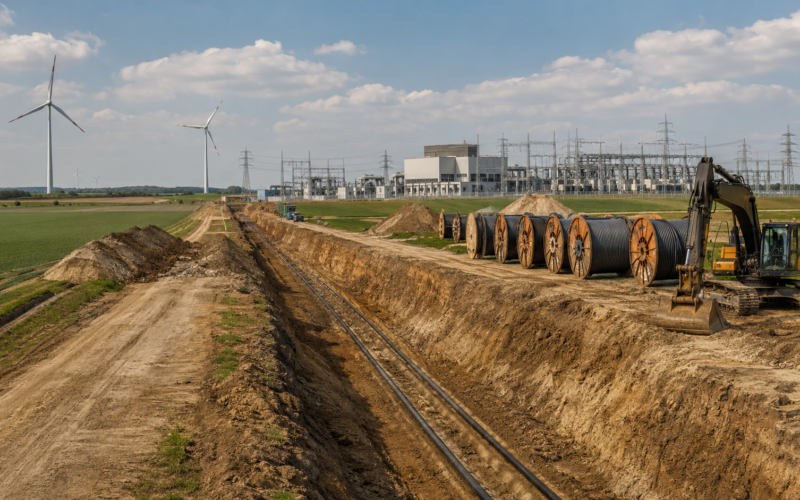
The physical development includes underground HVDC cable systems, converter stations, cable section stations, protection ducts, access infrastructure, major river crossings, underground construction packages and connections to Germany’s alternating-current transmission network. SuedLink also requires specialist works where conventional open-trench cable installation is not practical.
One of the most technically demanding components is the ElbX crossing between Wewelsfleth in Schleswig-Holstein and Wischhafen in Lower Saxony. PORR describes the bored tunnel beneath the Elbe river as 5.2km long. Other project descriptions use a slightly longer figure when referring to the wider crossing infrastructure, so approximately five kilometres is the safest project-wide description.
Another unusual section uses an existing mine operated by Südwestdeutsche Salzwerke between Bad Friedrichshall and Leingarten. Around 16km of the SuedLink route is planned through the mine, reducing the need for surface construction along that portion while creating a specialised underground installation environment.
Who operates SuedLink and how is the project ownership structure organised?
SuedLink is being planned, developed and operated jointly by TenneT TSO GmbH and TransnetBW GmbH, two of Germany’s four transmission system operators. TenneT is responsible for the northern portion of the route and the converter infrastructure in Schleswig-Holstein and Bavaria. TransnetBW is responsible for the southern route and the converter in Baden-Württemberg.
Unlike an oil field, gas development, LNG terminal or mining project, SuedLink does not have an upstream ownership structure based on production licences, reserves or participating interests. It is a regulated national power transmission asset delivered through Germany’s statutory network-expansion framework.
The commercial model is built around regulated transmission investment and a network of engineering, procurement, cable, converter and construction contracts. TenneT and TransnetBW remain responsible for the overall connections, while specialist companies provide the HVDC cables, power electronics, converter stations, tunnelling, civil engineering, installation, planning and project-management capabilities.
This structure spreads project execution across several major contractors and hundreds of kilometres of regional work packages. It also means that schedule performance depends on coordination between transmission operators, regulators, local authorities, landowners, cable manufacturers, converter suppliers and civil contractors rather than on one turnkey project company.
What is the transmission capacity of SuedLink and how will the system operate?
SuedLink will have a combined transmission capacity of 4GW through two separate 2GW lines operating at 525kV. The project does not produce electricity and should not be analysed like a power station. Its value lies in its ability to transport power over long distances while allowing grid operators to manage electricity flows between regions.
High-voltage direct-current technology is suited to this role because it can move large quantities of electricity over long distances with lower losses and greater controllability than a conventional alternating-current connection of comparable scale. Converter stations at the northern and southern endpoints will convert alternating current into direct current for transmission and then convert it back into alternating current for use within the wider German grid.
During periods of strong wind generation, SuedLink is expected to move electricity south from Schleswig-Holstein toward Bavaria and Baden-Württemberg. The system is also designed to permit bidirectional flows, allowing electricity to move north when southern solar generation or wider market conditions make reverse transmission necessary.
The 4GW capacity gives SuedLink a central role in supporting German industrial power demand. Bavaria and Baden-Württemberg host major automotive, engineering, chemicals, technology and manufacturing operations. These sectors require dependable electricity even as Germany’s generation system becomes more dependent on variable renewable resources.
SuedLink will not eliminate Germany’s grid constraints on its own. Its capacity must work alongside A-Nord, Ultranet, SuedOstLink, offshore grid connections, regional transmission upgrades, storage systems and cross-border interconnectors. Nevertheless, its scale makes it one of the most important individual links in the national transmission programme.
Which companies won the major SuedLink cable and converter contracts?
SuedLink depends on a concentrated group of companies capable of manufacturing and installing 525kV HVDC cable systems and building large converter stations. Prysmian, NKT, Siemens Energy and Hitachi Energy hold some of the most important technology and supply contracts.
Prysmian was awarded SuedLink contracts with a combined value of more than €800m. Its scope includes designing, manufacturing, supplying, laying, jointing, testing and commissioning a 2GW underground HVDC cable system. The work uses extruded 525kV cable technology developed for high-capacity, long-distance underground transmission.
NKT is also a major SuedLink cable supplier. The company’s scope covers cable systems, accessories and installation for a 525kV, 2GW section of the project. NKT describes SuedLink as the world’s longest underground HVDC power link. That description is a supplier claim and is best presented with attribution rather than as an independently established project record.
Siemens Energy is supplying converter infrastructure for SuedLink DC3, the 2GW connection between Brunsbüttel and Großgartach/Leingarten. Its scope includes HVDC Plus converter technology and specialised transformers designed for the project’s 525kV direct-current system. The converter stations will support bidirectional transmission, reactive power management and voltage control.
Hitachi Energy is supplying the converter technology for SuedLink DC4, the 2GW connection between Wilster and Bergrheinfeld. The company’s published project data lists a direct voltage of ±525kV, power transmission of 2,000MW and a commissioning year of 2029.
The 2029 date is important because it differs from the Federal Network Agency’s broader target of connecting both SuedLink lines to the grid by 2028. The difference does not necessarily indicate a formal delay to the entire project. It may reflect separate schedules for route construction, initial energisation, converter commissioning, testing and full operational availability. However, it means 2028 should be presented as the official target rather than a guaranteed date for complete 4GW commercial operation.
Which construction companies are delivering SuedLink’s tunnels and regional civil works?
PORR is responsible for the ElbX tunnel beneath the Elbe river on behalf of TenneT. The company’s work includes the 5.2km bored tunnel, deep construction shafts, tunnel lining, underwater excavation, concrete works, technical tunnel equipment and infrastructure required to carry the SuedLink cables across the river.
Mechanical tunnelling began in early 2025. PORR’s published construction schedule pointed to the tunnel boring machine reaching the target shaft around the middle of 2026. Until an updated completion announcement is issued, the breakthrough should be described as scheduled or expected rather than already completed.
The project also involves regional civil works contractors including LEONHARD WEISS and STRABAG. Their work includes protection-duct construction, route preparation, road and water crossings, excavation, reinstatement and construction packages across individual sections in Bavaria, Baden-Württemberg and Lower Saxony.
Jacobs has supported SuedLink through an integrated delivery role covering areas such as programme management, planning, permitting coordination, stakeholder engagement, technical services and logistics. The involvement of a delivery partner reflects the difficulty of managing a project divided into multiple regulatory sections, contractors and federal-state jurisdictions.
These contracts demonstrate why SuedLink cannot be treated simply as a cable supply programme. The project combines power technology with tunnelling, environmental management, logistics, land restoration, archaeology, road construction and extensive stakeholder coordination.
How did SuedLink move from political controversy to active construction?
SuedLink emerged from Germany’s need to expand north-south electricity transmission as renewable generation grew in the north and conventional power stations closed elsewhere. Early proposals encountered political and community resistance, particularly over the potential use of new overhead transmission lines.
The decision to prioritise underground cabling reshaped the project. Underground construction reduced the permanent visual impact of the transmission corridor but increased its engineering complexity, construction footprint and investment cost. TransnetBW has described SuedLink as a roughly €10bn energy transition infrastructure project.
The formal federal planning process began in 2017, followed by detailed route development, environmental studies, public participation and planning approval procedures for individual sections. To avoid waiting for every section to receive final approval, the Federal Network Agency authorised early construction activities from December 2022.
Those early-start approvals allowed selected compensation measures, drilling, clearing, archaeological work and other preparatory construction to begin before the complete project had secured final approval. Construction therefore developed in stages rather than starting simultaneously across the entire corridor.
The Federal Network Agency completed the original SuedLink planning approval process on October 10, 2025. That milestone established approved routes across the project and allowed the operators to accelerate full construction activity.
However, completion of the original approval process does not mean the detailed plans are permanently frozen. Large infrastructure projects frequently require amendments as construction designs, local conditions and technical interfaces evolve.
What are the latest SuedLink developments and construction updates in 2026?
The most important 2026 development is that SuedLink is now being implemented as a fully approved corridor while detailed construction-related permitting continues. The project has progressed from a largely regulatory story into a multi-region civil engineering and system-integration programme.
The Federal Network Agency opened public participation for the first plan amendment covering section D1 of SuedLink Projects 3 and 4 from June 15 to August 14, 2026. The process concerns the section south of the Hesse-Thuringia border toward the area south of the Thuringia-Bavaria border.
The amendment does not reverse the October 2025 completion of the original planning approval process. Instead, it demonstrates that project-level modifications can continue during implementation. The distinction is important: SuedLink has received its original corridor approvals, but changes to approved plans may still require consultation and regulatory decisions.
Construction has begun across numerous northern, central and southern sections, with some packages further advanced than others. Work includes cable-route preparation, protection-duct installation, drilling, road crossings, environmental measures and converter construction.
The ElbX tunnel remains one of the most closely watched engineering milestones. The tunnel will provide a protected route beneath one of Germany’s most important waterways, avoiding the risks and disruptions that would accompany a conventional surface crossing.
At Leingarten, TransnetBW’s previously published schedule targeted operation of the converter in STATCOM mode by 2026, independently of the completed SuedLink cable connection. STATCOM operation would allow the converter to provide reactive power and support grid voltage before it begins transmitting electricity through the full north-south HVDC link.
A newer official TransnetBW announcement confirming that the Leingarten converter has entered STATCOM operation was not available at the time of publication. The 2026 milestone should therefore be described as the company’s published target rather than as a confirmed operational achievement.
Why are converter stations important to SuedLink beyond electricity conversion?
The SuedLink converter stations will perform more than the basic conversion of alternating current into direct current and back again. They are designed to help control voltage, supply or absorb reactive power and support the stability of the surrounding transmission system.
These functions are becoming more valuable as conventional nuclear and coal power stations leave the German grid. Large rotating generators historically supplied some grid-stability services as part of their normal operation. Modern converter-based infrastructure must increasingly replace or supplement those capabilities.
SuedLink’s converter technology can also help grid operators control the direction and quantity of electricity flowing through the corridor. This controllability distinguishes HVDC connections from less flexible conventional transmission assets and allows the system to respond to changing renewable generation and demand conditions.
The early STATCOM strategy proposed for Leingarten illustrates this wider value. Even before the complete SuedLink cable route is available, the converter may be able to support the regional alternating-current network by managing reactive power. The final operational timetable still requires current confirmation, but the planned function demonstrates that converter investment can generate grid benefits before full corridor commissioning.
What environmental and regulatory issues continue to affect SuedLink?
SuedLink crosses agricultural land, waterways, transport corridors, settlements, forests and environmentally sensitive areas across several German states. The project’s underground design reduces its long-term visual impact but creates substantial temporary construction requirements.
Open-trench installation requires topsoil and subsoil to be removed, stored separately and restored after protection ducts and cables are installed. Closed construction techniques, including horizontal drilling and tunnelling, are required beneath roads, rivers, railways and environmentally constrained locations.
The project also involves archaeological investigations, unexploded-ordnance checks, groundwater management, environmental compensation and detailed restoration commitments. These activities can affect construction sequencing because work must comply with seasonal environmental restrictions and site-specific permit conditions.
The 2026 D1 amendment consultation shows that regulatory oversight continues after original route approval. This is normal for a project of SuedLink’s scale, but it creates an ongoing execution risk. Even relatively local design modifications can require documentation, consultation and approval before the revised work can proceed.
Legal challenges and planning amendments are therefore part of the project environment rather than evidence that SuedLink lacks approval. The more relevant question for the schedule is whether such proceedings affect critical construction activities or remain manageable within the operators’ programme.
How does SuedLink affect TenneT, TransnetBW and Germany’s industrial strategy?
For TenneT and TransnetBW, SuedLink is a defining regulated infrastructure investment. It expands their transmission networks, increases their regulated asset responsibilities and places both operators at the centre of Germany’s attempt to build a power system capable of supporting large-scale renewable generation.
For Germany, the project is closely tied to industrial competitiveness. Southern Germany contains electricity-intensive manufacturing and supply chains that require reliable power. As transport, heating and industrial processes become more electrified, demand for both generation and transmission infrastructure will increase.
A failure to expand north-south grid capacity can lead to renewable curtailment in the north and continued reliance on more expensive generation, imports or redispatch measures elsewhere. SuedLink is intended to reduce that mismatch by allowing more efficient use of electricity already generated within the German system.
The project also has implications for Europe’s infrastructure supply chain. Its cable and converter contracts support demand for 525kV HVDC technology, large transformers, power electronics, specialist tunnelling and high-voltage installation skills. SuedLink, A-Nord and SuedOstLink together demonstrate that grid equipment has become one of the most strategically important parts of the European energy transition.
Why will SuedLink remain strategically relevant after commissioning?
SuedLink’s importance will not end once its lines are energised. The corridor will remain a structural component of Germany’s power system because renewable generation, electricity demand and cross-regional power flows will continue to change over the coming decades.
The line is designed to support a grid with higher levels of wind and solar generation, both of which fluctuate according to weather conditions. Long-distance transmission allows regional surpluses to be moved toward areas experiencing higher demand or lower generation.
SuedLink will also serve as a benchmark for other European underground HVDC projects. Its experience in permitting, public consultation, converter integration, cable manufacturing, tunnelling, mine installation and soil restoration can inform future transmission corridors.
The project’s performance will influence perceptions of whether Germany can translate renewable targets into usable infrastructure. Successful commissioning would demonstrate that large underground HVDC systems can be delivered despite complex regulatory and construction environments. Further delays would reinforce concerns that transmission development remains one of the biggest constraints on Europe’s energy transition.
What is the future outlook for the SuedLink HVDC project?
The outlook for SuedLink is constructive, but its remaining risks are concentrated in execution and integration. The original project route is approved, major supply contracts are in place and construction is active. The challenge is now to complete hundreds of kilometres of civil works, cable installation, converter construction, testing and system integration without allowing local delays to disrupt the wider programme.
The Federal Network Agency continues to target grid connection of the two SuedLink lines in 2028, and TransnetBW has said construction should be completed by the end of that year. Hitachi Energy’s 2029 commissioning date for DC4 introduces a more cautious indicator for when the entire 4GW corridor may become fully operational.
The safest conclusion is that SuedLink is targeting major completion and grid-connection milestones around 2028, with some converter commissioning and final operational steps potentially continuing into 2029. The exact sequence will depend on construction progress, testing, regulatory amendments and coordination between the two HVDC systems.
SuedLink will not solve every German transmission constraint, but it is one of the projects capable of materially changing how electricity moves through the country. Germany already has significant renewable generation in the north and major industrial demand in the south. SuedLink is the infrastructure test of whether the national grid can connect the two at the scale and speed required.
Discover more from Business-News-Today.com
Subscribe to get the latest posts sent to your email.


