


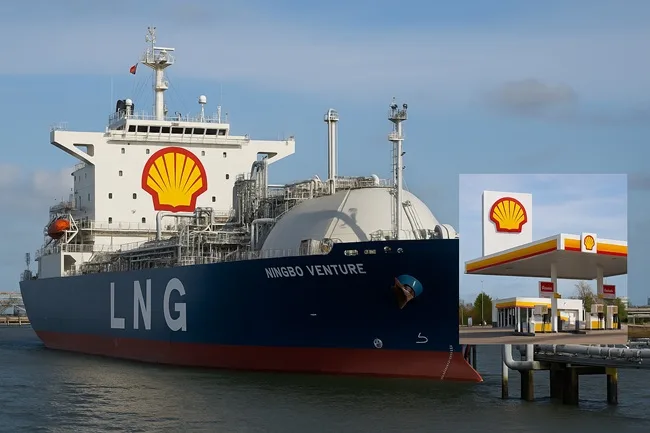
Shell plc (NYSE: SHEL) released its tenth annual LNG Outlook on Tuesday, June 30, 2026, telling the market that global liquefied natural gas trade will be broadly flat in 2026 if shipping through the Strait of Hormuz returns to normal during the summer, ending more than a decade of uninterrupted year-on-year volume growth. The base case follows a four-month Middle East conflict that has shut in roughly one-fifth of global monthly LNG supply, lifted Asian spot prices above $20 per million British thermal units at the peak of the disruption and damaged Qatari export infrastructure that supports the world’s most concentrated LNG export hub. Shell sees growth resuming in 2027 and long-term demand rising about 65 percent to nearly 700 million tonnes per year by 2050, anchored on South and Southeast Asian coal-to-gas switching, Japanese AI data centre power demand and a seven-fold expansion in LNG bunkering to 27 million tonnes annually by 2035. Shell shares closed Monday at $76.77, well below the mid-point of a $68.63 to $94.90 52-week range, with the stock under pressure since the company paused its $3 billion share buyback programme on June 12 to preserve capital flexibility through the Middle East shock. The report is the most consequential forward-looking statement from the world’s largest LNG trader since the conflict began, and it materially reframes capital allocation expectations for liquefaction project sponsors, gas-fired power developers, energy infrastructure investors and Asian utility planners through the end of the decade.
What does Shell’s flat 2026 LNG trade forecast actually mean for spot prices, contract renegotiation risk and Asian buyer behaviour?
The base case scenario rests on a specific operational assumption that the Strait of Hormuz reopens to normal tanker traffic within the next three months and that Qatar, the world’s second-largest LNG exporter, can restore liquefaction throughput on a comparable timeline. Under that assumption, full-year 2026 LNG trade lands close to the 422 million tonnes recorded in 2025, with the back half of the year absorbing the supply that should have moved in the disrupted spring window. Market resilience in the first half of 2026 has been higher than the bear case implied, with increased liquefaction output from the United States Gulf Coast, improved utilisation at existing facilities and softer Asian import demand offsetting roughly half of the Middle East supply shortfall.
The alternative scenario, in which Hormuz remains constrained for weeks longer, would produce the first annual contraction in global LNG trade since the supply category began continuous expansion. That outcome would have second-order consequences well beyond the headline volume number. Long-term contract holders representing roughly two thirds of global trade would face force majeure debates with Qatar, Asian buyers would accelerate switching to coal and domestic gas, and price-sensitive South Asian importers including India, Pakistan and Bangladesh would step back from spot purchases. The price implications would be asymmetric, with spot prices remaining elevated even as physical trade contracts, because the marginal cargo would clear at distressed levels.
The Asian buyer behaviour data already reflects this tension. First half 2026 Asian LNG imports tracked at 127.70 million tonnes per Kpler data, down nearly 4 percent year on year, with the May 2026 average buyer-paid price at $11 to $12 per MMBtu against $7 to $11 per MMBtu in January 2026 before the conflict began. The combination of price elevation and volume contraction is the canonical signature of demand destruction rather than transient disruption, and Shell’s flat 2026 base case is consistent with that pattern stabilising rather than reversing in the second half. Investors should read the report as Shell admitting that the buyer side of its LNG portfolio is now operating on materially altered economics.
How does the 65 percent demand growth call to 700 million tonnes by 2050 actually break down by region and sector?
The long-term demand thesis underlying Shell’s 2050 number is more granular than the headline implies. South and Southeast Asia account for roughly 40 percent of global LNG imports by 2050 in Shell’s projections, driven by economic growth, electrification and the structural decline in domestic natural gas production across India, Indonesia, Thailand and Vietnam. Emerging Asia requires approximately 300 million tonnes of LNG annually by 2050 to bridge the gap between rising gas demand and falling local production, which is more than the entire 2025 global trade volume served to that single regional cluster.
Mature Asian markets contribute a separate growth vector. Shell explicitly flags Japanese AI data centre electricity demand as an emerging structural driver of natural-gas-fired power generation, which is a meaningful tonal shift from the company’s prior outlooks that emphasised Japanese demand stagnation. South Korea, Taiwan and increasingly Singapore face similar dynamics, with data centre capacity additions accelerating well ahead of corresponding nuclear restart timelines. The implication is that LNG demand from mature Asian economies, long expected to plateau, may instead see a modest uplift through the 2030s driven by digital infrastructure power needs.
Europe rounds out the demand picture as a structural buyer rather than a swing market. The European Union faces continued decline in domestic natural gas production from the North Sea and ongoing political constraints on Russian pipeline gas, leaving LNG as the durable balancing supply for power generation, industrial heat and renewable intermittency. Shell positions European demand as supportive but not the marginal growth driver, which is a sober reading consistent with the European Commission’s REPowerEU transition trajectory. China, the world’s largest LNG importer, is forecast to see annual LNG imports moderate even as gas demand grows, with a fall in 2026 imports specifically attributed to the Iran conflict and a structural shift toward domestic gas, Russian pipeline supply and renewable electrification. China is therefore a buyer of last resort in Shell’s outlook rather than the relentless growth engine it represented from 2010 to 2024.
Why does Shell argue 200 million tonnes per year of new liquefaction supply is needed beyond projects already under construction?
The supply gap arithmetic is the most consequential capital allocation signal in the report. Roughly 180 million tonnes per year of new liquefaction capacity is expected to come online by 2030 from projects already under construction or final investment decision, including United States Gulf Coast expansions, Qatari North Field trains, Mozambique Coral developments, Argentine floating LNG capacity and Russian Arctic LNG output. Even at full delivery against that pipeline, Shell calculates that approximately 200 million tonnes per year of additional supply will be required through the 2030s and 2040s to meet the 700 million tonne 2050 demand scenario.
For project sponsors, that gap is a green light to advance new front-end engineering and design work on tranche-two and tranche-three liquefaction projects. The Argentina LNG venture between YPF, Eni and ADNOC’s XRG, the Tanzania LNG project, the Papua LNG expansion led by TotalEnergies, the Browse and Scarborough developments in Australia, and Qatar’s potential further North Field expansions all sit inside that gap. Final investment decisions on these projects will face higher capital costs after a Middle East shock cycle, but Shell’s outlook materially reduces the demand-side uncertainty that has historically deferred sanctioning.
For incumbent integrated majors, the supply gap reinforces strategic prioritisation of integrated gas portfolios. Shell itself, TotalEnergies, BP, ConocoPhillips, ExxonMobil and Chevron all carry LNG project options that compete with renewables and downstream chemicals for capital. The 200 million tonne gap effectively endorses the integrated gas case at the board level for each of these companies, and capital allocation through 2028 should reflect that. The execution risk is that the entire industry may attempt to fill the gap simultaneously, producing late-decade oversupply if every flagged project achieves first cargo within a narrow window. That risk is real but secondary to the demand call itself.
What does the AI data centre electricity demand vector add to the LNG case that was missing from previous outlooks?
The explicit citation of AI data centre power demand in mature Asian markets is a new structural pillar in Shell’s framing. Previous LNG outlooks treated the data centre theme as a North American power story, dominated by the United States PJM Interconnection and ERCOT grids where natural-gas-fired generation is already the marginal source. Shell’s 2026 outlook extends that thesis to Japan, where the combination of nuclear restart constraints, limited renewable build-out potential due to geography and population density and a rapidly accelerating hyperscaler footprint creates a credible LNG demand uplift over the next decade.
The strategic read connects to broader Asian power planning. South Korea is navigating similar nuclear and renewable constraints, Taiwan has effectively committed to natural gas as the bridge fuel through its energy transition and Singapore is in the middle of a gas-driven data centre power planning cycle. Each of these markets is small in absolute terms compared with the South and Southeast Asian electrification story, but they cumulatively represent meaningful incremental LNG demand at a higher willingness-to-pay than emerging market buyers. That price tier matters because it supports the long-term contract pricing structure that underwrites new liquefaction sanctioning.
The execution risk on this vector is renewable substitution speed and grid-scale battery deployment. If solar plus storage economics improve faster than projected in Japanese and Korean grid contexts, the gas-fired generation component of AI data centre power could compress materially. Shell’s outlook assumes a measured pace of renewable plus storage build-out in dense Asian markets, which is defensible given current trajectories but represents the most contested assumption in the entire outlook for 2030 and beyond.
How does the seven-fold rise in LNG bunkering to 27 million tonnes by 2035 reshape the marine fuel market?
LNG bunkering, the use of liquefied natural gas as a marine fuel for shipping, is one of the under-discussed structural growth themes in Shell’s outlook. The forecast 27 million tonnes of demand by 2035 represents more than the total LNG imported by India in the prior year, which puts the bunkering category into context as a genuine new demand segment rather than a niche application. The global fleet of LNG-fuelled ships has expanded from 77 vessels at the time of Shell’s first LNG outlook in 2017 to more than 800 today, with order books indicating continued acceleration through the late 2020s.
The driver is regulatory rather than purely economic. The International Maritime Organization carbon intensity requirements, European Union FuelEU Maritime regulations and individual port emissions zones increasingly favour LNG over heavy fuel oil and very low sulphur fuel oil for new vessel orders. Shipping companies, including container carriers Maersk, CMA CGM, MSC and Hapag-Lloyd, as well as crude tanker operators and dry bulk fleet owners, are building LNG-fuelled tonnage as the regulatory-compliant pathway through to alternative fuels including ammonia and methanol that remain commercially immature.
The competitive implication is that LNG demand growth no longer depends purely on power generation and industrial use. Marine fuel adds a third durable demand channel that operates on different price elasticity than the power and industrial segments, giving LNG suppliers a more diversified buyer base. The execution risk is that LNG bunkering competes for the same supply that serves traditional power buyers in shoulder seasons, which could intensify spot market tightness during periods of high bunker demand. Investors in liquefaction projects and gas-shipping companies should treat the bunkering category as a meaningful long-dated demand tailwind that the previous outlook cycle did not fully reflect.
What does the SHEL stock context, the paused $3 billion buyback and the integrated gas portfolio say about how Shell positions through this cycle?
Shell trades at $76.77 in the lower portion of its 52-week range, well below the mid-point of $81.77 and substantially off the $94.90 high recorded earlier in 2026. The pullback reflects both crude oil price pressure as US-Iran ceasefire dynamics evolve and direct operational exposure to the Qatari LNG hub through Shell’s equity participation in Qatar’s North Field expansion projects. The company paused its $3 billion share buyback programme on June 12 to preserve capital flexibility, a notable signal from a board that had been aggressively returning capital to shareholders alongside dividend increases.
The Integrated Gas segment, which is the operational home of Shell’s LNG portfolio and the publishing function for the LNG Outlook, is the single most important earnings driver for the company. Trading and optimisation revenues from Shell’s portfolio of long-term contracts, spot cargoes, regasification capacity and LNG bunkering positions generate a material portion of integrated gas profit, particularly during periods of price dislocation. The Hormuz disruption has accordingly delivered a near-term trading uplift even as the underlying volume and Qatari equity production exposure produces operational drag. Sophisticated investors will look for Shell’s Q2 2026 disclosure on July 30 to differentiate trading gains from volume contribution, which historically the company has been reluctant to break out cleanly.
The strategic positioning question is whether Shell can maintain its targeted growth in LNG sales to roughly 100 million tonnes per year by the late 2020s against the backdrop of Middle East exposure concentration. Wael Sawan’s strategy has prioritised LNG growth, capital discipline and shareholder returns, and the buyback pause is a small but symbolically important acknowledgement that the second pillar may temporarily yield to the first under stress. The longer Hormuz remains contested, the more pressure Shell will face to reaccelerate non-Middle East LNG sourcing, which is the implicit logic behind the company’s growing exposure to North American liquefaction, Mozambique and the broader Atlantic Basin supply pool.
Key takeaways on what Shell’s LNG Outlook 2026 means for liquefaction sponsors, integrated majors, Asian utilities and investors
- Shell plc (NYSE: SHEL) base case calls for flat 2026 LNG trade against the 422 million tonnes traded in 2025, conditional on Strait of Hormuz shipping returning to normal during the summer, ending more than a decade of continuous annual growth.
- The alternative scenario of continued Hormuz disruption would produce the first annual LNG trade contraction in the modern industry era, with cascading consequences for force majeure debates and Asian buyer behaviour.
- Long-term demand projects to nearly 700 million tonnes per year by 2050, up about 65 percent from 2025 levels, anchored on South and Southeast Asia, Japanese AI data centres, European balancing demand and a seven-fold expansion in LNG marine bunkering.
- Approximately 200 million tonnes per year of new liquefaction capacity is required through the 2030s and 2040s beyond projects already under construction or sanctioned, providing demand-side cover for tranche-two project sponsors.
- Asian LNG imports for the first half of 2026 declined 4 percent year on year to 127.70 million tonnes, signalling genuine demand destruction in price-sensitive markets rather than purely transient disruption.
- China, the world’s largest LNG importer, is expected to see annual import volumes moderate in 2026 due to the Iran conflict and a structural mix shift toward domestic gas, Russian pipeline supply and renewables.
- LNG bunkering at 27 million tonnes by 2035 emerges as a credible third structural demand pillar alongside power generation and industrial use, materially reducing reliance on power-only demand growth.
- Shell paused its $3 billion share buyback programme on June 12, 2026 to preserve capital flexibility, with shares trading near the lower end of the 52-week range ahead of Q2 2026 results on July 30.
- The implicit endorsement of new liquefaction projects supports advancement of the Argentina LNG venture led by YPF, Eni and ADNOC’s XRG, the Tanzania LNG project, Papua LNG, Browse and Scarborough, and potential further Qatari North Field expansions.
- Late-decade oversupply risk is the principal threat to the demand call if multiple flagged projects achieve first cargo within a narrow window in the early 2030s, which boards will need to manage through staggered final investment decisions.
Share this:
Discover more from Business-News-Today.com
Subscribe to get the latest posts sent to your email.