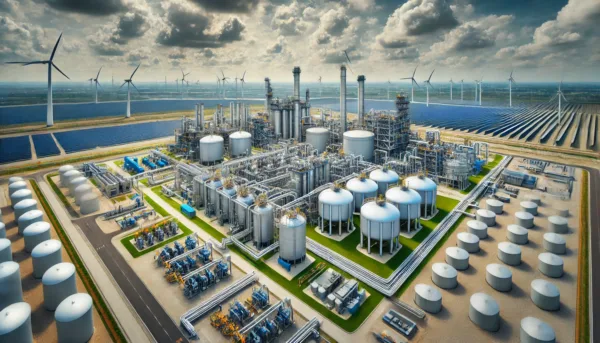
GE Vernova Inc. (NYSE: GEV) delivered a standout first-quarter 2026 performance on April 22, reporting orders of $18.3 billion, revenue of $9.3 billion, and free cash flow of $4.8 billion that exceeded the company’s entire 2025 full-year cash generation. The Cambridge, Massachusetts-based energy equipment and services company raised its 2026 financial guidance across revenue, adjusted EBITDA margin, and free cash flow, citing accelerating demand from power utilities, data centre operators, and grid infrastructure investors. Chief executive officer Scott Strazik signalled confidence in the demand cycle by lifting the company’s combined gas turbine backlog and slot reservation agreement target to at least 110 gigawatts by year-end 2026, up from 83 gigawatts at the start of the quarter. The results represent the clearest evidence yet that GE Vernova has structurally repositioned itself as a beneficiary of the global power capacity build-out rather than a legacy industrial conglomerate in managed decline.
How did GE Vernova’s Power segment drive margin expansion and what does the gas turbine backlog trajectory signal for 2027 and beyond?
The Power segment, which houses Gas Power and Nuclear Power, posted orders of $10.0 billion in the first quarter, a 59% organic increase, and segment EBITDA margin of 16.3%, up 470 basis points year on year. Gas Power was the primary engine, with 21 gigawatts of new gas equipment contracts signed in the period, comprising 19 gigawatts of slot reservation agreements and 2 gigawatts of firm orders. The company simultaneously converted 6 gigawatts of existing slot reservations into firm orders and shipped 4 gigawatts of equipment, resulting in backlog growth from 40 to 44 gigawatts and an expansion of slot reservation agreements from 43 to 56 gigawatts.
The progression from 83 to 100 combined gigawatts in a single quarter, and management’s revised target of at least 110 gigawatts by December 2026, is operationally significant for two reasons. First, slot reservation agreements represent future revenue that is essentially pre-committed, giving GE Vernova unusual forward earnings visibility in a capital-intensive equipment cycle. Second, converting reservations into orders at pace suggests customers are accelerating project timelines, consistent with data centre load growth and utility capacity tightening across the United States and Asia. Nuclear Power contributed through large services orders, an area where GE Vernova’s installed base gives it a natural moat. The margin improvement, driven by price and volume at Gas Power, was partially offset by higher investment in both Gas Power and Nuclear Power, investments that are likely to compound into earnings capacity in future years rather than dilute current returns.
What does GE Vernova’s $2.4 billion in data centre electrification orders mean for the grid equipment competitive landscape in 2026?
The Electrification segment produced the most striking demand signal in the quarter. Orders of $7.1 billion increased 86% organically, yielding a book-to-bill ratio of approximately 2.5, meaning the company booked $2.50 of new work for every dollar of revenue recognised. Within that figure, $2.4 billion came from data centre-related equipment orders, more than the full-year 2025 total from the same customer category, suggesting the artificial intelligence infrastructure cycle is accelerating rather than plateauing.
Revenue in Electrification reached $3.0 billion, up 61% on a reported basis inclusive of the Prolec GE consolidation and 29% organically, driven by switchgear, transformers, and high voltage direct current solutions. Segment EBITDA margin expanded 670 basis points to 17.8%, the strongest margin performance in the segment’s recent history and a direct consequence of volume leverage across Power Transmission and Grid Systems Integration. The equipment backlog in Electrification now stands at $38.6 billion, 75% higher than a year ago, a figure that includes $5.0 billion brought in through the Prolec GE acquisition. For peers such as Eaton, Siemens Energy, and ABB, a book-to-bill of 2.5 at GE Vernova’s scale is not a signal to ignore. It reflects both the depth of grid upgrade demand globally and GE Vernova’s ability to capture a disproportionate share of that demand, at least temporarily, through its combined transformer, switchgear, and substation product lines.
How does the Prolec GE acquisition reshape GE Vernova’s grid infrastructure strategy and balance sheet position?
GE Vernova completed the acquisition of the remaining 50% stake in Prolec GE from Mexican conglomerate Xignux on February 2, 2026, paying approximately $5.3 billion in cash. The transaction triggered a pre-tax accounting gain of roughly $4.0 billion from the remeasurement of GE Vernova’s previously held equity interest to fair value, which accounts for the headline net income figure of $4.7 billion and the 50.9% reported net income margin. Stripping that gain out, the underlying adjusted EBITDA of $896 million and adjusted EBITDA margin of 9.6% represent the more meaningful operating performance, and even that figure nearly doubled year on year.
Prolec GE is a leading manufacturer of power and distribution transformers serving utilities and industrial customers across North and Latin America. Bringing it fully onto the balance sheet adds approximately $3 billion in annualised revenue to the Electrification segment and $1 billion in planned capital expenditure from 2026 through 2028, and immediately plugs a capacity constraint in the transformer supply chain that has been a bottleneck for grid operators. The strategic rationale extends beyond transformer volume: full ownership gives GE Vernova direct control over production scheduling, pricing, and product prioritisation at a moment when transformer lead times across the industry have stretched to three years or more. To fund the acquisition, the company issued $2.6 billion in investment-grade senior notes rated BBB by S&P and BBB-plus by Fitch, adding leverage while preserving a cash balance that grew to $10.2 billion by quarter-end. With $1.4 billion returned to shareholders through share buybacks and dividends in the quarter, GE Vernova’s capital allocation cadence suggests management believes the balance sheet can simultaneously carry acquisition debt, fund organic growth investment, and sustain shareholder returns.
Why is Wind the structural drag on GE Vernova’s earnings and what is the realistic timeline for segment recovery?
The Wind segment continues to be the company’s most visible financial liability. Revenues fell 23% to $1.4 billion, segment EBITDA losses widened to $382 million, and segment EBITDA margin collapsed to negative 26.7%, a deterioration of 1,880 basis points year on year. The proximate cause is well-documented: soft orders placed in the first half of 2025 translated into a thin equipment delivery pipeline in early 2026, compounded by tariff impacts on Onshore Wind component costs and higher-than-expected contract losses in Offshore Wind.
The completion of turbine installations at Dogger Bank A in the United Kingdom and Vineyard Wind in the United States represents project execution rather than financial improvement, and Offshore Wind contract losses suggest the company is still working through legacy fixed-price agreements signed under different cost assumptions. Management’s 2026 Wind guidance of approximately $400 million in segment EBITDA losses signals no expectation of material recovery within the current year. The more meaningful data point is the 85% organic increase in Wind orders, driven by Onshore Wind in North America, which begins to build the delivery pipeline for 2027. Even so, a return to breakeven in Wind is a 2027 or 2028 story at the earliest, and the segment’s ongoing losses create a material drag on group margins that the Power and Electrification segments must continue to offset.
What does the revised 2026 guidance signal about GE Vernova’s confidence in its long-cycle demand cycle?
GE Vernova raised its full-year 2026 revenue guidance to $44.5 billion to $45.5 billion from the prior range of $44 billion to $45 billion, lifted its adjusted EBITDA margin forecast to 12% to 14% from 11% to 13%, and raised free cash flow guidance to $6.5 billion to $7.5 billion from the prior $5.0 billion to $5.5 billion. The free cash flow revision is the most consequential signal. A midpoint of $7.0 billion, against a market capitalisation approaching $270 billion, implies a free cash flow yield of roughly 2.6%, not inexpensive in absolute terms, but defensible in the context of a company whose backlog now exceeds $163 billion.
Power segment organic revenue growth guidance was maintained at 16% to 18% with EBITDA margin lifted to 17% to 19%. Electrification revenue guidance was raised to $14.0 billion to $14.5 billion, including approximately $3 billion from Prolec GE, with segment EBITDA margin increased to 18% to 20%. The guidance revisions across both growth segments reflect order momentum that is structural rather than cyclical, tied to electrification infrastructure rather than near-term economic conditions. For institutional investors seeking durable earnings compounders in the energy transition space, the trajectory of GE Vernova’s backlog and free cash flow is becoming a more compelling investment thesis with each quarterly update.
How is GE Vernova (NYSE: GEV) positioned in equity markets heading into the second quarter of 2026?
GE Vernova shares closed at $991.30 on April 21, 2026, with a 52-week low of $306.21 and a 52-week high of $1,009.89. The stock has roughly tripled from its 52-week low, a remarkable appreciation that reflects the market’s re-rating of GE Vernova from a post-spinoff industrial story into a structural beneficiary of data centre power demand, grid modernisation, and gas capacity tightening. Oppenheimer raised its price target to $1,139 from $871 on April 16, 2026, while JPMorgan also lifted its target and removed the stock from its Analyst Focus List around the same time.
The pre-market indication of approximately $999 ahead of the earnings call suggests the market had largely anticipated strong results. The degree to which post-earnings price action sustains above $1,000 will depend on whether institutional investors view the guidance raise as conservative or a ceiling. At a P/E in the mid-50s on GAAP earnings artificially elevated by the Prolec GE accounting gain, and in the low-to-mid 30s on a normalised earnings basis, the stock is not obviously cheap, but it is pricing in durable backlog execution and margin expansion through 2027 and 2028 that the first-quarter results do not contradict.
What are the key takeaways from GE Vernova’s Q1 2026 earnings and raised guidance for investors and industry peers?
- GE Vernova’s first-quarter free cash flow of $4.8 billion exceeded its entire 2025 full-year cash generation, underlining the pace of its operational improvement.
- The combined gas turbine backlog and slot reservation agreements grew from 83 to 100 gigawatts in a single quarter, with management targeting at least 110 gigawatts by year-end.
- The Electrification segment booked $2.4 billion in data centre equipment orders in Q1 alone, more than full-year 2025 levels, pointing to AI infrastructure investment accelerating rather than moderating.
- Full consolidation of Prolec GE adds approximately $3 billion in annualised Electrification revenue and direct control over a constrained transformer supply chain, giving GE Vernova a structural edge over grid equipment peers.
- Adjusted EBITDA of $896 million nearly doubled year on year on an organic basis; adjusted EBITDA margin of 9.6% was up 390 basis points, with the full-year target raised to 12% to 14%.
- Total backlog now stands at $163 billion, providing multi-year revenue visibility that insulates GE Vernova from near-term demand cyclicality.
- The Wind segment recorded EBITDA losses of $382 million, a 1,880 basis point margin deterioration, driven by soft prior-period orders, tariff headwinds, and Offshore Wind contract losses. Recovery is a 2027 to 2028 story at the earliest.
- Free cash flow guidance was raised to $6.5 billion to $7.5 billion for 2026, the most significant revision in the updated outlook, reflecting strong working capital dynamics and EBITDA growth.
- GE Vernova returned $1.4 billion to shareholders through buybacks and dividends while closing a $5.3 billion acquisition and growing its cash balance to $10.2 billion, demonstrating capital allocation optionality.
- At approximately $991 per share with a 52-week range of $306 to $1,010, GEV is trading near all-time highs; valuation is demanding but supported by backlog scale and improving free cash flow conversion.
Discover more from Business-News-Today.com
Subscribe to get the latest posts sent to your email.