






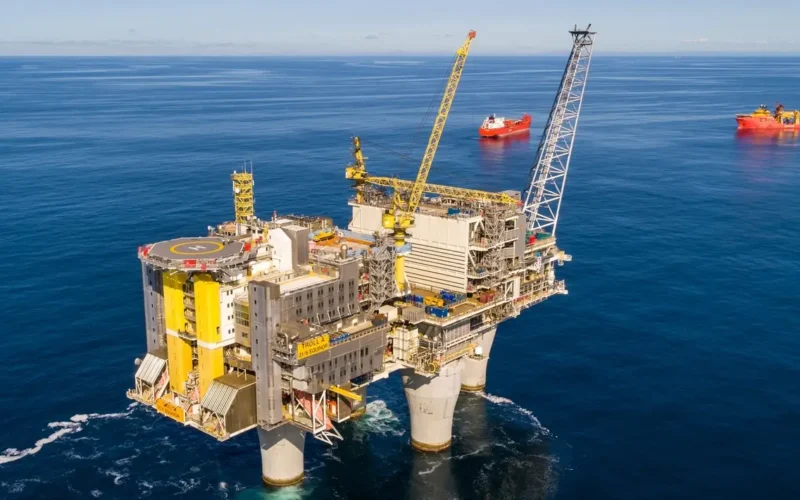
Equinor ASA (Oslo Børs: EQNR, NYSE: EQNR) and its Troll field partners will invest just over NOK 4 billion in the TWIN subsea development in the Norwegian North Sea. The project is expected to recover approximately 11 billion standard cubic metres of natural gas through two new wells connected to existing Troll subsea infrastructure. Equinor is targeting first production as early as 2028, with the development expected to add between 2 million and 2.5 million cubic metres of gas per day during its first eight years. The investment strengthens Norway’s ability to maintain pipeline gas exports to Europe without constructing another large standalone offshore platform. It also provides a practical test of Equinor’s strategy to halve subsea project costs and delivery times by standardising equipment and repeatedly using existing infrastructure.
Why does the NOK 4 billion Troll TWIN project matter for Europe’s gas supply?
TWIN, which stands for Troll West Increased Gas Recovery North, will become the third development stage within Troll Phase 3. The project targets gas in the Troll West reservoir and follows the original Phase 3 development and a larger second-stage expansion scheduled to begin production during 2026.
The project is relatively small when measured against the enormous scale of the overall Troll field. However, its strategic relevance comes from the field’s exceptional role in Norway’s gas system. Troll contains about 40% of the remaining gas reserves on the Norwegian continental shelf and currently meets roughly 10% of European gas demand.
Norway exported around 122 billion standard cubic metres of gas in 2025, with the overwhelming majority delivered to European customers. Approximately 95% of Norwegian gas production is exported through pipelines to the European Union and the United Kingdom. Against that volume, TWIN’s 11 billion cubic metres would represent the equivalent of about 9% of one recent year’s total Norwegian gas exports, although the project’s output will be spread across several years.
During its first eight years, the project is expected to deliver between 2 million and 2.5 million cubic metres per day. That is equivalent to roughly 0.73 billion to 0.91 billion cubic metres annually and just under 1% of Norway’s current daily gas production. The output is not large enough to transform European gas pricing by itself, but it provides incremental supply from an established and politically stable producing region.
Europe’s gas market increasingly values reliability alongside volume. Pipeline gas from Norway reduces dependence on flexible but often more expensive liquefied natural gas cargoes, particularly during periods of strong Asian demand or disruption to maritime trade routes.
TWIN’s importance is therefore best understood as part of a portfolio of smaller developments designed to slow natural production decline. Europe does not need every project to be another Troll-sized discovery. It needs a steady sequence of technically straightforward investments that can keep existing infrastructure full.
How does reusing Troll infrastructure make the subsea development more capital efficient?
The physical scope is deliberately limited. TWIN will include two production wells drilled through a new subsea template, together with a pipeline connected to existing facilities. Equinor will also extend the current umbilical and monoethylene glycol line to support the new development.
Umbilicals provide communication, electrical power and hydraulic control between subsea equipment and the host facility. Monoethylene glycol is used to prevent hydrates from forming inside gas pipelines, reducing the risk that water and gas create solid deposits capable of restricting flow.
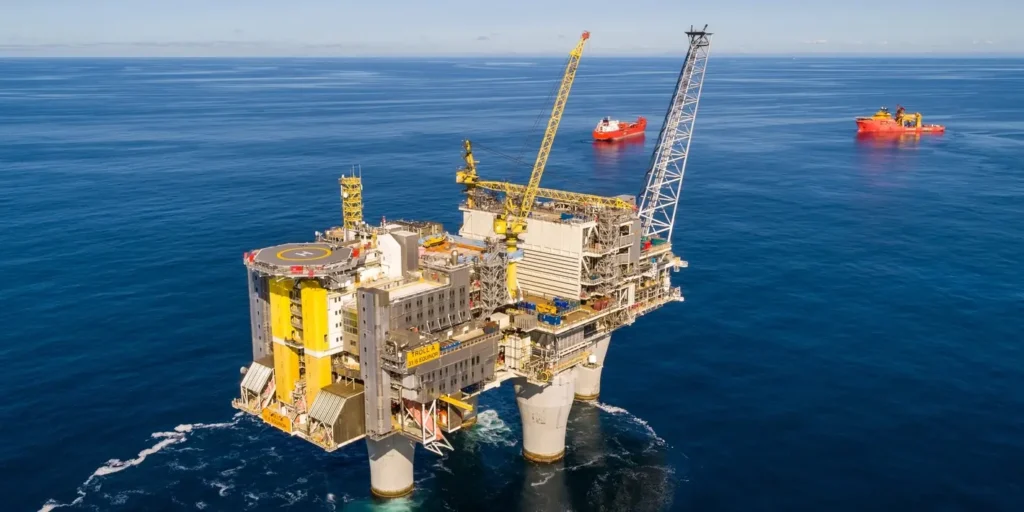
By extending infrastructure that is already installed, Equinor avoids the cost of building a new production platform, processing plant or export route. The wells can feed into the Troll system, with gas transported through Troll A and processed at the Kollsnes facility before entering the wider European pipeline network.
Kollsnes can process up to 143 million standard cubic metres of gas and approximately 69,000 barrels of condensate per day. Gas from Troll is transported from Kollsnes through the Zeepipe network toward European receiving terminals, including Zeebrugge in Belgium.
This infrastructure reuse materially changes the economics. The partnership is investing slightly more than NOK 4 billion to access approximately 11 billion cubic metres of gas, implying development capital of roughly NOK 0.36 for each cubic metre of expected resource before operating expenses, taxes, financing and abandonment costs.
That simple calculation is not a measure of final profitability, but it illustrates why brownfield tiebacks can be more attractive than remote discoveries requiring new host facilities. Much of Troll’s processing, power, pipeline and operating infrastructure has already been built and paid for.
TWIN also benefits from the field’s existing workforce and maintenance systems. Equinor does not need to establish a new offshore organisation around two wells. It can incorporate the development into established Troll operations.
The central commercial risk is that infrastructure reuse can create dependency. Production from TWIN will rely on the availability of the subsea system, Troll A, the pipelines to shore, Kollsnes processing and downstream export networks. An outage at one major point could restrict several connected developments simultaneously.
What does TWIN reveal about Equinor’s plan to industrialise smaller subsea projects?
Equinor has stated that ageing fields, smaller discoveries and rising costs require a different offshore development model. The company wants to halve both the cost and execution time of subsea projects and develop between six and eight tiebacks each year toward 2035.
TWIN is an early example of that strategy. Instead of designing a unique project around every discovery, Equinor intends to use standardised subsea templates, control systems, pipelines and contracting approaches wherever reservoir and site conditions permit.
Standardisation can reduce engineering hours, shorten equipment lead times and allow suppliers to manufacture similar components repeatedly. It can also simplify regulatory review and reduce installation risk because project teams are working with familiar designs.
The advantage becomes larger when several projects are developed as a programme. Suppliers can plan factory utilisation, retain trained workers and purchase materials across multiple orders. Equinor can apply lessons from one tieback directly to the next.
The company believes many of its future Norwegian continental shelf developments can achieve break-even prices below $35 per barrel of oil equivalent and payback periods of less than two and a half years. Equinor plans to allocate roughly 60% of its capital expenditure between 2028 and 2030 to the Norwegian continental shelf.
TWIN also shows the limitations of industrialisation. Reservoir conditions, seabed layouts and host-facility constraints are rarely identical. Excessive standardisation could result in equipment that is easy to procure but poorly matched to a specific field.
The best outcome would combine repeatable hardware with enough engineering flexibility to address local conditions. The worst outcome would be a standard design that transfers complexity from the factory to offshore installation and operations.
Equinor’s ambition is commercially credible because the Norwegian continental shelf contains numerous mature fields with available infrastructure. The strategy may be less transferable to frontier regions where pipelines, processing capacity and operating organisations do not already exist.
How does TWIN fit alongside the larger second stage of Troll Phase 3?
The second stage of Troll Phase 3 is a substantially larger development. Equinor and its partners approved an investment of just over NOK 12 billion in 2024 to install eight wells across two subsea templates, a new gas pipeline to Troll A and associated platform modifications.
That stage is expected to recover approximately 55 billion standard cubic metres of gas and begin production during 2026. At peak, it could contribute around 7 billion cubic metres annually and help maintain high production through Troll A and Kollsnes toward 2030.
TWIN extends that production strategy beyond the second stage. Its smaller resource base and limited infrastructure requirements suggest it is intended to reduce the decline curve after the larger development begins operating.
The sequencing is important. The first Phase 3 development started gas production from Troll West in 2021. Stage 2 adds new wells and processing capacity during 2026. TWIN is then targeted for 2028, providing another wave of gas as output from earlier wells begins to mature.
This phased approach allows the partnership to deploy capital closer to the point at which capacity is needed. It also reduces the risk of installing too many wells simultaneously and weakening reservoir management.
Equinor can use production data from the existing and second-stage wells to refine the TWIN drilling programme. Better reservoir understanding can improve well placement, expected recovery and flow assurance.
There remains a risk that the new wells do not perform as forecast. Subsurface uncertainty cannot be eliminated merely because the field is mature. Pressure changes, water movement and interference with existing wells could affect output.
However, Troll’s long operating history provides more data than a new discovery. This makes additional recovery projects easier to evaluate and finance than developments based on a limited number of exploration wells.
How will the NOK 4 billion investment be divided among the Troll partners?
Petoro holds the largest Troll interest at 55.93%, while Equinor operates the field with a 30.55% stake. Shell owns 8.19%, TotalEnergies holds 3.69% and ConocoPhillips owns the remaining 1.64%.
On a simple pro rata basis applied to a NOK 4 billion investment, Petoro’s share would be approximately NOK 2.24 billion. Equinor’s share would be around NOK 1.22 billion, Shell’s approximately NOK 328 million, TotalEnergies’ about NOK 148 million and ConocoPhillips’ close to NOK 66 million.
The actual expenditure may be slightly higher because Equinor described the investment as just over NOK 4 billion. Partner-level cash calls can also vary by timing and accounting treatment, but the ownership calculation demonstrates that Equinor does not bear the entire project cost.
Petoro’s majority position gives the Norwegian state substantial direct economic exposure in addition to the state’s 67% ownership of Equinor.
This structure means a large portion of TWIN’s future economic value will ultimately flow to the Norwegian public sector through Petoro revenues, Equinor dividends, petroleum taxation and other government income.
Norway’s government net cash flow from petroleum activities is estimated at NOK 686 billion for 2026. TWIN is modest relative to that total, but projects of this type help sustain the taxable and dividend-generating production base beyond the current decade.
For Shell, TotalEnergies and ConocoPhillips, TWIN represents a low-complexity investment within a large operated asset. Their minority shares limit the absolute capital commitment while providing exposure to pipeline gas sold into European markets.
The partnership alignment appears favourable because all participants benefit from keeping Troll infrastructure highly utilised. The remaining question is whether other potential subsea opportunities compete for the same engineering, drilling and installation resources.
Why could electrification improve operating emissions without solving the wider climate question?
Troll A and the Kollsnes processing facility are powered with electricity from shore. Equinor said this allows gas from TWIN to be produced with very low direct operational emissions.
Electrification reduces the need to burn natural gas in offshore turbines to generate power. This can lower carbon dioxide and nitrogen oxide emissions from production and processing operations.
The operating advantage is relevant for customers comparing the emissions intensity of different gas sources. European buyers increasingly consider methane leakage, production emissions and transportation efficiency alongside price and security of supply.
Norwegian pipeline gas may have a lower operational footprint than some liquefied natural gas supplies that require liquefaction, long-distance shipping and regasification. However, the final climate impact still depends heavily on how the gas is used and whether methane escapes across the value chain.
Low production emissions do not make natural gas carbon-free. Combustion by utilities, industrial users and households remains the dominant source of lifecycle carbon dioxide emissions.
The commercial argument for TWIN is therefore not that it eliminates climate concerns. It is that Europe will continue consuming gas during its energy transition, and supply from existing electrified infrastructure may be more efficient than developing higher-cost resources with larger operating emissions.
Policy risk remains important. European gas demand could decline faster than Equinor expects if renewable generation, nuclear power, electrification and energy efficiency expand rapidly. Conversely, geopolitical disruption or slow progress in replacing gas could keep demand and prices stronger.
A 2028 production start exposes TWIN to this uncertainty, although the limited development cost and existing infrastructure reduce the risk of creating a heavily capitalised stranded asset.
What does Equinor’s recent stock performance say about investor sentiment toward TWIN?
Equinor shares closed at NOK 316.40 in Oslo on June 19, rising 1.35% during the session. The stock remained within a 52-week range of NOK 226.40 to NOK 422.30, placing it approximately 25% below its annual high.
The shares fell about 9.2% from their June 12 close of NOK 348.40 and approximately 15.9% from their May 19 close of NOK 376. The sharp decline reflects broader commodity-price and geopolitical volatility rather than a negative assessment of the TWIN project.
The project announcement coincided with a 1.35% gain, but a NOK 4 billion development is too small to determine Equinor’s valuation independently. Investors are more focused on oil and gas prices, production targets, capital expenditure, dividends and share repurchases.
Equinor recently doubled its expected 2026 share buyback to as much as $3 billion and introduced a framework for annual repurchases of between $2 billion and $4 billion from 2027, depending on commodity prices and balance-sheet conditions. The company also targets more than 5% annual growth in its quarterly dividend per share.
Management expects group production to rise to 2.3 million barrels of oil equivalent per day by 2030. The Norwegian continental shelf is expected to contribute 1.35 million barrels of oil equivalent per day in 2030 and 1.3 million in 2035.
TWIN supports those targets at the margin. Its value lies in delivering relatively low-capital production that can generate cash quickly once wells begin operating.
Investor sentiment toward Equinor remains tied to a broader strategic pivot toward higher-return oil and gas projects. TWIN fits that direction neatly, but the stock’s recent weakness shows that capital discipline cannot fully protect shareholders from falling commodity prices.
What execution and regulatory risks could still delay first gas beyond 2028?
The Troll partnership must submit the required development notification to Norway’s Ministry of Energy under the Petroleum Act. An environmental impact assessment has already been completed, reducing one element of regulatory uncertainty.
Detailed engineering, drilling, subsea equipment procurement and installation must still proceed on schedule. Offshore projects can be delayed by vessel availability, weather, component shortages and competing activity across the Norwegian continental shelf.
Well performance represents another risk. The expected 11 billion cubic metres depends on reservoir behaviour, drilling accuracy and the long-term productivity of only two wells. Underperformance by either well could materially reduce project output.
Tieback projects also carry interface risk. The new template, pipeline, umbilical and monoethylene glycol system must work with equipment already installed at Troll. Engineering errors at connection points can produce delays that are expensive to correct offshore.
The 2028 schedule appears achievable because the development does not require a new platform or processing plant. Equinor’s ability to reuse standardised equipment should also reduce lead times.
However, the company simultaneously plans six to eight subsea projects annually toward 2035. That industrial scale could place pressure on drilling rigs, installation vessels, engineering resources and specialised suppliers.
Cost inflation remains another concern. A NOK 4 billion estimate leaves less absolute room for overruns than a larger project, but unexpected costs can still weaken project returns. The commercial case depends on maintaining the simplicity that justified the investment.
What are the key takeaways from Equinor’s Troll TWIN gas expansion?
- Equinor and its partners will invest just over NOK 4 billion in the TWIN subsea gas development at Troll.
- TWIN is expected to recover approximately 11 billion standard cubic metres of gas from the Troll West reservoir.
- Production could begin as early as 2028 and add between 2 million and 2.5 million cubic metres per day during the first eight years.
- The project uses two wells, one subsea template and a pipeline connected to existing Troll infrastructure.
- Reusing Troll A, Kollsnes and established export pipelines reduces capital requirements and shortens the route to production.
- Troll currently contains about 40% of remaining Norwegian continental shelf gas reserves and supplies roughly 10% of European gas demand.
- Equinor’s approximate share of a NOK 4 billion investment is NOK 1.22 billion based on its 30.55% field ownership.
- EQNR shares fell around 9.2% over five trading sessions and 15.9% over one month despite gaining 1.35% on June 19.
- TWIN supports Equinor’s plan to standardise subsea developments and deliver six to eight tiebacks annually toward 2035.
- Reservoir performance, supplier capacity, offshore installation and commodity prices remain the principal risks to returns.
Share this:
Discover more from Business-News-Today.com
Subscribe to get the latest posts sent to your email.

