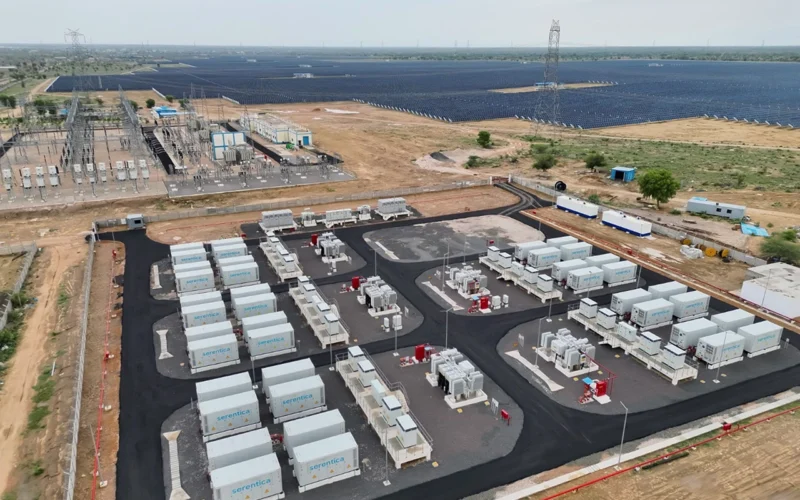
Serentica Renewables India Private Limited has commissioned the first phase of its planned 1GWh battery energy storage system in Bikaner, Rajasthan, marking its entry into utility-scale storage for commercial and industrial customers. The operating phase provides approximately 50MW of power and 200MWh of energy storage, allowing it to discharge at full output for about four hours. Serentica said the system will store surplus renewable electricity generated during the day and release it during peak-demand and nighttime periods as part of a time-block-based round-the-clock power arrangement. The commissioning is strategically important because energy-intensive industries require predictable electricity delivery rather than an annual total of renewable units that may not match their operating schedules. The central tension is whether Serentica can turn a successful 200MWh installation into a dependable 1GWh operating system while simultaneously building a planned 7GWh battery-order pipeline over the next two years.
What has Serentica Renewables actually commissioned at the Bikaner battery project?
The completed first phase consists of a 50MW and approximately 200.6MWh battery energy storage facility developed with Shanghai Gotion Digital Energy Tech Company. Its four-hour configuration means the system is designed for sustained energy shifting rather than only brief frequency-response events. Serentica described the architecture as modular, allowing the facility to respond rapidly to changes in demand while creating a basis for later expansion.
The distinction between power capacity and energy capacity matters. The 50MW figure describes the maximum rate at which the first phase can charge or discharge, while the 200MWh figure represents the quantity of electricity it can store. A larger megawatt-hour capacity allows the project to move renewable electricity across several hours, which is particularly useful for transferring afternoon solar generation into evening or nighttime industrial demand.
Serentica has not disclosed the total power rating of the full 1GWh system, its expected annual utilisation, round-trip efficiency or the battery degradation assumptions used in its commercial model. The company has also not published the first phase’s capital cost, financing structure, revenue contribution or target return. The commissioning therefore confirms physical delivery and operating capability, but it does not yet provide enough information to calculate the project’s economics independently.
The project should also be described as the first phase of a larger system rather than a completed 1GWh facility. The operating 200MWh represents approximately 20% of the planned energy-storage capacity. Serentica has crossed the project’s initial construction and commissioning threshold, while most of the planned battery capacity remains to be delivered.

Why does time-block renewable power matter more to industrial customers than annual green-energy matching?
Many renewable power arrangements are measured through annual energy volumes. A customer may purchase enough renewable electricity over a year to match its total consumption even though the renewable projects do not generate power during every hour in which the factory operates. This approach supports renewable procurement, but it does not fully resolve the physical mismatch between variable solar and wind production and continuous industrial demand.
Serentica’s time-block model seeks to narrow that gap by committing renewable electricity within defined operating intervals. The company’s wider arrangement with Hindustan Zinc Limited, for example, is structured to guarantee at least 315MW in every 15-minute time block through a combination of solar, wind and storage resources. Serentica’s August announcement did not explicitly identify the Bikaner battery’s customer, but it said the project supports one of the world’s first time-block-based round-the-clock renewable power arrangements for industrial consumers.
Battery storage is essential to this model because solar generation is concentrated during daylight hours. The Bikaner system can charge when renewable supply exceeds the immediate contracted requirement and discharge when generation declines but the customer’s load continues. Storage can also respond to short-term deviations between forecast production and actual delivery, reducing the amount of balancing electricity required from the grid.
A 200MWh battery cannot independently provide round-the-clock power for a large industrial customer. It must operate alongside renewable generation, transmission access, scheduling systems and other balancing resources. Serentica’s value proposition is therefore based on portfolio coordination rather than the battery acting as a standalone source of continuous electricity.
The commercial benefit for industrial customers is potentially significant. More predictable renewable delivery can reduce reliance on conventional grid power, lower exposure to time-of-day price movements and support emissions-reduction targets without requiring factories to alter production schedules. Serentica must still demonstrate that these benefits can be delivered at a tariff competitive with alternative combinations of grid electricity, captive generation and conventional renewable contracts.
Does the later-than-planned commissioning increase the execution test for the remaining 800MWh?
When Serentica announced its partnership with Shanghai Gotion in 2025, the 50MW and 200.6MWh Bikaner facility was targeted for commissioning by the end of that year. Commercial operation was announced on August 5, 2026, meaning the first phase arrived later than the original timetable. Serentica did not explain the change in schedule in its commissioning announcement.
Battery projects can be delayed by equipment delivery, grid connectivity, testing, protection systems, contracting changes or coordination with the renewable generation portfolio they support. There is no basis to attribute Bikaner’s revised timing to any one of these factors without further disclosure. The delay nevertheless matters because Serentica is now planning a much larger second phase and a multi-gigawatt-hour procurement programme.
In June 2026, Serentica said another 800MWh of storage would be added in the Bikaner region during the following quarter. That statement implied a completion timetable around the third quarter of 2026. The August commissioning release confirmed the first 200MWh phase but did not provide a detailed construction update for all of the remaining 800MWh.
The next phase is four times larger in energy capacity than the system now operating. Serentica may benefit from repeating the engineering, procurement and operating approach established during Phase 1, but scale can introduce new challenges involving land, interconnection, fire safety, system integration and commissioning. The larger phase will provide a more meaningful test of whether the project can deliver the flexibility required by industrial power contracts.
How does the Bikaner battery fit into Serentica Renewables’ wider Rajasthan strategy?
Rajasthan has become central to Serentica’s expansion because of its solar resource, renewable-energy zones and access to large industrial demand across northern and western India. The company said in June that the state accounted for more than half of its solar portfolio, with assets across Bikaner and Jaisalmer and further development planned around Bhadla and Fatehgarh.
The company has outlined plans to expand its Fatehgarh solar platform through an initial 1,270MWp phase, followed by another 500MWp of solar capacity and a 2,500MWh battery system during the 2026-27 financial year. That proposed storage facility alone would be two and a half times the energy capacity of the complete Bikaner plan.
Serentica also acquired Statkraft’s Indian solar business, including a 445MWp operating plant in Bikaner and approximately 1GWp of development assets across Rajasthan. The transaction was intended to expand Serentica’s operating portfolio and provide renewable assets that could be integrated into its commercial and industrial supply model.
Combining solar generation and batteries within the same regional portfolio could improve operational coordination. Serentica can use batteries to reduce curtailment, shift electricity into contracted delivery periods and respond to deviations in solar output. The strategy may also improve the utilisation of transmission connections, although the company has not disclosed whether the Bikaner battery shares specific grid infrastructure with its nearby solar facilities.
The concentration creates risk as well as efficiency. Delays in Rajasthan transmission expansion, extreme weather, equipment constraints or local grid congestion could affect several interconnected projects. Serentica will need enough geographic and technological diversity to prevent one regional bottleneck from weakening multiple customer commitments.
Can the planned 7GWh battery pipeline turn storage into a repeatable Serentica business?
Serentica said it plans a 7GWh battery-order pipeline over the next two years. That is seven times the energy capacity of the full Bikaner project and 35 times the capacity of the first commissioned phase. The figure represents planned orders and portfolio development rather than operating storage already available to customers.
Part of the future requirement is supported by identifiable commercial demand. Serentica secured 600MW in the Solar Energy Corporation of India’s FDRE VII assured-peak tender, with a configuration involving co-located solar generation and battery storage for four hours of fixed daily peak supply. The company has subsequently referred to a 600MW and 2,400MWh power purchase arrangement with the Solar Energy Corporation of India.
These contracts can provide greater revenue visibility than speculative battery construction because storage is linked to defined delivery obligations. They also create performance risk. A developer promising firm or peak-period electricity must maintain enough charged capacity, equipment availability and renewable generation to meet each contracted time block.
A 7GWh pipeline could give Serentica procurement scale, allowing it to negotiate larger equipment orders and standardise control systems, maintenance processes and operating software. Repetition may lower development costs and shorten commissioning periods after the company resolves the difficulties encountered during the first project.
The pipeline could equally increase concentration in one technology class and supplier ecosystem. Battery prices, import rules, currency movements, warranties and cell availability can change rapidly. Serentica will need to balance the cost benefits of large orders against the risk of committing too early to equipment that may become less competitive before every project enters service.
Does Serentica Renewables have the financing capacity to support its storage and generation ambitions?
Serentica is privately held and does not publish the same level of consolidated financial information as a listed utility. Project-level debt, parent-company leverage, cash flow and the capital committed specifically to the Bikaner battery have not been publicly disclosed. This makes it difficult to assess the project using conventional balance-sheet measures.
KKR has committed a total of $650 million to Serentica through an initial $400 million investment and a subsequent $250 million commitment. Serentica has also raised debt from Indian power-sector lenders for renewable projects, including financing arrangements with REC Limited and Power Finance Corporation Limited.
Chairman Pratik Agarwal said in November 2025 that Serentica planned to invest between $10 billion and $11 billion to reach 17GW by 2029 or 2030 and could raise between $6 billion and $8 billion over five years. At that time, the company had approximately 2GW operating and expected another 2GW to enter service within ten months. Serentica later announced that commissioned renewable capacity had reached 3GW by July 2026.
Those ambitions show that the battery programme is part of a much larger capital strategy rather than an isolated technology trial. Storage can strengthen the value of Serentica’s solar and wind assets by making their output more dispatchable, but it also adds another capital-intensive layer before customer revenue is collected.
The financing test is whether long-term power agreements can support debt on terms that preserve acceptable project returns. Falling battery costs may improve future economics, while interest rates, imported equipment exposure and construction delays could offset those benefits. Disclosure of contracted tariffs, capital expenditure and operating performance would make the financial case more transparent.
Why is India’s policy environment increasingly supportive of projects such as Bikaner?
India’s power system requires substantially more storage as renewable generation expands. The Central Electricity Authority has estimated a requirement of 41.65GW and approximately 208GWh of battery energy storage by 2029-30, alongside pumped-storage capacity. Government projections for 2031-32 indicate a potential requirement of roughly 47GW and 236GWh of BESS capacity.
The policy framework is moving toward co-located storage, firm renewable procurement, viability-gap funding and market participation by energy-storage assets. The Ministry of New and Renewable Energy lists guidelines covering BESS procurement, interstate transmission-charge waivers, co-location with solar projects and viability-gap funding. India’s draft National Electricity Policy 2026 also identifies batteries as location-flexible assets with relatively short construction periods and calls for support for lower-cost technologies and domestic manufacturing.
Serentica’s project differs from a conventional utility procurement because it is focused on commercial and industrial supply. This market can develop without relying entirely on government capacity payments when industrial customers are willing to pay for firm renewable electricity. It also places greater commercial pressure on the developer because customers will compare the delivered tariff with other open-access, captive and grid-supply options.
The Bikaner commissioning demonstrates how private industrial demand can create an additional route for battery deployment. However, one operating phase does not establish that every C&I battery project will be economical. Contract duration, customer credit quality, renewable-resource quality and transmission charges will continue to determine which projects reach financial close.
What operational evidence will show whether the Bikaner battery is delivering dependable value?
The first proof point will be availability. Serentica must demonstrate that the 50MW system can charge and discharge when scheduled, maintain adequate state of charge and avoid extended outages. High technical availability is particularly important when storage supports time-block obligations rather than discretionary electricity trading.
The second test will be usable energy after efficiency losses and degradation. A 200MWh nameplate rating does not mean the same quantity will be delivered to customers during every cycle. Conversion losses, operating reserves, temperature management and battery ageing reduce usable output, while warranty conditions may limit how aggressively the system can be cycled.
The third test is integration with renewable generation and industrial demand. Serentica must forecast solar and wind output, schedule charging and preserve enough stored energy for the periods when contracted power is most valuable. Accurate software and portfolio optimisation can therefore influence returns as much as the battery hardware itself.
Completion of the remaining 800MWh will be the clearest strategic milestone. The company must show that lessons from the first phase can support a larger rollout without another substantial schedule movement. Progress at Fatehgarh and the Solar Energy Corporation of India project will then indicate whether Serentica can repeat the model across different customers and commercial structures.
Serentica has improved its industrial decarbonisation proposition by moving from planned storage to an operating four-hour battery. What remains unresolved is the cost of the complete 1GWh system, the timetable for the remaining capacity and the operating evidence behind the company’s round-the-clock claims. The thesis will strengthen if Phase 1 maintains high availability and the next 800MWh reaches operation without material additional delay. It will weaken if project schedules slip again or if storage costs make firm renewable delivery less competitive than customers’ alternative power sources.
What are the key takeaways from Serentica’s Bikaner battery storage project?
- Serentica Renewables has commissioned the first phase of a planned 1GWh battery energy storage system in Bikaner, Rajasthan.
- The operating phase provides approximately 50MW of power and 200MWh of energy storage, giving it a duration of around four hours.
- Shanghai Gotion Digital Energy Tech Company supplied the battery solution for Serentica’s first utility-scale storage project.
- The system stores daytime renewable electricity for release during peak-demand and nighttime periods.
- Serentica said the project supports a time-block-based round-the-clock renewable power arrangement for industrial consumers.
- The first phase was commissioned later than the end-2025 timetable announced when the supplier partnership was disclosed.
- Another 800MWh is planned in the Bikaner region, but the latest announcement did not provide a detailed completion schedule.
- Serentica is targeting a 7GWh battery-order pipeline over the next two years.
- The company has not disclosed Bikaner’s capital cost, contracted tariff, expected revenue or project return.
- Availability, completion of the remaining 800MWh and repeatable delivery across future projects are the next measurable tests.
Discover more from Business-News-Today.com
Subscribe to get the latest posts sent to your email.