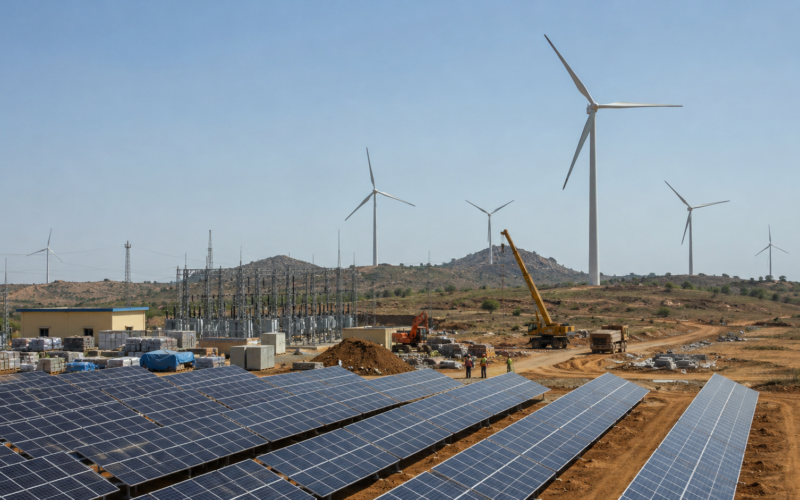
The Tata Power Company Limited, listed on the National Stock Exchange of India as TATAPOWER, has broken ground on an 800 MW renewable energy project in Andhra Pradesh through its subsidiary Tata Power Renewable Energy Limited. The ₹5,750 crore development will combine 400 MW of solar capacity at Pattikonda in Kurnool district with 400 MW of wind capacity at Kanekallu in Ananthapuram district. The project represents one of the first major construction-stage outcomes from Tata Power Renewable Energy Limited’s agreement with the Andhra Pradesh government to explore up to 7 GW of renewable capacity in the state. Its commercial significance lies not only in its scale, but also in its combination of solar, wind, battery storage and interstate transmission connectivity. The central question is whether Tata Power can convert the technically diverse project into contracted, operational capacity without allowing execution costs, financing requirements or the currently unallocated portion of the solar capacity to weaken returns.
How does the 800 MW Andhra Pradesh project convert Tata Power’s 7 GW agreement into executable capacity?
The groundbreaking ceremony held in Kurnool on July 30, 2026 marks a material shift from development intent to physical execution. Tata Power Renewable Energy Limited signed a memorandum of understanding with the Andhra Pradesh government in March 2025 to assess up to 7,000 MW of solar, wind and hybrid projects, potentially involving investment of as much as ₹49,000 crore. That earlier agreement covered preliminary assessments, feasibility studies, site identification and development support rather than committed construction across the entire proposed capacity.
The newly launched 800 MW project accounts for approximately 11.4% of the capacity envisaged under the broader 7 GW arrangement. Its ₹5,750 crore investment represents nearly 11.7% of the indicative ₹49,000 crore investment attached to that state-level pipeline. Those proportions suggest that the project is broadly consistent with the capital intensity anticipated when the original agreement was announced, although the actual economics will vary because this development includes wind infrastructure, battery storage and transmission-related work alongside solar generation.
This distinction matters because renewable energy announcements frequently remain at the memorandum, land-identification or tender stage for extended periods. The move to a groundbreaking ceremony, identified sites, an engineering contractor, grid connectivity and a contracted customer for part of the capacity provides a stronger indication of execution readiness than the original state agreement alone.
Nevertheless, Tata Power has not disclosed a commissioning date for the complete 800 MW development. Investors and industry participants therefore still need evidence that land possession, equipment delivery, transmission infrastructure, construction sequencing and commercial arrangements for the remaining capacity can progress on schedule.
Why does combining solar, wind and battery storage improve the project’s commercial quality?
The project’s structure is intended to reduce the limitations of relying on a single variable renewable resource. Solar output is concentrated during daylight hours, while wind generation can follow different seasonal and intraday patterns. Combining the two resources can produce a more balanced generation profile, particularly when the assets are supported by storage and connected to a national transmission system.
The solar component will be developed at Pattikonda in Kurnool district, while the wind capacity will be located at Kanekallu in Ananthapuram district. Tata Power Renewable Energy Limited will act as the developer of the wind asset, with Suzlon Energy Limited responsible for the engineering, procurement and construction scope. The entire development will occupy approximately 3,462 acres, including around 2,700 acres for solar infrastructure and 760 acres for wind development.
Of the 400 MW solar component, 200 MW has been structured as a firm and dispatchable renewable energy project for NTPC Limited. It will be supported by a battery energy storage system rated at 25 MW with 50 MWh of storage capacity. At full output, the battery could discharge at its rated 25 MW level for approximately two hours.

That storage capacity is relatively modest compared with the 200 MW contracted project. It should therefore be viewed as a firming and balancing asset rather than a system capable of independently delivering the full contracted solar capacity throughout the night. The commercial performance of the NTPC arrangement will depend on how Tata Power integrates solar generation, wind availability, battery charging, forecasting and power scheduling.
The remaining 200 MW of solar capacity is available for future allocation. This provides Tata Power with flexibility to respond to future utility tenders, corporate renewable demand or group captive opportunities. However, it also means that one-quarter of the project’s total 800 MW capacity does not yet have a disclosed commercial allocation.
Securing an offtake agreement for this balance capacity will be an important milestone. Construction can create generating capacity, but contracted revenue visibility determines whether that capacity produces predictable cash flow and supports the project’s financing structure.
Why is interstate transmission connectivity one of the project’s most important advantages?
Tata Power said the project has secured 800 MW of Inter-State Transmission System connectivity through the Ananthapuram II and Kurnool-4 Central Transmission Utility of India Limited substations. This allows the generated power to be evacuated through India’s national transmission network rather than being restricted to consumers within Andhra Pradesh.
Transmission availability has become a critical differentiator for Indian renewable projects. Developers may secure land, equipment and power purchase arrangements, but delayed substations and transmission lines can prevent completed assets from supplying electricity. Curtailment can also reduce plant utilisation when available transmission capacity is insufficient.
Tata Power’s latest financial presentation showed that renewable generation during the June 2026 quarter was affected by load curtailment and transmission constraints in Rajasthan and Gujarat. The company’s solar plant load factor remained broadly stable, but wind utilisation was affected by a delayed monsoon, illustrating how both natural-resource variability and network availability influence renewable profitability.
The secured grid connection therefore reduces one of the most significant development risks facing the Andhra Pradesh project. It does not remove every execution challenge, because the associated substations and transmission interfaces must still be completed and synchronised with the generation assets. However, securing connectivity before commissioning is commercially preferable to building capacity first and searching for evacuation access later.
Interstate connectivity also expands the addressable customer base. Tata Power can potentially supply central government agencies, utilities in other states and large commercial or industrial consumers seeking renewable electricity. This supports the strategic logic of locating the project in a resource-rich southern state while monetising the electricity through a wider national market.
What does Suzlon Energy’s 400 MW wind contract reveal about execution responsibility?
Suzlon Energy Limited will deploy 127 S144 wind turbine generators for the Ananthapuram component, with each turbine carrying a rated capacity of 3.15 MW. The total nameplate capacity of those machines is approximately 400 MW. Suzlon’s scope includes land acquisition, turbine supply, balance-of-plant infrastructure, the pooling substation, extra-high-voltage lines, commissioning, operations and maintenance services.
This end-to-end engineering, procurement and construction structure places substantial execution responsibility with Suzlon rather than dividing accountability among several equipment and civil contractors. A unified delivery model can simplify project coordination, particularly where turbine foundations, roads, substations and transmission lines must be completed in sequence.
The contract is also the fourth order awarded by Tata Power Renewable Energy Limited to Suzlon. Their cumulative partnership has now crossed 1 GW across Andhra Pradesh, Karnataka, Maharashtra and Tamil Nadu. Repeat orders indicate that Tata Power has experience with Suzlon’s turbine platform and execution model, reducing some technology-selection and counterparty uncertainty.
However, an integrated engineering contract does not eliminate development risk. Wind projects require timely land access across dispersed locations, transportation of oversized components, civil works, electrical infrastructure and coordination with grid authorities. The next meaningful evidence will be turbine deliveries, construction progress, substation readiness and staged commissioning rather than the contract award itself.
The partnership also gives Suzlon a larger operating footprint in Andhra Pradesh. Suzlon said its installed base in the state already stood at 1.8 GW, while its Andhra Pradesh order book was approaching 1 GW following the Tata Power contract. This existing presence may support local service capability and supply-chain familiarity, but the scale of concurrent orders across the industry will continue to test manufacturing and execution capacity.
Can Tata Power maintain capital discipline while funding its renewable expansion?
The disclosed project cost implies investment of approximately ₹7.19 crore per MW across the combined 800 MW capacity. That figure should not be compared directly with a simple utility-scale solar benchmark because the investment includes wind turbines, solar infrastructure, battery storage, land requirements and grid connectivity.
The project arrives during a period of exceptionally high capital deployment by Tata Power. The company invested ₹5,375 crore during the first quarter of the 2027 financial year, its highest quarterly capital expenditure to date. Group revenue increased 8% year on year to ₹18,898 crore, earnings before interest, tax, depreciation and amortisation rose 8% to ₹4,249 crore, and reported profit after tax increased 11% to ₹1,401 crore.
The renewable business generated ₹3,771 crore of revenue during the quarter, an increase of 4% from the corresponding period. Renewable earnings before interest, tax, depreciation and amortisation rose 8% to ₹1,696 crore, while profit after tax increased 15% to ₹612 crore. The improvement suggests that Tata Power’s renewable platform is generating stronger earnings even as the company continues to add capacity.
The balance-sheet trade-off is becoming more visible. Net debt associated with Tata Power’s renewables platform increased 15% year on year to ₹33,440 crore, compared with net worth of ₹16,293 crore. Higher borrowing is not unexpected during a capacity expansion cycle, but it increases the importance of completing projects on time and converting construction expenditure into operating cash flow.
The renewable generation portfolio reached 6,734 MW at the end of the June quarter, including 5,405 MW of solar and 1,329 MW of wind. The Andhra Pradesh development is equivalent to nearly 12% of that existing renewable generation capacity, although actual portfolio growth will depend on when the project is commissioned and whether other assets are added during the same period.
The strategic argument for the investment is credible. India requires additional renewable generation, transmission and storage, while commercial consumers and utilities increasingly seek round-the-clock clean electricity rather than standalone daytime solar supply. The financial test is whether Tata Power can preserve returns while simultaneously funding generation projects, solar manufacturing, battery storage, pumped hydro, transmission and distribution expansion.
How does the Kurnool project strengthen Andhra Pradesh’s renewable energy strategy?
The development is being implemented under Andhra Pradesh’s Integrated Clean Energy Policy, which was designed to attract large-scale investments in renewable generation, storage and supporting infrastructure. The state government’s March 2025 agreement with Tata Power Renewable Energy Limited contemplated up to 7 GW of projects, with the New and Renewable Energy Development Corporation of Andhra Pradesh assisting with site identification, project facilitation and evacuation infrastructure.
The 800 MW project is expected to generate approximately 4,000 direct and indirect employment opportunities during development, construction and operations. Landowners are also expected to receive annual lease income, although Tata Power has not disclosed the aggregate rental value or the precise distribution of permanent and temporary employment.
For Andhra Pradesh, the project strengthens an emerging cluster of renewable assets across Kurnool and Ananthapuram. Concentrated development can support common transmission infrastructure, specialised contractors, equipment logistics and a local workforce familiar with utility-scale renewable projects.
The state must nevertheless manage the cumulative demands created by multiple large developments. Land acquisition, environmental permissions, water access during construction, transmission expansion and community engagement can become more complex as project density increases.
The most valuable outcome for Andhra Pradesh would be the creation of an integrated renewable ecosystem rather than a collection of isolated generation assets. The combination of generation, storage, manufacturing, transmission and long-term industrial demand would provide stronger economic benefits than capacity additions alone.
What does Tata Power’s latest share performance indicate about investor sentiment?
Tata Power shares were trading at approximately ₹380.80 near the close on July 31, 2026, up about 1.3% during the session. The stock had gained approximately 1.7% over one week and around 1% from its June 30 closing level of ₹377.10. Its 52-week trading range stood between ₹342.50 and ₹464.90, while its market capitalisation was approximately ₹1.21 lakh crore.
At the current level, Tata Power was around 18% below its 52-week high and approximately 11% above its 52-week low. This positioning suggests a market that remains constructive about the company’s long-term power and renewable strategy but has not restored the more optimistic valuation reached earlier in the year.
Morgan Stanley maintained an Equal Weight rating and a ₹399 price target following Tata Power’s June-quarter results. The target was less than 5% above the July 31 market price, indicating that the brokerage viewed the company’s operating performance positively but saw limited near-term valuation upside without further execution evidence.
The Andhra Pradesh groundbreaking is strategically supportive, but it is unlikely to transform valuation on its own. Investors already recognise Tata Power as a major participant in India’s energy transition. A sustained rerating would more likely require a combination of project commissioning, renewable earnings growth, disciplined debt management and stronger evidence that capital expenditure is producing attractive cash returns.
Which milestones will determine whether the Andhra Pradesh renewable project creates lasting value?
The first test will be physical execution. Investors should look for evidence of land handover, site mobilisation, turbine manufacturing, solar equipment procurement and construction of pooling and transmission infrastructure.
The second test will be commercial allocation. Tata Power has identified NTPC Limited as the customer for the 200 MW firm and dispatchable renewable energy component, but another 200 MW of solar capacity remains available for future allocation. Securing a credible customer and an economically attractive tariff for that capacity would improve revenue visibility.
The third test will be integration. The project must combine solar generation, wind output, battery storage and interstate transmission into a coordinated supply profile. The battery is useful for balancing, but its 50 MWh capacity means forecasting and resource complementarity will remain important.
The fourth test will be financial discipline. The renewable platform’s earnings are growing, but so are debt and capital commitments. Delays could increase interest during construction, postpone revenue and weaken project returns.
Tata Power has moved the Andhra Pradesh opportunity beyond the memorandum stage and established a credible execution structure involving identified sites, a major engineering contractor, transmission access and partial customer allocation. What remains unresolved is the construction schedule, the commercial destination of the unallocated 200 MW solar component and the eventual return on the ₹5,750 crore investment. The project will strengthen Tata Power’s renewable portfolio if execution converts those commitments into commissioned, contracted and cash-generating capacity without placing disproportionate pressure on the renewable business’s balance sheet.
What are the key takeaways from Tata Power’s 800 MW Andhra Pradesh renewable project?
- Tata Power Renewable Energy Limited has broken ground on an 800 MW renewable development involving ₹5,750 crore of investment.
- The project will combine 400 MW of solar capacity in Kurnool district with 400 MW of wind capacity in Ananthapuram district.
- The development represents approximately 11.4% of the 7 GW renewable pipeline contemplated under Tata Power’s agreement with Andhra Pradesh.
- Suzlon Energy Limited will execute the 400 MW wind component using 127 S144 wind turbine generators.
- A 200 MW solar component has been structured as a firm and dispatchable renewable energy project for NTPC Limited.
- The NTPC project will include a 25 MW and 50 MWh battery energy storage system to support power balancing.
- Another 200 MW of solar capacity remains available for future allocation, making the next offtake agreement an important commercial milestone.
- The project has secured 800 MW of interstate transmission connectivity through the Ananthapuram II and Kurnool-4 substations.
- Tata Power’s renewable profit increased 15% year on year during the June 2026 quarter, but renewable net debt also rose 15%.
- Commissioning progress, customer allocation, grid synchronisation and capital discipline will determine whether the project produces attractive long-term returns.
Discover more from Business-News-Today.com
Subscribe to get the latest posts sent to your email.